Archive for the 'Venezuela' Category

Chavez defends and praises Mugabe: It takes one to know one.

September 28, 2009

mugabe_270

(Mugabe sleep at the Margarita Summit)

At the ASA Summit this weekend Dictator Hugo Chavez gave Robert Mugabe a resounding backing saying:

“Mugabe has turned into the target of attacks of various institutions of the world system and through the world press he has been satanized, he is attacked…I want to give him our moral and political backing…The people recognize him for his anti-imperialists fights. He is a man that has spent all his life in the anti-colonianism fight. We have to align ourselves in his defense”

This is the same Hugo Chavez that criticizes Obama “because he has not denounced the military dictatorship in Honduras”, which is not even true. But while Chavez made this criticism in New York last week, he came back home to meet with some of the bloodiest Dictators on the planet, just a week after he had visited most of them. After the Margarita meeting, only North Korea is missing from Chavez’ list of face to face meetings with the worst Dictators of the planet. After his defense of Mugabe, visiting Kim Il Sung will add nothing to our understanding of Chavez’ true frame of mind.

Hugo Chavez: A “Socialist’s” fascination and fixation with banks

September 27, 2009

D1907AM1

For a so called socialist, Hugo Chavez has a strange fascination with a tool that is an integral part of capitalism: Banks.

Ever since he became President, Chavez has created quite a few of them. Remember Banco del Pueblo Soberano? It was supposed to give small loans to poor people, who would in turn pay back their loans at preferential rates and allow the bank to give out even more loans. It was an idea copied from the very succesfull Grameen Bank founded by Muhammad Yunus. The Venezuelan version did not work as well. Within a year it had to be capitalized as those running it spen half of the initial equity on the bank’s system. Then there was some sort of scandal because the bank would mostly invest its funds in Government paper, rather than lend it out as was its mandate. But much like the 2,000 Barrio Adentro modules left without Doctors, Chavez lost interest in the project, there was little follow up and nobody ahs heard from it in years. It hasn’t published financials since 2002.

As if they were not part of the “Pueblo Soberano” Chavze created in 2001, el Banco de La Mujer. It was just like the Banco del Pueblo, but aimed at helping women, particularly those head of households that were running a small business to support themselves.

Chavez also converted the old Fondo de Inversiones to Bandes, the Development Bank, which acts in somewhat mysterious ways and participates in lots of teh high level financial operations of the country.

Chavez also created the Banco Del Tesoro, a good idea, whose main function was to concentrate the deposits of the public sector, to make public finances more efficient. It ahs done some of that, but only a small fraction. Public deposits continue to drive a lot of the business of the private banking sector, particular small and medium sized banks, which for a fee, pay Government officials for their deposits. Much of these funds stay in these banks, rather than being used, so that the Government officials that run them can continue receiving fees from this racket, one of the biggest corruption schemes of the Bolivarian robolution.

On the way, the Government’s workhorse bank, Banco Industrial de Venezuela has been recapitalized twice and was recently intervened as the bank continues to lose money in a country where banking and finance has been one of the most profitable activities during the Chavez era.

The Chavez Government also created the Development banks, aimed at financing development projects, but somehow, people can’t tell the difference between them and regular banks. Even the Iranians got into the game, with the foudning in Venezuela of the Banco Internacional de Desarrollo, a fully owned Iranian bank that operates in Venezuela and which has been in the news recently thanks to the warnings of Robert Morgenthau, who argues that these activities represent a serious danger to the US.

Chavze also nationalized Banco de Venezuela, which was a subsidiary of Banco Santander. Reportedly Chavez wanted to buy a bank that would allow the Government to disburse payments to supporters around the country, something Bandes had been trying to do but not very sucessfully. Banco de Venezuela was not the best bank for that, but when Chavez gets an idea in his mind he gets it and he got Banco de Venezuelatwo months ago. He overpaid, given valuations of banks in Venezuela, but not given the profits that well run banks may earn in this artificial financial environment, where even with all restrictions, arbitraging the Government can be quite profitable.

One of the few measures that Chavez has announced was that he named the President of Banco de Venezuela, as if he did not have enough to do, as President of all Government banks, likely hoping that some of the good things that Banco de Venezuela still has will rub off. Unfortunately, the Government has been running that bank for too short a time and it may be that it will be the other way around and soon Banco de Venezuela will see its profits and its competitiveness drop dramatically.

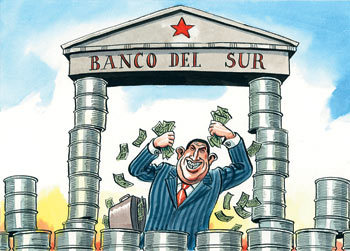
Chavez has also been promoting the idea of Banco del Sur, a regional bank, located in Venezuela which would become a sort of IDB of South America or Latin America. Most countries showed some interest in the belief that Venezuela will put a up a few billions for them to borrow, but Chavez is not that dumb and now he does not even have the money due to the drop in oil prices. But he had to sign something important at the Margarita summit and he revived the idea of the bank, which was so preliminary that Chavez said the bank would have a capital of US$ 20 billion, but his Foreign Minister Maduro said that it would start with US$ 7 billion. I bet everyone will wait for Venezuela to put up the seed capital, which means that the bank will not get going for a while.

As if this were not enough, Chavez came up with even another bank during his ASA Summit (America-South-Africa) and suggested there should be another bank for joint projects among these countries. He even came up with a name: Bancasa.

Thus, Chavez claims to be a socialist but seems to have this fascination or fixation with a very capitalistic institution. Somehow, it may be that he does not get the idea of how banks function quite well. He seems to view banks as institutions that you can get money out of, but does not seem to give much thought to the fact that someone has to put the money in, the money has to be invested and banks are supposed to make some money at the end of the day, or at least break even.

But so far, all Chavez has done is spend money in creating bureaucratic structures, sinkholes for money, which in the end have not resulted in the generation of loans or aid for the poor or for much development. But rather than step back, look at it and evaluate, eliminating some of these wasteful institutions, he presses forward, creating new ones, making bombastic announcements that in the end, are completely useless.

But the fixation continues and in the absence of checks and balances, nobody seems to ask whatever happened any of them as money is wasted on another Chavez whim and fascination.

An Economic Plan by Chavez or random decision making?

September 26, 2009

random-international-main

For the last few weeks we have been hearing about the new Economic Plan that Chavez’ “Team” was putting into place. First we heard that there were 40 measures and some fairly vaporous announcements were made, such as the naming of six Vice-Presidents and promises that CADIVI will allow more foreign currency to flow. But at last count, no more than six or seven announcements had been made, leaving everyone to wonder whether the plan existed or not in its entirety.

Everyone knew that issuing debt was part of the plan. Part of that was known, when this week the Official Gazette published the approval for the issuing of US$ 5.7 billion in local currency debt. This was all that the National Assembly had approved, thus either the Assembly had to rush to approve more or there would not be any dollar denominated debt issued, which is what everyone was expecting. In fact, market players were saying that the announcement woudl be made Monday or Tuesday.

Then last night, soemwhat late, Minister of Finance was quoted at the Agencia Bolivariana de Noticias (can’t find that link, here is another one) as saying:

“There will be no sovereign debt issues the rest of the year, there may be some buybacks and refinancing”

Rodriguez even explained himself saying that recent local issues had an effect on the swap rate, which has gone down 15% in the last two weeks.

Fairly clear, no? Not doing something which the Government has done frequently is in itself a decision and part of a “plan”, no?

Except that today in Margarita, Ali Rodriguez, the same one that last night felt the urge to say there would not be any sovereign issues the rest of the year said this time around:

“The Government will issue US$ 3 billion in (sovereign) bonds next week”

this is clearly a WTF moment in Chavista economic policy making, changing your mind within less than twenty four hours, definitely makes it sounds as if there is no economic plan and what you have is some form of random decision making process.

And while the decisions may not be random, they do have a random element, because the decision making process is quite complex:

First of all, none of those involved is an economist. Merentes is a Mathematician, Rodriguez is a lawyer and Giordani has a Bachelors in engineering and a Ph.D. in Planning (I understand in Urban Planning). To top it all off, the Chief Economist is Hugo Chavez, he has the ultimate decision making power in the whole process and makes the ultimate decision.

But add to this that the various teams disagree on what should be done. Merentes is the great proponent of issuing dollar denominated debt. He used it when he was at Finance and thinks it’s a great tool to lower the swap market.

Giordani on the other hand (and he seems to have Rodriguez on his side) is against these dollar issues sold for local currency. He argues (and he is right!) that these issues no longer have much of an impact on the swap market, They do help in lowering it, but the effect is only temporary. Furthermore, argues Giordani, how these bonds are allocated is not transparent and moreover does not get the foreign currency to the hands of those that need it. Additionally, Giordani is reported to have proof of the corruption involved in some of the Bs./US$ issues of the last few years.

I believ Giordani is correct in his assessment and interpreted last nights announcement as evidence that he had won the argument over Merentes.

But something clearly happened today and likely Merentes  made some argument with Chief Economist Chavez that changed his mind. Maybe the argument (this is PURE speculation!) was quite simple: It was too late to change to no bond, all of the important members of the financial bolibourgeois groups were positioned to take advantage of the bond. Canceling would not only give them huge losses, but by forcing them to go to the swap market and cover their short positions (They sold dollars they did not have ahead of the announcement of the bond), the swap rate would go back up next week sharply and part of the work done by the Government would be lost.

Which is true, but only because the privileged information that the bond would be released had been leaked to the friends of the robolution.

Unfortunately, every decision is made like that. Each group fights for its own point of view, Chavez has the final decision and in the end the policies of the plan are incoherent, making the whole process look and act absolutely random on the Venezuelan economy and our daily lives.

In the end the process is no different than throwing darts and/or picking pieces of paper at random from the floor.

And it shows…

A night to escape from the realities of our poor country

September 24, 2009

chamiss

So, tonight, as most people in Venezuela watch either Miss Venezuela or Larry King interviewing the Dictator (or both by switching channels), I think about this uneventful day in Venezuela when:

1) The 12th victim of the Chlorine spill died today. So far, only the truck driver has been jailed and I suspect nobody else will ever be jailed for this. Neither the PDVSA people who allowed the truck to be driven unsafely through Venezuela, nor the ones that did not secure the cylinders, nor the traffic people that allow all drivers to go 30-40% above the speed limit, nr the local authorities that allowed the highway to have potholes and deteriorate, nor the Government officials that allowed the hospitals to deteriorate (We are all responsible said Hugo, he should be charged too!) to such an extent that the Clarines hospital did not have the supplies to take care of those affected by the accident.

Thus, the driver becomes the “Chino de Recadi” the only man jailed in a chain of irresponsible of events where the driver was probably the weakest link. To his credit, he even tried to drive the truck away from Clarines but the truck went into the drain.

2) Yesterday or the day before there was a shoot out in El Valle in South Western Caracas. A total of ten people were killed by the police (El Nacional page C-8). The mother of the person the police were looking for acknowledges that her son was not a saint, but she says at least five of those killed were innocent. Some in the barrio say the cops routinely go in the barrio and kill kids at will. Other say the cops stole stuff from their home.

What kind of country have we become when the police can kill ten people like that and there is no outcry?

3) The number of new malaria cases is already higher in 2009 than it was in 2008. There have been 22,183 cases so far in 2009. Ten years ago, there were 16,686. For the first time in twenty years, there have been malaria cases detected in urban areas. In 1999 there was a whole department in charge of containing malaria, that department was shut down in 2001, its programs dismantled. I really have no idea if they are back.

Malaria used to be a priority, dengue too, the number of deaths from dengue is up 31% year over year. And these are official numbers. The real numbers from swine flu are anybody’s guess, the country has one of the lowest incidences per inhabitant in Latin America, according to official figures.

4) The Venezuelan Federal Medical Association says that it is not 2,000 Barrio Adentro modules that are closed, but 4,800. So much for the showcase of the Chavez administration.

5) In the proposed weapons law, citizens may only buy up to 50 bullets a year. I guess they want the estimated 6 million weapons to be limited to killing the whole population of Venezuela.

6) According to ONG’s Provea and Espacio Publico, both with impeccable credentials, there have been 2,079 protests so far this year in Venezuela. Of these 130 have been repressed by the authorities. Those repressed yielded six people killed, 461 injured and 440 people jailed. 70% of the protests are labor related, but the pattern seems to be independent of the type of protest.

This is the Venezuela that according to Chavez will change the world. This is the socialism that will be expanded everywhere. This is the bizarre country that we are putting up with and living in.

So dance with Miss Venezuela and/or watch Hugo lie in CNN. We have got to escape somehow.

Truly bizarre…

The Chavez “show-off” style hurts Venezuela both ways

September 23, 2009

Circus

Everyone knows that Hugo Chavez likes to show off. He loves a red carpet, a bombastic claim, an outrageous promise. He makes announcements daily most of which stay just at that, part of the daily fantasy of Hugo Chavez the egomaniac, the fantasy man that lives off announcing anything. He goes on foreign  trips where he signs dozens of agreements, most of which are shelved as soon as he leaves, without any follow up.

The problem is that this works both ways. He has announced the construction of seventeen (or is it eighteen?) refineries that have never panned out, but recently there have been four announcements that may have some truth to them, but are handled in such shoddy and strident way that in the end one has no clue if they are true or not.

It used to be that any oil exploration and production project had to go through the National Assembly. Even if Chavez can get anything through the Assembly faster than a speeding bullet, he does not even care for such details, the Hugo Chavez show must go on and there will not be any discussion of the details. Ahora PDVSA es de Hugo Chavez.

In Russia, for example, Chavez signed a deal by which Russia would invest US$ 16 billion in the Orinoco Oil Belt. Chavez signed an agreement on it and said that the PDVSA-Russia project would set up an upgrading plant that would produce 450,000 barrels of oil. No time frame was given for completing it. No details of the contract. Nothing. If true, the contract would have given a boost to Venezuela’s debt, but why bother? It’s the show that counts.

From Moscow, Chavez went to Madrid. He decided to go to a bookstore to buy some reading material to occupy his time when he is not talking. By “Chavista chance” he happened to run into the President of Repsol at the bookstore and proceeded to have a conversation with him that sounds too good to be true. With one well, a miracle of Spanish engineering, Repsol was able to estimate that the natural gas field it is exploring is 33 squared Kilometers in size and one of the biggest natural gas fields in the world. I am sure there is evidence that there is lots of gas, but the fact that only one well has been drilled, that little is known about the gas in it and that it was announced in such a non-standard fashion, means that the announcement has little credibility at this time. Exerts tell me that even if the whole enchilada was true, it would not be until 2016 that this project would contribute to PDVSA’s bottom line anyway.

Chavez then came home to check on his economic non-plan and announced that he had signed a project with the Chinese to produce 450,000 more barrels of oil from the Orinoco Oil Belt and that the Chinese oil company would invest US$ 20 billion within three years to produce another 450,000 barrels of heavy crude from the Orinoco.

But then it was not clear, was this an agreement that was reached? Or did Venezuela really sign something? (Without anyone knowing the details)

Because lots of question arise. Some are basic: Why does it cost the Russians US$ 16 billions to produce 450,000 barrels of oil a day, while it will, cost the Chinese US$ 20 billion? Just asking…

And there are others. For example, is this the total investment? If so, where is PDVSA going to find the money for its 60% stake in each project? That is, if the Russian and Chinese oil companies will participate in US$ 36 billion worth of partnerships, then PDVSA will have to contribute 60% or US$ 21.6 billion. How can a company that can not even pay its suppliers and contractors US$ 5 billion it owes them come up with that amount of money?

Of course, it may be that the Russians and Chinese are willing to lend PDVSA its share just so that they can learn about heavy oil upgrading and production (Neither of them have experience in this), but since no details were given, we just don’t know.

Once again, if true this would be great news for Venezuela, just the idea of US$ 36 billion being spent in the country in the next three years would be an incredibly positive development.

But wait, can you really build a 450,000 barrel a day heavy oil upgrader in the Orinoco Oil belt within three years?

Well, it doesn’t seem very feasible. The old Cerro Negro, Sincor, Petrozuata heavy oil projects took a minimum of five years to start production to get and they were smaller and developed by companies that had experience in heavy crude production and upgrading. So, once again, if half of the whle thing was true, it would be great, but the lack of detail, colors everyone skeptical on all this.

Sounds like another lost opportunity.

And then just when people are starting to feel that this whole set of showy announcements by Hugo Chavez may be be  a boost to Venezuela for the next few years, comes this extremely solid and positive announcement by Eulogio Del Pino, Vice-President for Exploration and Production of PDVSA, that PDVSA and France’s Total, plan to spend US$ 25 billion on another upgrader in the Orinoco Oil Belt, including technical details and all.

Except that Total rained on the PDVSA parade by issuing a press release saying that “Oil projects with Venezuela are plans, not facts”

Which by now, makes everyone a skeptic.

Sadly, there has to be some truth to some of all this. Even a fraction of what has been announced would make Venezuela’s and PDVSA’s debt go up, which means that both could get cheaper financing in the future and cheaper financing means more funds for Venezuelans.(There are rumors that the Government will sell US$ 4 billion in bonds next week in a 2019 and a 2024 issue to be sold locally for Bs.)

But no such luck, because besides Chavez’ desie to be in the limelight, showing off, he relies on a bunch of people that suck up to gim and Ramirez who have to keep pleasing him whether what they say is true or not. So, even before the anything is finalized they make announcements about things that are not even off the drawing board, like Total’s project and in the end screw up regular Venezuelans,who get no health care, have to buy more expensive items or do not receive the social serives they need simply because the Hugo Chavez show must go on.

And that is all that matters.

Venezuelan oil exports to the USA: You say you want a revolution…

September 22, 2009

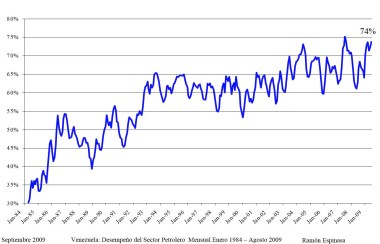
You have to love this graph of the percentage of Venezuelan exports to the US by Ramon Espinasa which was published in today’s El Mundo. As you can see, 74% of the country’s oil exports go to motorize the Evil Empire an all time high, proving the Beatle’s wisdom when they said: “You say you want a revolution, oh well, you now we all want to change the world”

espinasa1

Chavez’ Economic non-plan

September 21, 2009

HelpCoyote[6]

After wondering, arguing, discussing and waiting, we finally have Chavez’ Economic plan…only six months late

or do we…

Let’s see:

There will be 40 measures, but Chavez could not keep his own secret and leaked some of them, among them:

Already implemented: Six Ministers of the Cabinet have received an upgrade and have become Vice-Presidents, so that in Chavez’ words “We can have a more political Cabinet than administrative one”

Is he kidding us? Does he think that 2,000 Barrio Adentro modules have no Doctor because of political rather than administrative matters? And on top of that the people are the same ones that have been incapable of doing anything!

But let’s not get hung up on this, after all, this is the “easy” measure. already decreed, sworn in, more assistants, higher salaries and the like. Meaningless…

The next measure:

An employment program..

Jeez, Chavez got frustrated in 2004 with about eight employemnet programs that never panned out, I guess he is willing to give a try to another failure.

Next:

We will sell a bond to lower the lowered “parallel” market

I guess the most significant part of this, was that Chavez not only acknowledged the existence of that “other” market (which is legal), but that he admitted that the Government had lowered it. According to El Nacional, the Government injected US$ 300 million this week, I hear it was US$ 350 million. It does not matter, that rate is simply not sustainable, either you give CADIVI money or the swap market. Both it is simply not possible.

As to the bond, most previous issues have been atomized in such fashion that they have only lowered the swap rate “psychologically” up to the date of the bond allocation. And given international markets, US$ 3-4 billion may give markets indigestion.

In any case, issuing a bond is not a plan, it is like giving aspirin to someone that has swine flu. Monetary liquidity stands at US$ 103 billion, reserves at US$ 33 billion. See the problem,? Liquidity keeps going up, reserves stay around US$ 30 billion. What happens when liquidity reaches US$ 200 billion, or US$ 300 billion. I don’t know when this bubble explodes, but it will and the result will be ugly, very ugly. While it doesn’t, inflation is at 30%, I wonder if anyone has explained to Hugo what this mean to the “people”.

Next:

CADIVI will give more money to importers.

Jeez, this is like the doctors in Barrio Adentro, we have been hearing about CADIVI giving more money to importers for months, but nothing happens. Is this an administrative or a political decision?

And the final part of the “plan” that we know about is that the “Misiones” will be revived. Which actually depends more on the “administrative” than on the “political” Cabinet. But Chavez seems to think the second one is more important.

In the end, this is an economic non-plan. These are so far just a bunch of measures, all disjoint, aimed at trying to reduce some distortions in the economy, but they are not part of a plan that attacks the problems of the distortions in the Venezuelan economy.

In the end, it is all political for Chavez. Unfortunately for him, if oil stays at current levels, a year from now, none of these “measures” would make a difference. On the contrary, these are all superficial and temporary measures whose effects will dissipate even before the end of 2009.

(To the Chavez cheerleaders I tell them: Try living on minimum wage with 30% inflation and tell me the Venezuelan economy is doing fine. As for oil, the chart looks positive, it seems ready to break 75 bucks, if it does not, watch out Hugo!!)

Forrest “Jimmy” Gump Carter: Stupid is, stupid does…

September 20, 2009

jimmy-carter-hugo-chavez

And this year’s loser award goes to Forrest “Jimmy” Gump Carter for managing to say in a single interview that:

“I am disillusioned with Hugo Chavez”

That is called being a pendejo Jimmy, you should have known better, but I guess you lusted for him in your heart…

and…

then he told us that he thinks the US knew about the 2002 “coup”. Yeah, that violent coup that overthrew Hugo Chavez, as seen in this picture:

n565024645_591500_129

sorry, that image was not violent enough, here is this one

n565024645_591501_705

There you are, the violent General forcing Chavez to resign. But the next one is even more grotesque:

n565024645_591503_1818

nothing worse than a man of the church with a machine gun pointed at a President to stage a coup.

By the way Jimmy, there is a really cool store online called Amazon, you can buy a book with you credit card (I assume you have one). Buy this book and then tells us how the US “knew” about all this.

Stupid is, stupid does…

Chavista Management at its best, some case studies

September 20, 2009

pastedGraphic1

(Painting by Oswaldo Guayasamín, late 60’s “The Macuto (The Brute)”)

Case study 1: Mision Barrio Adentro

This one comes from the horses mouth, Hugo Chavez yesterday. The President declared health services to be in an emergency state. Somehow, someone has just discovered that 2,000 of the Barrio Adentro modules that are supposed to provide primary health care in the barrios, do not have a medical doctor. It’s hard to know how many there are total, because the target was to have around 9,000 by 2009, but if the existing ones did not have a doctor, you have to wonder whether the “new” modules were actually completed. But see, according to Hugo Chavez, 2,000 modules don;t even have a medical doctor.

I would like someone to explain to me how the “showcase” program of the revolution can be short its most basic supply: Doctors. How does someone running Barrio Adentro not notice that a large percentage of the modules hailed around the world as the revolution, manned by questionable Cuban doctors, a parallel system to the existing one, does not have Doctors of all things. We are not talking gauze, or needles, we are talking about the most important part of the system: It’s Doctors.

Somehow, feeble Fidel Castro had to tell Chavez (according to the master storyteller yesterday) that something was amiss and he would send replacements soon. Apparently, nobody, absolutely nobody in Venezuela had realized it, the Cuban Doctors left and that was it, they were empty. Minister of Health? Well, he did nt even go to the Unasur meeting on the needs for the swine flu virus shots of each country, how could he have time for knowing that Barrio Adentro had become Barrio Empty?

Imagine now, if this is the state of the showcase of the robolution, what is happening at the regular health care system that Chavez tried to bypass with Barrio Adentro, the many hospitals in Venezuela where people have, for example, operations, or give birth in, the same ones that Chavez seems to acre little about. Well, 65 of those hospitals received half a billion (Yes, 500,000,000 dollars, the revolution does not fool around) in 2005 and the National Assembly opened an investigation to find out why not a single ONE of those projects has been completed. (Corruption? Nahh!!! According to Russian the Comptroller)

Case Study 2: Merida has become an island

Merida is the capital city fo the State of the same name. It is a beautiful city, in a valley in the Andes with 5,000 meter high mountains surrounding it. Chavismo has run the State for the last 9 years, but somehow, Merida has become isolated as described by Milagros Socorro in today’s El Nacional (page A11, by susbscription).

Merida has become an island 15,000 feet above sea level. Let’s see ho you can get there:

1) By plane. Well, flights from Merida’s airport have been “suspended” since mid-2008 because there was an accident and the Chavista solution was to simply suspended all flights and make you go to El Vigia airport, a smaller airstrip two hours away.

Then there are roads. To go fro Merida to Caracas, you either go towards Valera (7), via Barquisimeto, or through Barinas/Barinitas (1 and 5), as shown below, Caracas is to the Northeast (top and right):

merida

Well, there is bad news if you are in Merida. If you want to go through Valera, the Timotes bridge fell 7 months ago and the revolution has not gotten around to fixing it (Certainly not because Barrio Adentro was distracting it). The Barinitas road has been closed for almost three weeks (lots of rain, but it did rain in the horrible IVth. Republic, no?)

The solution is clear, you have to go back the other way (remember Merida is in the middle of the mountains, so this going “back” implies going down these mountains in the wrong direction). Once you have managed this, you go down towards Lake Maracaibo and you are on your way, some five to six hours added to your schedule. (As Milagros Socorro points out, you could all the way back to San Cristobal, near the border of Colombia, but that would be like going from an Francisco to New York with a stop in New Orleans)

Buy hey, maybe it is like the Barrio Adentro problem, nobody noticed the bridge fell and after all, people go from Caracas to Barinas, Chavez was born there, but who wants to go to Merida where people work hard, the weather is nice and there is one of the best universities in the country?

Case Study 3: LOE or Lee?

With all the concern about the new Education Law, someone in Government forgot to get the school buildings ready for opening last and next week. You see, apparently Minister Navarro was so busy ghostwriting the new Bill for the National Assembly and Chavez so busy getting the PSUV patrols to make sure schools opened, that some 40% of the schools facilities were not ready on time.

Surprise! The patrols had nothing to patrol, even if in most cases they did not even show up. (PSUV is looking into the latter, not the former, patrols not showing up is more serious than schools not being ready on time)

I guess that is why the revolution needs 40 years to succeed. Running a country for ten years, while controlling all powers and having an oil windfall in the middle is difficult when the few clever revolutionaries are busy turning themselves into millionaires, rather than helping out Chavez that has no clue as to what managing is all about. Thirty more years!

When ignorance takes over a country: Minister of Science Chacon and earthquakes

September 16, 2009

Last April, there was an earthquake in the early morning hours with a magnitude of 5.4 in the Richter scale. Jesse Chacon, the current Minister of Science and Technology came out and made this very public statement:

Now, I don’t know who told Chacon then about this non-existent models that predicted that in 1,000 years there would not be another earthquake of this magnitude, because the area where that quake took place has had stronger quakes every sixty years. So Mr. Chacon did not know his science, nor his history when he made that statement, because he was proven wrong ver fast last Saturday, when Caracas was shaken by a quake with magnitude 6.4 in the Richter scale, a full order of magnitude higher than the “impossible” event in 1,000 years predicted by Chacon.

But this is the man that is guiding policy in Venezuelan science these days, despite the fact that he has no knowledge or training whatsoever in science and confuses science, technology and even making modern products when he talks about what science is. This was demonstrated by his letter to Science magazine a couple of months ago, where he noted among the accomplishments of science in the revolution, the access to computers by school kids, a cell phone factory and the fact that Venezuela purchased a turnkey satellite from the Chinese.

But that has been the hallmark of the Chavez administration, he has had a bunch of Nescafe instant Ministers that he has rotated from one position to another, without these Ministers having any knowledge or training in the newly found position. Chacon has been Minister of Justice, Telecommunications, Infrastructure and Science, among others, and he has pontificated with the same style as the video above in each of them.  A year ago his topic was police systems, now its science and technology, next year it will be healthcare or who knows what. This is the hallmark of the Chavez administration: Improvisation by former military with little management experience but who walk through positions acting and talking as if they had intimate and extensive knowledge about their positions.

And in the process they do irreparable harm to whatever they do, from oil, to light and heavy industries, to science, culture, to agriculture, the track record of destruction by the Chavez revolution is truly remarkable. Minister after Minister talks about projects, future, but never about accomplishments, there are so few of them. We always hear about oil projects, never about the completion of one. We always hear about grandiose promises (Remember the Amazon pipeline, the 16 refineries with other countries and the grandiose gas and oil projects?) but we never see Chavez inaugurating any of them, because they never get completed or even started.

It is the revolution of ignorance that has taken over our poor country and Jesse Chacon is simply setting the bases so that Venezuela’ s Science and Technology system is destroyed, such that it will insure that we remain an underdeveloped country for years to come. His ignorance and arrogance is the guarantee of that.