Theater of the absurd: Chavez Government to investigate Globovision for reporting earthquake

May 8, 2009

I will once again be silent for a few days as I leave Budapest, but I can’t help but write a brief note on what is definitely the most absurd thing to come our way in a while: The Government will investigate Globovision for its reporting of the earthquake last week and if sanctioned, could shut down the TV station for 72 hours or completely. 

Globovision reported the tremor (conspiracy?) and noted that the webpage of Funvisis, in charge of seismic research in Venezuela was down and there was no information from the Government. (The same was true last month when a tremor hit Caracas on a Saturday afternoon, I had to use information from the US)

According to the investigation, Globovision created “fear” and “panic” with its report of the physical event, but of course people were avid for information as VTV showed a pre recorded Chavez tirade at 5 AM that morning.

What Globovision did was to use data from the US Geological service and note that it was a strong earthquake from a fault that had been dormant. 

I guess soon,the media will not be able to  report shortages, rain, floods or crime…

What a stupid revolution!

(Imagine if Globovision, or any other media outlet dared to report on Chavez’ “other”, “great”, “Science” and “Technology” project, the overpriced Simon Bolivar satellite, wobbling in orbit as a symbol and monument of the stupidity and ignorance of the revolution)


The Devil from Bratislava

May 7, 2009

As I look at the effects of decades of communist rule in Bratislava, I can’t help but wonder what the results of years of the Chavista will be in our battered country. Hopefully our music will not become as sad as the Slovakian folk songs I have heard (above) nor our look as drab.

But I am not here for political enlightenment, but to disconnect, a task which is made harder by the earth deciding to shake so hard that I get phone calls at 5 AM from Caracas that scare the hell out of me, but were somewhat aimed at getting some comfort . Which I give, but I have no basis for, as the fault that produced Monday’s tremors had been dormant for quite a while and while never responsible for a big quake, it could unsettle more “traditional” faults in the North. But tell that t the revolution as the newly minted Minister of Science and Technology Jesse Chacon, recycled through many Cabinet positions, uses the opportunity to cal the people with information gathered from who knows whom and says that having a tremor stronger than the 5.4 on Monday would be a one thousand year phenomenon and the aftershocks are “natural”.

An irresponsible statement, as unjustified as Mr. Chacon being Minister of Science. Because Caracas is surrounded by faults known to induce a 6-plus earthquake every sixty years on average, which would destroy Mr. Chacon’s statistics easily, Of Course, Chacon is likely to be crossing his fingers as he makes these outrageous statements, hoping that he will never have to justify his mistake. And even if he were shown to be wrong, it would not be a problem as the revolution would find a way to blame the opposition, God or whomever, but never the process itself.

We are after all reassured that the country has the most modern equipment to monitor the tremors, but that is all that can be done, monitor after the fact, and even in that US geophysical services were faster and more precise to tell us where and what happened in the early hours of Monday.

And I also stay connected because my infamous Bolivar credit card stopped working this weekend, a fact communicated to me by many friends. I can’t complain about a system that I abhor, but I don’t suffer much from it, I do have other credit cards to complete my trip with. But how many Venezuelans were left out there stranded by the irresponsible policies of CADIVI? They travelled believing that they had a precise amount of money to use, but were cut dry in the middle. Whether fair or unfair is not the question. The question is whether any system should have such a random and chaotic factor associated with it. Of course, most that travel are the rabid anti-Chavistas, so why bother at all in any case.

And I also hear that in a country where confrontation between the Government and unions is on the rise after a repressive may 1st. celebration, a high ranking Toyota union leader was killed today. Another mystery never to be solved by a Government that intimidates its enemies and never is capable in finding out who the intimidators were.

And thus, even as I disconnect, the ties remain, the links are there, the never ending presence of a fake revolution that never lets you sleep in peace even if you are in Bratislava.


PDVSA zero coupon bond rumor: makes sense, but does it? (And two bits on the Central Bank and bonds)

April 29, 2009

Rumors are rampant that PDVSA will issue a two-year zero coupon bond which would be sold to local investors for local currency. The issue would attack two problems: One, it will give PDVSA local currency to pay off contractors, suppliers and salaries. Two, it will supply the parallel market with US$ 2.5 billion and will help hold it down for a while.

While Minister of Finance Rodriguez denied that PDVSA had the authorization to do it, there has to be some truth to it, because some parts of it make sense. For example, making it a zero coupon is sensible, as this means that the company will have no interest costs. Two years makes some sense, but three would be best. Why? This bond, if true, would mature in 2011, but there is already a maturity for one of the country’s bonds in 2011, for US$ 1 billion that year, that would mean that US$ 3.5 billion in Venezuela and PDVSA bonds would be due that year. Fine if oil prices bounce back, but no so great if they don’t. So, 2012 would be best.

But once one gets into the details, things get murkier. Foreign investors prefer sovereign risk than PDVSA risk. Thus, while at first sight a yield of 14-15% might be what investors would demand, it may be higher initially. The second problem is that it is likely not to have much of an impact on the swap market right now, except for the psychological impact initially. This is because US$ 2.5 billion is likely to be sold in little pieces to thousands of small “investors’, which does not attack the problem of corporates that need foreign currency for imports. Thus, the bonds will likely end in the hands of those looking to make some money, rather than satisfy the swap market needs. Moreover, those same corporates have needs that exceed the US$ 2.5 billion anyway.

What would seem to make more sense is to say the country (not PDVSA) is buying back the 2010’s and issuing US$ 4 billion of longer terms bonds with a low coupon. But clearly this is not what the Government is thinking. It would certainly be a strange transaction, if true, as a zero coupon issued by PDVSA. Think about it, suppose the Government wants to sell the bonds at an implicit swap rate of Bs. 4.3, which is what optimists are saying in Caracas. Then, let’s say the bond would sell in world markets at 70% of its nominal value, to give a yield of 13-14% more or less. Then, this would mean that it has to be sold to local investors at 140-150% of its nominal value. That is, if you buy a million dollars, you pay (1.4 x 2.15)=3.01 million Bolivars for it. But once you have the bond you sell it for (0.7 x 1 million or 700,000 dollars which means you pay 4.3 Bs. (3.01/0.7) for each dollar you get. I wonder how may bonds have been sold in a primary market with such a premium in history. If PDVSA sold them at an implicit rate higher it would have to be even higher. Weird no?

I hope my numbers are right, I don’t even want to use a calculator on my vacation and doing things from memory.

And speaking of numbers, how about Mathematician Nelson Merentes becoming Head of the Venezuelan Central Bank? Chacon is Minister of Science and Merentes President of the Central Bank, it’s hard for things to get weirder than that. When I met Merentes in the 90’s he had no clue what a spread was, I do hope he reads my post on Central Banks in early February and knows his is bankrupt and what it means.

And since we are on the subject of bond, the revolution that claims to defend the country’s sovereignty so well, approved yesterday, via the National Assembly, that bonds can be issued with collateral of Government property. This would be a first. Supposedly, this is being done so that CVG, the corporation that manages companies in Guayana, can issue bonds guaranteed by its gold production. Truly amazing when you think about it, CVG does not even have audited financial statements.

It is indeed a revolution, a clueless one at that.

Away for a while, will post occasionally

April 26, 2009

I will be going on my yearly vacation. Thanks to this new software I will be able to post while away, but obviosuly I will not be as in touch as usual. In fact, there are eight days on my vacation when I will have no Internet connection or possibility of having one. I will only post in this web address as the old system does not allow me to do remote posting.


A few economic tidbits from the revolution

April 26, 2009

1) Venezuela’s non-oil GDP is back down to 1977 levels according to Toby Bottome of Veneconomia. I guess this is a backwards revolution, 35 years lost, proving once again the IVth. was bad, but the Vth. is worse.

2) Two weeks ago, I was telling people I did not understand why the parallel swap rate was not soaring given that CADIVI is simply not giving much (Even if we don’t have statistics for March). Now that the rate has soared in two weeks, I am concerned that there are no more shortages out there. One notices shortages in paper products and dairy products, but something has to give at some point. According to Association of Supermarkets, the number of products you find in their shelves is down between 45 and 50%. And you notice it when you visit supermarkets.

3) And Minister of Finance Ali Rodriguez correctly said gas prices need to be reviewed “but now now”, but said that ther can be no devaluation until local production is given incentives to produce more. I guess Rodriguez does not understand that local producers see 30%-plus inflation, over 2% per month, while the Government imports at the same official rate of Bs. 2.15 per US$ than 4 years ago. There is simply no incentive that will allow local producers to invest and work more, it is just impossible to compete under those conditions.

4) And while taking over farmlands is no longer news in Venezuela, this week the Government decided that sugar cane lands in Aragua and Carabobo states are too fertile for sugar cane and have to be taken over and/or planted with different crops. This includes some of the best rum producing areas. Of course, nobody has given it any thought in the Government as to what to do with the sugar processing plants nearby, the workers that are there and what happens to them if the crops are changed. In fact, why doesn’t the Government show us how efficient it has been in making productive the 2 million acres of land it has taken over forcefully since 2000. And you know why that is, go back to item #1 on this list.

5) And the Government is also going after farms that breed horses for racing. Government over the years have slowly destroyed what was once a thriving industry in Venezuela. In fact, estimates are that the racing industry during Chavez’ time has destroyed some 11,000 jobs under the Government’s hands. What’s interesting is that while three fairly important horse farms ahve been intervened, the on owned by the brother of a certain Cabinet member was visited but left alone…Love the revolution, no?

6) And how about Chavez’ coop movement? Since 2003 the Government has created 366,000 cooperatives for the development of shared responsibilities and profits. Of these, only 20,000 are functional today. How much money was lost in the process? To say nothing of the wasted effort and illusions of the people who participated who were sold fantasies by the revolution.


Intolerant Government fires retiring tenured researcher

April 25, 2009

This is a remarkable story of the intolerance and selective repression pc_1_1024 of the Venezuelan Government which ignores the law and at the same time has little respect for those that have spent their life working in and for Venezuela, accomplishing what few do.
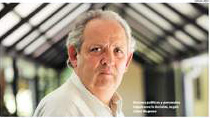
Jaime Requena is a biologist with a Ph.D. from Cambridge University. He is a distinguished and accomplished scientist with over 100 publications to his name (including three books). He has worked at the Venezuelan Institute for Scientific Research and IDEA, a research foundation established in the 80’s  and is a member of the Venezuelan Academy of Sciences. He was even President of IDEA in 1988. In 1996 he was appointed to the Simon Bolivar Chair at Cambridge University. And that is when his problems began…

I like Jaime because he is quite irreverent and outspoken, you may remember the active role he took up to block Chavez from receiving an Honorary Degree from Cambridge, which I published here. . He is not the type to be quieted down easily. In 1997, after spending a year at Cambridge he asked for a months’ leave of absence, a typically routine and automatic procedure in Venezuelan academic institutions. He needed to stay in Cambridge to finish off a few things he had done there. He never received a reply, but thought nothing of it and stayed. He came back to find out that he had been fired. Firing somebody with tenure is not an easy procedure in Venezuela. In fact, firing someone Venezuela’s civil service  is fairly hard But Jaime was even fired without following the procedures. Three members of the Board of IDEA took advantage of this procedure to get rid of him.

Jaime spent a decade fighting his firing in the Courts and went all the way to the Venezuelan Supreme Court and won. IDEA had to hire him back and pay all his back salary. His firing however, stopped his career as an experimental biologist. During the years of his fight, he worked at Universidad Metropolitana, a private university, where he was General Manager of its foundation and did research on Venezuela’s scientific productivity and history. He compiled what is by far the most extensive and complete database of Venezuelan scientific researchers and published  papers.

When he was hired back by IDEA, Requena’s lab had been taken apart, so he tried to continue his reaserch on Venezuela’s scientific productivity. But he was clearly not wanted at IDEA. Jaime not only disagrees with the direction science policy has taken in Venezuela, but in 2008 wrote a letter to prestigious scientific journal Nature, denouncing the exclusion of social sciences from public financing by  the Chavez administration. Requena says that the only time he met the Head of IDEA, he recriminated him for writing the letter.

Requena’s life at IDEA was rough, he had no furniture in his office, had to supply it himself, was given nobody to help with his research and was not even given a computer. His access to a database needed for his work was restricted. Requena thus decided to request his retirement, given that he had worked for 41 years for the Venezuelan Government, more than sufficient to retire. He also requested that he be named Emeritus researcher of IDEA.

Instead, eleven days later he was fired for “immoral conduct”, “omissions which affect the security of the workplace” and “grave faults in his duties”.  The decision was made by the Head of IDEA and there was no meeting of the Board of Directors of the institution as required by its by-laws.

This was clearly political in nature. The argument by the Prsedient of IDEA was that Requena was still holding  his position at Universidad Metropolitana, which is not the case as he resigned when he rejoined IDEA and that he had requested that IDEA buy for him a software package which that University sells, which the President of IDEA called a conflict of interest. Requena needs that software for his research as it is the one that he had been using for years while at Metropolitana. Requena continued to be involved with the activities of the Foundation, but was not getting paid for it.

This is the arrogant and intollerant way in which the revolution with few accomplishments treats Venezuelans that have disntiguished themselves in their careers devoted to working for the Government with low salaries and limited funding, but managing to achieve international and national recognition for their work. Requena represents what Chavismo hates, knowledge, accomplishments and excellence, something quite rare among the Government’s supporters. That is why IDEA’s President Prudencio Chacon, whose scientific career pales in comparison with Requena’s, took it upon himself to fire him and thus remove from his surroundings someone that he envies and who openly opposes the Government he loyally represents.


Weil, Chavez, Obama and Facebook

April 23, 2009

20090423_talc1_20_2_g1


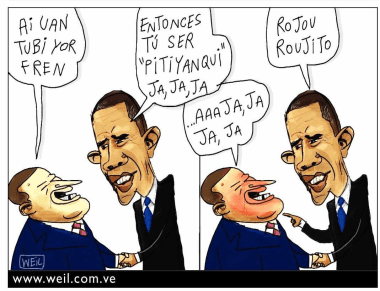
Weil on Chavez-Obama meeting

April 22, 2009

image0011

From left to right:

Chavez: I want to be your friend. Obama: Then you are a Pitiyanqui. Laughter. Obama: Rojo Rojito


Government shows its true colors now that Rosales has been neutralized

April 22, 2009

While getting Rosales out of the way was clearly an act of revenge, it is clear that a secondary goal of the Chavez Government was to attempt to regain the Maracaibo City Hall in the belief that once Rosales was out of the way, PSUV’s Di Martino could easily beat anyone replacing Rosales.

The outlaw nature of the Chávez Government was clearly seen when it had a judge declare illegal Rosales’ request for a leave of absence due to a formality. Rosales once again went through the process and now Chavismo wants to go through the Courts to insure that the position would be declared eligible for election.

However, someone had the clever idea that the ideal candidate for the position would be Rosales’ wife. Immediately the Chief Chavista suck-up lawyer in the National Assembly, Carlos Escarra, asked the prosecutors office to charge Rosales’ wife with complicity. This is Chavismo’s idea of justice, there is no evidence, it is not even their domain of responsibility, but immediately they accuse, charge and find anyone guilty when it is convenient. To hell with evidence, in Escarra’s words : “The prosecutor can charge her and she will see if she joins her husband in Peru or stays here to face Justice”

And if we are there, why not charge Rosales’ own party as suggested by the other honorary, adjunct Prosecutor Deputy Mario Isea who asked that anyone that advised, talked to or was near Rosales be charged with complicity and cover up. How about all of Un Nuevo Tiempo’s leaders? Wholesale persecution and injustice is cheaper and more efficient.

The funny thing is, Rosales has yet to be charged formally. Yes, he was going to be jailed, but there is no formal charge against him, so Deputy Isea was simply “pissing out of the perol“, as usual. But Chavismo does not care about such formalities, so maybe they will find them all guilty of conspiracy or racketeering or whatever.

Because the whole Justice system in Venezuela is so corrupt and manipulated by Chávez and his cohorts, that persecuted politicians are quickly added to Interpol’s capture list, as in the case of Nixon Moreno the student leader that was never allowed to leave the country after seeking asylum at the residence of the Vatican’s representative. Nixon  escaped last month, but is already in the list, but curiously, neither accused drugtrafficker Walid Makled, nor la Piedrita leader Valentin Santana appear on Interpol’s website. This despite the fact that santana was ordered jailed by Chávez himself in what was only an election ploy.

But we are promised that Rosales will be added to the list, just to prove that that going after political enemies is the true priority of this criminal Government.

Rosales meanwhile sent a message to the country, saying he declared all income in his income taxes and there is no evidence of illegal enrichment against him. But as I suggested in the previous post, it may be too late for Rosales. The only silver lining behind his departure may be the fact that with Rosales out of the picture, Pablo Perez and other new faces of the opposition may be able to become known on their own right  and come out of the shadows of the old leaders.


Rosales in exile: Death of a politician…

April 21, 2009

When someone in the Court where Rosales was to have had an audience yesterday leaked his sentence ahead of the audience, Manuel Rosales decided to go into exile in Peru in what is likely to become the death of his career as a relevant politician in Venezuela.

Rosales’ attitude is understandable, the sentencing papers contained information only the Judge knew and they were ready to jail him, but what else did he expect? A fair trial? Understanding? There was no question in anyone’s mind that this was to be Chavez’ revenge, so for Rosales to expect any fairness was naive to say the least.

But the move is truly shortsighted politically. Rosales is not a reporter, a second rank military officer or a two bit swindler, he happens to be one of the main opposition politicians in Venezuela and as such it was his job to stay and fight. He should not have considered any other option: Leaving represents playing into Chavez’ hand, giving up the fight, sending a signal that he may even be guilty. Staying would have represented an honorable and political battle against all odds. It would have made life difficult for Chavez and his Government. He now becomes an irrelevant problem. A has been. So long Manuel!

Yes, it is the human solution. Nobody likes to go to jail. Nobody likes his or her freedom to be restricted. But when you become a politician, more so in a country like Venezuela, it is part of your fight. It is your responsibility.

Just think if Rosales had been jailed yesterday and sent to a prison with Pedro Carmona, Eduardo Lapi, Carlos Fernandez, Raul Baduel, Carlos Ortega and a couple of military officers now in exile. Much like when Hugo Chavez was jailed in 1992 after staging his coup, the jail would become a fertile ground for conspiracy and political noise. An uncomfortable source of news for the Government and a constant distraction from Chavez’ well orchestrated challenges to the opposition.

People would visit the jail and meet not only their friend, but others, would help them and would send a signal to the country and the world that something is not right with Venezuela’s justice and political system.

Instead, Rosales will have been forgotten in a month and his stature will have been diminished in the eyes of Venezuelans. Not because he will have lost it, but because he will no longer be part of Venezuela’s daily political fight.

And in a country with mediocre and weak opposition, the people will have witnessed the death of another opposition leader because he chose the exile option. In the end, Rosales chose his own political death.

It may be the right decision for him, but the worng political option for everyone.