Chavez’ lies about salaries of high Government officials

March 26, 2009

I was a little surprised when Hugo Chavez began talking about his salary, saying he would b ashamed if it was  too high like Bs. 10,000 per month (US$ 1,666 at the swap rate) and that the poor Deputies of the National Assembly made only Bs. 4,300 (US$ 716) per month. Surprised, because I had heard that high Venezuelan Government officials were making around Bs. 30,000 a month (US$ 5,000) at the swap rate, plus juicy bonuses and perks.

Then I thought I was really clever and I would get into the webpage of the Social Security administration and check the payments made into the system by Government officials, which would give me a glimpse into salaries.Essentially, you go to the IVSS webpage, input the ID number and birth date and it gives you all of the details of the account. How would I get the ID and birth date? Well, I could not think of  a better way to use the Maisanta/Chavez database than this, using its convenient reverse function look up table, insert a last and first name and it gives you all I need.

Unfortunately, nothing is simple in Venzuela. It turns out that lwayers do not contribute to Social Security and nether do the military. So, forget about the Supreme Court, one of the places I was curious about.

I did find a couple of interesting things. First, I looked up Hugo the Dictator himself. Guess what? The data is fine, he did not contribute (as military) until he got elected President and then in 1999, he did:

chavez

Funny thing is he never contributed after that. Weird, no? He is not military, he contributed his first year as President and then, nothing…

In fact, Chavez lied today saying that he did not make enough money to pay taxes. If he makes Bs.10,000, he has to pay taxes and with much less social security taxes. Something smells funny here.

Maybe a reader can enlighten me.

The only other interesting fact I found, was when I checked the new Minister of Commerce, Eduardo Saman, the same one that yesterday was telling people you had to pay taxes and all of those glorious things, like sacrificing profits,  that revolutionaries are saying, as if they had discovered warm water.

Well, the curious thing is, that Mr. Saman will turn 45 next week and either he was unemployed until 2001 or did not pay his social securty taxes, because he does not appear in the registry until 2001..

saman

Fortunately others have begun doing the same job but with better access to information. While Chavze talked bout his salary or that of the National Assembly, El Nacional gave us a whole list:

Rafael Ramirez Bs. 60,000 a month

CNE Directors Bs. 25,000 to 35,000 a month

Central Bank President Bs. 42,000 a month

Supreme Court judges 40,000 a month, 5 to 8 months bonuses

Now, I have no objection to people in these positions making good money. What I object to is these lying bleeding hearts saying they care so much for the poor and then increasing their salaries to 50 times the minimum salary.

The Assembly approved now a Bill to put a cap on salaries. That Bill was introduced in 2007 but even though the Assembly did nothing last year as Chavez legislated by decree, the Bill never moved. Now that the Dictator wants it, it is rushed through the Assembly.

To me this Bill violates Venezuelan Labor laws. The Government can put a cap on salsries, but according to Venezuela’s Labor legislation you can not decrease anybody’s salary, the law is even more general than that, you can not “worsen” the working conditions of a salried worker. This applies to all of these positions. But I am sure they will genuflect and give thanks to Chavez for the privilege of working for him.


Will the swap market get all tangled up tomorrow?

March 26, 2009

42-18122069I am hearing that US authorities froze some accounts used by local brokers in the swap market in the US today and that at least three dozen brokers may be involved. The amount of money frozen may be in the hundred millions and clearly nobody knows how long the process may last.

What this means is that in the upcoming days, the swap market may become all tangled up, soaring one day, down the next or whatever, as many of these brokers appear to be some of those PDVSA sells foreign currency directly to. This means that a lot of the settlements in this market will not take place and there will be defaults all over the place, possibly creating a sort of domino effect.

As brokers default, the market is likely to become somewhat dysfunctional, as PDVSA will also have trouble supplying the market with foreign currency. Note that at the same time, PDVSA itself will be affected as some brokers may not receive their payment in Bolivars, when they do not deliver the foreign currency and thus PDVSA will not be paid either.

So, prepare for a few wild days in the swap market…


Ideological cleansing in the Chavez revolution: Banning snow from children’s books

March 24, 2009

burning-books

To me the idea of even throwing away a book seems extremely distasteful, let alone the pssibility of burning it or converting it into pulp. In the last month there have been reports in Venezuela of how the former Governor of Miranda State, now Minister of Infrastructure and Hosuing, Diosdado Cabello, sold library books to turn them into paper pulp and shut down libraries as the space was needed for other purposes. (El Nacional March 14th. 2009 page Caracas 3, El Nacional March 18th. 2009, page Caracas 3, El Nacional March 21, 2009, page Caracas 3 2009))

It turns out that the destruction of the books was done for “ideological reasons”, according to the President of the Library System of Miranda State.

This ideological cleansing was performed with some planning, eliminating for example, texts that had to do with the “Empire” (i.e. The U.S. of A.). Then this intellectual promoter of the revolution gives one such example (I am not making this up!):

For example, children’s books which have snow in them

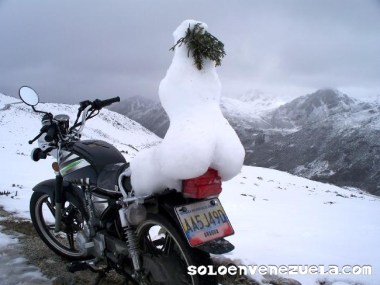
Jeez, while it is true that snow may not be part of the everyday life of Venezuelans, it not only exists in the country, but you can play with it and even make snowmen and make sexy snow women, riding a motorcycle, as demonstrated in this picture taken in Merida, Venezuela:

la-reina-de-las-nieves

Because let’s try to understand this a little better. Snow is a type of precipitation, which occurs whenever certain atmospheric conditions are present. It is not exclusive to the US, they see it in Russia, China and North Korea, to name a few. Thus, the principle seems to be here to remove anything that comes from nature, which at the same time is not part of the daily reality or perception of Venezuelan kids, giving priority to those “revolutionary” concepts that are. And clearly, its national origin its not critical, as in the case of snow.

It would then seem to me, that there are many other items that should be banned then, that qualify even better than snow, given that at least some fraction of the country’s can see, touch and play with snow. (Even if the distinguished revolutionary librarian of Miranda State is not)

Let’s take electrons for example. This subatomic particle is as foreign as can be to a Venezuelan. It has charge and mass, but because of the Heisenberg Uncertainty Principle, you can’t see it. You can only infer that it exists. Even worse, this ideologically incorrect particle was first detected by a British scientist by the name of Thomson and its charge measured by, imagine that, an American by the name of Millikan.

Thus, I see no reason, why the electron should be present in any Venezuelan library. If snow is banned, electrons should have been banned long ago! After all, the number of Venezuelan who can say they have performed the necessary steps to believe that an electron exists, is much smaller than those that have seen snow, here or abroad. (I have inferred electrons in my lifetime both here and abroad, but I am a privileged oligarch, I guess)

Then, we could ban anther pernicious non-revolutionary concept, which is clearly not ideologically pure, but obviously superfluous: World Geography. And the esteemed leader of the Miranda State Library system is the best proof of this. If she had not wasted so much time learning where the Empire is located, she could have learned more of our own geography and know that there is snow in the Venezuelan Andes.(Or there are Andes, for that matter) She could have a stronger national identity, more ideologically pure, without having to learn all of the foreign places and locations, that she should not even be interested in visiting or knowing. No?

Then, we should ban strange animals and book with weird animals, which Venezuelans are as likely to ever see, as an electron. Take the Aardvark, for example, I don’t even know if in Spanish the name is the same. Or the Komodo Dragon, because once Geography is banned, Indonesia would also be out of the books, so it would make little sense to talk about that dragon.

And then, of course, let’s ban all books and films that mention penguins! If you don’t know about snow, why would you care about this silly imperialistic animal, that invades us via their March that the average Venezuelan, whether adult or kid, should not care about. Let alone happy feet, a movie abut this animal which is in a state of constant happiness and exhilaration, something which is simply not part of the revolution or revolutionary. Just look at Chavez! Diosdado! Jesse! Jorge! Jose Vicente! Tibisay! Any of the leaders! Mostly gloomy, all the time. And to top it all off, the stupid penguin lives and sleeps in snow! Which we already banned.

I could go on, but you get the picture. There is a lot of work to be done, we have to start committees, communal organizations, create an open software database, have the National Assembly investigate. So many other things to be banned in order to make the revolution and the country ideologically pure.

Next on the agenda to be banned: Aurora Borealis, Cricket, Escargot, Blues, Peanut Butter, ESP, Sitars, Teleprompters (Chavez does not need one) and Elvis.

(Thanks to GSB and my respect to Beatriz W. De Rittigstein for her excellent article)


The world’s biggest corruption scam in four acts

March 23, 2009

corruption_470451

Exchange controls have always been a source of corruption. Every time the Venezuelan Government has implemented exchange controls, it has eventually become an opportunity for graft and corruption.

This time has been no different, but actually much worse and in magnitudes never seen before in Venezuela’s history. Much worse, because in the previous exchange control regimes, corruption was limited to the office that approved requests for foreign currency and there were checks and balances that would limit the graft. But more importantly, this has been worse, because the Government has been intervening in the parallel market in an extremely non-transparent fashion, creating not only an additional source of corruption, but one that goes completely unchecked.

In the end, because the exchange control office CADIVI is controlled by military and there are no checks and balances, little is known about how big corruption may be in that office. We all know that there are people that will ease your requests for a fee, and that the payment of private debt has been a source of very juicy profits, as local companies have purchased their debts at a huge discount, only to pay it with official dollars at 100% of their face value.  But there is no way of estimating the magnitude of these rackets.

In contrast, this blog and newspapers like Tal Cual, have followed closely what developed in the parallel swap market and it has allowed us to establish the multi-billion nature of the racket. Unfortunately, those denouncing this have been few and far between and as I noted in another blog, politicians have failed to talk about this, which makes you wonder about their commitment to fight corruption.

There have been essentially three stages to this, below I summarize them, concentrating on the first and last one:

Act I: The Merentes Era and Argentinean bonds: At some point during Minister’s Merentes last tenure in the Ministry of Finance, Hugo Chavez came up with the idea of helping out Argentina by purchasing that country’s debt. The debt was purchased and soon afterwards, the Minister of Finance, a Mathematician with no finance experience, started gloating that the country was making a nice profit in these transactions.

Everyone was a little surprised that they could get rid of them so fast and at a profit, except the Government was not selling the debt in the international markets. Instead, it was selling it to local brokers at a price higher than the purchase price, but for Bolivars at the official rate of exchange. These brokers would sell them in the international markets at a lower price, but they would get dollars which they could sell in the parallel market and get more Bolivars than they paid for.

Made up example:

Government buys bond for 80 cents on the dollar. That is, it pays 800,000 dollars for a million dollars of the bond. It sells the bond for full value, that is, for one million dollars but at the official rate of exchange. The Government “made” money, because in theory it only recognizes the official rate and it only paid 800,000 dollars, which it values at Bs. 2.15 per dollar, but then it sold it for one million dollars but at the Bs. equivalent to 2.15 million Bolivars. Instant profit.

Let’s look at what the broker does. He buys one million dollars of bonds at Bs. 2.15, or Bs. 2.15 million, it sells the bond and receives only 800,000 dollars in the international markets, but those dollars can be sold in teh parallel market at say Bs. 3 per dollar. Voila! they get Bs. 2.4 million or a profit of 250,000 Bolivars. A 16% plus profit, without doing anything!

Of course, it was more complicated than that, as those “lucky” enough to get the bonds had to pay a 60% (average estimate) kickback on the difference to a bunch of “intermediaries”.

More or less at the same time, Fonden also began buying “structured notes”, which are essentially a security issued by a foreign bank in US$ with certain conditions or instruments under it.

These notes were also sold into the parallel swap market, which conditions like those of the Argentinean bonds, commissions, artificial profits and all of that. Except that more money was made with these, because there were also fees paid to structure the notes and to dissolve them.

I can’t remember the break down of how much was sold under Merentes, but as you will see, the numbers are simply huge.

Act II: Cabezas replaces Merentes: Once Cabezas replaced Merentes, the Government stopped intervening the swap market, supposedly because Cabezas disagreed with it. In the absence of the Government supplying foreign currency to the parallel swap market, the rate soared.

I was actually impressed at the time that Cabezas would stop the corruption associated with the selling of the bonds and structured notes, but as the rate soared, the sales of the notes began again. I guess the realities of the market were stronger than Cabezas’ qualms or ethics and there was periodic intervention of the swap market that managed to slow down the rate of increase of the parallel rate.

Act III. The Isea semester: When Minister Rafael Isea accepted the position, everyone was puzzled. he was Chavez’ choice for Governor of Aragua State in the November election, which implied he had to resign by August. Why become Minister of Finance for only a few months?

Soon after Isea became Minister, the Government, via the development fund Fonden (The one supposed to develop infrastructure and back social programs) began an irresponsible and and massive campaign to lower the parallel swap rate. While some hailed the action, it was a waste of time and money, as they lowered the swap rate from Bs. 6 per dollars to Bs. 3.2. But it was clearly unsustainable and the question was whether Isea wanted to lower the swap rate or this was a way of raising money for his campaign.

In the end, between Acts I and III, the Government sold close to US$ 7 billion in Argentinean bonds and some US$ 8 billion in structured notes, that’s US$ 15 billion, while I know that commissions ran close to 15% for both sides, assume only 10% and you can see that between the “intermediaries” and the brokers, they made a nice piece of change of US$ 1.5 billion.

Just like that, in the open and everyone knowing about it. Including Chavez. Even the names of the intermediaries were out in the open. Ultimas Noticias published them.

Act IV: Ali Rodriguez  to Finance, crooks move to PDVSA: Then last June, Ali Rodriguez move to the Ministry of Finance. Interventions suddenly ceased in the market and the swap rate began rising. Clearly, Rodriguez stopped the racket. This means there is some semblance of honesty in him, as he clearly said: not through my Ministry. Problem is, I am sure he knows that the crooks moved to PDVSA.

And in this new and novel phase, PDVSA has been intervening, not with bonds, or notes, just plain, pure simple cash. We can guess as to whether PDVSA intervenes with US$ 100 or 200 million per week, but we can’t monitor any parameters. We don’t know how much the brokers are ebing sold the dollars for, how much they pay, how much they split. We can hear rumors that last Friday PDVSA sold US$ 100 million, or that it is all flowing through an account in Bank of America. But there is so little transparency, that this is in the end the most obscure of all the acts. What economist Orlando Ochoa called yesterday in La Razon: “The Venezuelan economy has fallen into hands of the lack of scruples and immorality”

And Ochoa is right. Because as he says, the official rate is at Bs. 2.15, the swap rate is near Bs. 6 per US$ and PDVSA is selling its cash, in whatever form, using  various mechanisms and intermediaries to supply the swap market with dollars at the parallel swap rate.

Which leads you to ask: Does PDVSA receive the lower rate and the difference is simply split among the players? Or is it in between?

What is clear is that there is a 200% arbitrage between the two and in the words of Ochoa:

“This is an open invitation to corruption…how does the Government register these transactions, since it only recognizes the Bs. 2.15 rate? …This is unacceptable”

The problem is that Ochoa dares to say what few do. You don’t read about this in El Nacional or El Universal. You don’t even see it in Globovision, let alone Venevision and obviously not in the Government’s TV stations. You don’t see opposition politicians talking about it either. Why? I have no clue. But fear is my first suspect. Complicity is the second. Maybe we can also have a 60/40 split on that.

Only Petkoff in Tal Cual, Ultimas Noticias a couple of times and Ochoa, and a couple of more economists and some blogs like this one (We were the first ones to talk about the Argentinean bond racket) dare to give details.

And in the meantime, the biggest corruption racket in the western world continues day after day in poor Venezuela, under the cooperative and indolent eyes of the autocrat turned Dictator. We are talking a few billions of dollars. It is said easily: A few billion dollars in commissions stolen from the Venezuelan people under the eyes of the robolution and its leader Hugo Chavez.

Imagine what this could for health, infrastructure, nutrition, housing or whatever. But this criminal corruption is backed by Chavez and his cohorts only because it is part of his control mechanism. The one that he thinks (and it may) allow him to remain in power forever. Those that fed from the cesspool of the corruption of the robolution, will defend the process to death. They would be nothing without it.

It is a tragicomedy in more than four acts.


Hugo Chavez’ “I didn’t do it!” ability

March 22, 2009

yo-no-fui

I can’t help but marvel at Hugo Chavez’s ability never to take responsibility for anything.  It is the same attitude of a little kid, which in Spanish is best represented by saying “Yo no fui” (I didn’t do it!).

He gets away with this time after time. Ten years in Government screwing things up and he still comes out and blames everyone but himself. And unfortunately, a lot of people believe him.

Yesterday was emblematic of this attitude by the Venezuelan President. Take the salaries of high ranking officials. Since the exchange rate crisis of 1982, never did the salaries of high ranking officials rise as fast and in such a grotesque fashion than under Chavez. When Chavez became President, a university Full Professor was making maybe Bs. 3 million or US$ 3,000 at the official rate of exchange, this was the same salary as a Minister or a Deputy of the National Assembly. Today tat same Professor makes maybe Bs. 7,000 (US$ 1,100 at the swap rate, the only one he has access to) while the Deputy makes about Bs. 14,000 plus bonuses, diets, travel and perks. And let’s not talk about Supreme Court Judges, CNE Directors or President’s of the myriad of Central Government institutions Chavze has created.

And who allowed this to happen? Hugo Chavez. But you would have thought it was some othe perverse Government who did it. Becasue in the end Chavez has needed this outrageous salaries to keep the Captains happy. And it was the juicy bonuses and pensions of the Supreme Court and Central bank, that made them so attractive to the Chavistas “light” willing to trade a university pension for a cushy position with would readjust their pension a factor of five at the end of the road. Human rights and justice be damned, go for the money!

And who did this? “Yo no fui!” President Hugo Chavez. He has never tried to stop it (Don’t think he will this time around either)

whofarted1

And all his talk last night about austerity and eliminating superfluous expenses also reminded me that but not devaluating, I will be able to go to fly to Europe at Bs. 2.15 per US$, really no sacrifice for me. (Why go to the Empire, if it’s so cheap to go to Europe or Asia?)Not only that, but I will get a 400 euro cash advance and US$ 2,500 per dollar for my expenses. But Hugo was not about to remove this privilege, fearing the middle class would get mad at him. I wonder why, since he has so little support in that part of the population.

And who set up this system? Ummm…funny if it wasn’t Hugo Chavez himself who created all of these rules and has maintained this subsidy for the rich, which is extremely superfluous.

But Chavez would say: “Yo no fui!”

And as the ports are taken over, look at prior efforts to “take over” things for the national good. The Macuto Sheraton? Empty and abandoned. The Melia Caribe? Abandoned. The Cable Car? It’s deteriorating. Venepal? Dying. Veneiran? You got to be kidding me to ask. PDVSA? A joke, it has twice the number of workers produces less and its debt its huge.

And Chavez would say, “Yo no fui!” We know better, but do others?

And of course, 20,000 traitors were fired from PDVSA in 2003 because we had to preserve national “sovereignty”, but Ramirez is right now going aroudn the world trying to get US$ 4 or 5 billion in exchange for futre oil production, while Chavze got an additional US$ 4 billion advance from the Chinese for his China Fund, which is exactly the same, money received so that Venezuela will later send oil to the Asian country. Pan para hoy, hambre para mañana. (Bread today, hungry tomorrow)

And Chavez is certainly to say: “Yo no fui!”

Because the Showman/Dictator has to be given credit for his ability to lie and deceive. Funny that he remembered the criticism by Nobel Prize winner in Economic Joseph Stiglitz to the policies of Barak Obama, but he failed to recall that Stiglitz also said Venezuela is among the countries that will do worse because of the crisis.

And while Chavez talks about efficiency, savings and not devaluating because we don’t need it, the truth is that every week PDVSA changes foreign currency in a ver non-transparent way, allowing some PDVSA officials and some local brokers to make a mint in the process, arbitraging the Venezuelan currency. Sure, thsi is being done without Chavez knowing…

And Chavez would say: “I didn’t do it”

And in the end he may get away with it. He has for ten years after all. He gives away the money, he gives away the oil, he gets rid of Venezuela’s oil research complex, he destroys private companies, wipes out farms, allows wholesale corruption, denies basic rights, inflation our of control, controls the system of justice.

But he always gets away with “Yo no  fui!”

You’ve got to give him credit!


And in “democratic” Cuba, not everyone is allowed to travel

March 22, 2009

cuba_1123020c

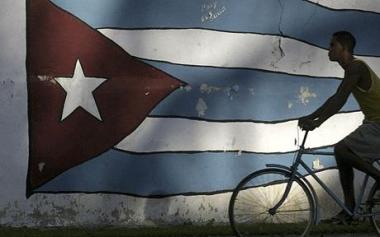
Despite reassurances that everyone who wants to travel abroad in Cuba can do it, blogger Yoani Sanchez was denied the possibility of traveling. As Sanchez points out, she has never been found guilty of anything or even charged with anything.

Maybe some of our PSF friends can enligthen us on this matter. How would they feel if they could not travel away from their countries? This is where PSF’s become ostriches or in their putrid brain justify the action as “national security” or some stupid justification like that.

Will they cheer when Chavez starts doing the same? Guess what? he already did for a while when after the 2004 recall referendum, we were denied passports because we went against the Dictator.

But we know, these policies are “necessary” here for the common good and unnecessary in your own very civilized countries.

So dear friendly PSF, don’t come telling me about democracy and rights either here or in Cuba, please.

We are not stupid, you are…


Hugo Chavez announces very timid economic measures to confront drop in oil revenues

March 21, 2009

cluelessVenezuela may be the only country in the world where the President addresses the Nation to say that two days later he will announce a set of economic measures which he calls “tactical adjustments”, because he is afraid that the people will think of this as the same type of “package” of economic measures that were common in the IVth. Republic. But in the end, its is exactly the same, but badly done, poorly conceived and will likely be badly implemented.

Badly done, because the reason they were not announced on Thursday is that the Government had not yet decided what measures it would implement. Thus, after months of low oil prices, improvisation and ignorance continue to rule the management of the Venezuelan economy, since Chief economist Chavez has veto power over all suggestions from professionals and thus, the real adjustment needed is once again postponed until later and measures are half baked ones.  If baked at all.

But even as Chavez spoke on nationwide TV today at noon to announce that he is now formally a Dictator, as he has illegally taken over ports and airports from the regional Governors, Chavez said that some details about his economic plan needed “rounding up”, in another proof of the level of improvisation surrounding the way Venezuela is being run. (BTW it was grotesque to see Diosdado Cabello, an incompetent Governor ousted by the voters three months ago, leading the takeover of the Puerto Cabello port facilities and boasting that this was a matter of “justice”)

And in the end, the measures announced tonight left a lot to be desired. There will be no devaluation and no increase in the price of gas. I was not expecting a devaluation given the revived presence of Minister Giordani in the Cabinet, but I did think Chavez was preparing the way for the gas increase last Sunday, which would help PDVSA alleviate its cash flow problems. But even such a simple move is too unpopular for charismatic Chavez to implement.

Thus, the only concrete measure announced is the increase of the Value Added Tax (VAT) from 9% to 12%. All of the rest sounds like a typical Chavez project, lots of fluff that will need to be executed if it is going to have any effect: A reduction of the budget by 6.7%, elimination of superfluous expenditures, a cap on salaries at high levels, more efficient expenditures and an increase of debt issued. Since it would be very difficult for Venezuela to issue debt today abroad, this debt will all be local, Chavez talked about increasing debt in Bolivars from Bs. 12 billion to Bs. 32 billion.

And in the indispensable populist note of the night, Chavez also announced that the minimum salary would be increased by 20% starting on May 1st., it was not clear if the cut in the budget would be before or after this salary increase which was not included in the original budget for 2009. I bet that with this announcement, the original budget remains essentially the same as the one proposed last November.

Chavez again talked about the nationalization of Banco de Venezuela, but at a “fair” price. I am sure the owners have a “fair” price which is much higher than wthat Chavez is thinking about. At the same time, given the need to protect the country’s foreign currency, this would seem to fall under the category of ‘superfluous” expenditures, but we all know this is a Chavez whim and we all know when he throws a temper tantrum, he always gets his way.

Thus, as expected, not much substance in Chavez’ program, a couple of measures that are real (VAT and salaries), but the rest a lot of wishful thinking that will face the resistance of the bureaucrats to implement them, since it affects their power and their perks. Since nobody will do follow up to all these measures of savings, efficiency and rationalization of expenditures, they will in the end not have much of an impact.

One of the highlights of Chavez’ presentation was his use of the best precepts of How to Lie with Statistics, when he presented a graph showing how he has increased the minimum salary in US dollars by almost a factor of three since he became President. Of course, he failed to note that the calculation since early 2003 was at the official rate of exchange. If he uses either the swap rate (Bs. 6 per US$) or the rate of inflation (Prices have tripled since Jan. 2003), then the minimum salary has actually lost ground or remained the same in the best case. But either he does not understand this, or he is lying, both a common occurrence for him.

In the end, if oil prices do not rebound significantly, we will see a repeat of this week’s show in June-July, with another set of measures, this time, much tougher ones, as the country begins drawing down foreign reserves and PDVSA’s cash flow becomes critical. Shortages will become quite common by then, much like what happened in late 2007 and speculators and oligarchs will be blamed.

But the poor economic management of the country by Chavez and his Minsiters will not be blamed or even mentioned.

This was as irresponsible as these guys get!!! They are clueless, but that’s not an excuse!!!

(Chavez was careful all day to reassure people that he would announce everything before the Venezuela vs. S. Korea World Baseball Classic game tonight and he did. However, he shoudl have kept talking and spare us, Venezuela is getting whipped 10 to 1 in the seventh inning…sigh…)


Prosecutor follows Hugo Chavez’ direct orders, asks that Manuel Rosales be jailed

March 19, 2009

Today the Prosecutor asked that former Presidential candidate, Governor of Zulia State and current Mayor of the city of Maracaibo Manuel Rosales be jailed for corruption.  Whether Rosales is guilty or not of corruption, I have no idea. However, the case is laughable as Chavez’ hatchet Comptroller Russian “The Ruffian” determined in his characteristic partial way that Rosales could not justify the origin of the funds of all of the assets that he swore he had in his obligatory yearly declaration of assets to Ruffian’s office.

Yeah, Rosales was not only corrupt but also so stupid, so as to add assets over the years in his yearly declaration that he obtained via graft.

There is simply no indictment that says Rosales obtained the money this or that way. Rosales simply gave himself away by putting the proceeds of corruptions into his personal balance sheet. This was not the many accusations by Chavismo that Rosales owned farms, or businesses, none of which have ever been proven. Nope, this was simply one man with pieces of paper submitted by Rosales, deciding Rosales could not justify all he had.

Of course, the whole of Chavez’ family was easily and quickly exonerated from similar charges for property that none of them presented in their declaration of assets. Assets that they own, but keep under somebody elses name. Despite this, they were cleared.

And let’s not talk about the non-existent investigation into the Maletagate case, where the US$ 800,000 came from, or what role Minister Rafael Ramirez played in this, or Daniel Uzcategui, the former Vice-President of PDVSA in charge of suitcases. Or the sudden wealth of those that went to Miami to help Antonini hide the origin of the cash. Or the new millionares of Chavismo, including his family. I could go on, but why bother?

Because we all know that the only reason that Manuel Rosales will be jailed, was because the owner of “Justice” in Venezuela Hugo Chavez decided it long ago. Indeed, last October Hugo Chavez went to Maracaibo and in his by now usual Dictatorial way, handed his divine justice and said he would jail Manuel Rosales:

and the Comptroller complied.

There is nothing more this case than that. The abuse of power, the rule of law, the Dictatorial rule is now an everyday phenomenon in Venezuela. The Constitution is not even worth the paper is written on.

Who is next? Whomever Chavez detects as being his biggest contender within the opposition that could threaten him in the future.

Nothing else to it, get used to that…


Chávez and gasoline prices: the clueless revolutionary

March 17, 2009

I worry when I agree with Hugo Chávez on something. Not only is it rare, but there are so few things that he says that make much sense or are not outright lies, which are contradicted by evidence and what he has said or done before.

Imagine then my reaction when Chavez himself suggested he may increase the price of gasoline, because in his own words “we sell the cheapest gasoline in the world” and “there are people that use lots of gasoline, those that have luxury cars”. I have been saying this for ten years.

The only thing Chavez did not say, was that it was his enemies, the oligarchs and some of his newly enriched collaborators, who own these luxury cars.

But what Chavez did not explain, was: Why has he kept gas prices so low? Why has he given it away for ten years (gas is 17.07 cents a gallon at the official rate of exchange and 6.11 cents at the parallel swap rate)? Why give something essentially free to the rich, while there are so many poor people in the country? (The gas subsidy for someone like me is 4 times higher than for the poor)

And while we are on the subject, why did he give dollars at the official rate of exchange so that the same people could buy these luxury cars?

Is that part of the revolution?

A really weird revolution if you ask me.

Because Chávez has been in power for ten years, he did not start last year. So, he is saying that as administrator of our resources, he has wasted billions, just because…Did he only realize this yesterday? Does he realize what he could have done with it?

The answer is no, he has no clue as to what a house costs, or a kilometer of road, or school. Numbers have no meaning for him, order of magnitude is something he personally does not understand.

But maybe he can explain to us why it is that he actually reversed two important policies of the previous Government, when he arrived in power in 1998:

First, he stopped increasing the price of gasoline periodically, so that gas would be sold locally at the FOB price and PDVSA would not lose money. Is he just realizing now that PDVSA loses money when it sells gasoline? This has been happening for his ten years as President. Nothing new there. I could have told him that…I guess nobody told him, or nobody around was capable of doing so. Or was afraid to tell him once he made up his mind.

Second, in 1999,  PDVSA canceled the natural gas project for vehicles, eliminating its distribution from gas stations and ending a program that was a key part of the solution to having realistic gasoline prices without a large impact on the poor population of Venezuela. Why was this done? I guess because it was a project conceived by the IVth. Republic and it is better to be a good revolutionary and eliminate it, that to continue a good project from the IVth. (Remember the school lunches and the glass of milk projects? Yeap, Chavez got rid of them) That’s ignorance for you. (BTW, this natural gas project was “revived” last year)

And then in his best “Yo no fui” (I didn’t do it!) style, Chávez also complains about the cheap price of electricity…

Well, when Hugo Chavez came to power, the electric sector had been force to divide into three parts: generation, transmission and distribution. Then, the Government set formulas for the calculation of rates for each part of the system, giving companies a reasonable rate of return as well as  a yearly increase to be approved by the Government.

Then Chávez came and suspended any increases. Later, he took over the whole electric sector in 2007, and whoops! Guess what? It is now the Government that loses money, not the capitalistic oligarchs, so the system needs to be changed.

Which only goes to show how improvised this Government continues to be after ten years and how empty Chavez’ revolution is. Chavez wants to have a revolution, but ten years after he was first elected, he still has no clue as to what it means, except that he wants to “do good”.

The problem is how…

And this whole charade shows he has no criteria for making the decisions he regularly does, nor the reliable advisers that can tell him that what he has done for ten years made no sense.

Because in fact, it made much more sense to increase the price of gas a year or two ago than it can ever be right now.

Think about it, in June of 2008, PDVSA was selling a gallon of gasoline locally for 6.11 cents (swap rate) or 17.07 cents (official rate), while gasoline in the international markets could be sold for US$ 3.6 per gallon, while today gasoline was at US 1.41 per gallon.

Thus, PDVSA’s opportunity cost is much lower today than it was last summer at the peak of gas prices, gas prices were then twenty one more expensive then that local prices, compared to eight times today (official rate). Yes, that is eighteen, as 1800%, and seven, as in 700%. How stupid can this be?

Just think, had he increased gas prices last year, a tearful Chavez could come on his reality TV show and announce that he cares so much for the people, that he would actually lower gas  prices, simply out of love for them.

Because now the real question is. To what level is he really planning to increase prices now? Given the difference between the current price and market prices, the increase has to be more than just  symbolic. If he triples prices, PDVSA will still lose lots of money, in addition to the opportunity cost. (In fact, I don’t believe PDVSA can sell gas at a profit internationally). Thus, only a huge increase, which would have a hgh political cost, woudl make sense at this time.

Clearly, Chávez could sell magnets to Garcia Marquez’ Melquiades, only to convince him the next day to trade them for a magnifying glass. The problem is that he then sells the people the same magnifying glass and all we get are once again magnets. And people will still love him, even if the magnets point south.

The perverse and tragic fact is that these are decisions which imply wasting billions of dollars, in  a country where a few hundred million could solve significant problems of the population. Because in fact, due to this blind and reckless policy of keeping ags prices low, the traffic problem has increased dramatically and Chavez does not even attempt to begin solving it.

I haven’t done the calculation, but I would bet, that with the money from the gasoline subsidy in the last ten years, the housing problem in Venezuela could have been solved.

Imagine that! But Chavez can’t, the numbers are too large for his mind…


The Miami Venezuelan Maletagate trial part XVIII (and last?): Franklin Duran sentenced

March 17, 2009

Franklin Duran, the only man accused in the Miami Maletagate trial, who declared himself innocent, was sentenced to four years in jail and three years of parole, for acting as an agent of the Venezuelan Government without registering. He will also have to pay a fine of US$ 175,000.

Duran went to Miami with four other Venezuelans to help in the cover up of the origin of the US$ 800,000 found in the suitcase of Guido Antonini as he arrived in a PDVSA flight in Buenos Aires. Of the other four men involved in the case, three declared themselves guilty and cooperated with the prosecutor, while a fifth one is still at large.

Despite the accusations made in the Court and the testimony by the men involved and evidence in audio tapes that high level Venezuelan officials were involved in the cover-up, the Venezuelan Government has disregarded the case as a US plot.  However, the money and the evidence shows the levels of corruption and lawlessness present in the Venezuelan Government.