Did The “Pragmatists” Win A Battle In Venezuela Today?

August 13, 2013

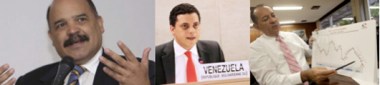
triadThe pragmatists “triad” Merentes, Porras and Tovar.

When you come down to it, about the only positive silver lining in the 100-plus days that Nicolas Maduro has been President of Venezuela has been the apparent (so far) more flexibility of PDVSA, in that Rafael Ramirez seems to be operating independently and trying to be more pragmatic about increasing the country’s oil production.

When Maduro first shuffled the Cabinet he inherited form Hugo, people were disappointed in that, while he named the more pragmatic Nelson Merentes to the Ministry of Finance, he split the Planning and finance Ministry into two, leaving the ever present and influential Jorge Giordani as Minister of Planning. Even worse, a Giordani ally, Edmee Betancourt, was named as President of the Venezuelan Central Bank, making everyone wonder whether the pragmatic side had any leverage to do what it wanted.

And the pragmatic side certainly has had a rough time so far, as there has been little change in economic policy, beyond a decree that should concentrate foreign currency in the Venezuelan Central Bank (but hasn’t) and a kluge of an foreign exchange auction system, named SICAD which has been as effective as aspirin for treating cancer.

But something funny happened today, when in a surprise move, the Venezuelan National Assembly approved Nicolas Maduro’s nomination of Eudomar Tovar to the Presidency of the Venezuelan Central Bank.  (Which had something to do with the fact that Bandes’ President, Temir Porras, last Friday went to the Prosecutors office to ask to investigate the bond trading rip off at Bandes, which the SEC had jailed people for. (Edmee Betancourt happened to be President of Bandes when all of that happened).

But, t start with, Tovar happens to be an economist, that rare avis, seldom seeing in the fourteen years of Chavismo in any position where economic matters are discussed or decided. Indeed, Eudomar happens to be a bona fide economist, who even has done graduate work on financial matters, earning a Masters degree and studying for an additional one. Given that I have a soft heart for qualified people, no matter what their ideology is, I can only applaud this.

But more importantly, Tovar is a Merentes ally and buddy, who accompanied him in the Venezuelan Central Bank and Merentes forced in as President of CADIVI, after Maduro assumed office for Chávez in January.

And to top it all off, another economist (did you really think Chavismo had only three?) Jose Khan, was named as the new President of the foreign exchange office CADIVI.

Thus, in one apparent swoop, the “pragmatists” seemed to have wrestled control from the “ideologues”, including Jorge Giordani and, in my mind , that can only be positive for Venezuela.

Then, the Merentes, Porras and Tovar triad now represents a new powerful force on economic matters and it certainly seems as if Giordani’s influence is diminishing. That can only be good for Venezuela.

Maybe I am completely wrong, but I certainly hope that this means that Merentes will now have more autonomy to establish more rational and economically sound policies, within the bizarro world of Chavismo/Madurismo. Because so far, deciion making has not only been slow, but has been dismal in its execution.

Hope I am right. Watch international reserves in the next few days, if parallel funds move their money there in the next couple of weeks, that would be a great sign and a confirmation that I have some basis for being somewhat positive.


The Gigantic Failure Of The Bolivarian Revolution In Two Graphs

August 11, 2013

People still want to defend the Bolivarian revolution. The poor they say, the Justice they dare mention. Democracy, they claim, simply making me laugh.

But the following two graphs sum up why the Bolivarian revolution is simply the biggest scam in our history. Simply indefensible, I just wish I could quantify corruption in a similar graph, to make it three.

1) The inflation rate in Venezuela, either reported by the Government or the implied inflation rate, defined as that measured by the change in the black market rate, is worse than in war ravaged Syria, and only beaten by that of North Korea, as show in this graph ripped off from the Wall Street Journal.

InflationwsjHat tip: JSB, thanks!

2) The fourteen years of the Bolivarian revolution have made Venezuela a very unsafe place to live, with homicides jumping by a factor of 4, making Venezuela one of the most dangerous countries in the world, whether you believe the 73 murders per 100,000 inhabitants of the official statistics (black line) or the 84 of the Venezuelan Observatory of Violence. Note the poor have a higher incidence of homicides and crime than the middle class. (This graph appeared in last Sunday´s (August 4th.) Expediente in El Universal, but was not included in the digital version. Thanks VS for getting it for me.)

homi

Two simple graphs, a Gigantic Failure…


Supreme Court Rejects Election Challenge, Fines And Orders Capriles Investigated

August 7, 2013

Henrique-Capriles-Radonski

The surprise today was not that the Constitutional Hall of the Venezuelan Supreme Court rejected as inadmissible Henrique Capriles’ challenge to the election results in a one page decision. The surprise was that besides the legal travesty, the Court fined Capriles the maximum amount for insulting authority with the challenge and accusing the Court of being partial to the Government. The Court also asked the Prosecutor to have Capriles investigated for these insults.

Jeez, the ruling was worse and more biased than I could have ever expected and simply proves Capriles’ point. In fact, every ruling along the way, from allowing Maduro to take office for Chávez, to permit him to campaign as President, doing “cadenas” all the time, simply emphasizes the point.

But I guess in this so called Chavista/Madurista democracy, free speech is not allowed and you have to agree with everything the Government says  or does, or you are being disrespectful and can thus be jailed.

Do I smell a jailed Capriles in our future?


Venezuelan Government Fails To Pay Sidetur Bonds

August 6, 2013

For fourteen years, President Hugo Chavez said and boasted that despite everything, his Government had always paid its bonds on time and honored all international debts. And he was right, even after the 2002-2003 strike, when oil production went down and when oil prices dropped, Venezuela continued paying its bond obligations.

This is no longer the case, as of July 20th. Sidetur, a company whose assets were expropriated by the Venezuelan Government last year, failed to make payment for both interest and capital on its 2016 bond, which has a 10% coupon. Remarkably, the amount owed is peanuts in the context of the country’s debt, as the amount owed today is only US$ 73.75 million plus one quarter of interest payments.

The Venezuelan Government expropriated all of Sidetur’s assets, including its offices and bank accounts, as well as absorbing  all of the liabilities of the company, except for the bond. This was all transferred into the Complejo Siderurgico Nacional, in fact, the website under use is nothing more than the old Sidetur website “refurbished” for the Complejo Nacional Siderurgico, but even the documents in pictures, tags on products and the Sidetur “S” in the search function, are derived from the Sidetur website that the Government took over when it forcefully expropriated the Sidetur’s offices, as can be seen below:

Sidetur


While the formal default of the Sidetur bonds took place on July 20th., the reality is that the problem started last January, when the Venezuelan Government failed to make payment into a trust in Deutsche Bank, which is supposed to have two quarterly payments accumulated at all times. Investors sort of assumed that payment would be made before July 20th., as it makes no sense for Venezuela to default on such a small amount of debt, given what is outstanding and that apparently Venezuela and PDVSA plan to issue debt in the future.

What the Government argues is that there is a legal opinion that says that the bonds are the responsibility of the shareholders of Sidetur, or at least that is what was said by the Minister of Industry when the Government first suggested that it had no plans to pay Sidetur’s debt. This is a surprising argument, even if I have not seen the opinion. First of all, shareholders do not issue debt, nor are they responsible for debt issued by the company they own. Second, when company’s fail to pay their debts, bondholders go after the assets, the cash or the cash flow of the company, all of which, in Sidetur’s case, are in the hands of the Venezuelan Government, so that it would be impossible for the shareholders to use them to pay. Third, the Government has not compensated Sidetur’s shareholders for the expropriation. If it had, it would have to take the debt into account and either pay it directly to the bond holders or pay to the the Sidetur shareholders who would the be able to honor the company’s debt. (Technically, the Government expropriated all of Sidetur, but not the company)

But the most surprising thing is that this case is no different than those of Cerro Negro, Petrozuata or Fertinitro, where it was the Government or PDVSA who paid the bondholders, even though it had not compensated the shareholders. Thus, it seems difficult to justify legally in the case of Sidetur that there is any difference.

What is most surprising is the somewhat nonchalant attitude that the Government has assumed on this problem. In the other three cases mentioned above, the Government met with bondholders and a solution was worked out in all cases. In fact, Cerro Negro and Petrozuata never even reached the point of default. However, in the case of Sidetur, there has been no response by the Government to any of the letters of the Steering Committee of the bondholders, nor any answer to their calls.

The only reaction so far by Minister Merentes is that he said that there is a technical opinion that the Government is not responsible for this debt and that he had created a trust to guarantee payment, which in itself seems to be a contradiction.  But to the mostly institutional investors in Sidetur bonds, the creation of this trust is mostly irrelevant, as they have clients who will only benefit if the Government actually made payment, not if it makes some vague promise of guaranteeing what it says can not pay.

Investors believed that Minister Merentes would find a more practical solution, given the fact that he is ideologically less rigid and has always looked for not only practical solutions, but also to protect that same image that Venezuela will honor its debts. The simplest such practical solution would be to either pay the bond in full, as the indenture of the bond says should be done if any part of Sidetur changes hands or is sold, or simply pay the quarterly interest and capital payments until the problem can be resolved in full from a practical and legal point of view. Any amount paid to the bondholders could be later subtracted from the compensation given to Sidetur’s shareholders.

It may be that Merentes and his team feel that the default has had no impact on the country’s debt. But they are wrong. Most of the institutional investors that own Sidetur, have much larger positions in Venezuela and PDVSA bonds and are unlikely to buy any more bonds until the matter is resolved. In fact, if they perceive that the Government will not find a solution with Sidetur, they are likely to become sellers of their current Venezuelan positions. This is the last thing the Government wants if it plans to sell new international debt, more so when the existing long term debt has yield to maturity between 10.5% and 12%. The fewer buyers, the higher the cost will be. In fact, some of these investors have begun granting public interviews to express their frustrations with the situation and this is likely to occur more and more in the future. As Ray Zucaro of SW Management says in that interview, there are lots of doubts about the will to pay of the Venezuelan Government.

The bondholders have so far tried to reach out to the Government to find a solution, but they have received no answers. They have done that in the belief in the promise that Venezuela will honor its debts. But as time goes by without anything happening, the bondholders may decide to resort to legal means to obtain payment. And that process can be extremely noisy and negative for the Government, as Argentina has seen with its default and restructuring, which is still creating problems for that country eleven years later. The size of the problem may be smaller, but the legal means would not be too different, which only would be an unnecessary hassle for the Venezuelan Government and PDVSA.

Whatever the future may bring, one thing is for sure, for the first time since Hugo Chavez took over the Government, there has been a default of the Venezuelan Government’s debt, that in itself is a blemish in the country’s record which can not be erased and will have a cost in the future.

Disclaimer: The author of this post has owned Sidetur’s debt since it was first issued in 2006 and thus has an interest in the resolution of the problem :-).

I guess on the eleventh anniversary of the blog, I can write a post out of sheer self interest.

Everyone In Venezuela Is Into Arbitrage

August 4, 2013


arbiWhen Adam Smith suggested or showed that economic self-interest maximizes economic welfare, I don’t think he had in mind the economic self-interest that is promoted by the arbitrages available under the so called Bolivarian revolution.

These pages have recorded billion dollar arbitrages, some with bonds, others with CADIVI; there was SITME, travel dollars, airline tickets, now Sicad and many more without going into much detail today.

What Chavismo/Madurismo has failed to learn throughout these fourteen years, is that the longer these possibilities of arbitrage become available, the more widespread their exploitation becomes. That is what made SITME eventually so inefficient that it had to be scrapped, what makes CADIVI such a nest of corruption and what is making SICAD unworkable in such a short time. People learn fast and exploit the weaknesses of systems to promote their self interest via arbitrage. Every time the Government announces something, people get ready to see how they an make some money off it.

Whenever I visit Caracas, I talk to people trying to find out more about what their reality is like. I mean, with inflation soaring and noticing how everything has gone up every time I come back, I have to wonder how people, particularly the less well to do, can make ends meet.

This week, it was a parking lot attendant I know. We started talking, he complained about the Government and I started asking questions.

For him, let’s call him Profito, things are ok. They are better, because the parallel dollar is very high. He said he makes a little more than minimum salary in his job, which must mean around Bs. 3,000. He sends his mother in Colombia a US$ 300 a month in a “remesa”, which costs him Bs. 1,890, but he sells half in the black market, which gives him Bs. 4,950, for a net of Bs. 3,060, which doubles his salary just like that.

Things are tough, so he decided to send his son to Colombia, it’s too dangerous here, plus the kid could become a malandro (hoodlum), with the neighbors he has. The advantage is that his expenses went down and he can send the kid another US$ 300, give his mother half and net another Bs. 3,090 in the process.

To round it all off, Profito, has also now entered the export business. When he discovered that “perfumeria” items are so much expensive in Colombia, he started shipping about Bs. 5,000 a month in supplies via MRW (a courier) and he makes “casi” (almost) 100% profit a month from this venture.

Oh yeah, he said, I do go once a year to Colombia and ask for the $2,000 dollars for travel, this year he will get less, there will be no money for the kid, but the black market has increased so much that he will make about the same. (Not quite, he will make more, as the parallel rate has doubled since December, but he will only pay once).

Totaling it all up, Profito makes his Bs. 3,000 from his job and from his arbitrage activities he will make this year an additional Bs. 6,180 a month from “remesas” to the family, about Bs. 5,000 (he claims) from his import/arbitrage and an additional Bs. 2,000 or so from his travel allowance, for a grand total of Bs. 16,180 a month, or at least five times the minimum salary. Not a bad monthly income in Venezuela and he has health care. Except only one of those minimun salaries comes from his job. The rest is all thanks to the promotion of self-interest arbitrage by the distortions of the revolution.

And the Government? Fixing the price of SICAD very low to promote arbitrage even more…


Maduro’s New Gaffe Places Raises Doubts About His Capabilities

August 4, 2013

You have to wonder about Maduro’s intellectual capabilities. He goes from gaffe to gaffe, insulting countries, showing he does not even know Venezuelan states and the like. For a man that was Foreign Minister for six years, you have to wonder how he did not even learn much in that time.

But his latest gaffe really makes you question his intellectual abilities. Maduro after all, lived in Cuba for over a year, then goes on onto this tirade praising Cuba and its supposed independence and sacrifice to be independent, getting all sentimental, grabbing the flag, joining it with the Venezuelan flag in a symbolic gesture, almost tear eyed, except…

The flag is Puerto Rico’s flag, not Cuba’s.

I know they are similar, but the colors are all inverted, Maduro should know, that flag (the Cuban one) is sadly present in too many Venezuelan Government and military facilities.


PDVSA Creates Privatization-Like Program To Increase Oil Production

July 29, 2013


Oil rigs are seen on Lake Maracaibo from the shore in Cabimas

In one of the most intriguing, and positive, news to come out in Venezuela in quite a while, PDVSA presented a project to reactivate more than 1,000 oil wells in the Lake Maracaibo area, by asking for bids form private service companies interested in activating and running this old wells.

While details are not available on the conditions, the private companies will reportedly bid on single wells, which they will reactivate and run. Pdvsa would sell the oil and the money would go into a trust, where the private company would receive a certain percentage per barrel sold, with some incentives based on increased production.

The companies will receive historical and geological data on each well, so that they can present bids for their operation according to what they expect can be produced. Most of these wells were shut down at least ten years ago and have production levels in the hundreds to low thousand bares per day.

The proposed model is not too different from the so called “service contracts” that Hugo Chavez cancelled based on ideological reasons six years ago, claiming this was a privatization of the country’s oil wealth. But times have clearly changed and this, a privatization by any name you may think of, is the new proposal.

Clearly, this shows that PDVSA is worried about declining production and/or prices and has set aside ideology for the sake of increasing future production. The project name is “Oil well connection project by service companies”, clearly a name invented to make it look like it is only about interconnection of wells by pipes. But in reality, companies will have to work on interconnections, pump stations and platforms, as well as running the wells.

We should have more details in the upcoming days, but for now it looks like the most positive news to come out of PDVSA in a long time, with a potential to have a very positive impact on the company’s production in a very short time. In fact, it has similarities with the proposal of a certain candidate on how to jump start PDVSA’s oil production.

This could have been done at anytime in the last ten years, but ideological baggage blocked it from happening.

We welcome the change.


Venezuelan Government Websites Hacked, Government Silent

July 26, 2013

BP56QprCEAA7hyW.jpg_large

Except for a brief report in Tal Cual and an article  in the Miami Herald which has the link broken, there is little in the Venezuelan press about the fact that a group of hackers claims to have hacked a large number of Venezuelan Government websites. as shown above for the webpage of the Venezuelan Army (ejercito.mil.ve), the group managed to take over many webpages.

The webpages hacked include Ministries, State Universities, the Army, the Public Stock Market, the National Guard and many more. So far, the Government has been silent about it, but what we find most curious is the silence of the local press on the matter.

The group doing the hacking is reportedly Anonymous Venezuela and they are demanding Maduro’s resignation.

According to the hacker’s twitter account (@VenezuelanH), the CADIVI website was also hacked, but the page was restored because people got “hysterical”. Last time I checked, some sites are back, but others remain offline at the time of this post.


Nico: ¿Por Que No Te Callas?

July 25, 2013

Pinofidel(Thanks to @ManoloReveron for finding the picture)

At this point, it would be better for Nicolas to just shut up. Stop talking like you know what you are saying, because, sadly, you don’t. Don’t be so silly as to say that Capriles met with Pinochet’s private secretary, because it was not a one on one meeting and, after all, even your dear idol Fidel met not with the Secretary, but with the fascist Dictator himself, in what was a fascist to fascist, Dictator to Dictator meeting. After all, the two really have a lot in common, no? Maybe you can ask Fidel why he met with Pinochet before accusing those that went to Chile as traitors. Pity, you can ask him, but he will likely not be able to talk back to you.

And you really think that the US is going to stop meeting with distinguished Venezuelans like Pedro Mario Burelli just to have relations with a questionable Government like yours? Burelli got to where he is on his own and if you are going to try to insult him, you better find a word that exists, because I checked in the RAE and its other sources and personajillo simply does not exist, carajillo. And I am sure Mr. Burelli would be much better accomplished than you in any position, from bus driver, to Foreign Minister to President. After all, you are what you are because you rode on Chavez’ back, always agreeing to anything he told you to do.

And you are not doing a great job either Nico. Face it! The wagons have circled around you and you are trying to fight them off by being more radical than the radicals, but it just does not fit your image or personality. You are no tough guy. And anytime you want to be tough, you screw up relations with another country, be it Spain, Colombia or the USA. Then you have to  spend your time trying to make up. What is clear is that you learned nothing in the only job you ever had for a reasonable period of time, your six years as Foreign Minister.

And please look up oligarchy in the dictionary, maybe it will help you realize that Chavismo represents the new oligarchy.

And you really have to spend your time on more productive things Nico. You have lots, lots of problems. Whoever told you Sicad will fix the foreign exchange problems has no clue. And Sicad started as screwed up and corrupt as your Government. If not, ask Merentes how this ¨multicriteria¨pseudo-criteria was implemented or why no legitimate medical equipment company got one dollar. And stop saying inflation is going to go down and there will be growth the second half of the year. Even if your foreign experts (French or American)  tell you otherwise , scarcity has yet to budge, and as long as it is near 20%, inflation in May was no mirage and will stay around that level. And if you don’t grant price increases, watch those numbers go even higher.

So Nico, you just better shut up, like King Juan Carlos famously told your boss. Stop improvising, you are not good at it. If something bothers you, count to one hundred, hold your breath, before saying anything. Then call Cuba, even your old boss used to do that and he was better at improvising. Understand you have a short fuse and you are illegitimate. Temper tantrums not work well for Presidents. And if you are going to get mad every time someone meets with someone you don’t like, just keep it to yourself and use it when its needed. Paranoia is not the best of traits. Ask Diosdado, he has been meeting with lots of your friends and knows who you meet with, but he says little.

And please stop using the word respect. This is something you earn, not a given. So, get to work, defuse the demons around you first, really attack corruption and maybe, just maybe, you will start earning some respect.

But I doubt it.


Tales From The Upside Down Country: Venezuela Doubles Interest Payments To Petrocaribe

July 24, 2013

venezuela

Bloomberg is reporting that Venezuela advised all countries which are members of Petrocaribe on May 16th, that it would double interest payments on the oil loans that are provided to the members of the group.

Yes, doubling it!

From 1% to 2%!

For those that don’t know it, Venezuela sends oil to Petrocaribe nations, to the tune of 212,000 barrels a day, for which the countries have to pay 40% in cash or stuff (which has included pants, for example) and the remainder gets paid at a 1% interest rate for the next 25 years. Effectively, Venezuela loses on this simply because of the fact that international inflation is higher than that.

But wait! Venezuela issues debt paying double digit interest rates too! So that, while we pay through the nose, Petrocaribe nations, which include some well-off Caribbean islands with GDP per capital much higher than Venezuela’s, receive a huge subsidy so that their citizens can go to the beach or simply become beach bums. For example, if Venezuela were to issue a 20 year bond today, it would have to pay around 12% in interest for international investors to be interested.

Now, 212,000 barrels of oil per day is US$ 7.738 billion per year at US$ 100 per barrel. Of this, 40% is supposedly paid (See it to believe it!), leaving new debt of US$ 4.6 billion a year to be paid in 25 years. Thus, the increase means that Venezuela will receive barely US$ 46 million per year from this increase from 1% to 2% on the oil sold in 2013. Not enough to pay two Maduro trips abroad, but even worse, Venezuela will likely issue about U$ 4 billion in bonds this year, or borrow US$ 5 billion more from the Chinese.

Get the picture of the upside down world we are in this country? We borrow at 12% and lend at 2% to other countries, many of which are better off than Venezuela.

The ironic (or amazing) thing, is that Guatemala is considering leaving Petrocaribe due to the increase in interest by Venezuela, as Venezuela has apparently indicated that it may increase rates as high as 4%.

Yeap, I would be offended too. This is no way to buy your friends. I mean, to treat your friends. Sorry!