Venezuelan Housing Minister Breaks The Law, Man Who Taped Him Detained

July 23, 2013

This video of Minister of Housing Ricardo Molina has been going around a while, showing the type of fascist hordes the Government is breeding, as the Minister is hailed by the people for saying he does not give a damn about what Labor Laws say, he will not accept anyone that supports the opposition (he also shows he does not understand what the word belligerence means)

But what is interesting is not the video, is the fact that Fernando Bello, a worker at the Minister for Housing, who taped the video, has been detained tonight for taping it. He is reportedly being charged with “informatic crimes”, as the CIPCC has been investigating him and determined that he made the video, which he readily admits.

Thus, Mr. Bello is detained for taping a Minister saying that he does not care about the law, or people’s rights, but the Minister is the hero and he is the criminal.This is the upside down revolution in Venezuela.

How I wish Snowden had come to Venezuela! That way international reporters would all see this stuff. Will they notice now?

Well, at least now everyone will see the infamous video

Note added: Guy was released today (day after), which does not change the story very much, he was held overnight, the Minister slept at home.


When You Thought You Had Seen Enough Corruption And Distortions In Venezuela

July 21, 2013

20130123-091727

While Chavismo/Madurismo continues to solidly embrace controls, creating ever more complicated systems, rules and regulations, there is daily evidence that the whole thing has become a Rubesque-like system whereby the system has become absolutely ineffective due to corruption and arbitrage. Despite the daily evidence, the revolution (?) presses forward with its brainless creation of economic rules and foreign exchange systems, where common sense and logic are completely absent.

Two items caught my attention in the last two days that absolutely make you wonder if these guys even try to use their brains when designing the whole thing:

1) The Head of the Venezuelan Association of Airlines said yesterday (today’s El Nacional, page 6) that during the last three months, occupancy in international flights has not exceeded 40%, despite the fact that flights are completely sold out and all tickets have been booked.

Do you know what this means?

Easy, with the large arbitrage between the official rate (Bs. 6.3 per US$) and the black rate (about four times more) the times of Oligarco Burguesito are back! The only way that occupancy in flights can be that low, is that organized Mafias are gathering cedulas, buying tickets and obtaining Cadivi dollars for travel. Say you buy a ticket to go to Spain with Iberia. I just checked, and on October 1st, I could go for Bs. 14,857 round trip. If you buy the ticket, get US$ 3000 for the trip in your credit card and 400 euros in cash, that is about US$ 3,520, which at the black rate is something like 116,000 bolivars, subtract the Bs. 14,857 and without bothering to travel you have made a tidy profit of around Bs. 100,000. Why bother to even travel and use the airline ticket?That cost money after all. Give the credit card to someone and have them use it to get cash or whatever.

Or organize twenty or thirty people like that and you yourself could go and take care of it, paying everyone one of them a fee for the use of their cedula in your endeavours.

And clearly someone is doing that right now, in massive numbers, if 60% of the seats flew empty before the summer season began.

2) You would think that scams and “guisos” would take a while to develop under the new Sicad rules. Well, corruption is so entrenched, that in the first Sicad auction corruption was already present in full force. Indeed, 127 companies of the health sector were assigned foreign currency. This health sector was defined as “only medical equipment and parts”. If these 127 companies were assigned the “average” amount of 166,000 dollars per request, we are talking about US$ 21 million for all of them.

The problem is that the Venezuelan Association of Distributors of Medical, Odontological, Laboratory and Similar Equipment, reported that of its 137 members not one was approved a single dollar (El Nacional yesterday).

Yes, not ONE, of the ONLY association that groups distributors of medical equipment and the like.

So, the mafias were in place even before the auction took place and they were generously rewarded. Except they went overboard and somebody noticed. The Government said it will “investigate”, “hold off” giving out the dollars and the like, but pardon me for being skeptical, if the Mafias are so entrenched, I am sure the same people that decided to award the dollars to what are mostly phantom companies, will carry out the investigation and nothing will happen.

So, all that complicated system, “checks” and “balances” and in the end, the dollars went to the wrong hands.

I guess in Chavista/Madurista la-la land, it is time to create even more controls…


Venezuela Is Going Well…

July 17, 2013

58177merentes

After announcing the results of the first “modified” Sicad auction, where the Government sold some US$ 180 million dollars at an exchange rate probably close to three two times the official rate and around half one third of the unmentionable black rate, Minister of Finance Nelosn Merentes announced two more upcoming auctions and said:

The country is going well.

Yeap. As the Government formalized another devaluation, introducing a “second” official exchange rate (or third for that matter, the rate is secret), the Minister said things are going well, as inflation has soared and shortages are still out there. Even more boldly, the man who has so often predicted single digit inflation and economic growth and who has no clue as to what an econometric model is, said confidently that inflation will go down in the second half of the year and growth will be stronger. He even challenged those that do know economics, to wait until the year is over to see who is right.

Unfortunately, Dr (in Math). Merentes does not even appear to understand that growth in the next two quarters will not be compared to the last quarter, but that economists have this quirk, that it is measured with respect to the same quarter a year ago. Given that the economy has likely shrank for the first six months of the year, it will have to make up the loss and then show a gain for the third and fourth quarters to show growth, something that looks difficult right now. Additionally, given that the growth last year was driven by Government spending and that spending is down by double digits so far in 2013, it seems unlikely that growth will be positive for all of 2013.

But the real trouble is inflation. As recently as October Merentes was “questioning” predictions of 28% in 2013 and inflation is up 25% in the first six months of 2013 alone. In fact, a month after saying that, he said it was “feasible” to achieve 14-16% inflation in 2013. Jeez, Nelson, you will be off by 100% at least in that econometric prediction.At least as a Mathematician, you should be able to understand how bad that is.

But the real problem is that the Government has built in continued inflation into the system with its policies. By holding back price increases, there is a guarantee that there will be shortages and later more inflation as goods get scarce. In fact, inflation for controlled goods was 21% in the first six months of the year, another sign the whole system does not work. Reportedly, Vice-President Arreaza has presented Maduro with a list of 10 items whose prices need to be increased, which will do little to slow down inflation.

Neither will the fact that what used to be imported at the SITME rate of Bs. 5.3, will now be purchased at Bs. 16 or so. Yes, some of that stuff was being bought at the black rate, but the truth is that much of that stuff, like auto parts, was simply not being imported, as importers were not willing to buy parts at the black rate with the scant dollars they could find in that market.

Meanwhile, the black rate is likely to slow down for a while, until people realize that they will get little from Sicad. Individuals only got half of what they asked for in today’s Sicad auction and despite estimates that there were requests for US$ 800 million, the Government mysteriously sold US$ 20 million less than expected in the auction.

But Merentes was not alone this week in making statements that make you wonder if these people are brain dead or what. Maduro said, even before the auction, that the new Sicad auction “had generated great positive expectations”. Somehow it seems par for the course that this Government accomplishes so little that it boasts about expectations that simply can’t and will not be satisfied.

And Central Bank Director Armando Leon, he of the Bolivar Fuerte creation, dared say that inflation in the second half will be significantly lower and that this new auction does not imply a devaluation. Sure Armando, and the Bolivar Fuerte is your most important creation.

And then, of course, is the price-Nazi, Eduardo Saman, who not only said that the institution he runs is “a repressive institution of the State”, which reveals a very definite state of mind and attitude towards the citizens of Venezuela, which seems to have permeated the Government. Most institutions of the Government are run as repressive institutions, with little regard and concern for the people.

But Saman’s crowning glory was to suggest that if a company is losing money because of price controls, it should just go borrow money from a bank, which will help “capitalize” the company. Mr. Saman clearly has no understanding of how a productive system or the economy works, he seems to believe loans are free, banks are charitable institutions and has no understanding about how a loan really works or what it is.

And so it goes… Venezuelan is going well in the mind of the guy in charge of the Minsitry of Finance. Maybe he should go and ask the opinion of his friend at Merril Lynch who is talking about a deep reecession. Speaking of ML: Whatever happened to Merentes’ visit to New York in the first half of July?

I guess since things are going so well, he no longer needs it…


Maduro’s Possible Hugo Moment Fading Fast

July 16, 2013

toilet

I am glad I was away when the whole Snowden affair blew up, as I think it is mostly irrelevant to the problems of Venezuela. My take on the reaction of the Venezuelan Government is simple: Maduro finally found something that could become his only Hugo moment since being elected, by giving Snowden asylum and doing his own in your face insult to the US. But the moment may not come to pass and Maduro’s offer will likely be forgotten as the possibility of Snowden coming to Venezuela seems to be fading fast. I think Nico did not think well of the consequences. No, not geopolitical consequences, but how damaging for him Snowden could become if he came to Venezuela.

But in the end, it points to Maduro’s rambling policies, where he acts tough one day, light the next, clearly under pressure from all sides. He visits only accepted countries, ignoring Hugo’s circle of terror friends since he became President. He names pragmatists to Finance, but leaves the dinosaur in Planning. He removes Chavez’ brother from Corpoelec, but brings him back shortly elsewhere. He brings back ultra radical Saman,the creator of the socialist areperas, but more importantly an absolute ignoramus on economic matters. He sends Jaua to have his Disneyland photo moment with John Kerry, only to destroy the picture by offering asylum to Snowden. The asylum may never happen, but any improvement in US-Venezuela relations got thrown overboard.  Maduro has been anything but consistent in his brief 90 days as President, but he did need his “smell like sulfur” Hugo moment and Snowden could have been it.

Except that if Snowden ever came to Venezuela, it would end up biting Maduro back for sure. To begin with, the international press would descend in Venezuela and dozens of articles about how the Venezuelan Government spies on its citizens would appear in the international press. Even a deaf and blind reporter from The Militant would learn about these cases and spread the word, making people wonder why the hell Snowden chose Venezuela for.

But in the end, it would be Snowden who would become the problem for the Government. The same international press would descend on him and ask him about his opinions about Venezuela. Snowden would hold press conferences and be on live international TV from Caracas and eventually the Venezuelan Government will simply say Nyet to all his political activities in favor of human rights, the lowest of rights on the Chavista totem pole of values. I am sure the shallow Mr. Snowden, shallow because the countries he chose are anything but icons of good behavior in spying and repressing their citizens, would not like to be silenced and the problems would begin. For Snowden, and for the current Venezuelan Government.

But other problems would surface even earlier, such as the fact that Mr. Snowden’s life in Venezuela is likely to be anything but the golden asylum he may be imagining. From not speaking the language, to crime, to shortages, Snowden is unlikely to find a place or a society where he would fit in, even if the Venezuelan Government were to offer to pay him to hack his way around the world. He would likely tire of living in Venezuela, which would force him to look for an alternative. But once here, no other country is likely to want to touch Snowden with a ten foot pole, so he would have to either stay put or go back to the States. And once in the States, he could talk freely about the wonderful world of Venezuelan human rights violations.

Thus, Maduro’s Hugo moment was not well thought out and now looks unlikely to happen. Meanwhile important matters continue unresolved, as his enemies from within carefully wait for the right moment to act.

And Snowden is still in Russia and seems further and further away from ever eating an arepa..


Let The Sicad Foreign Exchange Games Begin In Venezuela!

July 14, 2013

Rusicad

As you may have guessed, I have been away, biking in a very nice area of the world, which together with sightseeing and resting from the exercise, gave me little time to post. Which does not mean that I did not follow the news, despite spotty internet coverage in many places. And I am very happy that I avoided the Snowden drama, which I will post about at some point, but consider it to be mostly a distraction.  What I found more interesting, was that after only three months, the incompetent Venezuelan Government finally will start selling dollars into a new, and they claim, improved, SICAD system. It took only three months to create rules, limitations, allocations, quotas and the like, attempting to include almost everyone. I have been somewhat surprised at the positive reaction to this new system by many analysts, suggesting is a step forward and that the unmentionable rate will somehow go down.

But I am not impressed.

To begin with, the Government will sell US$ 200 million every two weeks in this new revitalized SICAD system. This comes out to about US$ 20 million per day, well below the US$ 40 million that used to be regularly sold per day in the old SITME system. The difference is that now there are some quotas and individuals will be allowed to participate (and more Bolivars in the system). Sitme was good about oiling the system in providing dollars to importers and in emergencies, but I really don’t think it eased the pressure in the black market very much.

As if this were not enough, there will be more participants. And I think this is the weak point of the system. With the control the Government will exert on the rate at which dollars are sold, the arbitrage between the SICAD rate and the black rate will be large and more and more individuals will register to participate and that number, much like what happened in the Bolivar/dollar bond system, will balloon in time as individuals try to take advantage of the system. If a family of four, for example, plans to travel, having each member participate creates a subsidy for the trip that can even be partially funded selling dollars in the other market.

The rules reportedly will be different for each auction, which simply creates too much guesswork for importers who really need the foreign currency to function. In the first auction Margarita and Paraguana will receive a quota, if this is not permanent, it may not do the job desired. But more importantly, companies have lots of pent up demand and now that a mechanism in which they can get what they need is available, they will all go to Sicad to complement their needs. Massively. Access to Sitme had more rules than the new Sicad does, so the demand side will be stronger.

The good news is that exporters will be able to sell their foreign currency in Sicad, which is definitely a very positive development. But one needs to be careful in estimating how much this will bring to Sicad, as exporters can keep part of their dollars, so that not all of their foreign currency will flow back. What is positive is that it increases the competitiveness of these exporters, a sector that has been affected severely by exchange controls and the overvaluation of the currency.

I think the unmentionable rate may slow down its increase with the expectations of the first of auction, but I really don’t think it will have a significant impact in bringing it down. The new Venezuelan foreign exchange market, under Sicad, will not be a true market. There are billions of Bolivars that will be chasing for those few dollars. With monetary liquidity about Bs. 851 billion, at Bs. 20, for example, there are US$ 42 billion in the system. Pent up demand is large, as for over six months, the only game in town has been Cadivi and to a lesser extent that other market. Thus, you have lots of demand with little supply comparatively speaking. The only way that other rate would go down, would be if the Government did not impose any limit on the price of the Sicad dollars, but as long as this is under control, it just will not happen.

So, a new era in foreign exchange games begins in Venezuela this week. The Government is likely to increase rules as it goes along (there are rules even at what times you may access the system depending on your cedula or tax number), they simply like to do this too much. And the players will all be ready to adapt, change course and develop strategies in order to get their foreign currency. We have seen this movie too many times in the last few years. Moreover, all of this will be done with no transparency, as to who gets the dollars and at what price, allowing once again for favoritism and graft.

As usual, some will make a lot of money, others will be frustrated and then the Government will reintroduce a new and improved Sicad again, as the problems are noted. They are just too predictable.


Venezuelans Are Trapped In Their Own Inconsistencies

July 2, 2013

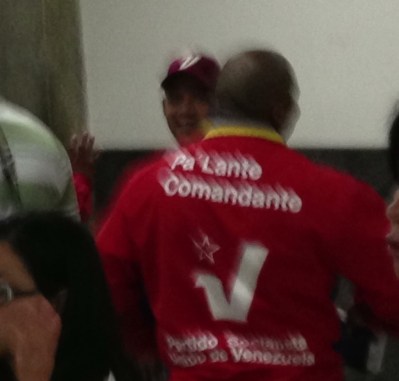
palante

As I was leaving Venezuela last week, this guy in the picture above in his Pa’lante Comandante and PSUV jacket, created quite a stir, as the immigration line was about 40 minutes long, but the jacket gave this new oligarch the privilege of bypassing everyone and be thru the whole process in about two minutes. Some people silently bitched about the whole thing, others were vocal, yet others were quite loud about it. Using Capriles’ phrase, they called him “enchufado”, plugged into the system to get his privileges.

But then, I had to open my mouth. There was a group of young guys, excitedly going to Miami for the first time in their lives. They were quite pissed at the Pa’lante gordo and I talked to them about it as I took the picture. But then, I created another stir, by reminding these young guys, that they are as privileged as the Pa’lante guy, even if to a lesser degree. (They get the ticket, but not the special line)

These guys took offense at this, so I explained: “You guys pay a cheap ticket, get a couple of thousand dollars at the official rate so that you can go out and party for a week or so, that seems quite a privilege in Venezuela, if those that can not afford it could see this line and understand, they would be as mad at you, as you are at the Pa’lante guy”

Well, I did not make much headway, to them traveling at Bs. 6.3 and their CADIVI dollars is essentially a right by now, the same way the poor think that they should be given a home by the Government and free food and appliances when election time comes up.

In fact, it seems as if Venezuelans are all trapped in their own inconsistencies.

The opposition does not dare say what they think, because they know they would not get elected if they did. But neither do Chavistas. Most of them understand how screwed up the revolution is, but they can’t say anything , for they risk their own future. It is hard to explain to opposition people that yes, the opposition is censored, but Chavismo/Madurismo is censored even more. Some in the opposition are not allowed to say what they want, but if you are Chavista and you say what you want, you are banned, recused, accused of treason and the like. So, all Chavistas stay silent, it is the Arepa muzzle at work. (Bozal de arepa)

And privileges are everywhere.

Nobody believes the gasoline subsidy can be removed. (I do!). But how can the price of gas have an impact on anything, when a bus costs 500,000 Bolivars and if you fill the tank up daily, you spend Bs. 10 per tank? That is one third or one quarter of an arepa per day. Make it five times more expensive and the owner of the bus would spend 15,000 Bolivars per year. That’s 3% of the cost of the bus. Are you kidding me? Raise it by a factor of twenty!

But everywhere you turn, there are privileges. I was talking to a Colombian that wants to leave the country, but he sends his parents $300 per month via Cadivi and another $600 to his kids. That is all of Bs. 5,400 he spends, but the family keeps only $300 and returns $600, that he readily exchanges for a net of (18,000-5,400)=13,600 Bolivars, more than he can make in a moth working in Venezuela or Colombia! This guy is really trapped!

And the whole education discussion in CCSC reveals the same. Why should CADIVI give anyone money to study undergraduate abroad? (Don’t get mad bro!) It’s absurd. And graduate work is even more absurd. That is a sure guarantee that the person will never return.

As for the University conflict. Yes, it is very valid, but so are a few dozen conflicts around the country. I mean, why would a Guayana worker complain if he gets his salary without working? He is also trapped. Or maybe he has more than one job, since he does not have to go to the other one to get paid.

Everywhere we look is the same. And if the Government, any Government, tried to rationalize anything, from gas to electricity prices, to Cadivi, to make pensions available only when you are 65, let alone make people work, that Government would have to face the consequences.

Venezuelans are trapped and I don’t see anyone “poniendole el cascabel al gato” however you may say that in English (Putting the bell on the cat???)


Government Imports Soar In Venezuela

June 24, 2013

Imports

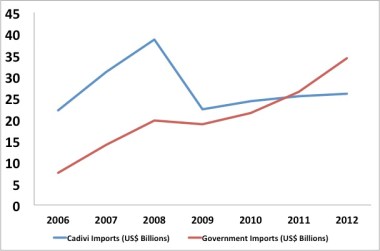
Seeing the data above really opened my eyes at the problems with the allocation of foreign currency in Venezuela. The Government has gone from importing US$ 7.5 billion in 2006, to importing US$ 34 billion last year. Not only that, but Government imports, which used to be 25% of all imports have not only surpassed private imports, but have now become 57% of all imports.

Think about it, if you are a manufacturer or merchant you have to go through a few dozen steps before CADIVI authorizes your imports. But if you are a Government official who wants to import some widgets, you not only get the dollars right away, but you don’t go through CADIVI, you buy from whomever you want and you probably only need one or two signatures to buy the stuff. Imagine the chain of suppliers between that Government official and the stuff that is being imported. Imagine the commissions, overcharges, fake imports (Giordani dixit!), empty boxes (idem!) and the like. Imagine how little planning goes into deciding how much to import or what to import. Obviously, it is hard to buy something locally, as local suppliers in the private sector have to go through the CADIVI nightmare.

But the most important thing is the inefficiency of the Government importing all this stuff. That is why in a country with little supply of new cars, because CADIVI does not allow the import of all the parts needed, the Government goes and imports 2,000 Toyotas at once for its own use. That is why food is found rotten in warehouses, some guy with no clue as to how much wheat or corn the country needs or consumes, decides to buy twice as much as needed and it needs to be stored somewhere or is just abandoned at the port for months.

Meanwhile the blue line of private imports is almost flat, the private sector is importing almost the same today as it was in 2008, but the average yearly price of the Venezuelan oil basket has increased significantly (From an average in the sixties to around 100 today). Thus, a voracious Government imposes controls, but nobody controls the Government and what it imports, why or at what price.

The result is more distortions. But instead of imposing controls on Government imports, the Government disappears SITME, which tripled and quadrupled prices of anything not in CADIVI’s list. And these guys think inflation will go down. Sure.

Meanwhile there is no mystery, there are plenty of dollars around, but the sinkhole of Government imports takes too much of the country’s foreign currency. And Maduro blames the oligarchs. And he is right, by definition, Chavismo/Madurismo is the new oligarchy and they are bleeding the country dry and destroying it.


As People Look For Pragmatism In Currency, Venezuelan Government Ready For More Controls

June 19, 2013

billete500

Things are going well, Maduro is in Paris eating and drinking better than in Caracas. The National Assembly will investigate how Chavez’ cancer was inoculated, but refuses to discuss how the terms of the Comptroller, some CNE Directors and some Supreme Court Justices have ended and they should be replaced (Most of the elected when the opposition had no representation in the National Assembly), while that exchange rate hits all time highs, even if its increase has been stopped by rumors the Government will do something to “open” the foreign exchange system.

But it is harder to find a dollar in Caracas that a roll of toilet paper.

People really understand little about how ideology is the main driving factor behind the now Maduro revolution. The papers are full of speculation about how the swap market will come back, the necessary laws changed and we will live happily ever after.

No such luck, as we have been predicting for weeks…

Yes, the Illicit Foreign Exchange Bill will be changed, but that’s about it. It will be changed so that the absolute ban on foreign currency trading without the Central Bank in the middle is removed and participants can buy/sell foreign currency in a market tightly controlled and regulated by the Venezuelan Government.

Yes, according to Central Bank Director Armando León, the “father” of the Bolívar fuerte, what the Government has in store for us, is simply a “new and improved” SICAD foreign exchange system, the same one that so horrendously failed in March.

According to Leon:

“The final alternative system to the official Cadivi system will be expanded and will be made to be as efficient as possible”

In fact, I can´t find a link to all that León said, but here is a summary:

-Venezuela is working to resume Sicad dollar auctions at the beginning of second half of year.
– The Government is working to allow private and public companies and banks to sell dollars on the Sicad system
addition to cash.
-The Government is focused in May and June on delivering more dollars to small and medium companies that are key to resolve shortages
-The Sicad in its debut was very complicated. A review of the system has been completed so that it includes small and
medium companies and individuals
-The Government will also make the official Cadivi exchange system more effective.
Thus, while people are looking for some sort of more pragmatic policy, what the Government is thinking about is about making more “efficient” a system that the same people planned and designed in March but failed miserably, but this time around, “trust us” it will be dynamic, pragmatic, efficient and will solve of the problems with shortages, drive the swap dollar down and make people happy.

Yeah, sure! And the Bolívar fuerte was going to stop inflation. Didn’t you suggest that Armando?

So, what we will see is a an expanded SICAD, with all sorts of rules and regulations. Remember SITME? The same people that created and designed SITME are in charge of this SICAD with Fluoride. These are the same people who blame the failure of SITME on the banks, the oligarchs and the capitalists.

Which is why the new system will also fail. First, they will make up a lot of rules. The ones for the first SICAD auction were doomed from the beginning. The ones for SITME were the ones that created the system that amde a lot of people a lor of money. They will improve on that and create many more. They love that, that is what they are experts on, control, rules, distortions and the like.

But, they have not said the most important thing: Who will sell dollars into the newfangled and improved system?

That, my friends, is the only important question. And as long as the system is rigged and controlled and the priced fixed, only the Government will. And that solves absolutely nothing.

As simple as that.


Venezuela: One Upgrade, One Downgrade And One Improved Outlook

June 18, 2013

While President Maduro has done nothing on the most pressing problems of the economy, in the last two weeks, the country received an upgrade in its status with the US, a downgrade from Standard and Poor’s and the Catholic Church seemed to give its blessing to Maduro and the country when Pope Francis met with the Venezuelan President., essentially seeing an improved outlook in relations with the country.

While Maduro is probably happy about the total, unfortunately for the average Venezuelan the only one of these that will affect his or her pocket is the downgrade from B+ to B by Standard and Poor’s. Yesterday morning, before the downgrade, Venezuela’s bonds were trading about at a 1% lower yield than today, which means that any new debt that is sure to come will cost around US$ 10 million more per year for each billion dollars issued.

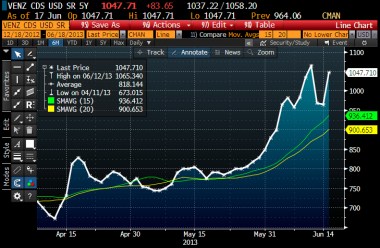
In fact, so far Maduro being elected has been quite costly for the country, as shown by the graph below:

cds-1

In the graph I show the value of the 5 year CDS, or the cost to insure against the country’s debt default, which is a measure of the so called “country risk” or “country premium”. As you can see, Maduro has been costly to the country since he came to power. Just by being elected the CDS jumped from about 673 basis points (6.73%) to about 830 bps (8.3%). Then, after the electoral noise went away, it was calm for a while, but then markets got impatient (and so did S&P) and started punishing Venezuelan bonds. A few days ago it got as high as 1065 (10.65%) basis points (which was also influenced by world jitters). Then it seemed to calm down dropping to 960 basis point, only to jump yesterday on the downgrade by S&P.

From the graph, it is hard to precisely separate world jitters from Maduro, but if we say the first jump was all Maduro and the recent downgrade was all Maduro, you have at least 250 basis point or about 2.5%due to him since assuming office, or roughly US$ 25 million more in interest payments per year for each billion dollar of bonds issued. In a US$ 3 billion issue, the likely amount of what this Government want to start its issuing would then cost (us Venezuelans) for ten years US$ 250 million.

But Maduro is probably relishing on the fact that the Pope met him, Kerry met Jaua and the FAO gave him the most stupid award possible given the current shortages and the level of inflation.

And when Maduro is gone, Venezuelans will be paying for his ignorance. Meanwhile Maduro is “celebrating” his tenth week as President without a single important economic measure being announced.

Which is precisely why S&P downgraded the country’s debt. Oh yeah! S&P did say that if economic policy became more “pragmatic” the outlook, which is negative, could improve.

Don’t hold your breath…


Nicolas, Really, What’s Up With The Hats?

June 16, 2013

Maduro1

Maduro2

Maduro3

Maduro5

Maduro6

Maduro8

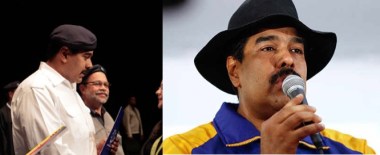
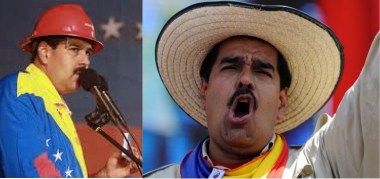
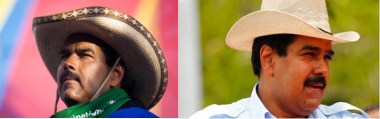
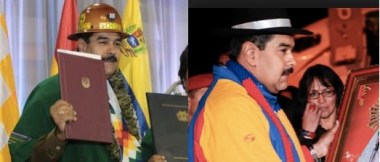
In his efforts to imitate Hugo, Nicolas Maduro can’t seem to resist putting on a hat. For someone whose head was always bare, it looks silly and most of the time he looks too contrived and unnatural. But he continues doing it.

Nicolas, you are no Hugo!