Archive for October, 2005

October 13, 2005

I don’t know Anamar Gonzalez. I just saw the following letter in
today’s Tal Cual and knew I had to ask her for her permission to
translate it and post it. It is written with humor and intelligence and
it reflects the incompetence of this Government. If it was difficult to
get a passport before, now it seems as if a virtual barrier has been
placed on the process. Oh yes, corruption reportedly has been
eliminated, but so has the possibility, briefly available to those that
opposed the Government in the recall referendum, of obtaining this
travel document.

Misión Passport
by
Anamar González

Starting eight days ago, my life has been turned upside down and all
because of my
stubbornness
in requesting a passport through the new service of the Onidex. I-who would
wake up after six hours of refreshing sleep, would have breakfast, would go to
the gym and would start my work day- now wakes up at unusual hours of dawn and
come and sit in front of the computer, trying to catch that magic moment in
which the server will allow me to be one of the 6,000 elected for that day to
request the blasted document. I now drink one coffee after another, the bailoterapia
classes are now history, my clients demand their translations and –to add
insult to injury- I am about to suffer from tunnel carp syndrome due to the repetitive
task of pressing the left button on the mouse.

At last I
got in! I empty my data to “compose the Request Form” and I click on the “Save”
tab.

I forget
my religious skepticism and I entrust myself to Saint Christopher (The patron saint
of travelers), to Jizo-san (a Japanese deity that accompanies those that begin
long journeys) and to Ulysses (the mythical Greek hero of the Odyssey). The
dreaded message of error appears once again. Time continues to go by and a huge
ominous threat closes over my necessary visit to Spain, No, it is not a leisure
trip.


I am going to a Workshop about literary translation in
Tarazona and to look for new professional and work horizons. No, I am not
pretending to return to the land of my grandfather. I want to offer my services
as a translator to a number of Spanish publishing houses and continue working
from here, my country. No, I do not know discouragement, nor I give up. I do
not wish anyone to provide me with the name of the patron saint of lost causes.


I keep trying it and I remember four Government clerks comfortably laying in
their chairs, as well as the tour girls, uniformed with brown vests and red
berets, fighting the anti corruption battle, in the recently inaugurated office
of Onidex in Maracay, and I ask: Why in an office as modern and full of workers,
by all indications idle, can’t they process, let’ not say 6,000 daily requests,
but all of those that are presented? Meanwhile, in a box on the left side of
the screen, I see the image of the President and some words that I assume are
his: “The strength of a Nation resides in its identity”. I swear, I never have
felt so weak in my life!

Sophronities Coccinea

October 12, 2005

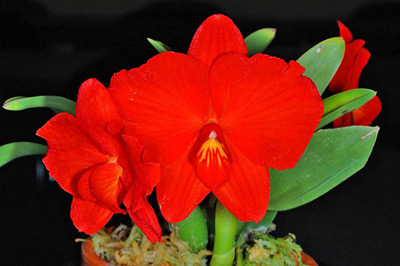
It was indeed premature to take the picture. Here it is fully opened
in all its splendor and beauty. Sophronitis Coccinea var. Aurea!

The not so Supreme Court

October 11, 2005

A couple of days ago I reported how the National Assembly was
considering expropriating the Coca Cola plant because supposedly
Panamco had not paid fired workers what they were due. Today I learn
that the Court’s have actually resolved the issue. In fact, according to today’s Universal it was the Supreme Court, which in 2004 ruled that the workers’ demands were not warranted.

Then yesterday I reported
how a person democratically elected to the city council of the
municipality of Sucre in Caracas, was never reinstated to his elected
position despite the Supreme Court saying that he could not be removed.

Well, today I read
that the Supreme Court ruled that the Santa Rita farm had been taken
over illegally by the Government and had to be returned to its rightful
owners. But this does not seem to help them, as the Head of the Land
Institute (INTI) said on Saturday that the Court’s decision was simply
a technicality and that the people who had taken over the land were
doing productive activities and would be protected by INTI. He also
said that he did not discard that the cooperative working the land
would leave one day and return the next with new papers gving them th
rights over it. Well, it seems like they are going to have to remove
the word Supreme from the Court as nobody in this Government seems to
take it seriously or have any idea that Supreme means the highest
ranking authority in the land.

So much for the rule of law in the not so pretty revolution!

Who is on first?

October 11, 2005

Last week
the Electoral Board’s (CNE) President Jorge Rodriguez gave a press conference
in which he came very close to accusing the opposition for the killing of the
CNE representative in Amazonas state. This man was taken from his Hotel at
gunpoint, driven in a car and then knifed to death. The whole thing was a
little bit too much, Rodriguez was calling for the military to begin the
operation that protects the electoral process, as this is the second CNE
representative killed this year. While Rodriguez was making the accusations,
saying that attacks of the Electoral power had to stop, the investigative
police (CICPC) was saying that this appeared to be a robbery by common
criminals. I decided not to write about it, thinking that Rodriguez was simply
shocked at the news.


Well this morning the
Prosecutor makes statements
saying that this is indeed a robbery and not a
political crime and he can “responsibly say that up to this point the
investigations do not suggest such a motive but it is a common crime”. But
then he says that the investigative police have been removed from the
investigation because “some officers may have participated in the crime”.
I said: Waaaaaait. This was a “common” crime committed by officers of
the investigative police? Is this a common crime?

Just a couple of hours later, the Minister of the Interior and Justice who
happens to be the boss of the investigative police comes
out and says
that it has been ruled out that it is a crime of passion and
it is either a political crime or it was done for economic reasons. He then
rambles about how the dead CNE officer imposed supervision which eliminated
“corruption” in electoral activities in that state and that once
“profits” disappeared from electoral activities, some groups tried to
“displace” him to “regain” control. He even says that they
tried to simulate a robbery to hide the true objective.

Hold it! Can someone explain to me how you make money within the electoral
process? This is not political? How is this a common crime? Why does the
Prosecutor, who is the one that is supposed to substantiate crimes, say it is a
common crime, while the Minister of Interior and Justice says the opposite just
hours later? What is going on within the Government? Why the charges and countercharges?
Is this public infighting?

It just
reminds of the Marx brothers movie when they asked:Who is on first?


Truly, who
is on first?

(Note added: Somebody noted that this is a line from the Stooges, I
guess I was thinking of Why a duck? Will leave it as posted, but
I stand corrected.

Correction to the correction: I guess I can’t shoot straight the
comment said that it was Abbot and Costello and I switched it once
again this time to the Stooges. I guess it was not from I love Lucy for
sure. Sorry guys)

October 10, 2005


Cesar
Millan was elected city councilor for the alliance between Chavez’ MVR and MAS
in 2000 for the Sucre municipality of Caracas.
Millan began denouncing irregularities and the Mayor (who just happens to be
the VP’s son) and the other pro-Chavze councilmen began having problems with
him.


In
September of 2001, the Comptroller removed him from office after the City
Council had suspended him in his function for being associated with a group
opposing the Mayor. But Millan believed in the law, knew that nobody could take
away what the electors had given him and went to the First Circuit Administrative
Court (Coincidentally the one in which Judge Perkins Rocha who wrote the article
below was part of). To ask for an injunction to be reinstated in his elected
position. The Court ruled in his favor.

Unfortunately,
the City Council of Sucre refuse to even acknowledge the injunction issued by
the Administrative Court.
So, Millan, ever the believer in the system, went to the Venezuelan Supreme
Court to ask for an injunction to be reinstated in his position. The Supreme
Court also ruled in his favor and asked the City Council to reinstate him. But .he
was not reinstated. The Courts decisions were simply ignored.

Millan continued his battle by going to the
Electoral Council and asking that the election for the Circuit that he had been
elected to for four years be suspended, since he had been unable to fill the
mandate of the voters. He presented his request in May, the elections took
place on August 7th. and Millan has yet to hear from the CNE. This
is also a clear violation of the administrative procedures law that says any
public office that your request something from has to respond to you within
fifteen days.

But
who do
you go to in these cases? Decisions in this case seem to come directly
from the top, how else can the VP’s son manage to ignore decisions by
teh Supreme Court without anything happening to him? Of course,
Chavez’s supporters will likely use the common excuse these days to
justify the incompetence of the Government: I bet Chavez does not
know anything about this!

This is
what happens when independent powers disappear. This is what happens when
autocrats pull all of the strings of power in a country or a society. Is this democratic?

Wait until it affects you, no matter if you are pro or against Chavez!

A story of orchid obsession

October 10, 2005

I usually write posts in this section and just post pictures in my orchid
section, but this time there is a story to this beautiful picture, so check it out:

A tale of orchid obsessions and one orchid: Sophronitis Coccinea

October 10, 2005


There is
no doubt that people who collect orchids are somewhat obsessive. They see a new
plant in an exhibit or read about it and begin to think –What if I could get one of
those?- And that is precisely how orchid collections grow, mostly a few plants
at a time.

To me, one
of my most memorable plants in terms of mystery and obsession is Sophronitis
Coccinea
, a species from Brazil. It always comes up when you are either first
learning about orchids or later teaching others about them. You see, Sophronitis
Coccinea happens to be the only true “red” orchid of the Cattleya type in nature. The
problem is, that its flowers are tiny, an inch or slightly bigger in size. Thus,
there have been many efforts to use Sophronitis Coccinea in hybridization to
bring out the red, but attempting to have the flowers be bigger. This has led
to hundreds of red hybrids, many of them in small flower sizes that have come to be known as
MiniCatts
.

I too fell
in for the mystery of Sophronitis Coccinea when I first learned about it when I
was first learning and reading about orchids in the mid eighties. It seemed so
incredible, the only “true” red orchid, but tiny. I would look at the pictures
and try to imagine how big they were. Then, sometime around 1986 or 1987 I went
to a conference in Brazil,
specifically in Rio de Janeiro.

Somebody
had told me that in the back of the Ipanema region of Rio,
famous for the song about the girl from there, there was a small market where I could buy orchids on the
weekend. If my memory serves me right, the market was actually called the
Leblon market or known as such. I set out walking towards that market my first
morning there and found it without any problem. To my disappointment, it was
very commercial, mostly hybrids which are not my favorites, except for…dozens
of plants of Sophronitis Coccinea collected in the Tijuca forest in the mountains
behind Rio de Janeiro,
something which I learned later in another trip.

I was
enchanted by the delicacy and beauty of the flowers. They were small, but not as
small I had imagined and they had an incredible beautiful color and texture. They
also cost very little, so I bought one. The plants were small, just a single
clump of leaves with one or at most two flowers. Later in the trip, I went to a
commercial grower (Floralia)
and I bought something like four or five different varieties of Sophronitis,
none a red as Coccinea, but all in the orange-red category.

Unfortunately,
I did not quite understand that they were not Cattleyas and they did not grow
well in Catlleya-like conditions. They all died and I simply decided I could
not grow them. In fact the key to growing them was right there staring in my
face, in the clouded forest of the Tijuca
Forest where the plants
grew in the wild, but it would take me a long time before I understood it
clearly.

Many years
later, I went to Hawaii
and by chance there was an orchid exhibit at a Mall. It was a small exhibit but
there were truly wonderful things. But the most wonderful one was a large
“specimen” plant of Sophronitis Coccinea that had maybe 30 or 40 flowers. I was
enchanted by the beauty of the plant with all of its flowers and my interest in
going back to growing them was reignited.

By chance,
I went to a Conference in San Diego
and went to see a commercial grower which had many species. In one wall he had
many Sophronitis plants and I asked how they grew so well (even if they did not
have many flowers). He explained what now seems obvious: These plants grow in
clouded forests where they get regular showers many times a day, thus the usual
treatment of Cattleya, watering once every couple of days simply does not work;
you need to water them many times a day. What he did was to have a rubber hose
with water pressure during the day only. He would make pinholes in the hose
right above the plants in such a way that it would drip on top of the plants continuously
during the day, but the roots would dry at night. (This obviously does not
necessarily happen in the wild, but wet roots at night may promote root rut)

I filed
this information and decided that next time I found someone selling Sophronitis
plants I would acquire them. My plan was simple, since I have a misting system
in my orchid room, I would place them right below the misters, which turn on
frequently during the day, but are off at night when the humidity of Caracas is sufficient. I
first came across a Sophronitis Cernua which I had read was easy to grow and
flower and I have posted images
of here
. And it worked! The plants thrived and today my original Sophronitis
Cernua has become many plants, it grows and grows and last week I won third
prize with one plant with about eight flowers.

Once the
Soph. Cernua worked, it was time to start looking for Coccinea. I got a plant
and learned that it would be a slower grower because it likes it cooler than it
ever gets here in Caracas.
The plant progressed and has flowered once. But at some point between when I
got it and when it first flowered I went to an exhibit and saw an amazing and incredible
sight: A mutation of Sophronitis Coccinea called Aurea (or flava in some books)
which made the flower be yellow, completely yellow, instead of red. If I thought
the red one was beautiful, this one was simply spectacular! But I knew of nobody
who sold or owned one. And my search began.

Most people
told me that I had to go to Japan
to get one. Amazing no? You have to go to Japan to get a Brazilian orchid plant;
I guess there are some very obsessive people there. Taking advantage of the Internet
I wrote to a few people that were said to sell simply Sophronitis plants or
even have yellow varieties. But I had no luck.

A couple
of years later, I was googling for images of orchids and I found one and there
was an email associated with the picture. I wrote to the owner and he said that
he did have some, but right now he had none for sale. He asked that I write to
him in six months or so and he might either have some or be close to having it.
I made a note to myself (Those that know me realize how unlike me that would be)
and six months later I emailed again. The answer came back: I will have them in
a couple of months, write again. And I did.

Thus, I
came to own my first Sophronitis Coccinea Aurea. At this point the question was
simply will it grow well or not? And it does. In fact, it grows better than the
regular “red” variety. Last week I was playing around in my orchid room and
noticed a little yellow bud in the plant. Since them I have been checking it
two or three times a day. This morning it was open! It was simply bliss and in
some sense a beautiful ending to the obsession and it was worth it!

And here
it is below, my wonderful first flower of Sophronitis Coccinea var. Aurea. The
picture may be premature (I will take others and post others later), it seems
like the flower has not fully opened and I got home when it was getting dark,
so the lighting was not the best to take a picture. But hey, isn’t it absolutely
beautiful!


Goodbye to the bicha by Perkins Rocha Contreras

October 9, 2005


Bicha is a
pejorative term for an animal in Spanish, in this case female. For quite a while, Chavez referred to
his Bolivarian Constitution using that very term. It has been a while since we
have heard the term, as the “bicha” no longer serves the “process”very well. In the
following translation of a very good article by Perkins Rocha, former Justice
of the Administrative Court, which was simply eliminated by Chavez’ Supreme
Court with one swipe, I have left the term in Spanish, it just seems unfair to
attempt to translate it in any possible way. This
excellent article appeared in El Nacional Friday October 7th. (By subscription
only)


Goodbye to
the bicha
by Perkins Rocha Contreras


We still
find fresh in our minds all of those sublime adjectives that would place it
superlatively at the same level as the great books of humanity such as the Bible,
the Koran or the Quixote. “The greatest masterpiece written in the Spanish Language!”
The best constitutional text in the world!”

By the
way, now, retrospectively, I don’t understand why it was not compared to Marx’s
Das Capital or the Five philosophical pieces of Mao, whose pocket edition-but
in the red version, not the blue one-I imagine the leader  always keeps on
the left side of his suit waiting for just the precise moment to use it.

And
obviating its evident conceptual failures (a decentralized federalism, a
Constitutional Hall and not a Constitutional Court, a citizens power that is
neither autonomous nor independent, Government functions within the judiciary,
etc.), incongruences (a federal state without a Senate) and even the wrong
legislative technique (the annoying and unnecessary use of the feminine
gender), truth be told, we learned to love it thanks to the way in which it
approached institutions such as effective judicial guardianship, states of
exception, due process, the referendum, concurrent competences, the Federal
Council of Government and Constitutional protection, among others, all treated so
successfully, that it made us forget momentarily, the bad taste left by its
gestation.

The
transit from a programmatic text to one with real regulatory value of immediate
application, gave us after some time a little breath after the storm.

However,
the “War till death” (Guerra a muerte) has already been declared and the decree
that contains it was formalized at the event where the candidates for Deputies
of the officialdom were named. And I ask, what has happened to that same text
printed in the same shops of the Parnassus in
the image and similarity of the noble and exquisite spirit of our tropical Zeus?
Well, that the bicha became an uncomfortable animal. The bicha is biting the
conscience every night. She was politically written so that the leader would
return to his ashes after his first Government, with civil society
strengthened, but not to maintain him in power. It was written with the frame
of mind of being opposition, not of being Government.

And now it
has to be killed, because each time a farm is taken over by assault, without
being preceded by the public affectation contemplated in the law, the bicha
bites over there in that land that borders between the Me and the Super –Me,
that one that perturbs us at night and does not allow us to sleep. Because
besides not talking about the “social role” of property (in contrast with that
of 1961), the bicha of 1999 requires public utility and social interest, a firm
sentence and the payment of prior idemnization as presupposed and indispensable
facts to take over the assets, and he knows it, but because he believes that
all property has been stolen, then, according to his criteria-it comes form
some illegality that someone made at some time in the chain of titles, the animal
of 99 makes it inconvenient.

She
defends those that have the best title and the burden of proof is placed upon
those that pretend to take away the property, not the current owner or beneficiary.

He also
knows that the kids that accompany him, despite being leftists, ultra leftists,
stone throwers and perfect rabble rousers, were born and grew within a system
that with all of its imperfections, did not establish when, push came to shove,
bigger political differences that those of the white ones, the green ones and
the red ones, with all of the intermediate tonalities included. A world without
hierarchies and without no major homage if not for those like comrade, “compa”,
“broder” for the reformers and “camarada” for the most radicals.

That stuff
about saluting a guy dressed in olive green and asking for permission to speak
sounded in those times like fascism and unfortunately for him, that libertarian
and irreverent sensation is hard to lose. It is there right below the skin. And
when those comrades become Governors and Mayors, nothing stops them and their
heads begin to be filled with flapping of the greatness of a true revolution, romantic
and idealist and that is where the problem begins. But, because the bicha
protects them, since it establishes a federal system that even if imperfect, consecrates
direct and secret election for state Governor and Mayors, it is necessary to create
a monster that will return the power to the boss, a Unitarian state, communist,
which does not share power nor establishes common responsibilities.

The bicha
disrupts. The bicha took its own shape in the streets and in the leadership in the
barrios, in the universities and in the unions. The bicha with all of its ailments
is an instrument of the international democratic measure of his democratic
aptitude.


They have to kill it before it continues to grow, just in
case one day we might truly believe the tale that it is a beast at the service
of our rights.

Two Species, a local one and one from far away

October 9, 2005

Two different shots of the same Cattleya Lueddemanniana Maruja x Purto
Cruz, which I got from Orquimiel two years ago as a seedling. This is
the first time it flowers, very nice color, hopefully a little bigger
next tiem.

Weird Dendrobium Alexandrae, a species from Asia. This one won third place at the exhibit last week.

Is my Coca Cola drinking endangered if Coca Cola is declared of public utility?

October 8, 2005

Deputy Iris Varela, the so-called “Fosforito” DEputy of Chavez’ MVR,
announced on Thursday that the National Assembly may ask the Executive
branch to declare the Panamco-Coca-Cola plants in the country as
“public utility” and have the workers run them, if the company does not
give fired workers their rights.

The statement comes after she met with workers fired from the Coca-Cola
bottling plants in the 90’s who claim they have not received what they
were due. Curiously, the Venezuelan courts have failed to rule in favor
of these workers either on those rights that the Deputy is claiming to
defend. According to the Deputy, Coca Cola made all workers partners by
giving them shares in the company, but this was simple to exploit them.

Will Coca Cola sell them the secret coke syrup or will I simply have to start drinking Pepsi?

(Afterthought: Who is next McDonald’s or Microsoft?)