Archive for February, 2009

Post I From the Devil:The Stanford International Bank Story: The duck spreads its wings…abroad

February 13, 2009

On Monday I was chatting via email with Duck-Tale extraordinaire, whistle blower, Caracas and Florida-based analyst and it turns out regular visitor Alex Dalmady and was telling him how surprised I was at the little impact in Venezuela of his piece in the monthly Veneconomy on Stanford International Bank, despite the fact that it was reprinted practically in its entirety by Descifrado.

He noted that we all have a friend, relative or acquaintance who has or had an account in it and thus this may be limiting the spreading of the news. And while we were watching inside Venezuela, the whole thing exploded outside. That night I finally wrote my piece on it, not because I was delaying it, but simply because I finally had the time to write it!

And then the whole thing exploded, not here, but abroad. What I had probably not understood is that while the victims of SIB may be located mostly in Latin America and the Caribbean, the wounds and noise of Madoff have set off a race to find new Ponzi/Pyramids/Madoffs wherever they may be. Funny, when Venepiramides first appeared I thought the topic was somewhat narrow, maybe its owners now regret not doing it Enlish rather than in Spanish. They were on the right track and have kept up their great job, but the Venezuelan blogosphere has yet to catch on to the subject.

My post was noted by Inca Kola News (hey! I don’t hate Chavez, I just don’t want him as President!). Soon after a post appeared in portfolio.com written by Feliz Salmon, which was clearly noticed as Seeking Alpha picked it up and then Business Week and the ball started to roll (and then gave Alex and Veneconomy credit).

But in some sense, it did, because Alex Dalmady had a very specific prediction or smoking gun to watch in his Duck Tales article: SIB was supposed to provide financing to Health System Solutions to acquire Emageon by Feb. 11th. and it just failed to do so, suggesting that SIB was indeed having liquidity problems if it was unable to come up with the funds and incurr in a US$ 9 million loss. And SIB failed to do so, pushing Emageon shares down as much as 56% that day. I had earlier found a similar failure for SBI to deliver financing to Elandia, which cost SBI control over the company. That makes two separate smoking guns that liquidity is just not well a the US$ 8.5 billion institution.

By now, the duck is spreading its wings far and wide. Bloomberg broke the story concentrating on the sale of SIB’s CD’s in the US, clearly a no-no. Caracas Gringo interviewed Dalmady, the Financial Times jumped on the story loving the cricket angle, a New York Times blog got into the story and by now the  Associated Press is also into it. (Only Forbes and the WSJ are missing now…)

But still, what the hell is going on at the Duck?

So far, responses to the criticism have been surprising to say the least. “It is just one analysts opinion” simply does not fly well. And then tonight we get a letter (see comments, its veracity ahs been confirmed) from none other than Sir Allen to its employees, which to me raises more questions than answers:

” Although we have not been the beneficiary of any taxpayer money, hard as we try, we are not immune from that crisis”

Funny, all the accusations by Dalmady are based on the Antigua based Stanford International Bank, why should that entity get anything?

“You have heard that regulators from different agencies have visited our offices in recent weeks, as they have been doing to many financial operations around the country.”

Visits all over the country have a different purpose than looking into the sale of CD’s issued by Antigua-based Stanford International Bank to US citizens.

“SIB remains a strong institution, and even without the benefit of billions in US taxpayer’s dollars we are taking a number of decisive steps to reinforce our financial strength. We will take the necessary actions to protect our depositors. I have already added two capital infusions into the bank and we are considering a number of other steps as needed.”

Once again, why should SIB even aspire to receive US taxpayers dollars?

And then, if as reported in the December 17th. letter in its website, things were peachy and the bank had not incurred in any losses, why did SIB had to inject US$ half a billion in capital and “is considering a number of other steps are needed”?

There were very simple questions which were not answered in this letter, like: Where are the assets that generated the wonderful results SBI claims in a year when equities were down 4-0-50% across the world and the bank claimed to have started the year with a 50%-plus allocation to Equities? Why did the bank fail to provide financing to Emageon and Elandia? Are withdrawals being promptly met? Or even why did Sir Allen really withdraw his funding from the 20/20 cricket challenge in December?

But in the end, the strangest aspect of the whole story is that there is total silence in Venezuela. Nothing in the news in the country that gave SIB its initial push, with as much as US$ 3 billion in deposits from Venezuelans. Stanford even purchased a local bank “Stanford Bank” to give some semblance of legality to the sale of SIB products, which is a gray area in my country. Stanford’s reach is so wide, that I am sure that many of the new Boli-bourgeois, have accounts there, after all, it was probably the bank with local presence with the lowest compliance requirements in the market and the most aggressive sales force.

As I said, everyone in Venezuela either knows or is related to someone with money at SIB. In fact, I have been warning people I knew about this for years. And I must say, while some listened to me partially, not a single one of them withdrew all of its savings from SIB. Not one.

Finally, I find it somewhat hilarious that when I wrote about this on Monday, the Duck Tales or El Pato write ups were nowhere on the web, so I decided to post them  at my usual location (www.filesavr.com) where I load up documents that I can’t find on the web. Everyone seems to be unloading it from there…You truly never know where your blog will take things…

But as you can see from the next post, Alex Dalmady is quite amazed…

New and parallel Devil

February 12, 2009

Last December, as I was about to write my Christmas post, I realized I had run out of storage. I got out my credit card and paid for extra storage to Radio Userland and the code they sent would not work. I wrote to sales, and customer service and it took about twelve days before someone got back to me and gave me the right code.

As you can imagine, the experience was unnerving. I had resisted moving my blog even if I knew the software was obsolete, because I like the idea of my site being in a single place, it is a permanent database of things that have happened in Venezuela in the last six and a half years. When I mentioned this, Dean suggested he could find some Chinese students that could help me migrate the whole thing at a reasonable cost. At least three readers were generous enough to offer to host it for free in their servers. Thank you all for your offers to give me a hand.

But they key push came from Omar, who wrote that while there is no migration path from Radio Userland directly to WordPress, there is a migration from Userland to LiveJournal and another from LiveJournal to WordPress. And indeed there was, so I began learning my way around WordPress and the first free weekend I had, I moved all of the six and a half years to WordPress and have actually been running the Devil in parallel at https://devilsexcrement.wordpress.com. In fact, I have been posting first at the new site and then later just copying and pasting into the old one.

There are some differences. In Userland I had many categories that could be sort of independent blogs, like my orchids page, where I post my pictures there and, but they don’t appear in the main sections. I can not do the same thing in WordPress, so that I will probably keep posting those pictures in the old blog.

I was not able to move the comments, maybe there is a way, I just don’t know how to do it.

I was planning to announce this next week after the referendum, but then I realized that posts go on the air very fast with wordpress and this will be an advantage on Sunday when people check eagerly for any news.

Thus, I will continue posting in both systems for a few months, it is not much of an effort. Sometimes next week I will redirect the domains devilexcrement.com and devilsexcremnet.com to the wordpress site.

I am not finished with the new site. It has been a lot of work to migrate everything and make it look good, but wordpress does not use html but CSS and I don’t know much about CSS. So, if any reader knows enough CSS, maybe they can give me a hand in inserting a picture in the heading of the new blog and posting the blog award box on the left side. I would really appreciate it.

In the meantime thanks for reading me and if you want to see the posts faster move to the wodpress site and if there is something you don’t like about the new look, let me know, I may be able to change it. I will let you know in a few months when I stop posting in the old site with the old software

Stern Government Warning: Don’t eat your ballot on Sunday or else!

February 11, 2009

And in a bizarro piece of news, General Gonzalez Gonzalez, the same one that held a press conference to deny the undeniable and who is in charge of the voting logistics on Sunday, warned Venezuelan citizens that anyone eating his/her ballots on Sunday’s referendum would be jailed.

Said the General: “They have eaten them. This is an electoral crime”

Clearly the General has the best interests of Venezuelan citizens in mind. Who knows, the ink from the machines may be poison or when they extract it, your vote’s secrecy may be lost.

These guys really have their priorities straight.

Chavez personally bans Lech Walesa from coming to Venezuela

February 11, 2009

Last year, Polish Nobel Peace Prize winner Lech Walesa was invited to Venezuela to talk to the opposition and there was an uproar when it was reported that the Venezuelan Government had told him not to come. However, the Government said that it had nothing against Walesa, but they had told the Polish leader that they could not guarantee his personal security. The argument was strange, given that Chavez travels under heavy guard and his buddies Evo Morales, Rafael Correal and Daniel Ortega come regularly to Caracas and are given high level protection.

Then this week Walesa gave an interview saying that he was coming to Caracas in response to an invitation from the Venezuelan opposition students and to meet with ONG’s. Walesa said that he would help give students powerful arguments against Hugo Chavez.

Well, lo and behold this time around Chavez had no qualms about saying Walesa was simply not welcome in Caracas. Chavez asked his Foreign Minister to stop Walesa from entering the country.

The Venezuelan President said that he had to defend the dignity (???) of the country and Walesa could say anythng he wanted outside Venezuela but not here. Once again, like in the case of La Piedrita and so many others it is Chavez that gives orders as if this was his private fiefdom and there were no laws and regulations. It also becomes clear what a liar Chavez and his Foreign Minsiter are in that last year they simply used the argument about Walesa’s security to stop him from coming to Venezuela in an elegant way.

Say NO to letting them take away what is yours by Teodoro Petkoff

February 10, 2009

A modest looking lady requests medical attention. The receptionist informs her that now this health care center is private and she has to pay. The voice of the narrator says something like of the NO wins “they will take away your missions”.

This  scene is a TV ad by Chavez’ Government. It is a despicable ad, it represents an indescriptible low point, based on the crudest lie, of those you hope, according to Hitler, that is so exaggerated that it ends up being credible. What in the campaign of officialdom is not based on the figure of Chacumbele (Chávez), its based on the false manipulation of the good faith of the poorest sectors.

The smallest reflection by a victim of this dishonest campaign, will make him realize that this lie lacks any support from what is happening in real life. Or don’t misiones function  in Zulia and Nueva Esparta States where the opposition governs? If in any of these two places its respective Governors had shut down even one Barrio Adentro module, don’t you think the noise form the loud birds of the official channel and from Chacumbele himself would have reached the sky? In Petare the new opposition mayor, Carlos Ocariz, found thirty Barrio Adentro modules completely destroyed and without doctors and he is rebuilding and reequipping them, as well as providing them with doctors. The lie has very short legs.

But beyond these confrontations between lies and facts that refute them, the reality is that in order to protect the social programs what is advisable is to vote NO, because if anyone has been reducing them to their minimum expression is the Government of Chacumbele itself.

According to PDVSA’s report on the subject, between January and September of last year, the contributions of the oil company to social programs were reduced 65.3% with respect to the same period in 2007: from 2.3 billion dollars they dropped to 804 million. According to PDVSA itslef, the misiones most affected by this brutal cut were Barrio Adentro, Mercal and Milagro. For this year 2009, in the budget approved by the national Assembly–even before there was talk of an economic crisis–, there is no increase considered for the misiones. Thus, what was reduced, stays reduced. “Say NO to letting them take away what is your” says the advertising from the Government,don’t let the Government take away what is yours giving away to the Givemesomething Group the money that is needed here. All those cuts were made in a year in which Venezuela’s average price for a barrel of oil was 88 US dollars. So far in 2009, that price has dropped down to 37 US dollars. If having the money in 2008, the misiones received much less financing, what will happen in 2009? Will they continue sacrificing misiones to pay for Russian weapons? Say NO to letting them take away what is yours.

Observing a possible financial duck close to Venezuela

February 10, 2009

When financial markets experience turbulent times, like those we have witnessed over the last year, institutions with shaky foundations or suspicious business models begin to unravel and it is difficult for those managing them to continue hiding behind high growth or questionable practices. This is what happened with the now well known Ponzi scheme of Bernie Madoff which managed to divert some US$50 billion out of people’s pockets. (For a fairly comprehensive coverage of the Madoff affair check out clusterstock).

Since the Madoff affair, there have been quite a number of smaller cases discovered and in Venezuela it gave rise to fairly entertaining blog in Spanish called Venepiramides, which has been covering this subject in detail.

Then last week, Veneconomia, in its monthly issue (of which I am a collaborator), carried an article called Duck Tales, (in Spanish here) written by our friend and sometimes reader Alex Dalmady in which Alex analyzes Stanford International Bank (SIB), an Antigua based financial institution with some US$ 8 billion in deposits mostly from Latin America and an estimated US$ 3 billion from Venezuelans. Another blog in English, Caracas Gringo, has already reviewed most of Alex’ findings.

What Alex does in a very entertaining style, is to ask what you should ask yourself if you are trying to find a “Financial Duck”, that is, a financial institution which like Madoff, it’s too good to be true, nobody can match what it does, like the Madoff pyramid it is run by a very small group of people and with no single institution having the incentives to uncover the fraud.

After analyzing SIB, Dalmady concludes that SIB has feathers, quacks, waddles and has webbed feet. That is, all of the tests that Dalmady could come up with, point to SIB looking a lot like a financial duck and people should be more careful of not placing their money with something that looks like  a duck.

For many years, I have been hearing stories about SIB. When most banks paid 3% in deposits, SIB paid 6-8%. No amount of digging or understanding would clarify what it was they were doing, much like Madoff did in the US, where he managed to trap some very smart people. In fact, looking at its financial statements, I realized a while back immediately that SIB looked more like a hedge fund (half the banks investments were in stocks every year) where investments were made with depositor’s money, but those taking the risk were compensated with fixed income rates of return. As long as markets were fine and growth continued, nobody would notice, but as Alex analyzed in his report, the question now is how much did the bank lose last year and how can anyone really find out?

In fact, while Dalmady found a transaction between SIB and a company called EMAG that was delayed in December and which may represent a warning sign, I found a second one last week which has already played out: A company named Elandia had an agreement to receive a loan of US$ 28 million but terminated it it last Friday. Because of this, Elandia has canceled 16.5 million of its own shares previously owned by SIB. As a result, SIB has lost control of Elandia. While there may be a reasonable explanation for this, it seems surprising that a bank with US$ 8 billion in deposits would lose control of an investment because it could not deliver US$ 28 million.

Thus, this represents another surprising feature of the taxonomy of this financial animal, which we are all exposed to. In fact, I have found so many people near me exposed to it, that I am simply amazed about how easily people trust their money to financial institutions without much transparency, just because of the promise of more yield. It is in the end greed that drives the whole thing.

The same greed led many Venezuelans in 1994 to deposit their money in the local banks that paid the highest interest. They paid dearly for it. Will they once be caught by another Anatidae financial bird?

Is Chavez’ backtracking on La Piedrita a sign he is losing in his polls?

February 9, 2009

While it is hard to know whether the No or the Si is ahead, reading the Government’s reactions may be telling us quite a bit.

At this point, we have had a very strange reversal of polls which went from NO way ahead, to SI slightly ahead back to No somewhat ahead, in less than a month, a rather unusual path, more so given the fact that some of these dramatic changes took place in the absence of any rea significant news.

What was clear was the aggressive attitude of the Government, including Chavez’ threat to gas the students with his “best gas”, the violent actions of the La Piedrita group against Marcel Granier as well as its statements that they were declaring a number of opposition figures as targets and the raid on the Mariperez synagogue.

And then all of a sudden, Chavez and his Government backtrack. First, they accuse the opposition of attacking the Mariperez synagogue, but today they order the capture a number of members of the Metropolitan police, investigative police and PoliCaracs, saying they are responsible for the raid on the synanogue. Funny, not only are none of these people related to the opposition, but they represent organizations in the hands of the Chavez Government for quite a few years.

Then Chavez calls into a meeting between the organizers of Saturday’s march and the Government and actually says that he will tie up his violent people and hopes the opposition will do the same. Of course, the march went on without a hitch for the first time since the students started marching against the amendment.

And then, the Head of La Piedrita, an armed and aggressive pro-Chavez group, gives a threatening interview after he and his group have been creating violence at will around Caracas and against opposition figures for months. (Reportedly the cops went to capture the Head of la Piedrita and were not even allowed to go in the area where La Piedrita operates).

La Piedrita goes around the city armed and without anybody stopping them. But something funny happens, Chavez actually calls for the jailing of Valentin Satana, the leader of la Piedrita, calling him a criminal and calls on long-time violent leader (and buddy) Lina Ron to separate herself from that group.

Strange, no?

Well, to me this simply suggests that the number are not looking pretty and the three weeks of aggressive behavior by Chavez have backfired and he is backtracking in the hope that he can change the results.

But can he?

Seems difficult by now. There is only five or six days left for the referendum and if Chavez’ image has been damaged, it would seem as if these last minute efforts will make little difference.

But to make matters worse, the La Piedrita group, now with even a webiste, responds to Chavez, asking him to jail Ravel, Manuel Rosales and a bunch of leading opposition figures and challenges Chavez to jail:

“The red, very red revolutionaries, the looting red shirts of our Mercales (markets), the red saboteours of our revolutionary missions, of our almost non-existent Barrio Adentro, the Directors of most of the State Institutions, the landowners who have killed  200 peasants who embraced the Land Bill, the assassins of Puente El LLaguno, the Generals, the corrupt officials within the Coche market, the officials that constantly block the people’s project, the Ministers that lie raising the flag of non-existent projects”

And then to close, La Piedrita declares that it is not pro-Chavez but always critical of the Government.

Thus, La Piedrita is claiming to be the true revolutionary, the true Chavez in all this, splitting with the President because of his about face and in some sense, not helping with Chavez’ strategy. Calling Chavez’ revolution “conservative”

So Chavez can no longer control the monster (s) that he created and this will likely affect the outcome of the vote next Sunday, as the public debate between La Piedrita and Chavez will likely dominate the news for the next few days and neutralize the effects Chavze was looking for in distancing himself with violent groups that support him.

Central Bank musings: Printing money and going bankrupt

February 9, 2009

This is going to be a long post. Understanding Central Banks in general is going to be important in the next couple of years and understanding what is going on with Venezuela’s Central Bank shows why unless oil prices rebound, really rebound, we are in trouble because of the irresponsibility of our current Government. Simply put expect devaluation and inflation like we have never seen before.

At the same time, the recent credit crisis does imply that the money supply in the US has also increased because of its aid packages and it will have its consequences when the recovery of the economy arrives in the form on inflation. Devaluation in the US? Well, the difficulty there is that Central Banks in both Europe and the US have been printing money to get out of the crisis, the guessing game will be who will print more and therefore, who will devalue more and have more inflation.(Which benefits Asia which avoided much of the credit crisis, even if it is feeling it)

But let’s start at the beginning.

1. Your personal balance sheet

Your personal balance sheet has two parts: Your assets, that is what you own, have, have saved, etc. and your Liabilities, as an example:

balance1

In this example you are quite solvent, you have more assets than Liabilities: you have equity. There is no problem, your net worth is 58,000 units. If you had to pay your debts, liquidate everything ad you will have 58,000 whatevers in your bank account.

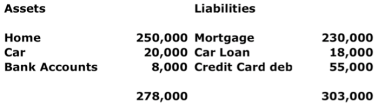
But suppose you were a subprime credit risk in the US and your balance sheet looked like this:

nuevo1

Here you would be bankrupt if you were for some reason forced to liquidate, as in the end you would have more debt (303,000 units) than assets (278,000 units): your equity is negative. But, as long as you have your job and the money to make payments every month on your mortgage, credit cards and loans you will be alright: You can service your debt, you have cash flow. As long as you can pay your debts every month, nobody wil bother you.

As an aside, part of the recent credit crisis arose because people’s homes dropped in price and payments increased, but people realized that they owed more on their homes than the value of the home, so why bother? Better take the loss, give up the house and pay rent.

2. The Balance Sheet of a Central Bank

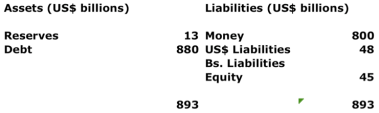
The Balance Sheet of a Central Bank is not too different from yours, except that the Central bank does a lot of different things, including issuing money. But it may look something like this (simplified):

balnace3

Note the equity is included on the liability side, because if it is a company or bank the equity is “owed” to the shareholders. If the company is dissolved, the equity will be distributed to the owners. If the Central Bank is dissolved, in Venezuela the Government wil get the equity (if it exists)

Now let’s look at the simplified Balance Sheet of the Venezuelan Central Bank in Bs. x 10^6 Times (one million), as of December 31st. before US$ 12 billion in reserves were taken out:

bcv

It looks ok at first sight, Liabilities equals Assets, nothing funny at first sight. However, if we “open” the “Assets in Bs.” line, it is composed as follows:

bcv2

As you can see mot of these assets are in the last two lines which add up to Bs. 32.2 billion or US$ 14.98. The “notes” refers to the notes attached to the Financial Statements which were published in El Universal on January 28th. When you go to these notes it turns out that Note 9 is just the US$ 6 billion transferred to Fonden in 2005-06 and Note 10 contains US$ 8.3 billion also transferred to Fonden in 2007, for a total of US$ 14.3 billion.

Notice the problem?

This money no longer exists!

US$ 14.3 billion the assets of the Venezuelan Central Bank, which has Equity of US$ 6.3 billion (see above) has vanished into Fonden and has been spent. Thus, the Venezuelan Central Bank has negative equity, this is like the second case in 1). In fact, since this was the picture on Dec. 31st., by now, with the transfer of US$ 12 billion in mid-January to the Fonden, a full US$ 26.3 billion in assets are listed in the balance sheet which will soon no longer exist.

Truly revolutionary indeed! But, what does it mean?

If it were you, it would mean, you kept the mortgage, but the house was sold, you have nothing to back the loan.

As in the second case above, the question is whether the Central Bank is insolvent because its balance sheet is insolvent, or whether it is insolvent because it can not pay its obligations, its debt.

A Central Bank has costs, not only those related to running the bank, but also it can issue money, but issuing money, increases liabilities and increases inflation. So, this is limited in scope. To function, the Central Bank has to pay interest on commercial banks reserves,as well as offering instruments when it needs to control monetary liquidity.

Currently the Venezuelan Central Bank has some US$ 25.4 billion in deposits from commercial banks, not all of it bearing interest and has issued US$ 10.7 billion in CD’s that it has used in operations to absorb monetary liquidity.

Where does the Central Bank get money to pay for the interest on this?

Easy, from interest it receives on investing international reserves and, of course, once again it can print money. It becomes a vicious circle.The more money that is printed, the higher inflation and the more difficult it becomes to control inflation. Zimbabwe is an example.

This whole thing can be written as an equation, which I will not do, but basically, there is a condition such that the Central Bank needs to have a net worth that will not be wiped out in the future in order to keep its operations. (I don’t want to go into more detail on this)

What happens now, as oil prices fall, is that the Central Bank will have lower income, but the monetary mass will be larger, there will be more money going after the same goods. More Inflation. In the last few years, as Chavez has taken money out of international reserves, oil prices have gone up, allowing international reserves to increase and give the Central Bank enough money to pay its costs. If no devaluation takes place, this will no longer be possible soon.

That is why devaluing is such a convenient tool. You devalue and the Bolivars you need to keep the Central Bank functioning become less in terms of the US$ dollars it holds in international reserves. Reserves can once again pay the way of the Central Bank. But you get hit by inflation.

However, even if you devalue, the Treasury of the country needs to at some point to recapitalize the Central Bank. Until that is done, the problem is not over, it will repeat. That is why taking the Fonden reserves is such an irresponsible act: At some point, at whatever rate of exchange it may be, the Treasury will have to put the money back to replace the lost equity of the Central Bank.

The more the currency is devalued, the cheaper it will be for the Treasury…and so on…

Perverse, no?

And that is a key difference between what is happening in Venezuela and in the US. So, let’s look at that case briefly.

3) The Balance Sheet of the US Federal Reserve

I will look first at the balance sheet of the US Federal Reserve last year before the collapse of any financial institution. It sort of looked like this:

usbank

So, with the aid to JPMorgan to take over Bear Stearns and TARP I and Tarp II, what has happened is that the US Federal Reserve created more money, but it exchanged it for assets, mostly preferred stock in these banking institutions.

This is a huge difference, because these are assets in the balance sheet and they produce income for the Fed. The Balance Sheet of the Fed after the first TARP round may look like this (Assuming 800 billion dollars in new money and assets):

usbank2

This is of course, terribly inflationary, as there will be a lot more money out there. However, the difference is that if the plan works and banks become healthy again, they can buy back those preferred shares that were added on the left side and the Fed can then eliminate that money from the money supply. It may not work, but that is the theory behind it.  Additionally, before this happens, banks will pay the  Fed interest on those preferreds and that money will be useful for the Fed to maintain its ability to pay its debt.

But there is another difference: Venezuela has dollar liabilities, dollar debt. The US does not. The US can print and print and as long as it can pay the debt it issues, it will do it all in US$. But Venezuela has lots of debt in US$ and while it ca print Bolivars to pay that, it needs to have the dollar to purchase them and pay debt.

Once again, devaluation can fix that problem easily.

Of course, I have oversimplified the whole thing, but I hope you get the idea. There are problems in Venezuela and the US, but ours are much worse because of the invention of the “excess reserve” concept and the existence of dollar liabilities.

And this will lead to more inflation and devaluation…

Opposition closes campaign with a march in favor of the NO vote

February 7, 2009

Today was the march in favor of the NO vote in the upcoming amendment referendum. It was huge, I have been to quite a few marches and never felt it so congested as today, many times I thought I could not move forward and when I finally managed to get to the front, the speakers were done. Here is a picture of the march:

marchaThis was taken from the top of the Avenida Libertador bridge, you can see the stand way at the end on the right.

The students make a huge different on these marches, they sing, shout and dance with joy and keep it up the whole way. The distance was long from Petare to the end of Avenida Libertador (Is it the first one to leave from Petare?).

I took this video of the students, there were more exciting moments for them, but this is the best one I managed to capture. I will help you feel the nature and excitement of the students:

Of course, a huge march does not determine the outcome, but one has to be encouraged by this.

When institutionality crumbles, people take the law into their own hands

February 7, 2009

This is a terrifying story of the consequences of the crumbling institutionality in Venezuela. Last Wednesday, in the Matanzas barrio of El Valle, a group of people grabbed a man, accused of two rapes in their neighborhood, started clobbering him, shooting guns at him and once he was dead, burned his body beyond recognition.

This was not a small group of people, this included men, women and children and reportedly, even cops. Soe participated, others watched and even scarier, they recorded the lynching in their cell phones. The body was burned four times, each time a new reporter showed up, it was burned anew. The people are not even sure that they got the right guy. In denouncing the rapes to the police the two men do not appear to coincide with the dead man. But one of the women raped said the guy with the cut in his face was the man that raped her. Except the police claim that the man that escaped was the one with the cut in his face.

Here is a picture of the people as the body was burned, look at all the people taking pictures:

img002

This was not done in obscure corner of El Valle. This was done in one of its main streets. Lots of people saw it, lots of people celebrated it. There is even joy at the lynching.

This is what happens when institutionality crumbles and people begin losing their values. Violence becomes an everyday affair. The frustration of suffering daily from threats, whether real or not, and not having someone to go to, ends in these equivalent violent expressions of hate and collective outrage. When groups of people get together to perpetrate such a barbaric act, there is something terribly inhuman that surfaces. When they calmly record it and cover each other up, there is a sense that something very important has been lost in Venezuela. Violence begets violence and nobody does much about it. Vigilantes surface everywhere. Violence becomes part of all of us.

According to El Nacional and the Observatorio Venezolano de Violencia, 66.5% of Venezuelans backs acts of executions by those affected by crime and 32% favor lynchings.

Sad, very sad, that this is what we are becoming as a country. I will not even blame anyone, why waste my time? This is what too many of the citizens of this country have become. The question is not whose fault it is, the question is whether we will do anything to stop it from deteriorating any further. And if we do, how long will it take to erase these beliefs from two thirds of the Venezuelan people.