Archive for the 'Venezuela' Category

Court Orders Media to Act “Responsibly” On Water Quality News

March 22, 2012

(The picture above is for illustration purposes only, it only has a vague relationship to the post and is placed here simply to provide an image of the topic for the contents of the post)

In the upside down country that Venezuela has become, rather than investigate water quality in Monagas and Valencia, the Government had a Court issue an injunction telling the media to act “responsibly”. So far, there has been no similar order for the Government to use “extreme responsibility” and prove that the water is safe to drink. Here is our report which complies with the order:

After the oil spill into Rio Guarapiche on Feb. 4th. XXXXXXXX remain XXXXX, despite the fact that Government officials say XXXXXX. The Governor of the State XXXXXX said that XXXXXX, creating a crisis after the Minister of the Environment said that XXXXX. This has been contradicted by XXXXX, who said that XXXXX. The Government is not investigating whether the charges are true.

Separately, an ecological movement (link withdrawn) said that the waters in lake Valencia present XXXXXXXXX and it reptresnts a time XXXX and it represents a XXXXXX and XXXXXX crisis. The Government denied :lake Valencia was XXXXX and said it would accuse the Governor of Carabobo for XXXXXXX XXXXX in the population. The National Assembly will wait a month before looking at the problem.

There you have it, a fully complaint post on water problems in Venezuela. Enjoy our democracy!

The Fonden Papers part VIII: Another Peek At The Dance Of Billions

March 18, 2012
View this document on Scribd

When you thought I was done talking about pet obsession Fonden, an eager reader sends me this intriguing document above, the report by the “Comisario” as of June 30th. 2011 for the fund. The “Comisario” is an independent overseer in Venezuelan companies, which acts independently of the Board and has to report annually on what the Board and the auditors say about the company or institution. Typically, these are fairly lame reports as “Comisarios” are paid by the Board, so they don’t want to give away the annual payment they get.

This report is sort of strange, it basically seems to take snippets from the auditors report and comments on them. What is even weirder is that it has material about stuff that did not happen in the period covered, which I don’t quite understand. Here is a summary of what it says:

-The first thing that is different, is that despite having used “official sources” for contributions to Fonden, including the Central bank and PDVSA, for some years my “OLD” table in this post, had errors of as much as one billion dollars, small change for the revolution. Here is the summary from the report above (page 4) and the comparison. Totals and differences are in red:

Of course, my “OLD” table only included up to 2010, this includes up to June 2011. Note the size of the errors, a billion there, a billion here. That is how the revolution works, it is a perverse dance of billions.

-We then find out that the development fund Fonden, seems to have as one of its main purposes, contributing to other funds.  Indeed, the Fondo Simon Bolivar is funded by the returns of Fonden (page 5)

But more interestingly, in the circular world of Chavismo and the Bolivarian revolution, there were two 2 billion dollar contributions to the China Fund and US$ 2 billion in projects that also came from Fonden (page 6) One was in 2008, the second one for US$ 1.955 billion in 2008 but it appears the “projects” were transferred, then in 2009, another US$ 2 billion was transferred to Bandes for the Chinese Fund.

Note that this is in part how Chavez becomes like Jesus Christ in multiplying the fish and the bread, each one of these is an announcement (or many), but in the end it is the same billion here or there, it just gets recirculated around in the dance of billions.

-We then come to investments:

In point 1) The “Comisarios” note that Fonden has money in Commerzbank, Barclays, Deutsche Bank and Emerald Capital.

Hello? Emerald Capital? WTF?

All I could find about this company in such distinguished company was a report by Businessweek that textually says: “does not have significant operations. The company is searching for assets and businesses to purchase that would provide significant shareholder value.”

Jeez, aren’t we all? I guess they found some assets and someone made some juicy commissions. Emerlad’s business plan seems to be starting to work at Fonden’s expense.

But it gets better, in point 2) (page 9) Fonden purchased US$ 86 million of Republic of Bolivia Bonds, a country that has not issued bonds to public markets, according to Bloomberg, since the 1920’s. Nothing like being a pioneer investor.

But it gets even better: In point 4, Fonden purchased some Republic of Honduras bonds, which somehow wanted to exchange later. I guess Zelaya left and they no longer were interested.

Now it really gets cool and capitalistic with Fonden investments. Remember this is the money to be invested for the country’s future. But in point 6) page 9, you can read all about how Fonden had US$ 876 million in none other than your friendly neighbor financial organization, Lehman Brothers, which just happened to go bankrupt in 2008. It says here that somehow, Fonden managed to exchange this for a Note backed by Venezuelan instruments and Fonden made US$ 5 million. There are no details of who was the fool who did such a transaction, but somehow, I think there were Bolivars involved in the middle.

To cap the investment track record of Fonden, the fund invested in Ecuador bonds (point 8) These are the same Ecuadorian bonds that country defaulted on (Shucks, you can’t trust the comrades) Somehow Fonden, exchanged those defaulted bonds and somehow in the end supposedly made a gain on some part of it. Lots of commission in the middle. I guess someone was truly “developing” his or her future with all these deals. But not much happening in Venezuela.

Finally, (page 11) Fonden “invested” US$ 366 million in buying 49.99998779% of Russian bank Eurofinance Mosnarbank, another giant step in Venezuela’s economic development.

-Where it gets interesting is here: The document tells us how Fonden distributed the money. Remember the missing US$ 29 billion? (Plus or minus a billion, to use revolutionary nomenclature). Well. it turns out that they just did not want to show that the money was not “invested” in projects, but just recirculated around.

Quico sent me his spreadsheet (Thanks!) in which he added all of the projects Ministry by Ministry of what Giordani told Deputy Ramos had been assigned to projects. Below find the original table, corrected with the new data (You can click on it to see it better):

It is very interesting, the largest share of the “missing” money is in the Ministry of Finance, a difference of “only” US$ 10.8 billion dollars. Clearly, since that Ministry does not execute projects, that money was used as needed, sort of a billion dollar petty cash fund, whenever Giordani, who not only runs Fonden, but is the Minister of Finance and Planning, needed a billion or two, here and there.

After that, there is a US$ 6 billion difference with Energy and Oil, once again, PDVSA gives money to Fonden, which Fonden sends right back, as needed, in a sort of vicious and virtuous circle at the same time. Add Agriculture and Transport and Communications and you have already found US$ 23 billion of the “missing” money.

In fact, “differences add up to US$ 34 billion, more than we thought was missing, because this includes the 2011 (first half) contributions, which were not part of our accounting.

Ironic, that in this merengue of billions, the number one problem in the country, crime, gets a puny or miniscule US$ 25 million via the Ministry of the Interior and Justice. That is roughly 0.034% of all the money spent by Fonden. Amazing!

-Finally, it appears that (page 13) Fonden has lots of things in Banco del Tesoro, but that bank failed to provide proof of the instruments, but these are numbers in the range of a billion or so, fairly uninteresting by Fonden standards.

There you have it. Please, if you have access to additional information we would be delighted to receive it, analyze it, mutilate it and process it. It’s simply priceless to read how these people are destroying value and moving billions like there is no tomorrow.

Maybe there isn’t…for them…

Chavismo Fights Over Water With The Cat

March 15, 2012

If anyone had any doubts that Diosdado Cabello is the de facto successor, the recent water wars between Chavismo and the Governor of Monagas state, José Gregorio Briceño, whose nickname is “The Cat”. You see, the central Government and PDVSA have tried their utmost at covering up their incompetence in handling the big oil spill into a Monagas river. You see that river is the one that provides the city of Maturin with water and the citizens have put up with no water since the Feb. 4th. oil spill, a true disaster for Chavez’ PSUV on an electoral year.

Thus, the central Government has been pushing for the water to be turned on, but Briceño has refused to allow water to be pumped, because it believes that it is still highly contaminated. But Briceño’s true sin, was to suggest that this is just an attempt to get rid of him as Governor and that heir apparent Cabello is behind the whole thing. And no sooner that you could say Godgiven, Briceño was kicked out by Diosdado and Chavez said from Cuba he agreed with the idea.

Briceño was never true rojo-rojito. He was more of an independent, but so popular, that Chavismo knew that they would lose the Governorship if they did not ask him to be the candidate for PSUV, instead of his party which is colorfully called “Mi Gato”.

But Chavismo is worried about leaders jumping ship at this delicate juncture and could not tolerate dissent.

By now, even the Minister of the Environment, who had treated Briceño well, has joined the attack, suggesting that either Briceño turns on the water or the central Government will expropriate the Monagas water system. The mode continues to be one of denial, nothing much happened, it’s all fake, and just another opposition plot to make the Government look bad.

You have to give it to the opposition, imagine how hard it must have been to paint the kids dark in the picture above to manipulate the news.

Politically, all that matters to Chavismo is the Presidential election in October. While “El Gato” was important before, they can get rid of him and send the signal that dissent will not be allowed. And if express dissent, Diosdado, the heir apparent, will deal with you.

These cat and water fights are getting very interesting…

PDVSA and its Hong Kong Exchange Plans: Ignorance or Deception?

March 12, 2012

Once the Venezuelan press began writing about the intention of Chavez’ Government to place shares of part of PDVSA in the Hong Kong Stock Exchange via the sale of stakes in joint ventures to China’s Citic, as reported here and in Setty’s blog and Caracas Chronicles, the Government went into denial mode, having been caught rojo-rojito-handed with the fingers in the privatization till.

First, there was a curious Bloomberg story, in which a company official anonymously confirmed the story, but denied that this was strictly a privatization, “as shares will be offered in a holding company created to manage PDVSA’s stakes in the joint ventures and not in the state oil company itself”.

Jeez, these people really must think we are stupid,as the share of a company that just manages PDVSA’s stakes, can’t be worth as much as the stakes themselves. But, Mr. anonymous, pardon me, selling any company owned by PDVSA is a privatization, no matter how much you like or dislike euphemisms.

But that explanation was not noted much by the local press, so that none other than the President of PDVSA and Minister of Energy and Oil Rafael Ramirez, declared not once, but twice, that PDVSA was not planning to sell shares of any part of the company, because PDVSA has “never done much in the Hong Kong Stock Exchange and the idea is to negotiate, via Citic, any sort of transaction, but mainly bonds”

And you have to wonder, whether this statement reveals the absolute ignorance of the Minister or just another incredible attempt to lie and deceive about the true plans of PDVSA with its Citic sale.You see, if you take Minister Ramirez words at face value, PDVSA has never had anything to do with any Stock Exchange in the world, as far as I know, except the Caracas Stock Exchange. This is the only exchange where its bonds have ever traded.

The reason is simple: Bonds rarely trade in exchanges, they are usually traded by professionals “over the counter” and PDVSA’s bonds are no exception, so the explanation is extremely suspect. The reasons for this are many, you can read most of them here, but basically, bond issues are small, many bonds are fairly illiquid, they are affected by slow moving news like changes in credit quality and interest rates, so they move slower than stocks. But in the end, brokers have no vested interest in making their markets more transparent. It is a good business.

And the Honk Kong Stock Exchange is no exception, while some bonds are issued and registered in it, they trade rarely. For example, you can see here , that of the bonds registered in that exchange only, one, uno, traded in all of January 2012 , a Government of Hong Kong bond maturing in 2014 . And December 2011 was not much better. So, Mr. Ramirez, there is no true opportunity in doing what you said. You hear!

The question then boils down to whether this was simple ignorance or just another attempt to hide the true intentions of PDVSA and the Chavez Government to do whatever they want or feel with our country and its resources.

Once again, the idea of selling these pieces of the joint ventures is not a bad one, PDVSA needs money, but somehow it would seem as if Venezuelans should have a priority, no? Imagine, for example, getting US$ dividends on your Petropiar shares under the current exchange controls.

That’s how you distribute wealth…away from the Government.

But clearly, this plan to sell Petropiar shares was never meant to be made public. Only the revolution was privy to it.

What else is new?

How Chavismo Celebrated International Women’s Day 2012

March 11, 2012

You have to wonder whether the perversity by the revolution was on purpose or just coincidencal. Last week, on International Women’s Day 2012, there were two separate judicial decisions in Venezuela: In the first one, Judge Maria Affiuni’s appeal against the extension for two more years of her detention, was denied by Appeals Court. In the second one, Edmundo Chirinos, who was sentenced to twenty years in jail for the murder of 18 year old patient Roxana Vargas, was given by the Appeals Court the benefit of serving his sentence at home.

The difference? Judge Affiuni should be tried in freedom according to the law, as she has been in jail for more than two years without a trail Despite this, the Appeals Court extends her jailing for two more years, which she is spending at home because she is ill. Of course, she can’t even get treatment in Venezuela, as she is not allowed to be visited by a Doctor or to go to a Doctor.

Giving Chirinos the benefit of serving his sentence at home is perfectly legal, such a benefit is contemplated by the law for people over 70 years old. He is 77.

However, Chirinos told reporter Ibeyise Pacheco, that he only turned himself in because he thought his connections to Chavismo would save him and if he were given the benefit of serving his sentence at home, he would escape.

Curiously, Affiuni is in jail for freeing an enemy of the Government who had also been in jail for two years without a trial. She applied the law and Chavez suggested she should be jailed. Which she was. The Prosecutor has never been able to show that there was any irregularity.

Meanwhile, Chirinos was given the 20 year sentence explicitly at the Yare II  jail. He can now go home and even try to escape thanks to the appeals Court.

Happy Perverse Revolutionary Women’s Day!

Venezuela And PDVSA Bonds Rally With Investors Betting On Change

March 7, 2012

During the last few weeks, Venezuela and PDVSA bonds have rallied sharply, as investors see increased probability of not only a possible political change in the country, but more importantly, change in the way Venezuela’s public finances are managed.

The rally has been stupendous as seen in the graph below, which shows the price of PDVSA’s 2022 bond, which carries a 12.75% coupon and which was issued in February of 2011:

The bond above has shown three distinct periods over the last year which I have noted with red boxes. First, there was rally last June, when President Chavez became sick. This rally was stopped (second red box) from August to November as the European crisis unfolded. Then, the last and powerful leg this year is shown in the third box and it began in January, as optimism all around the world first drove markets up, which was followed by a move up upon the successful opposition primaries, which received another powerful push up with the news that Chavez’s cancer had returned and the President had to be operated.

Chavismo has called the rally perverse. But in the end, the rally is a bet not on President Chavez’ demise, but the fact that if Chavez played a smaller role in the future of Venezuelan politics, the role of Minister of Finance and Planning Jorge Giordani would also be diminished. Because Giordani was, after all, ranked as the worst economic Minister of Latin America recently.

And ever since Giordani took charge of of Planning and ltaer Finance, Venezuela’s financing costs had been increasing and refused to drop. This can be seen in the next graph, where I show the Global 2027 bond from the year 2000 to last week. As you can see this bond has been at much higher prices (lower yields) than it is today during Chavez’ tenure, despite the fact that oil prices are near an all time high today.

From 2003 to 2007, this bond rose sharply, as oil prices increased. Venezuela had a relatively small debt and new issues were coming to market slowly and in a manner fairly well understood by the markets. Then came the financial crisis of 2008-2009, oil prices dropped and debt prices went down. During this time, Venezuela and PDVSA began offering ever increasing amounts of debt to sustain the exchange rate at an artificially low level. Even worse, the attitude towards the same investors that buy this debt has been unfriendly, surprising the market and issuing large size bonds that flooded the market with paper.

Thus, after the yield in the Global 2027, shown below, hit near 20% during the financial crisis, it had been unable to drop below the ~13% level until last summer.

The rally has been impressive. The PDVSA 2022, issued in February 2011, which traded at 75% in its first day, closed yesterday at 100%. That is a 33% return on capital to those that bought the first day, to which you have to add 17% return in interest, or 50% in little over twelve months.

The question everyone asks, is whether this can continue.

Well, as long as there is the possibility of change in the way the country is managed, the rally can certainly go on. While yields may not go down to the levels of 2006-2007, because the country’s debt has increased dramatically over these years, oil prices are higher and Venezuela could be in better shape than other countries yielding 2% to 3% below Venezuela’s yield. It is, in the end, all relative.

But the ride is likely to be bumpy, as the sell-off yesterday shows, after the violence on Sunday during Capriles’ rally. Investors can scare easily, even if the potential returns can be very attractive. But investors like the yield and this provides some cushion in this bumpy ride.

As usual with investments, it is when to sell that is the toughest to decide.

¡Fin de Mundo!: La revolución quiere privatizar parte de PDVSA

March 6, 2012

I very seldom publish posts in Spanish, but since the local traditional press has given no coverage to the agreements signed by Chavez with the Chinese which allow Citic to sell stock in parts of PDVSA, Quico and I collaborated on this post in Spanish which will be published in Caracas Chronicles, here and in El Excremento del Diablo. Please distribute!

¡Fin de Mundo!: La revolución quiere privatizar parte de PDVSA

La alergia con la privatización ha sido, desde el primer día, uno de los nortes ideológicos del chavismo. Por eso sorprende tanto el acuerdo hecho público recientemente a través del cual PDVSA no solo le vendería a la empresa de inversión China Citic el 10% de la empresa de la Faja Petropiar, sino que autorizaría a Citic a colocar parte o todas las acciones de Petropiar de su propiedad en la Bolsa de Hong Kong y al mismo acordaba asesorarse con Citic Securities para la posible colocación de las acciones de la propia PDVSA en este proyecto.

Este cambio en la política oficial representa la negación de gran parte del contenido petronacionalista de la revolución bolivariana. En efecto, el gobierno quiere privatizar un pedacito de PDVSA: ¡Fin de Mundo!

La prensa criolla no ha reaccionado ante todo esto. Aún cuando la noticia ha sido ampliamente difundida en inglés, tanto por las agencias Dow Jones y Bloomberg como por los blogs de Setty (1,2), Caracas Chronicles (1,2), el blog de Foreign Policy y el Devil’s Excrement (1,2), nuestros periodistas no parecen haberse percatado del asunto. El gobierno privatiza a PDVSA…¡no es cuento!

Este golpe brusco al timón no es difícil de explicar: PDVSA necesita financiamiento para poder desarrollar los nuevos campos de la Faja Petrolífera del Orinoco. En estas nuevas asociaciones, PDVSA posee el 60% y sus socios extranjeros el otro 40%. PDVSA ha tratado de que los socios extranjeros le financien sus inversiones, pero la mayoría de los socios, incluyendo a los chinos, no ha querido hacerlo, ya que su propio financiamiento representa ya un compromiso significativo.

Y es aquí donde los muy capitalistas asesores de Citic probablemente sugirieron la posibilidad de usar la Bolsa de Hong Kong como fuente de financiamiento, usando a Petropiar, un campo ya maduro, como prototipo de lo que se puede hacer. La primera fase es muy sencilla y aparentemente ya ocurrió:

PDVSA le vendió el 10% de Petropiar a Citic a cambio de una cantidad, que no ha sido revelada, de dinero.

En la segunda operación en un futuro, Citic, colocaría las acciones en la Bolsa de Hong Kong:

De esta manera, Citic recuperaría su inversión y posible obtendría una ganancia importante, mientras miles de inversionistas de cualquier parte del mundo serían ahora los propietarios de las acciones de Petropiar.

Pero aun mas importante, el Mercado establecería el precio del 10% de Petropiar, que produce 180,000 barriles de crudo mejorado de 24 API. Esto establecería un valor de referencia para los proyectos maduros de la faja, así como para los que se están comenzando a desarrollar hoy.

De lograrse esto, Citic realizaría una ganancia que podría reinvertir en otros proyectos, maduros o no, de la Faja. Para el Gobierno venezolano esto es ideal, PDVSA pierde ingresos, que ahora pertenecen a los accionistas y deberán ser pagados en dividendos, pero el Gobierno venezolano continua recibiendo, royalties, impuestos e el impuesto a la ganancia súbita por cada barril producido, que es donde esta el grueso del dinero. Para los chinos, no solo recuperaron su dinero, sino que esa inversión probablemente les garantiza que el petróleo de estos campos sea enviado exclusivamente a China, que es lo que a ellos al final, les interesa.

Pero fíjense que ahora el Gobierno puede vender de la misma forma, hasta la mitad de Petroanzoategui, (antiguamente Petrozuata), o hasta 33.3% de Petromonagas (antiguamente Cerro Negro) y hasta 10% de PetroCedeño, antes Sincor, recibiendo a cambio dinero de Citic, que a su vez se voltearía y colocaría las acciones en la Bolsa de Hong Kong, generando nuevos fondos que ahora podrán ser invertidos en los nuevos proyectos de la Faja.

El proceso es básicamente ilimitado, mientras haya apetito por petróleo y mientras haya campos por desarrollar en la Faja Petrolífera del Orinoco. Este tipo de operación se podrá repetir una y otra vez, aumentando la producción de petróleo venezolana, limitando la inversión de China en Venezuela, pero garantizándoles el crudo que produzcan los proyectos.

Por supuesto, en un mundo normal y no revolucionario, los chinos no harían falta para todo esto. PDVSA podría ir directamente a los mercados, incluso a la Bolsa de Caracas, sin necesidad de intermediarios. Pero la necesidad de esconder la verdadera naturaleza de las operaciones, en la cual el socialismo, mas que nunca, vive y depende del capitalismo, requiere de un intermediario remoto.

La estrategia tiene toda la lógica del mundo. Venezuela necesita financiamiento para desarrollar los recursos de la Faja. Acudir a los mercados de acciones o bonos es indispensable para obtenerlos. Aunque la idea haya venido de Citic Securities, el que PDVSA y el Gobierno la hayan aceptado, aunque sea por realismo, representa un desarrollo muy positivo para el país y para el futuro de la producción petrolera venezolana.

Ahora bien, nada de esto ocurrirá en el futuro inmediato por tres razones. Primero, el Gobierno revolucionario no quiere que esto se convierta en un tema de la campaña electoral, aunque recluye el atacar a la oposición por querer privatizar a PDVSA. Segundo, el Gobierno no quiere valorar el 10% de Petropiar mientras continua el proceso de arbitraje en el Banco Mundial, ya que esto podría establecer un precio aun mayor al que aspira a pagar PDVSA.

Finalmente, es probable que este plan esta concebido como un plan post electoral, ya con un Chávez con un mandato adicional de seis años, implementando este plan netamente capitalista y privatizador, con el único fin de obtener cantidades aun mayores para financiar su populismo. En última instancia, el gobierno terminaría con una política mixta que consiste en nacionalizar cuanta empresa consigue que de pérdidas, mientras va privatizando las que dan ganancias: buenísimo, ¿no?

Capriles Visit In Caracas Disrupted By Armed Chavista Thugs

March 4, 2012

Today opposition candidate Henrique Capriles had scheluded a visit to the Cotiza area of Caracas (Cotiza is the area after San Bernardino going West in the northern part of Caracas). The walk was interrupted first by a Chavista caravan of cars and later by a bunch of thugs in motorcycles. Some of these thugs had weapons and shots were fired, the son of Deputy Ismael Garcia was hit by a bullet. You can watch a jumbled video of some parts here. (Don’t know how to insert the video in this post)

You can also see one of the guys in a red shirt who was clearly armed in the following picture:

To make this truly ominous, Garcia’s son was standing next to candidate Capriles, when the bullet hit his arm. This is more than a simple violent incident to provoke the opposition or stop Capriles from campaigning. This is the result of thirteen years of promoting hate and violence, which could end badly if the Government does not impose control on its violent hordes. The response by the Minister of the Interior and Justice? To call Ismael Garcia, formerly pro-Chavez, a traitor and a clown via Twitter.

Today it was that close, what if it isn’t tomorrow?

Why I Think PDVSA Plans To Sell Stock In One Heavy Crude Oil Project Via The Chinese Governement

March 1, 2012

It’s hard to stop thinking about the bizarre plan or project by PDVSA to sell stock in one of its units via the Chinese Government’s CITIC Group (China Investment Trust Investment Corporation). With more details known at this time of the agreement between PDVSA and CITIC signed by Chavez right before his departure from Cuba, I believe I have some idea about what this is all about. For background, you can read the few press notes on this here and here, (Note none are in Venezuela’s press) or the contributions by bloggers here, here and here.

Recapping, PDVSA signed an agreement to sell 10% of it’s Petropiar unit to China’s CITIC. Nothing strange there, PDVSA can, according to the Hydrocarbons Law, sell up to 40% of these joint projects to anyone. In the case of Petropiar, formerly known as Hamaca or Petrolera Ameriven, PDVSA holds (or held) 70% and Chevron holds 30%. (In the original project, ConocoPhllips held 40%, but refused to sell its stake to the Government and it was expropriated). Petropiar uses very heavy crude (8 to 9 API) which through mixing with other oil and processing through an upgrader generates much higher quality 26 degree API oil, about 180,000 barrels a day of them.

So, to begin with, press reports suggesting that CITIC Securities, the stock market arm of CITIC will advise PDVSA on how to float Petropiar shares in the Hong Kong Stock Market are, or seem to be, incorrect.According to law, only CITIC or Chevron could do that.

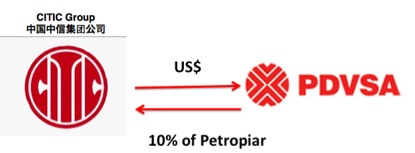
Thus, the first transaction is very clear: PDVSA is selling to CITIC 10% of Petropiar at an unknown price and the Chinese are giving PDVSA cash, which it needs to fund new projects or whatever:
So far, everything is OK, the Chavista Government or PDVSA gets more money from the Chinese. The problem is that the Chinese have no “exit” strategy, to use venture capital parlance. They give money and give money, but they have no way of either realizing the gain, or they may not want to commit ever increasing amounts of money to Venezuela for the heavy oil crude fields. But they do want more oil.

On the other side is PDVSA, that needs ever increasing amounts of money to develop the Heavy Crude Oil fields, but has found resistance from the Chinese in funding the projects. Essentially, the Chinese are willing to fund their 40% share, but expect PDVSA to finance its 60% majority stake in any new project.

Enter the very capitalistic Chinese people at CITIC Securities, who suggest buying a stake in a mature project like Petropiar, which is fully operational, at what I am sure is a good price, and have PDVSA allow CITIC to place part or all of the shares of CITIC in Petropiar in the Hong Kong Stock Exchange. Thus, sometime in the future, CITIC would sell its shares and get money in return. This is what would happen:

What has been accomplished? A number of things. First, CITIC recouped its investment and more than likely made a profit, knowing the Chinese, it will be a nice profit. Thousands of investors will now own the shares.

But more importantly, the market, the much hated by Chavismo capitalistic-Stock Market, will establish a price for a 10% stake of a heavy oil crude project in Venezuela’s Faja Petrolifera.

A couple of notes here. First, note that the upside of the sale goes to the Chinese, not to, for example, to Venezuelan investors. Perverse, no?. Two, for Venezuela this is a no-brainer, PDVSA gives up dividends (investors will have to be paid somehow), but the Venezuelan Government will continue to charge royalties, taxes and windfall taxes on each barrel produced, which is where the big money really is.Three, the Chinese have realized a profit in their investment and can now plow the money back into Venezuela. Simply recirculate it, they can buy 40% of Petroanzoategui (formerly Petrozuata, fully owned by PDVSA) or they could buy 23.3% of Petromonagas (formerly Cerro Negro, where BP has a small stake). Then, they can turn around and sell these in the Hong Kong Stock Exchange.

And they can take their money and their profits or whatever they sell their shares for and plow it back into Venezuelan oil fields.

But more importantly, PDVSA has found a way to raise money for the new projects, which are not producing yet and the Chinese to establish how much they will be worth when producing, a nice way to know your return in investment ahead of the project. After all, a barrel of improved oil from any of these projects is worth roughly the same in all of them. The Chinese get some money back, likely have clauses that the oil from new projects will be shipped exclusively to China and more importantly, they can sell their stakes in the new projects once they are fully functioning too.

And in a virtuous circle, an almost pyramid, as long as people need oil, they can invest the money in ever new projects in Venezuela’s heavy oil fields. The much-hated markets will provide the endless funding, like this, as long as it is profitable:

Over and over again. You can do this as many times as there is a new oil field to develop and there is investor appetite for it. Of course, oil prices and appetite for oil has to stay high too.

Of course, you don’t need the Chinese for all of this. PDVSA could have eliminated the Chinese middle-man and do a typical capitalistic placement directly in the World Stock Exchanges. This is what PDVSA was planning to do, but before Chavez. Thus, it was scrapped. It was against sovereignty, selling the country and all that revolutionary bla, bla, bla.

Except that PDVSA needs the money here and now and the revolution would look bad doing such an obvious about face about from what it claims to believe in. This is exactly what they have criticized and it is better for PDVSA to get the money now and later, after the elections, have the first transaction take place, pseudo-hidden behind the Chinese capitalists.

Which brings me to the last point: None of this is meant to take place until after the election for a number of reasons, the surprise is that they announced it now:

-First, you don’t want this to become a campaign issue, although it does remove the “the opposition wants to privatize PDVSA” accusation from the political debate.

-Second, you don’t want to place the shares in the market before the ExxonMobil and ConocoPhilips arbitration cases in the World Bank’s ICSID arbitration Court are decided. After all, if investor appetite were high for Petropiar, it would place a high price on its shares and could drive the compensation to the two oil companies mentioned much higher.

-Third, if Chavez does win the October election, he would have a few years to implement the above strategy, financing the development of the Faja, which would pump ever increasing amounts of money into the Government’s coffers.

And the virtuous circle of populism would just continue…They just hope…

Note Added: A friend notes that while PDVSA exercized an obligatory 60% majority on the projects when it forced control in 2007, the law says PDVSA only needs to have 50% of each Joint Venture. This implies PDVSA could sell an additional 10% of each of all the projects, a nice piece of change to add to the pot!!!

Chavismo Media Manipulation Not The Same Since Hugo Has Been Sick

February 29, 2012

(One of the many allegoric images circulated by Chavismo in the last two weeks)

The day Hugo Chavez shouted “Viva Chavez!” during his farewell procession down to the airport to leave for Cuba, you knew he had reached a new level of megalomania and irrationality. And this happens to be important, because it appears as if the genius behind Chavismo manipulation and use of the media was none other than the autocrat himself.

Because ever since Chavez got sick, the quality and the impact of media manipulation by the regime seems to have deteriorated and in the last few weeks has been totally off the mark, at a time that it is most needed.

It all began with the opposition primaries.(Which thanks God took place before Chavez’ relapse that prompted his trip to Cuba.) First Chavismo decided to lower expectations for the vote to ridiculously low levels. When I heard opposition people talking about maybe a million votes in the primary, I knew someone had drunk the Chavista Kool Aid. To me, defeat was a million and a half, even though I did not think three million was doable. But Chavistas really played it down, from saying there would not be a million voters, to suggesting the primary would not even take place. Thus, when three million votes were reached, Chavismo was truly caught leaning the other way, wondering what had happened.

And rather than play it down, Chavismo took the cue from the Generals and began questioning the veracity of the vote, which had been run by the Chavista Electoral Board, which did not like the questioning and went to extremes to defend their integrity. Come on! They can bend the rules, but not for the opposition. But maybe the winds of change are blowing and behind covering is going to become a national sport soon, no?

And just when this was leading the headlines, Chavez decided to reveal he was sick again. Despite his assurances to the faithful that he was cancer-free, not a single cancer cell in his body and ready to live for twenty years, Hugo had known since January that things were not fine.

And Hugo decided to call his tumor a “lesion” (An injury, for those that do not speak Spanish), using that funny doublespeak with respect to his ailment. And according to VP Jaua, the “lesion” was removed, but, how can you remove surgically a “lesion” without creating another one?

Just wondering…

To say nothing of Cabello and Izarra laughing at Bocaranda for telling us Chavez was not only in Cuba, but was going to need an operation soon. As Cabello and Izarra helped prop up Bocaranda’s reputation with their tweets, Chavez went on nationwide TV to tells us they were out of the loop, but Bocaranda, somehow wasn’t. Diosdado must not have been happy.

Then, at some point, it seemed Chavismo was ready to regroup, Chavez appointed a single spokesman for his illness (Spokeswoman actually) Minister of Health Sader. She was due to give us a report on Monday, but Monday came and went and nothing…We have yet to hear from her.

Once again, Chavez is too busy taking care of himself and Minister Sader has been overruled by those that want to show they have power.

Then VP Jaua read some prepared text in the middle of his speech at the National Assembly. He never said who wrote it, but he read it all, down to the “La Habana, Cuba” written at the bottom of the piece of paper he had been given (or ordered) to read.

And while we are still waiting for the person Chavez anointed to be the spokeswoman for the illness, the Minister for Communes (Of all people) tells us that the Government is being clear and transparent and that VP Jaua is the only spokesperson for the illness and, of course, blames the media for the confusion.

Who authorized her to say anything?

Meanwhile, all we know is that Chavez is in “good physical shape”, but we guess that Jaua or anyone, would have said that before the “procedure” that Chavez underwent in Havana. As to the”procedure”, it must have been rather simple, it took after all, only an hour and half, barely time to open and take a look, let alone to take a tumor or a “lesion” or even a hemorrhoid out.

So, we still don’t know, but the secrecy speaks louder than words. Things have barely changed since last summer. The predictions of Navarrete are behind schedule by maybe one only month. The country’s bonds have soared day after day, as if someone knows something about the upcoming and inevitable political change.

And Chavismo can do little to change the feeling that somethings is not right. Their leader is not around and he clearly played a definitive role in setting the stage and the discussion.

No more.

As for yours truly, I have not changed my predictions. To those that read the comments, I said long ago my late April birthday was a key time reference. I will continue to stick my neck out with that. Now more than ever. Worst case, I will be wrong by a few weeks.

I have done worse.