Archive for the 'Venezuela' Category

The Fantasy World of Hugo Chavez And the Story of the Expelled Miami Consul

January 12, 2012

Hugo Chavez has a mind of his own. He goes on TV and tells lies and stories just as if they were facts, sometimes lying about things a President should not even know about. Case in point is housing, Hugo needed housing built for his Mision Vivienda, in the absence of sufficient housing units built, he started making up numbers, claiming by the end of 2011 that 92% of the 150,000 promised housing units had been built. Experts do not even believe half of that was built as the program did not even begin until April.

But his ability to spew out high quality BS was clear when talking about the Miami consul Livia Acosta, who was expelled from the US after being taped by Spanish broadcaster Univision plotting with Cuban and Iranian buddies to cyber attack US nuclear power plants.

Chavez publicly confirmed the expulsion, but then went into imaginary overdrive, saying that Venezuelan intelligence sources new the action was coming and thus Mrs. Acosta left the US in Dec. 15th. and was already in Venezuela.

Except that…

Mrs. Acosta herself in a radio program said this week that she was in Miami on January 9th. when the expulsion order came through and immediately left the country, contradicting Chavez’ imaginary tale of Venezuelan intelligence being ahead of the game.

In fact, it appears that this was more of a problem of lack of communication within Chavez’ Government (Surprise, surprise!) Reportedly, the US Government had informed Foreign Minister Maduro of the upcoming broadcast and revelations to allow the Venezuelan Government to withdraw Acosta quietly. Except that Maduro not only decided not to remove her from her post, but failed to inform the boss.

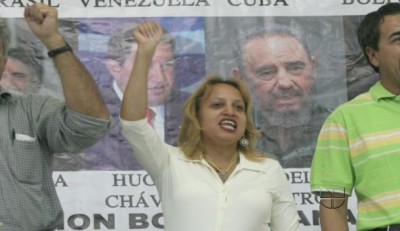
Meanwhile Mrs. Acosta (shown above) is back in Caracas after her meteoric rise in Venezuela’s diplomatic circles. She went from being a member of Chavez’ Bolivarian Circles, to being trained as an intelligence office in Cuba, to being a member of Venezuela’s intelligence service SEBIN (where apparently anyone can check if they have your ID number if you are an employee of the country’s intelligence service!!)  to Consul in Miami in eight years.

Only in the revolution…

Minister For Women Offers Herself To Be Stoned by Ahmadineyad by Chigüire Bipolar

January 9, 2012

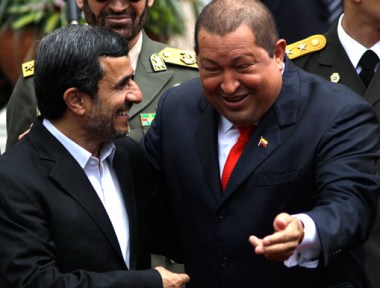
I wanted to write something about the grotesque visit to Venezuela by the the small man from Iran, but felt that I had little to add to the sad spectacle of Chavez calling the Iranian Dictator someone Venezuelans are supposed to have common ground with. But then I read this satire by the always hilarious and poignant Chigüire Bipolar and figured translating that post to English would tell very simply how absurd and incongruous the whole spectacle of the sick-fat man from Caracas hugging and praising the tiny-intolerant man from Teheran. Thanks to the Chigüire for the permission to do so.

Minister for Women Offers Herself to be lapidated by Ahmadineyad by Chigüire Bipolar

Yesterday, President Hugo Chavez gathered his ministers to request from them that they make feel at home his Iranian counterpart Mahmoud Ahmadinejad. The occasion was used by the Minister for the People’s Power for Women, Nancy Perez, to volunteer to be stoned by the distinguished visitor.

“Good afternoon, colleagues, my name is Nancy Perez and I am Minister for Women. Yes, just what you are hearing, I am not pulling your leg. You mean, you did not know there was a Ministry of Women! You never received the Official Gazette? ” said Minister Perez, as a way to break the ice. “Well, seriously, as a representative of Venezuelan women, for me personally it would be an honor to offer myself so that such a distinguished visitor may bury me in the ground up to my neck and stone me to his full pleasure. He can throw acid in my face, he can order me  to wear a veil if he likes it, you know what they say:Eyes that can’t see, heart that stops beating because they beat the shit out of it” commented the Minister while she pointed out the parts of her face where it hurts the least to be hit with sharp stones.

“The Iranian president can also whip me if I bend down and he can see my thong, he can have all my skirts destroyed, as well as my low cut blouses and my open sandals.  If gentleman Mahmud is Chavez’ distinguished visitor, then Venezuelan women become obedient and submissive, the way President Ahmadinejad likes it” said Perez, moments before calling the CH store in Sambil to ask if by any chance they had any red burkas.

After convincing his 55 colleagues that her ministry was not a joke, Minister Pérez ended her speech: “Our ministry, responsible for ensuring the dignity of women and gender equality, is pleased to receive this champion of the struggle for the rights of the macho, the male, the man and the boy. We declare our joy throughout the country, and therefore encourage women of our country not to leave their homes during the visit of the Iranian President, to remain silent in front of their husbands and boyfriends and indulge them in everything. Yes, everything. Even if it is degrading, disgusting and violates their rights. And please, do not come out with your revealing clothes, lest they awaken the libido of some representative from Iran and we may have to cut your little hands. The occasion demands it”

Venezuela: A Country Without Government

January 8, 2012

I was reading Carlos Blanco’s Tiempo de Palabra in El Universal this morning and agreed with his concept that Venezuela has no Government by now. For those that don’t speak Spanish, here is the main paragraph:

“There is not even a Government. If you look carefully, Venezuela is a country without government. There are several reasons for this curious event. One reason is that Chavez stripped the act of governing of its administrative connotation. This dimension means setting goals and objectives, budget, compliance assessment and other nuisances which have little to do with being heroic, in which there are no Chimborazos or Negro Primeros, but that shape key aspects of the act of governing. Instead of administration, there is a televised speech, and that is the main instrument of government: the government is what Chavez says, in a decade we have seen that it is a deceitful rhetoric,  but capable of shaping a story, and in recent months it has added the paroxysm, which is a product of the visceral ailments that afflict them.”

No sooner had I read this, which has a lot to do with Daniel video posts (One and Two) on how Chavez has turned the country  into one of beggars, when confirmation of Carlos Blanco’s accurate description became quite pertinent. And reamarkably, this conformation came from none other than Hugo Chavez himself.

Chavez had not held his Sunday program Alo Presidente since April of last year and only eight programs were held at all year in 2011, a reflection that his ailments began much earlier than we have been told. But worried about his popularity, Chavez decided to start them again and hold them as long as his illness allows him. Except that it did not start well today. Despite millions spent in Telesur and VTV, in buying equipment, training personnel to promote the revolution, the program had technical difficulties and the images and the voice were intermittent at the beginning and  and Hugo Chavez was not happy and his own voice came through quite clearly in his criticism of his Government, with Chavez thinking he was off the air:

Chavez: “A begining with lots of accidents for Alo Presidente. They don’t plan their “vaina” (shit?) well. Andres goes one way, Felicia is going another way, I don’t have a General Staff..”

If something as simple as TV broadcast has problems, imagine a complex project.

And when the program got off the ground, it was exactly what Blanco described: Chavez claiming the Oil Belt would create 300,000 jobs this year alone, that production will go to 3.5 million barrels a day, saying he will create a Mision “Knowledge” and “Work” that will create three million jobs in seven years and asking why should he be responsible for the crime problem”

None of this will come to fruition. In six months, if he is around, Chavez will not mention oil production or jobs, or will simply say the goals were met, even if he and everyone knows that it is all lies. After all, not one additional barrel of oil has yet to be produced from any of the dozens of announcements made by Chavez since he became President thirteen years ago. And you would think that with the money generated by the increase in oil prices since then, that would have been the easiest accomplishment.

But Chavez has destroyed the structure of Government. And any time someone has shown ability he has either moved it to another position, either thinking that the person was becoming powerful or popular or in his belief that an expert in one area will easily transfer his abilities to any other one.

So we live in an anarchists’ dream, a State with no structure. A State led by media appearances, empty words of goals and accomplishments. However, it is also an insatiable State, and here the anarchists dream ends, fed by ever rising oil prices. In 2011, the Venezuelan oil basket was up by 39.5%, postponing any serious adjustment of the economy and together with the irresponsible fiscal spending, allowing the Government to cover up and hide, the terrible effect of a dysfunctional and essentially non-exiting Government.

Diosdado Cabello Is Back!

January 6, 2012

Who would have thought that once ostracized Diosdado Cabello would all of a sudden  become again one of the most powerful men in the country? Diosdado was once Chavez’ buddy and ūber-Minister. Vice-President during the 2002 “coup”, but whose ambitions and mercantile interests and questionable relations brought him down. He was banished to the Miranda Governorship, where he failed to hold on to the position, giving way to none other than opposition front runner Henrique Capriles Radonsky.

But all of a sudden Diosdado has resurrected or is being resurrected. Last month he was elected first Vice-President of Chavez’ political party PSUV, and today he was anointed as President of the Venezuelan National Assembly. He replaced former guerrilla member Fernando Soto Rojas, who did a more credible job than anyone expected, trying to clean up the corruption in the National Assembly and a man who proved to be more open to talking to anyone than could be expected.

But clearly, this was a victory for the “mercantile-anti-Cuban-military” side of Chavismo, led by Diosdado, over the “bolsas-loyal ideologues” of the Miranda front led by Jaua and  the “pro-Cuban front” led by brother Adan and some military and the “suck-up to Hugo” group led by Maduro.

And it is hard for me to believe that Hugo wanted it this way. There is clearly some serious dissension and tension within the military about the current Cuban role in the country. And as I noted when Hugo got sick, the successor would likely be chosen between Maduro and Diosdado, favoring Diosdado because of his military connections. He is the one that can hold all the sides together, except for the Cubans, who will play a role to the last minute, so don’t count them out, I still think they may rise again with Ronald Blanco La Cruz as their candidate. Maduro apparently believed he was the one and Chavez did not like it.

And it has everything to do with Chavez being sick. Some military may feel comfortable with the Cubans as long as Hugo is around, but get edgy thinking he may not be around and the Cubans might decide to stay. And Godgiven is their man. Never mind his troubled past, his connections to the failed revolutionary banks, he is their choice and was forced on Chavez, despite Cuban protestations.

Por Ahora!

Will the Chavez Government Thank The “Old” PDVSA For Saving The Day On The Exxon Arbitration?

January 5, 2012

I know, this Exxon/Cerro Negro stuff is getting boring, you don’t want to hear any more about this dull ExxonMobil arbitration, who won, who lost. But there are a couple of more points that it is important to make, so please bear with me. Hopefully, this is the last post on that matter.

Yesterday President Chavez said that ExxonMobil’s demands for as much as US$ 12 billion was “crazy”. Except that such a demand never took place at the International Chamber of Commerce, but at the World Bank’s ICSID arbitration Court. And that court told ExxonMobil that it could not ask for such a compensation, because its stake in Cerro Negro was not owned by a company from The Netherlands until later, and the company could not ask for compensation for what happened before then.

What we will never hear is Chavez thanking the “Old” PDVSA for a job well done. And he should, because that is exactly what happened. ExxonMobil got in the arbitration exactly what the contract called for. And it was smaller and more limited than people expected, because the lawyers and negotiators of the “Old” PDVSA did a very good job and included a cap or a limit on the oil price that could be used in any such compensation as explained very well by Noel Maurer in his blog “The Power and the Money” via the great Setty.

The key is that the decision by the arbitration panel at the ICC was based essentially on Clause XV of the Cerro Negro Association Agreement, which in 15.2 says:

“Notwithstanding the foregoing, after the first period of six (6) consecutive months during which the Price of Brent Crude Oil is in excess of the Threshold Price, Lagoven CN will not be required to compensate any Foreign Party for any Discriminatory Action(s) with respect to any Fiscal Year in which the average Price of Brent Crude Oil is in excess of the Threshold Price, and such Foreign Party received Net Cash Flow commensurate, after taking into account the effect of the Discriminatory Action(s), with a reference price for the Production produced by the Parties that bears at least a reasonable relationship, adjusted for quality and transportation differences, to the Threshold Cash Flow for such Fiscal Year.”

The key is that Threshold value which I have placed in bold letters. Above that value, there was no compensation. As Maurer explains, that value was US$ 27 in 1996 dollars and inflation adjusted became US$ 37.5 in 2007. Thus, even if oil prices were soaring above this value ExxonMobil could not ask for more.

And thus, thanks to those people of the “Old” PDVSA, all ExxonMobil received was the compensation for the economic consequences from 2007 to 2035 up that cap or threshold value for oil. According to the decision by the ICC panel, this was US$ 12.68 million for 2007 and US$ 894.9 million for 2008-2035. Period. ExxonMobil could not ask for more.

At the ICISD it will be a different matter, as the treaty between Venezuela and The Netherlands talks about “market value”, a much harder to define concept, which has no limitation. What this market value is, or how it is calculated, will depend a lot on the arbitration panel. But in arbitration circles, market value is interpreted in a fairly restrictive way and is usually considered to be something like “What a willing buyer wants to pay a willing seller” to put it in simple non-lawyerly words.

How much can that be? Hard to say. But we can take a stab at it, using the above definition and book value. This is a very approximate way, but it is a reasonable guess.

The price to book value of the shares of most major oil companies ranges from 1.5 for ConocoPhillips to 2.6 for ExxonMobil. If someone, a “willing buyer”, tried to take over any of these companies it would have to pay a premium, to turn the owners into “willing sellers”, of between 30%-50% to current stock market value. That would be as low as 1.95 x book for ConocoPhillips, as high as 3.9 x Book for ExxonMobil.

Applying this back of the envelope estimates to the Cerro Negro property which had a book value of US$ 750 million, then one should expect a range of US$ 1.46 billion to US$ 2.95 billion.There may be other damages and compensations involved fort chaing royalties and taxes, but in terms of market value the answer should be around these numbers. (For ConocoPhillips, that could be as high as US$ 10 billion, those projects were much larger)

That’s my guess.

And after learning about the origin of the arbitration from Maurer, the contract and other various sources, I am changing my score to: ExxonMobil 1, “Old” PDVSA 1, PDVSA 1.

ExxonMobil Versus PDVSA: Arbitration and Numbers

January 2, 2012

By now, people seem a little confused by the victory by Venezuela and PDVSA at the International Chamber of Commerce (ICC) over ExxonMobil.

First, there is a numbers confusion, the first headline (Bloomberg’s) was “PDVSA has to pay US$ 750 million to Exxon”, the second (Exxon’s) was “PDVSA will have to pay US$ 907 million” and now we have a third one (PDVSA’s) saying “PDVSA will pay Exxon US$ 255 million”

As noted by Setty, this is just spinning. Exxon wants to show the largest number, PDVSA wants the smallest and Bloomberg reported the net amount awarded by the arbitration panel after a claim by PDVSA against ExxxonMobil in the amount of US$ 160.6 million for debts ExxonMobil had against PDVSA.

So, these are the true numbers:

In the arbitration case for breach of contract at the ICC, the case was decided against PDVSA in the amount of US$ 907.6 million dollars, which is about the smallest number ExxonMobil could have expected to get, as it represents book value for its 41.7% in the Cerro Negro partnership. Thus, this is a victory for Venezuela, because the amount awarded is small.

From the US$ 907.6 million, you have to subtract the US$ 160.6 million in liabilities ExxonMobil had in Venezuela.

Additionally, ExxonMobil had a New York Court seize US$ 305 million from a PDVSA account, which will now be turned over to ExxonMobil.

Thus, the net amount of cash that PDVSA will have to pay is (US$ 907.6 million-160.6 million-UDS$ 305 million)= US$ 442 million. Additionally PDVSA says ExxonMobil owed Venezuela US$ 191 million from the repurchasing of the Cerro Negro bonds, which is not clear what it means. Those bonds were repurchased by PDVSA in a decision in which ExxonMobil did not participate.

Thus, PDVSA will have to pay less cash, but the award against it was indeed US$ 907.6 million. How much it really has to actually pay or take out of its pocket is a completely different matter.

However, the case is not over. ExxonMobil went to arbitration in two courts: The ICC and the Worlds Bank’s International Center for the Settlement of Investment Disputes (ICSID).

How can this be? How can two parallel cases coexist on the same case? This is the second confusing point.

Well, after calling a good friend who knows his arbitration stuff like nobody I know, it turns out this is perfectly normal.

You see, in the the 90’s when ExxonMobil decided to participate in the Cerro Negro project, it signed a contract with PDVSA and Venezuela (Which was approved by the National assembly). At the ICC, this contract is what was being disputed: the breach of contract by PDVSA or Venezuela when it expropriated the partnership or changed its conditions unilaterally. What is awarded in this court is what the arbitration panel interprets the two sides had agreed upon in that contract.

However, separately, ExxonMobil owned its 41.7% stake in Cerro Negro via a Netherlands-based subsidiary and it so happens that Venezuela and The Netherlands have a treaty to promote and protect mutual investments. This treaty has specific clauses to protect investors from both countries. It is the violations of this treaty that the World Bank’s ICSID arbitration panel is judging upon (A decision is not imminent, there will be a hearing in 1Q12), Thus, the award by the ICSID will be determined by what that treaty says and the violations that may have occurred. This could be larger in scope, as it could include additional compensations and indemnifications.

Thus, at the ICSID the panel may give (or not) ExxonMobil awards to compensate violations such as not being paid before the expropriation, modifying contracts unilaterally, not being treated fair and equitably, discriminating foreign investors from local investors, not guaranteeing payments and many others.

As an example, the treaty specifically states (my free translation from Spanish):

“The parts will not take any measure to expropriate or nationalize investments made by nationals of the other country, nor will take measures which have the equivalent effect of nationalization or expropriation, unless the public interest is invoked and subject to due process, without discrimination and with prior compensation, at market value for the investments and with payment without delay at commercial interest rates.”

Clearly many of these conditions were violated in this case and the ICSID will have to decide on what compensation to award ExxonMobil, beyond what it was established between the parts in the original contract. The wording of the treaty is clearly much different than what may have been contained in the contract (Which I have not seen). In fact, the original contract was not even signed by a Netherlands company, ExxonMobil later transferred ownership to a Netherlands company to enjoy the protection of the treaty.

Thus, it may happen that the ICC awards something and the ICSID does not, or vice versa or both award amounts that are different because they are based on different legal concepts.In the two cases that Venezuela has lost at the ICSID, the award has been roughly book value in any case, but the amounts involved were much smaller.

Thus, the ICSID could give ExxonMobil a bigger award, or not. But for now, score it as: PDVSA 1 ExxonMobil 0.

ExxonMobil Awarded US$ 750 million For Cerro Negro Nationalization by Venezuela

January 1, 2012

Well, it is early in the year, but Bloomberg last night reported that the International Chamber of Commerce awarded ExxonMobil “only” US$ 750 million in its arbitration case against PDVSA over the nationalization of its assets in February 2007. This ruling is very favorable for Venezuela, as essentially seems to recognize only book value for the expropriated properties. Exxon had been seeking compensation not only for the expropriated property, but also for the loss in cash flow from the operation of the project. ExxonMobil owned 41% of Cerro Negro, which produced on average some 95,000 barrels of heavy crude per day. The multinational company confirmed the news according to the Wall Street Journal.

ExxonMobil had been asking for US$ 7 billion of which about US$ 747 million were tangible assets. According to Bloomberg the award was for US$ 907.6 million, which was reduced to US$ 750 after a counter claim by PDVSA. But in the end the number looks exactly like book value.

ExxonMobil had also been seeking compensation at the World Bank’s ICSID Court, I am not clear how the two overlap or what judgement in one implies for the other.

If arbitration in the oil projects determines that there will be compensation only for the assets of the projects expropriated, then the total liability to ExxonMobil and ConocoPhillips should be of the order of US$ 3.5 billion, rather than the more than US$ 20 billion being sought by the two companies. Estimates put the loss of cash flow from operations around US$ 9 billion, so that a decision including book value and cash flow would have been expected to be (rough numbers) US$ 12.5 billion.

But if the World Bank’s ICISD decides in a similar manner, the Venezuelan Government would have scored a very important victory in its arbitration fights, which would impact the nineteen arbitration cases at the ICISD against Venezuela.

This should be positive for Venezuelan bonds early in 2012

Let 2012 Be The Year Of Change and Improvement For All: The Best to You All!

December 31, 2011

The year is leaving us. The Government says we had a great year because GDP grew by 4%. I ask if with a 39.5% increase in the price of the Venezuelan oil basket and a 51.5% increase in monetary liquidity, is this supposed to be good? To say nothing of the 27.9% increase in inflation. It was only in April that Giordani was “seeing” a slowing of inflation, when the 12 month CPI stood at at 27.4% and we are closing the year not only higher, but with the highest level of inflation of any country in the world. Giordani does not see very well.

And I go back to the numbers. I like numbers. Thus, I find it curious that the President of the Venezuelan Central Bank says explicitly: “Las reservas internacionales se ubicaron en US$ 29.899 millones al 30 de diciembre de 2011” (International reserves were at US$ 29.899 millions on December 30th. 2011). Funny, as of the 29th. of December, the day before, on the webpage of the Venezuelan Central Bank the number was US$ 2.44 billion lower at US$ 27.45 billion. Where did this money magically appear from? When accounting at the Venezuelan Central Bank becomes creative, you have to be concerned. (In Spanish is called “maquillaje”, applying make up to the numbers. That’s exactly what they did)

So, Chavismo keeps stretching and stretching the distortions so they can win in 2012. But Venezuelans will have to pay one day for all of this.

That’s the bad news. The good news is that it will not be in 2012. There is too much at stake. All adjustments will have to wait for 2013, no matter who is in charge.

Given that, after this dose of numerical reality, I can only wish all the readers of the Devil, the best in 2012. Let the year be the year of change, the year of hope, the year that Venezuela turns around and finds a path of prosperity and harmony. A year in which peace and rationality prevail and rule over all of us.

Happy New Year my friends!

Chavez Entertains and Distracts Even at Christmas Time

December 28, 2011

While Hugo Chavez has patted himself on the back for working through Christmas, I am not sure he has really worked. The problem is that he calls talking, work. One of the dangers of talking too much is, however, that you may say absurd things as you try to entertain and distract the country from its problems. Many things he says are things that would make you laugh anywhere, but in Venezuela we have practically heard it all, from Chavez saying that men never walked on the moon, to inventing the number of housing units that have been built in the last year.

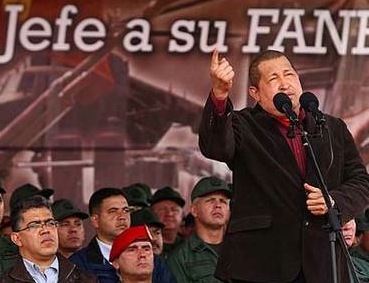
But Hugo clearly wants to close the year with a new bang in entertainment prowess. First, in a ceremony (see picture above) that looked taken out of a communist country in the 50’s, Chavez thanked his Russian friends for allowing Venezuela to have the strongest military power in its history, as if this was some sort of achievement or due to hard work and not thanks to all of the oil billions misspent in weapons, rather than on people. And the Russians, of course, have laughed all the way to the bank, with all of the stuff Hugo has purchased.

And to insure that we are all awed with is intellect, Hugo then begins speculating about the strange coincidence that four Presidents in Latin America contracted cancer roughly at the same time. Never mind that Lula was no longer President when he got his. Or that each of the cancers is different and in a different part of the body. Chavez’ perceptive mind has noted the coincidence and like everything, he wants to pin it down on the old USA, the source of all our problems, including, I guess, his terrible and ineffective Government.

And after saying he has learned to administer the resources of the country better, not bad after being thirteen years on the job, we learn that after more than 1,000 expropriations and nationalizations and eighteen cases in arbitration at the World bank’s ICSID, the Government has now issued two decrees creating advisory councils to deal with both. These advisory councils have, as their main goals, such things as “respecting the constitutional rights of people”, which have been violated right and left since Chavez began expropriations eight years ago. They would also establish mechanisms to determine the fair price to pay for expropriated properties. They would also advise on new expropriations that they feel like doing. It would also create, don’t laugh, a registry of all expropriations, because clearly the Government has no clue as to what it has taken over on the orders of the man who “has learned to admiisiter the country’s resources better”

And the Advisory Council on Arbitration is even funnier, more so given the fact that the Government itself has been saying some of these processes are close to being decided upon. But this new body will determine “strategies for the planning and coordination that State institutions have to follow to defend the country in front of foreign institutions, particularly those of arbitration”

Of course, this is all the work of the new Attorney General, Carlos Escarra, who is no dummy and realizes, a bit late, how illegal and arbitrary most expropriations have been and how the defense of the country’s position in arbitration panels has been carried out on a case by case basis and managed by various institutions. This could all be turned back, were PSUV to lose the next Presidential election, due to the myriad violations of the Venezuelan Constitution involved.

But maybe, just maybe, one day Chavez will learn that administering those resources better, should have involved appointing people who know that they are doing and not the mad whirlwind rotation of 180 Ministers (134 different people) that have “helped” him run the country in the last thirteen years.

And maybe, just maybe, if he stopped talking all the time, he could accomplish something.

Hugo Chavez’ Christmas Spam to all Venezuelans

December 27, 2011

Above is the message that most Venezuelans got on Christmas Day from Hugo Chavez (including me, I got it early on the 24th., as you can see above), it says: “Each December, we have victoriously celebrated our unstoppable march towards the Good and Pretty Fatherland…Full of happiness, justice (sic) and social equality. Merry Christmas, partners (comrades?). Hugo Chavez.

People have noted that the message is abusive, it is after all spam, much like Chavez’ forced “cadenas” where everyone is forced to listen or turn the TV off since nothing else is on. There is also the question of who paid for it. Did Chavez force the message on the telecom operators? Is the list freely available to anyone like that? Is this a violation of privacy? A waste of resources?

We will never know. What we do know is that if this had been sent by an opposition politician, Chavez and the government would have raised hell over the issue.

You can also complain about the message, not only about the use of the term “compañero” without the “ñ”, this could have been avoided choosing a better word, like venezolano, ciudadano and the like. The message is also quite partisan, as half the population does not celebrate Chavez “unstoppable march” to wherever he thinks he is taking us .

But what I want to point out and note, is that the message is quite effective. First of all, it has a high impact, as it is received by most Venezuelans, as cell phone penetration is over 100% by now (Operators do not subtract cancelled lines from their numbers). But more importantly, people are impressed that Chavez sent them a message. Of course your average opposition person does not like it, but I talked to a few people, not pro-Chavez, some who once supported him, who actually appreciated the message and told me about it not as a complaint, but more like: How about that message from Chavez!

So, much like many of the moves that Chavez makes, he got his money’s worth (or ours for that matter) sending a message that in the end earned him more goodwill with his supporters or prospective supporters, even if it was wasted on most of us who will never vote for the revolution.

Note added: The SMS was indeed a “cadena” that was sent free at the request of the Government.