Archive for the 'Venezuela' Category

Happy Holidays and Thanks For Visiting!!!

December 24, 2011

I am here in Caracas to spend Christmas with family. I wish everyone a Merry Christmas and hope you enjoy the Holidays, may you receive whatever gift, material or spiritual, you desire and enjoy a quiet, peaceful time with family and friends, forgetting for at least a while the problems around Venezuela and the world.

I would like to thank everyone for visiting the Devil, it is a privilege to have you all care for what I may have to say and many of you have become real or virtual friends in these nine plus years. This year I had the honor of having dinner with readers from as far away as Singapore, with friends from Caracas and San Felipe, with readers from Miami, a wonderful magical gift and an unexpected bonus for writing this blog, as I now “know” people wherever I may go.

Happy Holidays!

Will the Venezuelan Government Devalue in 2012?

December 24, 2011

The guessing game has begun. Will the Venezuelan Government devalue the currency at the beginning of 2012? Clearly a devaluation is needed, Venezuela has become very expensive,  liquid reserves are quite low, imports are soaring.

If it were an economic decision, the Government would devalue. Because it is not, it is all up to Hugo the almighty and the opinion of his minister of Planning and Finance Jorge Giordani. It has been reported that there is a report sent up to Chavez suggesting the currency be devalued. The question is what will be the decision.

Up to a few weeks ago, I thought that it was unlikely that there would be a devaluation. I have changed my mind. The odds are that there will be one, I put it at 60-70% probability. Why? Because of the deterioration of the international reserves and the Government’s infinite belief that they can control inflation using intimidation. Similarly, last years devaluation was dceided by Giordani and was larger than anyone expected, so an adjustment seems likely.

How much? That’s much harder to guess. I would think about Bs. 5.5 for the official rate and about Bs. 6..75 for the SITME rate.

Only a guess. We shall see how wrong  I am…

(P.S. Chavez says GDP will close at US$ 300 billion, for that to happen the economy would have to grow 26.9% in 2011, as GDP closed at Bs. 1.016 trillion in 2010 according to the Central Bank. Divided by Bs. 4.3, that gives you US$ 236.27 billion. If there is a devaluation, then it’s smaller. I wonder why that mistake was made…)

Where in The World is Hugo?

December 23, 2011

The Mercosur Summit ended three days ago. Everyone left. The question is: Where in the world is Hugo Chavez?

There was no “arrival” of Hugo Chavez in Venezuela. No announcement. No shots or video of the President arriving. Nobody has seen him since.

So, where is he? And is this anyway to run a country?

He is likely in Cuba getting treatment. He went to Uruguay not only to try to get Venezuela admitted as a full member of Mercosur, but also as a way of going to Cuba via the back door.

We will likely “hear” from him on Christmas Day, but unless he returns before Sunday or he left a video, we are unlikely to see the Venezuelan President until next week after treatment.

Some doctors had predicted this trip, but as most things surrounding Chavez, we may never know.

Such are the ways of the revolution!

No Mercosur for you, Hugo!

December 21, 2011

Despite pressures from the Government’s of Brazil, Uruguay and Argentina, as well as Hugo Chavez showing up at the Mercosur Summit, the much ballyhooed “political compromise” to allow Venezuela’s full membership in Mercosur, thankfully did not materialize. The political solution was simply to change the rules so that not all countries had to approve the country’s admission as a full member, bypassing in that way this requirement, which implies every single country is satisfied that the democratic standards are complied with by the country requesting admission.

But Paraguay would not play ball, not the Paraguayan opposition that refuses to approve Venezuela’s entry because they don’t believe the country satisfies the democratic requirements, but that country’s Government, likely fearful of the reaction by the opposition if they are bypassed.

Shame on Dilma Rouseff for backing this proposal. The Brazilian President was a victim of abusive Governments, but seems to feel naively they can not come back in her lifetime to haunt her. I hope she is right, but allowing abuses to continue in one country will simply allow all countries in the region to relax the defense of human rights and this will eventually lead to a backlash against those that allowed it.

Meanwhile, Hugo comes back to Caracas (or direct to Havana for treatment during Christmas?) having lost the battle that he decided to play with a full court press, including his physical presence in Montevideo, where he blamed power and obscure forces for the delay in Venezuela’s entry into Mercosur.

A victory for Paraguay, a small country battling giants, something Chavez would have hailed two decades ago.

A victory for Venezuelans, who at least know that Chavez will have to watch what he does to keep the pretense of democracy.

A loss for the leaders of those countries trying to make the defense of human rights more “flexible” , all “left wing” leaders who now that they have attained power have forgotten their fights when others abused their rights. But they will try it again, if Hugo’s health gives them a chance.

But for now: No Mercosur for you, Hugo!

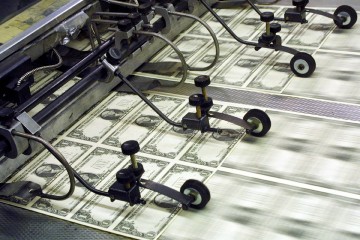
The Venezuela Money Printing Machine is Running at Full Speed

December 19, 2011

I had not looked at monetary liquidity M2 in a few months. This number measures the amount of money in the economy, including bank deposits.

I checked it yesterday and it had reached again US$ 100 billion at the official rate of exchange, in fact, to be precise, it is at US$ 102.3 billion after reaching US$ 100 billion on December 2nd, according to the Venezuelan Central Bank.

And yes, and I say it reached that number again, for the second time in the country’s history. You see, a year ago it had reached US$ 100 billion (US$ 113 billion to be precise), but then the Government through the magic of devaluation from Bs. 2.6 to Bs. 4.3, instantly pushed it down to US$ 68 billion on January 1st.

Thus, since the first of the year monetary liquidity has increased by 49%, or 57% since one year ago.

That’s a lot of new money out there. A lot of printing. That’s why inflation is so pesky, if rather than blame speculators and the oligarchs, the Government allowed M2 to rise more slowly, then inflation would ease.

It may sound like a chicken and egg problem, what comes first? The printing of money or the inflation? Well, I can assure you that if the rate of increase of M2 is double that of inflation like it is today (inflation is around 27%), inflation is surely going to go up. More so when the amount of goods available for sale has not increased much, certainly no more than low digits, while the amount of money has gone up dramatically.

It is simply too much new money chasing the same amount of goods.

And the amount of goods can not be increased via imports much. Imports this year are running more or less at the same pace as last year and right now, the ability of the Venezuelan Central Bank (or CADIVI) to give more money is quite limited. You see, a year ago when M2 was also US$ 100 billion, international reserves were about US$ 30.2 billion, of which gold was about US$ 16 billion. That is, “liquid” reserves (reserves-gold), with some caveats, was about US$ 14.2 billion. That is about six months of imports via CADIVI.

Today, reserves are down to US$ 27.7 billion, of which gold is about US$ 21 billion, that is a much smaller cushion of US$ 6.7 billion in liquid reserves and now the gold is harder to sell or pledge, because it is here. It would have to be shipped abroad first. Thus, the liquid part of reserves is slightly more than one quarter. A little more than three months, that’s all.

The worst part, is that the Government is very unlikely to devalue in 2012, because a devaluation would give inflation a push and you know who wants to be President forever. Thus, as the Government spends ahead of the 2012 election, to give people a felling of well being, M2 will increase more and more, making the idea of removing exchange controls more difficult. A year ago, there were Bs. 9.8 for each dollar in international reserves, today there are Bs. 15.9 for each dollar at the Venezuelan Central Bank (including the gold, of course). In a year, any attempt to remove exchange controls would require a bigger devaluation and more foreign currency to be able to defend a floating rate.

Barclays estimates that inflation in 2013 will reach 36%. The Government will pull all of the stops, decrees, bills and threats in order to slow down price increases. Unfortunately, this is a very difficult game as inflation accelerates, as the private sector may decide not to sell or make goods at a large loss. Then scarcity will increase and politically and scarcity seems to carry more weight with voters than inflation.

And no matter who wins the election, there will have to be a very significant adjustment to the rate of exchange in 2013. And thus, more inflation. The mirage of lower inflation moves further into the future, while the Government ignores the fact that it is the main driver behind it.

The Curious Downfall of the Heir Apparent to Hugo Chavez

December 17, 2011

It was one of the biggest political surprises of the last few months, if not years, when Hugo Chavez announced that his Foreign Minister Nicolas Maduro, would be the candidate for Governor of Carabobo State in 2012. Maduro had been considered Chavez’ heir apparent if it became necessary for the Venezuelan President to step aside in 2012 due to health reasons. In fact, many people, including yours truly, believed that Chavez would name Maduro as his Vice-President some time in the very near future, replacing Elias Jaua, who is not popular among various Chavista factions.

That all was not well in Maduro-land was barely noticeable last week when his wife, Cilia Flores, was replaced in the leadership of Chavez’ political party PSUV by none other than Diosdado Cabello, once also considered Chavez’  clear successor. But Flores had been in the doghouse for a while, as she had been removed early in 2011, before Chavez’ illness surfaced, as President of the Venezuelan National Assembly.

It was unclear why the sudden change of heart for Maduro, who had been acting in roles beyond that of Foreign Minister, including being the main speaker at a service held for Hugo Chavez in Manhattan and being part of the commission studying the changes to the new Labor Law. Maduro was also the only Cabinet Minister to go back and forth between Caracas and La Habana, when Hugo Chavez received treatment for his cancer in that city between June and September.

Chavez’ announcement was made the day after Maduro received an ovation that apparently irked the President, but I am sure there is much more to the story. For now, Chavez is in the search for a new Vice-President, with most betting that it will remain all in the family with his son in law, Jorge Arreaza, the current Minister of Science and Technology, being named Vice-President early in 2012*. His current Vice-President Elias Jaua, had already been nominated as candidate for Governor of Miranda State by Chavez a few months ago in what was believed to be an elegant way of disposing of Jaua.

Chavez is making daily changes to his entourage, with rumors that new important military appointments will be made soon. For now, none of the groups fighting for power feels they hold in a solid position, as the downfall of the heir apparent may simply be a signal by Chavez that he has yet to make his mind up. When he does, Maduro may be back, in another sideways move by the Venezuelan President.

*I don’t think that Arreaza can be Vice-President if I understand what “parentesco por afinidad” means in Art. 238 of the Venezuelan Constitution, which bans the VP from being related by blood and/or affinity to the President. I believe, but I am not 100% sure that Chavez is related to Arreaza by affinity.

A Gallery of Chavismo “cursileria” (Tastelessness)

December 14, 2011

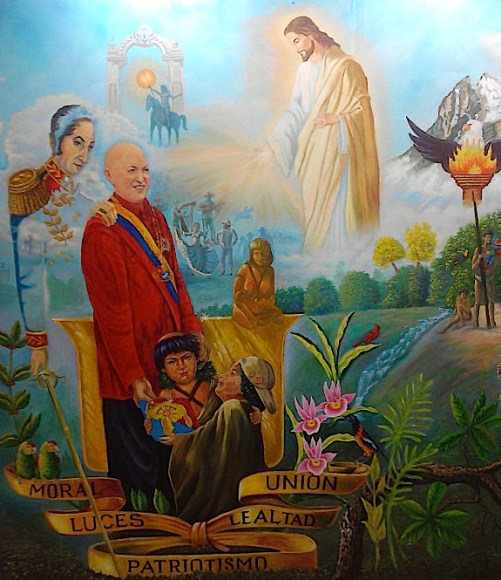
Yes, I read Tal Cual and saw the magnificent Guardia Nacional “cursi” tribute to Chavez that Daniel and Quico posted, but just did not have the time to post about the symbolism (Why so many indians? Really? Jesus Christ? Who is the guy in red?)

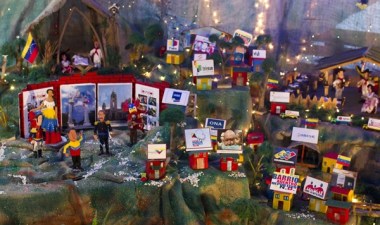
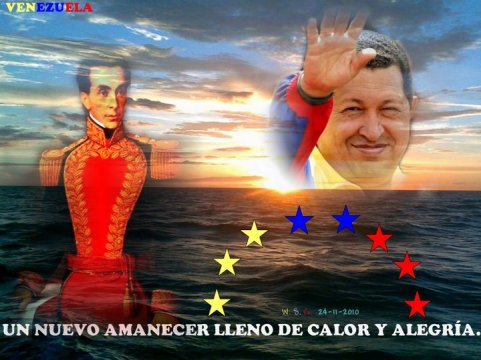
Thus, since I am late to the party, but the painting just has to be in this blog, here is a gallery of similar cursilerias from Chavismo, including today’s masterpiece:

Nativity Scene:

Bolivar and Hugo, or is it the other way around?

Merging his profile with the flag:

I guess Bolivar does goes first:

Just art

Sometimes Jesus comes in last:

and please don’t ask who is the guy with the beard, I have no clue.

How Did Crime In Venezuela Ever Get to Where It Is today?

December 12, 2011

It was 1988, Venezuelans were truly upset about crime. Imagine that! That year, there were all of 1,600 homicides in Venezuela, all of 9 homicides for 100,000 people.(I am using Veneconomy statistics)

Then came the Caracazo, the violence of that fateful day made numbers soar and that year, the number of homicides soared to 2,513. The coups in 1992 did not help numbers, 3,336 people were killed in 1992, doubled the number of 1988. And with it, gave way to the outrage and dissatisfaction that led to Hugo Chavez being elected. By the time Hugo came to power, 4,500 people were killed in Venezuela in 1998.

Today, the National observatory for Violence says there were 17.600 homicides in 2010, 57 deaths for each 100,000 inhabitants.

Almost seven times as much as of 1988 (per inhabitant)

Almost triple (per inhabitant) than when Chavez got to power.

These are homicides, the actual killing of a human being. Say nothing about the increase of theft, kidnappings or petty crime. The Government and people don’t even look or think about those numbers.

But look at the other side. According to the same Veneconomy numbers, when in 1998, the year before Hugo Chavez became President, the police made 118 arrests for each 100 homicides. Yes, they would detain more suspects than crimes, but they would be released.

Today that number is down significantly. How much?

Venezuelan police detains nine suspects for each 100 homicides.

That’s right. For each 100 people that lose their life only NINE are detained, many released when they are found not be involved.

Can Chavez be blamed for this?

You bet!

To begin with, he was the guy who refused to swear he would uphold the old Constitution, Yes, he created a new one, but he seems to have ignored it olympically.

But for 12 years, Chavez simply minimized security as an important issue. He dismantled a fairly competent police management created over the years, replacing them with former or active military with no clue as to how to fight or control crime. Meanwhile Chavez even justified stealing if you are hungry, much the way the Supreme Court decided to decriminalize invasions of private property today.

A prelude of new things to come.The end result will be the same, until the invaders take over the Justice’s property.And they will.

Meanwhile, the fight against crime becomes a struggle. Start with the numbers of weapons. After 13 year without control (and it wasn’t great before that!) the number of pistols, rifles and the like has also tripled. Unless you go and try to reduce that, there will be no progress.

Follow that with jails as full as they have ever been, where the jailed are innocent, half guilty and guilty, but now they all train for a new career in crime under one single roof. Ready for the real world next time the Minister for Prisons decides to lighten up the numbers.

Or take a Justice system that follows now the orders of the big honcho, jailing all those that make it alive to the prison. Yes, Hugo has discovered the crime problem and the cops are dealing with it the most effective political way: Kill them!

Do I need to go on? Not really. In the end, the question is not how we got here, but how do we get out of this?

Which goes back to Daniels’ question: Why do these opposition guys/gals want to be  President?

A Back of the Envelope Calculation of The Finances of a New Venezuelan Government

December 8, 2011

(To my friend: Yes, we can!)

Everyone worries about how a new Government would function financially  if there was to be a political transition in 2012. Personally, I think this is the least of our worries. Things like dealing with unions and personnel in PDVSA and nationalized companies will be orders or magnitude more difficult than dealing with “money”.

Here is why:

We are paying about US$ 6.5 billion for 30,000 Cuban doctors. Divide those two and you get about US$ 216,000 per doctor per year. Renegotiate this to Venezuelan doctor salaries and you have saved US$ 6 billion a year, about half of what the country and PDVSA issue in debt every year.

Then, there is Petrocaribe, sending oil to “country’s in need” and giving them easy credit conditions, like pay 50% now, two years grace period a less than 5% a year for the next like 25 years. The math is hard, there is barrels sent to Cuba, barrels sent to Petrocaribe and so on. But there is an easy way to quantify this: Last year, according to the Venezuelan Central Bank, accounts receivable with “friendly countries” reached US$ 23.088 billion. As of September 2011, this number had reached US$ 32.7 billion, a difference of, give and tale half a billion of US$ 9 billion in nine month or US$ 1 billion per month.

Yeap! This is the crazy revolution, borrow at 12% abroad and lend at 2-3% per year to your buddies, while your country goes hungry, enjoys shortages, malnutrition and the like. It is indeed a strange revolution.

But add the US$ 12 billion from these “friendly countries” and you are already up to US$ 18.5 billion a year in “savings”

Few countries in the world can find money so easily to balance the budget.

The Chavez Government has refused to do anything about gas prices. Gas is basically free today in Venezuela. We are talking about 700,000 barrels of oil a day given away (literally). At US$ 100 per barrel (it is more for the refined products we use) this is 700,000 x 365 x 100, some US$ 25.5 billion A YEAR in this subsidy. It is actually more, because producing this oil/gas is not free. Let’s say you decide to cover PDVSA’s cost, nothing more. That’s about (back of the envelope) about US$ 30 per barrel or US$ 7.65 billion a year. Say US$ 7 billion.

We are up to about to US$ 25.5 billion in “savings”

Now, the new President call him Leopoldo or Maria Corina, can call the IMF, the World Bank and/or CAF and from all of them extract without conditions, say US% 15 billion. With conditions you may get this up to US$ 30 billion, but politically, the conditions will be tough. So, we take the cheaper route.

We are up to US$ 40 billion, give or take half a billion. Nice war chest to remove exchange controls, no?

You could go bolder. Tell the Chinese you are sorry, but the law says you can’t pledge oil for loans and this will have to be renegotiated. Some US$ 10 billion in savings, as you will pay it slowly, let’s say at half the rate, 200,000 barrels a day, not 400,000.

We are up to US$ 50 billion.

Remove exchange controls. Buy back debt. Say you will not issue new debt. Change debt at 12% for multilateral debt at 5%.

Money will flow back into the country and you have yet to say you will privatize all those Government owned enterprises which are in intensive care.

Crazy?

Do the math, it is as simple as 1+1, the hard part will be dealing with real people…

How a Computer Virus Drove Venezuela’s Debt Up Higher Today.

December 7, 2011

If Venezuelan and PDVSA bonds are worth some US$ 60 billion, then today a computer virus made them gain about US$ 1.2 billion, just like that, as the virus was embedded in an email with a headline mourning the death of none other than Hugo Chavez.

The whole thing was bizarre. Venezuela and PDVSA bonds were sort of mixed in the morning and all of a sudden, around noon, I noticed they were up strongly, but there was no news explaining it. Then, a friend calls and tells me New York is full of rumors suggesting that Chavez may have died. I got a dozen calls or cahts on the topic within minutes. Given that he supposedly signed some documents mid-morning, it was hard to believe this could be true.

But the rally kept going. It was only later, that another friend sent me this denial by La Prensa:

You can read it better in the original, but basically it says that this email purportedly showing a page from Panama’s La Prensa was circulating, saying “All of Venezuela in Mourning” because of Chavez’ death. But the whole thing turned out to be a virus, as if you clicked in the video of Chavez, it would download a virus which supposedly takes over your PC.

Well, some people did not even click, they believed the news and it spread all the way to debt markets, where it had a not insignificant effect. Even Panama’s Police felt it had to issue a warning.

Go figure!

Some people speculated the virus came out of the Presidential Palace. Others joked it had to be fake, how could it say “All of Venezuela in Mourning”. But in the end, the underlying truth is that debt markets would have an incredible rally if there wa the possibility of political change in Venezuela. And I understand why. What I don’t understand is how not knowing how orderly or disorderly that transition may be, does not make a difference. Just think, if the news had been right, Venezuela’s President would be Elias Jaua, a lightweight politically. Jaua just happens to be in Russia today, I wonder what his enemies would have done about that if the news had been true.

But the effect is there, an orderly political transition in 2012 will lead to the rally of a lifetime in Venezuelan paper. In fact, the possibility of such a transition should n itself provide a rally for the books.