Archive for the 'Venezuela' Category

New Venezuelan National Assembly Sworn in today

January 5, 2011

I know, I know, I should have blogged about today’s swearing in of the new National Assembly. Sure it was good to have opposition Deputies back, my biggest surprise was that there was no violence, I guess Hugo must have ordered good behavior to his troops because the world was watching, I was sure there was going to be violence, the same way I was sure Hugo was not going to back track on the University Bill, which shows how much I really know, even if I try to “think” like Chavismo, which sounds oxymoronic.

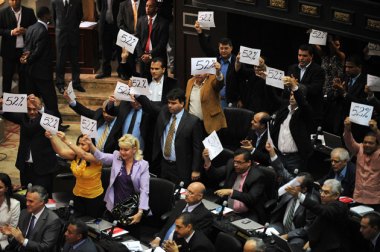
So, let’s review: No violence, that was good. Signs saying 52.2% for the opposition, you have to love this picture:

that was also good, seeing opposition Deputies there and talking, that is also good. Even juts bringing up boring points of order, like the fact that the Supreme Court request could not be in today’s agenda, that is good. Having Chavez say that they are going to crush opposition Deputies, that is also very good. Just wondering what he means for now.

The cool thing is the opposition is back, “No volveran” is dumb at this point in time, so it is good for Chavez and his minions to keep repeating it, they are back, whether they wanted it or not.

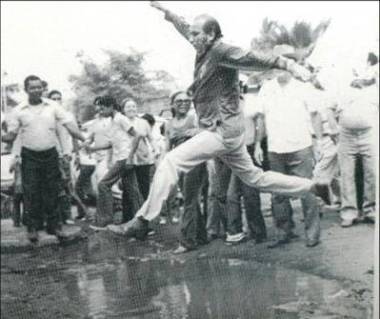
The bad part was watching the new President of the Assembly, Fernando Soto Rojas, swear himself in. He made Cilia Flores look good, imagine that! But knowing the guys background is the worst part. Talk about being Vende Patria! This guy killed Venezuelan soldiers and is proud of it! This guy is a Cubanoid, he helped Cubans attempt an invasion of Venezuela! This guy was actually rejected by the voters and Chavez illegally inserted him into the slate in a State this guy does not live or vote in!

Just watch him, Was he really drunk? I don’t know, but his intimate chat with Simon Bolivar gave me the creeps, he is certainly not what I want for our leadership. Where did he get that suit? If you don’t speak Spanish, it does not really matter, the body language says it all :

But maybe what bothered me the most was the public, not only applauding him, but taping him! Were they his grandchildren?

So, this is my much reluctant National Assembly post, sorry if you expected more, there wasn’t much beyond what we already knew…

How Cheap is Gasoline in Venezuela? Another Reality Check

January 5, 2011

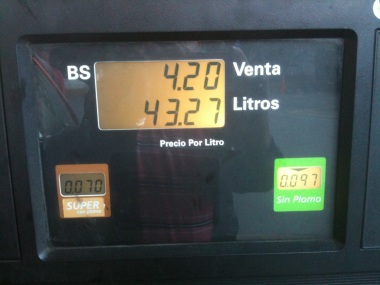
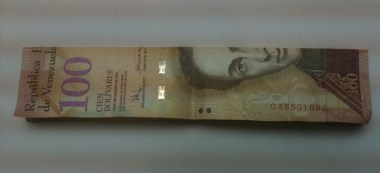
After a few discussions with readers, I decided to do another reality check on the price of gasoline in Venezuela. For all intents and purposes, it is free, no cost, zippo, as the picture above demonstrates.

I filled my tank yesterday. I used 93 octane, unleaded, which in Venezuela costs Bs. 0.097 per liter as you can see above in the green square.

Now, let me explain that Bs. 0.097. With the latest devaluation, the lowest exchange rate available is Bs. 4.3 per US$, which menas that a liter of gasoline in Venezuela is:

(Bs. 0.097/Bs. 4.3)= 0.0225 US$ cents

A number so small, that it is hard to relate to. Try 8.5 cents a gallon, yes US$ 0.085 per gallon or 35 times cheaper than the $3 gallon which prevails today in the US. Think about it, 35 times cheaper!

That is why I prefer for you to look at the other number: I got 43.27 liters for Bs. 4.2, or I filled my tank for less than a US dollar, exactly 97.6 cents.

Of course, there are exchange rates which are worse than Bs. 4.3 per dollar, like the Central Bank’s SITME system, which is Bs. 5.3 or the “forbidden rate”, which are even higher. If you use those, it is even cheaper.

Let’s put it in perspective: A bottle of water of 300 ml. or so, costs Bs. 7, more that my tank of gasoline. A can of Coca Cola about Bs. 6 or 7, also more than my tank of gas. I had a salad today, Bs. 50, ten times a tank of gas, well actually 11.9 times if you want to be precise.

I have a brother who fills his motorcycle with Bs. 0.45, gives the attendant Bs. 1 and tells him to keep the rest. The other day, my bother only had a Bs. 10 bill, gave it to the attendant and he said, no, it’s ok. The gas is indeed free!

So, if you double it, it is still free. Zero impact.

Think about it a different way: A barrel of gasoline is about 203 liters. It sells in Venezuela for US$ 4. It costs to produce at least US$ 20 at the new “low” exchange rate. Venezuelans use about 800,000 barrels of gasoline a day, times 365 times $16 of production subsidy is about US$ 4.6 billion. And I am probably low in the estimate. Of course, we could export it too and even make money. What a capitalist concept!

But think. Who owns cars? Rich people. Poor people go in buses. The impact of a one dollar tank of gas on the ticket price is zilch, zero, ok, it’s 1x 10⁻³, basically irrelevant. For the rich, it is a nice subsidy. Traffic is hell, so in the end we pay for it anyway.

Get the picture?

Evo Morales increased the price of gas from about 50 cents a gallon to 90 cents a gallon. He had to back track. But he went back to prices which are six times higher than in Venezuela, he wanted to make it almost twelve times more expensive.

This goes back to my old question: Can we insert a little rationality into our system, please!!!

Note added: Reader Lazarus, who knows the stuff, does the calculation in the comments for the size of the subsidy, here is his conclusion:

The loss opportunity cost to the country? Estimating, conservatively, 500,000 bbl per day internal consumption, if sold at the international market price of ~$120 per barrel of refined product, less the $3.50 actual sales prices, is about $58 million per day (BsF 267 million). Annually comes to $21 BILLION.

As he says, you could build a lot of stuff with that amount.

(By a remarkable coincidence, both Caracas Chronicles and Setty discuss the same topic today from different angles, maybe we should send all three posts to Ramirez and someone in the Government who speaks English)

Chavismo really thinks Venezuelans are stupid

January 4, 2011

Here is the top chart of statements that prove Chavismo thinks Venezuelans are stupid:

At #1, Minister for the Productive Economy Ricardo Menéndez: “Unifying the exchange rate could even lower prices in Venezuela”

Sure Ricardo, we are stupid, really stupid.

At #2, Armando Leon, Central Bank Director: ” In practical terms, there is no devaluation, because the implicit exchange rate that is used to fix prices of the things that are being sold in the economy is not Bs. 2.6 and that is what we have observed during the last four months of the year and we had warned about it”

Get it? I don’t. If someone has to pay 65% more for the same thing, that means that someone is going to want 65% more to sell the stuff. But yes Armando, we are stupid. Remember the Bolivar “fuerte”?

At #3, Jorge Giordani, Minsiter of Finance: “Unifying the exchange rate will have a minor impact on inflation”

It must be that he thinks “minor” is like the age of a human being, that is, minor means under 18….percent!

At #4, Hugo Chavez, Dictator: “They say we are generating the conditions to apply a neoliberal adjustment. It is, of course, a strategy to lie outrageously in order to create confusion…monopolistic power, with Fedecamaras in the lead, inflates prices, disregarding economic rationality and laughing at the people”

I got stuck on the “disregarding economic rationality part”, just that he uses “economic rationality” blew my mind.  He is clearly absolutely sure we are stupid.

More on the Venezuelan devaluation

January 3, 2011

When the Government decided to unify the exchange rate last week, it did something that was necessary, but at the same time it is an isolated measure that in the end does little if nothing else is done to the economy. As I have said too many times, the problem is that the Government has established so many controls of the economy, that everything is distorted and when you touch one of these distortions it reverberates negatively throughout the economy. This devaluation from Bs. 2.6 to Bs. 4.3 is one more example of that.

The Venezuelan economy contracted 1.9% in 2010, after shrinking by 3.3% in 2009. Think about this, it is eight consecutive semesters of contraction, this is a long recession by any standards and there seems to be no end to it.

The problem is in part that there are no real economists running the show. Thus, the plans and decisions which are made are simply stop gap measures to what the Government perceives are the problems. And for the Government this means spending, that is all that it seems to be focused on all the time.

But think about it, oil prices are near $80 for the Venezuelan oil basket and the Chavez Government does not have enough money to live on. And with stagflation destroying productivity, the Government decides to increase the VAT, reestablish a financial transaction tax and devaluing the rate from Bs. 2.6 to Bs. 4.3, which applied basically to food and medicines.

Jeez, if that is loving the poor, they are getting too much loving from Hugo and Giordani, because all of those measures happen to hurt the poor the most.

-The VAT is a great tax to collect for the Government, but since the poor spend all their money, it is a tax that gets them the most.

-The Financial transaction tax is only applied to those that have bank accounts, which does not include the poor, but it is a cost that will be translated into inflation.

-The 65% increase in food and medicines impacts the poor the most, as they spend more of their income on food than anything else.

-The gasoline subsidy benefits the rich the most. By now gasoline is essentially free, for $1 you can fill your tank in Venezuela (and that includes a tip too)

The devaluation is estimated will give the Government about Bs. 13 billion in additional income, about US$ 3 billion, but it could have achieved more by adjusting gasoline prices at the same time. Doubling the price of gasoline from Bs. 0.1 to Bs. 0.2, i.e. from nothing to nothing, would have given PDVSA US$ 1 billion in additional income, but would have had much less inflationary impact on the poor.

Because in the end it is a strange devaluation. It moves the Bs. 2.6 to Bs. 4.3, but PDVSA changes more of its currency at the higher rate. Thus, it generates fewer new Bolivars for PDVSA, while making it more expensive for the Government to subsidize the imports. Why not do a little of everything? Why not slide the others? Or eliminate the Bs. 4.3 and have all go trough SITME at Bs. 5.3? I guess it’s too moo much to ask of the current financial authorities to show some coherence.

But in the end, the problem is that all of the announcements are fiscal measures that benefit the Government, but there are no announcements that help improve salaries, productivity, restore confidence, reduce gas consumption and/or attack the basic distortions in the economy. So, you have the worst of shock therapy to the economy, without doing anything constructive.

The only sector that benefits from these measures are local producers, who will be able to compete with imports that were being subsidized. This will be a good year for them. Their problem is that the Government is unlikely to increase prices instantly. It will likely drag its feet for two or three months trying to delay the spike in inflation or at least spread it around.

Exporters, despite claims to the contrary are indifferent to the devaluation. They have received the higher Bs. 4.3 rate since January 2010, despite which non traditional exports did not go up in 2010.

In part the problem is that the government does not even seem to remember why it imposed exchange controls. In its control mindset, it does not even consider eliminating it, which would in the end boost the economy after the initial impact. The current system of controls is costly, time consuming and creates arbitrage opportunities (which are reduced by the recent devaluation). Simply the changes in rules, delay investment and decisions. It is preferable to have a single exchange rate and find ways of subsidizing those that really need it.

The Government loses credibility when it says that this devaluation will have little impact on inflation. over 70% of imports were made in 2010 at the lower rate of Bs. 2.6 per US$. If the Government does not allow price increases, there will be shortages, but it should not delay the approvals, they will go against is goal to get the economy moving.

I still think that 2011 may yield another negative GDP year. The wild card as usual is oil, which may move to $100 per barrel and stay there. Even then growth will be anemic, inflation will top 30% and in the middle of another oil boom, the Venezuelan economy will continue to be one of the worst ones in the world.

And guess who is to blame for that?

Hugo smiling at the Empire

January 1, 2011

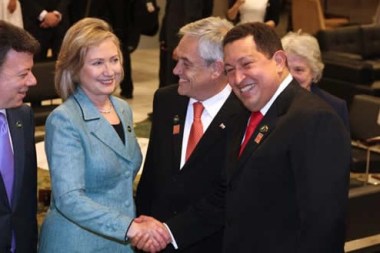
No post today, but could not resist putting these pictures up and ask, what’s your best caption?

Santos: Don’t worry, he is not a suicide bomber

Hillary Clinton: Is he kidding me, he wants to shake my hand?

Piňera: Boy! He has gotten fat!

Hugo: Friends again?

Santos: See, there was no bomb in his hand!

Hillary Clinton: I hate diplomacy, ick!

Piňera: He has no clue, don’t worry!

Hugo: Women can’t resiste me. I am so handsome!

Venezuelan Minister of Finance announces sharp devaluation of currency

December 30, 2010

Jorge Giordani, Venezuela’s Minister of Finance announced the devaluation of the “lower” official exchange rate of Bs. 2.6 per US$ to unify it with the Bs. 4.3 rate, essentially devaluing the exchange rate for all essential items by 65%. This decision affects the whole structure of subsidies (except energy) created by the Chavez Government in the last seven years, which was based on direct imports of food and pharmaceuticals at the lower rate, which was kept at Bs. 2.15 per US$ since 2005, increased to Bs. 2.6 per US$ in January 2010 and now increased again to Bs. 4.3 per US$.

The move is, in my opinion, a political one, it is a brutal devaluation which will have a huge inflationary impact in 2011, but whose effects will dissipate in 2012 and by making it so large now, removes the need for an additional devaluation before the 2012 elections. It removes partially the distortion that the multiple exchange rates cause, but it only goes half way and does not include additional measures.

The move does nothing for exports, all exports (except PDVSA changing its foreign currency, part of it had to be exchanged at Bs. 2.6) had been receiving Bs. 4.3 per US$ since January of 2010.

In terms of inflation, this will certainly contract demand and the Government is likely to postpone price increases until shortages appear, but the overall impact in the next few months is certainly going to be quite dramatic, particularly for the poor.

The announcement does signal that Minister Giordani is in charge, despite the terrible performance of the economy under his guidance. Perhaps nothing exemplifies his ability for deceit as saying that “this measure is adopted to place the citizens at the center of economic decisions”.

What he did not say is that he is aiming at them with a fully loaded inflationary gun.

Can Venezuela be run in a rational way?

December 28, 2010

Somehow two items in the news have suggested to me in the last few days that anyone trying to run Venezuela in a rational way would have a hard time doing it. It seems that even rational decisions receive irrational responses in this country:

1) Corpoelec has proposed an electric rate increase after eight years of freeze. The most common reaction has been to say that if Corpoelec gives such bad service, how can it possibly aspire to a rate increase. This argument is simply garbage. It is precisely the fact that rates have been frozen for eight years that has led to the crappy service given by Corpoelec. Just think, since 2002, when rates were last increased, inflation has gone up by 890%, so that in real terms, rates are lower dramatically, and people expect good service! Sure! Of course, the service is bad in part because Corpoelec is not run efficiently, but the Government simply can’t give everything away. This is no way to run a country.

How cheap is electricity in Venezuela? Well, my bill last month was about 1.6 US dollars cents per Kwh, about a quarter of the typical value in Latin America or a tenth of what it costs in developed countries. What is Corpoelec proposing? A 30% increase! Imagine that, the nerve!

Hopeless!

2) And people have laughed at Evo Morales for increasing the price of gas. Morales took the decision to increase gasoline prices by 83% and diesel prices by 73%, keeping natural gas prices for the home frozen. Prices had not been increased in six years (inflation has averaged about 9% per annum in those six years there). Gasoline prices are now expensive in Bolivia, relatively speaking. One liter of gas will now be 6.47 Bolivianos which is about US$ 0.9. Thus, Morales is simply selling it at international prices.

I can not disagree with that. If energy is expensive there is no reason to subsidize it massively like is happening in Venezuela or was happening in Bolivia. These subsidies always end up being asymmetric and rarely favor those who need it most. So, rather than criticize Evo Morales, we should praise him for trying to rationalize his economy, even if other things are not as rational. It is a first step. We should use it as an example of what Hugo should do, not the other way around.

So, good riddance if Chavez ever leaves. You will be demonized no matter what you do or try to do, however rational it may be. People really want to have their cake and eat it too.

And the cake better be free!

Carlos Andres Perez dead at 88

December 26, 2010

Carlos Andres Perez, twice Venezuela’s President in 1974 and 1989 died yesterday at 88. A controversial figure, CAP, as he was known, was twice in exile as a young Adeco activist in 1948 and the 1950’s and was in charge of the fight against guerrillas during Romulo Betancourt’s presidency from 1959 to 1964, first as a Director General of the Ministry of Interior and Justice and later as Minister. He developed an image of being tough during this time. When the 1973 Presidential campaign arrived, Romulo Betancourt quickly said he would not be a candidate, leaving the field open for CAP. It was the first multimedia electoral campaign in Venezuela’s history with CAP projecting an energetic image (he was a tireless worker), visiting all corners of the country and defeating Lorenzo Fernandez of the incumbent COPEI party.

Once elected, CAP was dramatic the first few months of his presidency, nationalizing oil and iron his first day in power, benefiting from the sharp rise in oil prices. But CAP, like most Venezuelan Presidents, had no economic knowledge and his Government was a hodge podge of Cepal-like recipes and the conception that the Government could do it all. But he dazzled the population, in the first month in power, he cleaned up Caracas, froze the prize of arepas (which made areperas disappear in short order) and decreed that all elevators had to have an operator, as a way of creating employment (Pleno empleo, full employment, was his motto).

The economy boomed, thanks to the oil windfall, but the same windfall hid all of the problems as CAP developed his vision of the “Gran Venezuela”. Money was thrown at steel, aluminum and technology projects in which the Government was the owner or provided the financing, but there was little control and/or know how to make it successful. He did try to protect some of the windfall, creating the Fondo de Inversiones de Venezuela, reduced oil production because so much money was not needed and maintained the structure of the oil industry before it was nationalized, creating PDVSA and naming General Ravard to preside it.

The boom was so huge that everyone benefited, poverty reached the lowest levels in Venezuela’s history, he created the Mariscal de Ayacucho program that sent 10,000 Venezuelans abroad for mostly graduate degrees, protected wild areas in National Parks, he created the oil research institute INTEVEP, he built important hydroelectric projects.

He was a democrat and he was a populist, a bit of megalomaniac, worried about his image and his legacy. He gave a boat to Bolivia which has no ports, as a symbol of its fight to have access to the sea. He reached out to Fidel Castro, while shunning the Dictators from the South, while making it attractive and facilitating for thousands of highly educated people from the latter countries to move to Venezuela to help in his push to increase the number of university students.

But his economic policies had as their central theme the intervention by the State. He removed the independence of the Venezuelan Central Bank, while increasing salaries periodically, which debased the currency leading to inflation. Venezuela was not ready for the huge inflows and there were lots of corrupt people ready to make a lot of money off the Government. By the end of his term, corruption charges, including the infamous Sierra Nevada refrigerated boat scandal, tarnished his image. He was brought to trial because of that case, curiously, it was Jose Vicente Rangel who cast the deciding vote to exonerate CAP. That was CAP, he was capable of talking to everyone and anyone, even his staunchest enemies felt that he was someone he could talk to.

His last year in power, oil prices dropped, forcing CAP to lower the budget by 10%, Venezuelans had the feeling that things were worse for the first time in many years (little did they know!) and his party lost.

CAP spent the ten years required by law between terms, traveling around the world, involving himself with the South commission and talking to world leaders. This changed his ideas, but still, he had little economic knowledge and as he ran for President in 1988, he promised  to return to the hey day years of his first term.

But it was not be. CAP reached out to a group of well educated non-adecos, including those that were involved in studies on how to change the state. It was not until they began talking to the people of the Lusinchi Government, after CAP was elected. that they realized how dire the situation was. International reserves were less than US$400 million. After a lavish “crowning” with all of the pomposity that was simply out of place, the CAP Government realized that they needed help form the IMF and imposed an adjustment program, a “shock” program that included increasing gasoline prices by 100%, interest rate increases, the increase of public tariffs, freeing of prices that had been frozen for years, eliminating tariffs and allow the currency to float.

One month after taking power, having won with 56% of the popular vote, riots started the “Caracazo” four days of rioting and protests against the gasoline price increase that cast a shadow over CAP’s Presidency. He believed people had the right to protest, doing little the first two days and the protests and the looting go out of hand. In the end an estimated 276 people died and the looting was in the millions. His Government was a lame duck Government even before he started.

But he pressed on. His intuition was right, that he was very good at. He implemented or began to implement many of the reforms suggested by the Commission for the Reform of the State, including the election of Governors, tax reform and the general decentralization of the Government. He was changing things very fast.

But his own party AD felt it had been replaced by these “technocrats” and he had opposition from within. His cabinet was composed of very knowledgable, very well prepared people, most of which had no political experience. CAP was supposed to take care of the politics, but he did not, it was an ego thing and that was what doomed him. Policies were working, the economy grew by over 9% in 1991 after all the adjustments, CAP thought he had no worries.

A group of people the self called “Notables”, mostly intellectuals, who had always opposed CAP and envied his popularity, began calling for his removal. Chavez followed this with his coup in February 1992 (which had been in the works for a decade!), weakening the Government further. When it was discovered that CAP had used funds from the secret slush fund to provide security to Violate Chamorro in Nicaragua and exchanged it at a preferential rate when the Government was ready to devalue, he was accused and impeached. He was later sentenced to 28 months in prison and charged with other crimes. He was elected Senator in 1998, which gave him immunity, but the 2000 Constitution eliminated the Senate and this rule, removing the protection he had. He never returned to Venezuela.

He was in the end, a true democrat, too ignorant on economic matters to have a coherent plan, but smart enough to follow his instincts with his collaborators, he allowed corruption to flourish around him, there was so much money to be made. But he did many positive things, implementing changes in his second Government that were very important. Some of them even took power away from him! He was willing to change, but sadly he did not sell the change the same way he sold himself. On a relative scale, he was not that bad, better than Caldera, who would never change, better than Luis Herrera, who had no program on how to change the country, better than Lusinchi, who had no clue. Betancourt was better, because he understood economics, oil and what the country needed, he had a program. Leoni simply followed Betancourt’s plans with honesty and surrounded by many of the same people.

And of course, he was much better than Hugo, who is not a democrat and has failed at all of his economic initiatives, allowing the largest corruption levels in Venezuela’s history and failing to leverage the biggest oil boom in the country;s history for the benefit of the people.

May Carlos Andres Perez rest in peace!
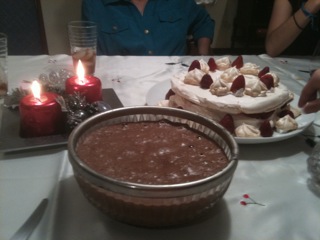
Some nice desserts for Christmas, diet starts next week

December 25, 2010

Merry Chistmas to all and Thanks for Reading the Devil

December 24, 2010

Even the Devil celebrates Christmas. Soon my family will arrive, we will have some nice drinks and then we will dig into our hallacas and pernil like most Venezuelans do. The group is getting smaller, as not only people leave for Christmas, but they also leave the country all together. We even know who will be next. At this rate, Christmas will soon be celebrated elsewhere.

But it will be a fine night, we will exchange presents, we will talk, laugh and we will try to ignore our surroundings for a few hours, we will stay up late, watch the impromptu fireworks and go to bed late for no other reason that we are happy to be together and we are all healthy.

And to you all, I wish that you have as much fun as I plan to have and get all your wishes tonight or tomorrow whichever you celebrate in your family.

Thanks for reading!