Archive for the 'Venezuela' Category

The Bolivarian Diaspora

July 18, 2009

(Este post está en español aquí)

Somehow I missed this article “The Bolivarian Brain Drain” in Newsweek at the beginning of the month. It details how the revolution is forcing the best and the brightest of the country to emigrate and more do not leave simply because they can’t.

Sadly this is all true, Venezuelans did not use to emigrate, they would always come back, but now:

And now after a decade of the so-called Bolivarian revolution, tens of thousands of disillusioned Venezuelan professionals have had enough. Artists, lawyers, physicians, managers and engineers are leaving the country by droves, while those already abroad are scrapping plans to return. The wealthiest among them are buying condos in Miami and Panama City. Cashiered oil engineers are working rigs in the North Sea and sifting the tar sands of western Canada. Those of European descent have applied for passports from their native lands. Academic scholarships are lifeboats. An estimated million Venezuelans have moved abroad in the decade since Chávez took power.”

And how about these draconian statements:

The number of papers published by Venezuelans in international scientific journals fell from 958 to 831, a 15 percent drop in just the last three years…An estimated 9,000 Venezuelan scientists are currently living in the U.S. – compared to 6,000 employed in Venezuela…Up until 2003, researchers at the company’s Center for Technological research and Development generated 20 to 30 patents a year. Last year it produced none, even though its staff has doubled.

and then the obvious conclusion:

“For the nations of the Bolivarian Revolution, this means some dark days are likely to be ahead. Even the wealthiest nations could ill afford to lose their best and brightest

While Curiepe’s drums were calling for war, the Venezuelan Government censored them

July 16, 2009

(Este post está en español aquí)

If the recent aggressiveness by the Chavez administration reflects the fear by the Dictator that his popularity may be dropping like a stone, the recent protests and riots in Curiepe, must be sending shivers down Chavez’ spine. Because Curiepe’s uprising can’t just be shoved under the rug like the Government tried to do by having the official media ignore the riots, no more than it can blame the events on some mastermind plot by opposition sabotageurs like the Major of that city tried to do.

You see, Curiepe is pro-Chavez territory, Mayor Liliana Gonzalez won last November with 2,059 votes  (48.48%) versus 1,414 (33.29%)  for her closest opponent who was indeed for the opposition. But the drums of Curiepe began crying for war yesterday over the defenestration of their local police and despite the attempt to surprise the city’s population with the National Guard raid on the police headquarters in the early hours of the morning, the people came out en force. And they were outraged once the National Guard began spraying tear gas, getting everyone out into the streets, including eighty and ninety year old women. And this man in his Che Guevara t-shirt being gassed below looks little like part of the opposition as the Curiepe Mayor would like you to believe

che

and if the pictures below are pictures of the opposition “destabilizing” the Government, then Chavez, Ramirez, Diosdado and the other cohorts of the revolution are really out of touch:

dos

Because the Government did not blow it once, but twice in dealing with this confrontation. The first one was to think that out of town and heavily armed National Guardsmen would be welcomed into Curiepe to remove the local police, composed of townies, out of their headquarters, just because Chavez and his Government wanted to limit the power of police of the State of Miranda, now that the people made the mistake of electing an opposition Governor.

Because this is the typical useless plan and fight that the Chavez Government engages in that takes up a lot of its time to obtain a political victory, but yields little, if any, benefit to the people, whether they support the revolution or not.

It all started with the defeat of pretty eyes Cabello to the Governorship of Miranda State last November. Clearly, while numbers were indicating Cabello would lose due to his low popularity, Cabello somehow thought that mobilizing and paying voters (and who knows what else!) would somehow give him the victory despite his lag in the polls. But it was not to be and Cabello scrambled to move money out of the Governorship before handing over power and decided to reduce the power of the State police, knows as Polimiranda.

On November 28th. 2008, the day before the new Governor was sworn in, thousands of weapons were removed from local policemen and ever since then, there has been a constant bickering over jurisdiction between the National Guard and the local police. The Government has sent in National Guardsmen in three towns, to remove the local police and replace it with out of town guardsmen. The moves, which have no legal basis, have been resisted by the population as they realize that no matter how bad Polimiranda may be, at least they are there for them when it comes to stopping crime and defending the people in the town. In contrast, the people view the National gaurd as their out of town repressive enemies, ready to act against them if orders from their superior says so.

And when the Guardsmen came in and removed the police from their headquarters, with the backing of the Chavista Mayor, the people were mad and the drums began calling for war against the invasion. And when tear gas was used, the population was incensed as women are children were out in the streets defending what little quality of life they could have with the thought that Polimiranda was there for them.

And while this was being shown on the traditional media, the Government sponsored media, VTV, Telesur, ABN, simply ignored the riots for over half a day. Thus, even those who are pro-Chavez had to go and watch (God forbid!) Globovision or Venevision, because their leader was censoring the repression of Curiepe. And this attempt at censorship was simply too close to Chavez and his cronies expressing their outrage  over censorship in Honduras.

And as a tense calm spreads over Curiepe, the reality is that the people are upset. And having the Head of the National Guard come on TV to say that the Curiepe operation was “impeccable” is not precisely what the people of Curiepe wanted to hear. And to deny the existence of injuries simply shows how insensitive the “people’s” Government has become. Somehow the needs of the Honduran people seem to be more important to the Dictator than their own.

And as the Government dismisses Curiepe, it also minimizes the problems in Guayana or today’s very succesful strike in the country’s universities. But the people are not dumb, they understand the implications of shutting down the radio stations for their ability to be informed, the same way they resent Zelaya’s jet setting in PDVSA’s jets and the “new”  limits over Government officials pay which sets an upper bound of US$ 95,000 for the salary of a revolutionary Deputy, Minister or Justice.

And as even aporrea.org seems to maintain a surprising silence over Curiepe. Chavismo should learn from history and heed the war cry of Curiepe’s drums. Because they are not being played for San Juan, following tradition, they are being played as a protest and in the defense of the people who only six months ago, believed that Hugo Chavez was best for their future, but today are willing to go and fight his emissaries, even if their only weapons are the drums and their outrage.

And both of them may be signaling that the people want attention and demand that Chavez stay home and worry about their problems and not those of far away lands which are difficult for the average Venezuelan to even imagine.

The promotion of hate and discrimination by the not so democratic Government of Venezuela

July 14, 2009

(Este post está en español aquí)

oligarchy

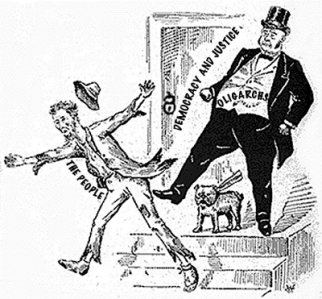
While idiotic cheerleaders of Chavez and his empty revolution scream democracy in every corner, the actions and words of Chavez and his cronies, promote exactly the opposite of the democratic values that any civilized and free society should have.

Today it was the turn of the all powerful Minister of Energy and Mines and President of PDVSA, rabid fanatic Rafael Ramirez, who begins by confusing who is the oligarch now in this country. It is him that pushes the strings, allows the corruption, flies in jets at whim, hires family members and goes shopping in “ta barato” trips abroad. So HE is the oligarchy now, so he can talk about the opposition, but the oligarchy now is in part led by him and it even has a popular name: The Bolibourgeois.

That is the new oligarchy. The one that controls the bilions in Venezuela and pay themselves millions to boot. The one that can get you jailed either if you are viewed as an enemy, or if you are a friend that does not want to obey orders from the top. The new political Mafia that has taken politics in Venezuela to the realm of white collar crime and bandits. The ones that are slowly allowing this new class to take over the country without effort, just contacts and commissions, no real business or abilities behind them.

But beyond the misconceptions of the Minister about oligarchies, are his words. His words that are not only discriminatory, but which establish hate as a valid political position in Venezuela. No democracy can function like that. A democratic society is supposed to follow the laws, promote respect and human rights of all kinds, not hate and fanaticism as Ramirez clearly does.

His words leave no room for interpretation, PDVSA and PSUV are one, and:

“PDVSA is not only red, very red,  but moreover PDVSA is with Chavez…the oligarchy has to fear us, because we hate the oligarchy..PDVSA will be here at the forefront of the revolution under the leadership of Commander Chavez. That is a reality and it is important that we assume it”

Need I say more? These are not the words of the Minister of any democratic country whose Constitution claims to defend equality and the defense of human rights. These are the words of a political bully, a hatchet man for the Dictator, a fanatic who believes the end justifies the means.

This is not new, this was the man that fired 90% of the scientists and engineers of Venezuela’s premier oil research and development center INTEVEP and still celebrates doing it. By firing them and blacklisting them at the same time, he drove them abroad, the largest contingent to Canada, where they now work for the competition. Some strategy, no? And anyone that argues that Venezuela does not need them is simply a fool, as Ramirez has doubled the number of workers at PDVSA, but production keeps dropping and investment is down to nothing.

But for Ramirez such as concepts as a more efficient PDVSA for the good of Venezuelans are not important, what matters is to insure and guarantee the permanent presence of Hugo Chavez in power, no matter what the cost. If it requires allowing corruption (Remember Maletagate?) so be it. If it requires destroying the country’s oil technology, so be it. If it requires firing more people, who cares?

Because in the end Ramirez’ trip was not even about the oligarchy. It was not about Chavez. It was about the fact that Ramirez wants the pro-Chavez union to win in the upcoming elections. Otherwise, he refuses to negotiate with the union that represents the “oligarchy”, i.e. not Chavez, if you are to believe such an oxymoronic concept. Only a feeble and fascist mind like Ramirez can believe such BS. In  fact, the members of Slate 9, a pro-Chavez slate to the oil workers union told Ramirez so in no uncertain terms: “You are the enemy we have to beat…we are with the revolution, but you are causing a lot of damage to the industry and its workers… we will not allow your intromission in labor matters.”

Is it clear who is the oligarch now? Is it clear who is against democracy in Venezuela? It is clear who is helping destroy the country and its principles?

After ten years of destruction and discrimination, people are getting fed up with this mediocre and hate promoting leadership. But they continue to act as if they will be there forever.

Note added: I missed the following phrase: “Worker that is not part of a socialist committee is suspect of conspiring against the revolution”

Two more double standards at work: Chavez’ brother and the not so innocent OAS

July 13, 2009

Double standards seem to be the rule of the day in this cynical world of Venezuelan and Latin American politics. Today we suffered through two cases, one new, one old, where the double standards of the robolution and its new found friend the OAS and its Secretary General are simply too sickening to pass up and note:

i) Those “poor” Telesur reporters: And while we are being bombarded by repotrts of the mistreatment of the Telesur reporters in Honduras (who just happened to be driving cars that had been reported stolen), I learn of the fact that Chavez’ brother, the Governor of Barinas State Adan Chavez, had New York Times reporter Scott Dalton kicked out of the political event presided by him, because Dalton was “suspected” of being a CIA spy or something like that.

Meanwhile, the outcry over Honduras detaining and kicking out the Telesur reporters does not cease, but Chavez was shown to be behind the effort to violate Honduras laws and promote the referendum to hold a Constituent Assembly in Honduras.

The difference between the two? Telesur is the very overt TV station of the Chavez revolution and its role in transmitting what is happening in Honduras has been very political from day one. While the OAS and the Venezuelan Reporters Association condemn what happened in Honduras, no mention is being made of what the Presidents’  fascist brother ordered done last week. Where is Izarra when it does not affect his personal and/or political interests?

ii) The not so innocent OAS: And the cynical and not so innocent OAS Secretary General Insulza turns out to have played a much more controversial and relevant role on the Zelaya referendum. Not only did the Supreme Court of Honduras rule the referendum illegal, but it turns out that the Congress of Honduras asked the OAS to withdraw the observers from the illegal vote and the motion approved by that body  expressed its surprise that the OAS would take part in such an illegal act and explicitly ordered to “express its profound indignation on the participation of the OAS in this illegal event and ask for the withdrawal of the observation mission”.

So much for Insulza’s claim that it is difficult to “interfere” with the internal affairs of a member country. In fact, via Daniel, in this note from Chavez YVKE Mundial radio station, none other than the Director for Electoral events of the OAS, Raul Alconada, tells Telesur (who else?) that everything is ready for the illegal referendum under the hostile (to the Honduras independent powers) supervision of the OAS. And while Alconada talks about the “State”, he should have said the “President” because the State, as represented by its Congress, asked that the OAS withdraw it mission and the OAS had to know that the Honduran Supreme Court declared the act illegal.

Thus, Mr. Insulza not only had a double standard on the case, but consistently helped  Zalaya on his goal to change the Honduran Constitution, despite the repeated calls to the OAS to stay away and noting the illegal nature of the referendum proposed by Zelaya.

Thus, Mr. Insulza claims on the Ledezma case his inability to interfere with internal affairs of a country, but on the other hand participates actively and aggressively in Zelaya’s attempt to undermine the rule of law in his country. And once Zelaya is removed, Insulza moves swiftly and strongly to condemn Zelaya’s ouster in a manner that was not used in in similar cases in Bolivia and Ecuador, while ignoring Hugo Chavez’ abuses of political and human rights in Venezuela.

A true double standard in both cases, which shows the ability of Insulza and Chavez’ cronies to be cynical and totally biased under similar circumstances.

The Washington Post and Ledezma: Double Standards in Latin America

July 13, 2009

(Este post en español aquí)
Double Standards in latin America by Jackson Diehl

As the Obama administration and a host of Latin American governments campaigned to reverse the coup in Honduras, another democratically elected Latin leader embarked on a lonely effort to draw attention to the double standard that has lately governed violations of political and human rights in the region.


Venezuelan Antonio Ledezma is no gadfly or dissident; as the mayor of Caracas, he received almost as many votes in last November’s election (700,000) as Manuel Zelaya (915,000) did when he won the presidency of Honduras in 2005. Yet while the Organization of American States has been united in demanding Zelaya’s return to his post, and in suspending Honduras for violating the Inter-American Democratic Charter, it has studiously ignored the case of Ledezma — who, since his election, has been illegally driven from his office by a mob, stripped of most of his powers and budget, and subjected to criminal investigation by the regime of Hugo Chávez.


So on July 3, as OAS ministers were gathering in Washington to act on Honduras, Ledezma launched a hunger strike in the OAS offices in Caracas. His aims were pretty straightforward: to force Chávez to turn over funds needed to pay thousands of municipal employees and to compel OAS Secretary General José Miguel Insulza to investigate Chávez’s massive violations of the democracy charter.


Insulza, a Chilean socialist who is counting on Chávez’s support to win a second term in office, embodies the double standard. He has been theatrical — and ineffectual — in his attempts to manage the Honduran crisis; a week ago he joined a foolish, Chávez-sponsored attempt to force Zelaya’s return to the country. Undertaken against the advice of every government in the Americas, save those allied with Chávez, the airborne caper produced violent clashes at the Tegucigalpa airport and led to the sidelining of Insulza’s diplomacy in favor of Costa Rican President Oscar Arias’s.


While championing Zelaya — whose attempt to illegally rewrite the constitution united Honduras’s Congress and Supreme Court against him — Insulza refused to interest himself in the case of Ledezma and other elected Venezuelan mayors and state governors who have been subjected to power-stripping and criminal prosecution by Chávez. The OAS “cannot be involved in issues of internal order of member states,” said a statement Insulza issued after a June meeting in Washington with Ledezma — a declaration he quickly contradicted once the pro-Chávez Zelaya was deposed.


Ledezma’s hunger strike eventually shamed Insulza into making a phone call in which he promised to meet with the Venezuelan mayors and governors in Washington, and to investigate their charges that Chávez had violated the democracy charter. But Insulza later repeated that “it is very difficult to determine how a country should organize itself internally.”


Such willful disregard of political repression was the prevailing policy among OAS members before the Honduran coup — including the Obama administration. Though Chávez launched his latest and most virulent campaign against elected opposition leaders and independent media shortly after Obama’s inauguration, the administration for months refused to publicly respond; instead, it agreed on a new exchange on ambassadors with Venezuela and repeatedly announced its hope to “work with” the caudillo.

Last week it finally began to look as though Secretary of State Hillary Clinton and others in the administration had changed their approach. Immediately after meeting with Zelaya, Clinton granted an interview to the Venezuelan television network Globovision, which Chávez has vowed to shut down because of its critical reporting. In it she reiterated the administration’s desire to “lower the temperature” with Chávez but spoke out against persecution of the media and “the arbitrary use and abuse of power that would lead to political prisoners being confined.” Globovision’s owner is one of the numerous opposition leaders now under criminal investigation.


In testimony to Congress the next day, the State Department’s incoming assistant secretary for the Western Hemisphere, Arturo Valenzuela, said that following the Honduras crisis, “it should be clear that the collective response of the hemisphere in support of democracy should not be limited to taking action simply when elected leaders are removed from office by force.” Does that mean the United States now will also push Insulza and the OAS to judge what is happening in Venezuela — and in Nicaragua, Ecuador and other states where freedom of the press and free elections have been under sustained attack? The administration’s high-profile effort to defend a hostile Honduran president has provided an opportunity to take the offensive against the hemisphere’s most dangerous anti-democratic actors.

Arbitrary new rules on radio and TV stations show the objective is a single voice, a single leader in Venezuela

July 12, 2009

(Este post en español aquí)

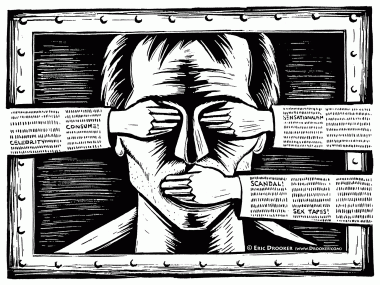
censorship-1Last week, Chavez’ hatchet man Diosdado Cabello, alias “Pretty Eyes”, came out and proposed a whole set of new regulations for radio stations and cable TV that represent another frontal attack on free speech and democracy in Venezuela.

To begin with, the whole new regulatory framework has absolutely no legal basis. Venezuelan legislation only says that nobody can control more than 10% of the radio spectrum. Thus, when Disodado Cabello argues that too much of the spectrum is owned by a few people, that is a political or personal opinion that he is now turning into law, just because his revolutionary hormones tell him to.

To begin with, the “census” of radio stations and their ownership opened by telecom regulator CONATEL in the last few months has no legal basis. To come out and say that only the original person that was assigned the concession of the radio spectrum, is simply a rule made up by Diosdado and his robolution on the spur of the moment. In the past, concessions were sold, inherited and even leased, as long as the regulator was informed. In fact, the new Telecom law that was approved in 2000, recognized the validity of those concessions and established a process by which all of the concessions in existence would be changed and turned into administrative permits within two years of the approval of the law. The process was never carried out, instead this census is opened and the Government “finds”, without explanation, that 240 of the 1004 radio stations in the country do not fulfill this “new and improved” unknown requirement, because the station was sold, the owner died or Diosdado felt like it.

And it becomes clear by now what is going to happen as Diosdado says that the radio spectrum will be “given to the people” a euphemism for “will be assigned directly by me” to whomever he wants and feels represents the “people”. We have seen this before and is another novel variation on corruption established by Chavez’ robolution.

And “Godgiven” also decides on a new criteria in arbitrary fashion: No “circuit” (network) of radio station can be comprised of more than three stations and if more, no broadcast can be longer than half an hour a day. This is simply an economic killer. Forget about nationwide news, no “circuit” can afford to have a reporter everywhere. Forget also about nationwide sports transmissions of a baseball game, no station in Apure will be able to have someone broadcast the Caracas-Magallanes game or the Serie del Caribe. The same way that on that election night in 2012, that station in Apure or Barinas, will have to be wondering when the “half hour” to broadcast the results should take place.

It also means that in the interior of the country even mild opposition voices will be silenced. As stations are no longer allowed to be part of “circuits” like Union Radio, La Mega, Onda, Exitos and the like, these regional stations will no longer be able to hear the opinions of important politicians and analysts who live in Caracas and are regularly interviewed in the largest markets of Caracas and Maracaibo and included in the nationwide programming.

But you can bet whatever you want that Chavez’ obligatory nationwide and system-wide “cadenas” forcing every radio station and TV station in the country to broadcast what he feels like saying, will not have the half hour restriction that is being imposed on everyone.

The math is clear: There are 1004 radio stations in Venezuela, 105 belong to the State, 243 are “community” radio stations and the remainder are private. Force 240 to switch to your side and the Government will have 588 radio stations on is side, an overwhelming majority. With unlimited resources to boot.

But add to that the restrictions on networks of radio stations and what you do is isolate opinions in the interior of the country to those of the Government, as the private sector will only have a string and permanent presence in the large centers of population.

All of these strategies in the end actually restrict the access to information making it less democratic, as the “new” stations, whether run by the Government or the community end up being unpopular as they want to broadcast what the political ideologues want and not what the “people” really want. Witness the case of RCTV which had all of its equipment confiscated and truned over to the Government’s TVES station which has never been able to go beyond 3-3.5% of rating, while RCTV had 35%. In fact, the great beneficiaries of the shutdown were Venevision, which captured a large fraction of the pent up demand and Direct TV and cable stations, which benefited by the increased number of subscribers looking for alternatives.

Of course, this will affect news flow, as news radio stations will be the most affected by the new rules, by in the end it restricts liberties, choice and freedom to listen to everything, whether it is Chavez’ boring (To me) Alo Presidente or Cadenas or the new and old voices of the opposition.

And there are other rules aimed at forcing “Venezuelan” foreign stations on satellite and cable TV to carry Chavez long-winded programs and speeches, simply because these represented a way out of having to listen or watch Chavez.

In the end, the Government could do the opposite, offer hundreds of frequencies to counteract the networks already in existence, that would promote diversity and democracy,  but the reality is that the Government knows that nobody will listen to them. People are fed up with the constant stream of Government BS and the only way to limit the tide is to limit free speech, to reduce what the people  can hear. To make it difficult to the guy in Barinas  to know there is a protest in Caracas and to make it equally difficult for th guy in Caracas to know about the strike in Guayana.

It is not about democracy and free speech, it is about promoting the voice, the one and only voice of Dictator Hugo Chavez. Which is what the revolution is all about, his eternal permanence as President of Venezuela.

Next: Print media and the Internet…like everything associated with the Chavez Government, it is a jump back, it is going back to a past where people were not only less informed, but had less access to information.

It is the way of the revolution, the promotion of ignorance and the cult to a single voice and a single leader.

The curious case of Antonio Ledezma

July 9, 2009

(Este post se encuentra en Español aqui)

20090707_TALC1_8_1_F1

Typically a politician begins his career within a party or a political organization or office and climbs up. But seldom does a politician rise, least of all in Venezuela, then drop and then manage to rise even higher than he had ever managed to get before. This is the curious case of Antonio Ledezma. As times has gone by, not only did he manage to strike a tremendous and disciplined victory and campaign versus Chavez’ machinery  and simpatico pro-Chavez candidate Aristobulo Isturiz, but his public image continues to rise, not only above where he has ever been, but even more surprisingly above any leader of the current Venezuelan opposition.

Ever since his election last November as Mayor of the Metropolitan area of Caracas, Ledezma has become the most consistent and persistent political leader of the heterogenous opposition. He has obviously been helped by the way Hugo Chavez stripped him of most of his duties, responsabilities and funding. This whole affair has been so outrageous and undemocratic, that everyone can see that the votes of the people of Caracas were stolen by Chávez after the fact.

But even more important, Ledezma has compensated his lack of charisma with his energetic approach. Last Christmas it seemed as if only Chavez and Ledezma did not go away for the holidays and Ledezma has fought since then the immoral war against him with dignity and remarkable poise.

What Ledezma has done is to go back to the style that helped him rise as a student leader of Accion Democratica, tiredlessly working day after day. An attitude he brought to his campaign that led him to be Mayor of the Libertador District, a position for which he was reelected to in 1998, but his term was shortened by the Constitutional reform of 2000. And maybe, just maybe, it is only a personal perception that Ledezma lacks charisma, he has beaten Aristobulo Isturiz twice and last November, he managed to beat an Isturiz backed by the overwhelming Chavista machinery and funding. That’s more than most opposition politicians past and present can claim to have achieved.

And taking a move out of Chavez’ playbook, it is now Ledezma that walks around carrying the little blue book containing the 2000 Bolivarian Constitution as in the picture above, a symbol and gesture that Chavez seems to have forgotten or realizes would be a little bit of a farse since he tramples his once ” best Constitution of the world” almost daily.

And in the middle of the Honduran crisis, which is actually boring to most Venezuelans, Ledezma decides to go on a hunger strike at the OAS Headquarters in Caracas, demanding the attention of the OAS and asking its Secretary General Insulza, that he ask all countries to respect the OAS Democratic Charter and not apply selectively as has been done in the last few years.

agencia2_2009-07-08_1247085897.orig

And as the Government of Venezuela was trying to get the OAS to agree to have  Ledezma removed, Insulza, who seems to have lost what little credibility he had left as Secretary General of the OAS, had no other recourse to accept those of Ledezma’s demands he could act on, while the Venezuelan Government quickly paid the money due to Ledezma’s office the day before the strike.

And while Chavez barked and threatened on Honduras, but got little done so far, Ledezma grabbed the spotlight (in all but the Government’s media) with his hunger strike, supported by the workers from the Caracas City Hall and the constant stream (and crowd!) of visitors to the OAS. (Even if most opposition politicians failed to even show their face)

And he quit the hunger strike and left today stronger than any opposition politician. He was the center of attention and now he will be received at the OAS (Joined by all opposition Governors, a Ledezma proposal) to formally present the numerous violations of the Venezuelan Constitution and the Democratic charter by the Government of Hugo Chavez.

It is indeed a curious case, how Antonio Ledezma has reinvented himself by going back to his youth, managing to come out of nowhere to suddenly become the most relevant opposition politician. Whether this speaks badly of the opposition is not the point. The point is that Ledezma seems to have more political intuition and desire than those that claim to lead opposition parties, without ever having received the same approval of the voters that Ledezma actually has.

Chavismo’s ideological consistency

July 8, 2009

(Este post se encuentra en Español aqui)

20090708_TALC1_20_3_G1

(I condemn the boycott of Cuba…Hello, Honduras does not want to obey us? Let’s boycott Honduras!)

I have been trying to understand the ideological consistency of Chavista actions and policies.

Case 1: Chavismo rejects and despises the economic boycott against Cuba.

Chavez announces that it will cut off Petrocaribe’s oil supply to Honduras until Zelaya returns to power. (Chavez is even asking that Honduras now pay back aid given before Zelaya was removed from power)

Case 2: Chavez rejects the “coup” against Zelaya because coups are something that military gorillas  do and are anti-democratic

The graduates from the 2008 Air Force Academy choose as the name of their graduating class “November 27th. 1992” in celebration of the coup attempt led by the Air Force (and fully supported by Hugo Chávez) on the date.

Case 3: Chávez and Venezuela reject the intervention of the US in any country in Latin America.

Chávez calls for Obama and the US to intervene in Honduras…

This all has the consistency of ideological tapioca…

Picture of the year: Ravell gets protection for Globovisión

July 7, 2009

(Este post se encuentra en Español aqui)

121228_1

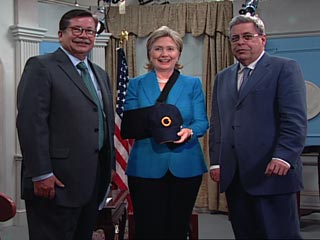
Hillary Clinton with the Ciudadano and Alberto FedericoRavell, just after Ravell twisted her right arm in order to have this picture taken and use it as protection with Hugo Chávez.

Petrobono 2011 operetta ends with a sleight of hand and a twist

July 6, 2009

(Este post se encuentra en Español aqui)

Let’s recap: The Petrobono 2011 was supposed to be for US$ 2 billion, but expanded to US$ 3 billion. It was supposed to trade only in Venezuela, but then PDVSA offered to register it abroad. It was supposed to be institutional, but then it was opened to individuals. The schedule was changed three times and it was issued under local law.

It’s purpose? To raise funds for PDVSA and help drive down the parallel swap market that was Bs. 6.45 at the time.

Finally, it closed last week and after this series of comical and amateurish steps, it was supposed to be assigned today.

No more surprises you think?

WRONG!!!

Because today PDVSA announced the results and the cut off price was 175% at Bs. 2.15 per US$ purchased and in a surprising sleight of hand, PDVSA placed less than the US$ 2 billion originally planned or less than half of the “increased” amount of US$ 3 billion.

Essentially, given all of the uncertainties still remaining on the issue, investors decided to play it very safe and place bids that would give them a low price in local currency for their foreign currency. But in the end, PDVSA raised less than it wanted and investors went through a lot of grief for nothing. PDVSA says there were bids for US$ 7.9 billion, which we find suspect, unless the Government’s own banks placed last minute bids.

But in the end this has just been an operetta, a comical display of sheer incompetence that achieved less than half of one of the two main goals of the placement. Because in the end, today the swap rate ended up above what it was when the bond was first announced (Even if rumors of its existence did play a role in keeping the rate down)

And to add insult to injury, there is the new twist tonight that PDVSA says that it is studying issuing “soon” the remainder of the failed issue at a price even higher of 181%.

Jeez, so the lucky ones that actually got the bond will live until the remainder is issued under the shadow of the possible arrival in the market of almost US$ 1.6 billion in additional bonds, which will do little to prop up the price of the bond once it is registered in the international markets.

What will they say tomorrow? That they will wait to register it in the international markets for the new issue? Truly nothing surprises us anymore in this mindless and incompetent revolution, so why not this too?

A bunch of high school students would have probably done a better job than these revolutionary “professionals” of not so high finance in placing, now and then, the new Petrobono 2011.