Venezuelan Election Postmorten: Maduro Ain’t Chávez

April 21, 2013

20130418_TALC1_7_2_F1

Independent of the outcome of the audit (Just think, besides the irregularities and votes abroad, 166,000 people could not vote because the border was closed ahead of time and 140,000 new voters were not allowed to vote, despite the law saying they could) Nicolas Maduro starts his term weakened by the close electoral result, his backtracking on the audits and the protests and the questioning of his victory. Had he allowed the recount on day one, he would be in a much stronger position, even if still quite weakened by the fact that his candidacy lost some 600,000 votes from the October Presidential election.

Maduro won in 16 states, while Capriles won in eight states, but the latter are the most populous and urban states in the Nation. Among large population states, only Carabobo went for Maduro and in that State is where the opposition appears to have the largest numerical inconsistencies.

Maduro was a very inexperienced candidate and that had a lot to do with his narrow victory. In contrast, Capriles started out weak last year in his campaign against Hugo Chavez, but improved dramatically as the election approached, Maduro had never been involved in a large campaign and the electorate did not get a clear picture of who he is, other that Chavez’ chosen successor. Maduro tried to be Chávez, but he is only a bad imitation, without the quickness, the wit or the charisma.

Maduro´s weakness began in January, when he started out on the wrong foot, as the Venezuelan Supreme Court created the concept of continuity to justify Maduro becoming interim President and guarantee that he would be President and candidate at the same time.

Maduro’s campaign began by appealing to the emotions associated with Hugo Chavez’ death. But he went too fast from mourning to singing, sending a mixed message to the electorate. Moreover, he never defined who he is, trying to sell himself as the son of Chavez, his successor, without clearly explaining what that meant. Voters really knew him very little, since as Foreign Minister he has not been in the public eye in the last six years and he presided over the country for the last three months, a period in which inflation and shortages have increased significantly. (The Venezuelan Central Bank did not report the shortage index in March for the first time in years, inflation was 2.8% that month)

And people were never too satisfied with the announcements of Chavez’ illness and the constant assurances that he was recovering, only to die on March 5tth. And while the long funeral gave people a chance to grieve and pay their respects to the leader, Easter week, a vacation week in Venezuela, broke the mood and by the time it was over Maduro’s campaign seemed to change, talking more about Maduro, son of Chavez, than about how much Chavez was missed. In the end, he never explained who he was or why he deserved to be chosen by Chávez.

And Chávez can also be blamed for the failure. Clearly, Maduro was not the best choice and he never explained beyond his loyalty, why Maduro should be the successor. Because loyalty was the only reason Maduro rose in the Chavista hierarchy. He did what Chávez asked him to do. He never questioned anything. Clearly, Chávez somehow thought he would not die, but not considering the possibility and announcing or even just promoting his successor earlier, now has a big political cost. In fact, even refusing to accept he would never go back to the Presidency had a cost. Had he stepped aside and an election held in February with Chávez alive, would have guaranteed a more ample victory for Maduro.

Time always was Maduro’s worst enemy.

Capriles on the other hand, reignited the opposition by frontally attacking Maduro, something he never did with Chavez. He managed the timing of the campaign very well, even beginning with an intrigue campaign the first weekend, creating the impression he had not decided whether to run or not. Two days later the MUD told him he was the candidate if he wanted, which he readily accepted the same day. This allowed him to be on the forefront of the news while Chavez’ funeral was still taking place.He treated Maduro as an equal, while carefully respecting Chavez and his memory. And Capriles also talked more about the problems that concerned the people, mostly shortages, inflation and crime, which Maduro seemed to be avoiding or trying to blame the opposition for, while making a few gaffes which made him look bad.

But perhaps the biggest surprise is not that the election was so close, but that it was close because a significant number of voters shifted their votes from Chavismo and actually went and voted for Capriles. Before the election, and in the absence of detailed polls, it appeared as if Capriles’ only chance was for the Chavista light votes, the more independent minded voter, not to show up for the election.

But show up they did and to vote for Capriles, who actually increased his vote total, something that was not expected. In the end Capriles was up close to 600,000 votes, while Maduro’s total was lower than Chavez’ in October by a very similar amount. This was totally unexpected.

And polls were really off the mark in this election. You can blame the short period of the campaign or Easter week, but clearly they were not even close, with only two pollsters projecting a Maduro win by single digits, the closest being Datanalisis with a difference of 7.2%, outside the error of the poll

But as we suggested last week, none of these polls gave us an inkling of the electorate was thinking, particularly the voters in the middle, those that do not consider themselves Chavista, but traditionally voted for Hugo Chavez and did not trust the opposition. Abstention was 21% and continues to be the most difficult number to be precise about in Venezuelan elections. Polls said it would be 15%, history suggested close to 30%, but clearly people were engaged and interested in the electoral process, even in Chavez’ absence.

If the result stands, Maduro does not start his Presidency on the right foot. He did not get the mandate he wanted and it will be thus be much harder to press the revolution further, without a backlash from the population. Moreover, his handling of the recount issues and the protests has only undermined further his weak mandate.

Maduro also faces very difficult decisions on the economy, with shortages on the increase, oil dropping and inflation increasing and being felt by everyone. His best path would be to change course on economic policies, change the economic team and impose a new line of thinking to fix some of the distortions created by Chavez’ policies. But his weak mandate will make it difficult for him to change course, given the differences within Chavismo. And these are huge. But beyond that, people need jobs, infrastructure needs investment, a model of distributing a now decreasing amount of money is now doomed unless there is true change.

For the opposition this has been a huge victory. Not only did they manage to show the country is divided exactly in half, coming very close to a victory, but the audits may show an even weaker victory for Maduro, which will only damage the credibility of the Government. Furthermore, Capriles, who appeared to be the person with the most to lose in this election, has now become the rightful leader of the opposition. He may not have won the election on Sunday, but he won the recount fight, a political victory in a country where a single man has dominated all political battles for the last fourteen years.

Politics is back in Venezuela, as we said a few weeks ago and some people have to learn how to play politics again.

But the opposition also needs a model for the country. We all know the things that have to be changed, from the exchange rate, to the gasoline subsidy, to restoring the rule of law, to the oil subsidy for foreign countries, to the subsidy to money losing enterprises, to really improving the electric infrastructure, to fixing infrastructure and promote local production.

But to the poor of Venezuela, there has to be real change, not the small change of money in the pocket seen in the last fourteen years, while crime soared, blackouts increased, less housing was built, human rights violations boomed, corruption increased dramatically, fewer jobs were available and the dependency on oil increased even further.

Until such change occurs, political instability will be the rule of the day, no matter who is in power in Venezuela.

Maduro Blinks, Recount Will Take Place

April 19, 2013

Madurosilla

Despite all the bravado, all the refusal to recount and even Luisa Estela’s opinion, the CNE spent a full nine hours yesterday discussing the possible recount and magically. an hour before UNASUR was to recognize Maduro but strongly request a recount, the CNE announced that the 46% of ballot boxes would be audited.

You have to realize that the other 54% was not 100% audited and that an audit is truly a recount, as votes, machines and voting notebooks have to match in detail.

So, what happened? Simply, Maduro was forced to blink. It was not only UNASUR, but also the Venezuelan military that exerted its pressure and force the acceptance of the recount that Maduro had backtracked on. And opposition radicals can claim what they want, but 46% is statistically VERY significant. Any discrepancy, any irregularity, any inconsistency will certainly come out in this audit.

Maduro may look really bad after this recount…

What Maduro and his cronies did not realize is how sensible a recount sounds no matter how partisan you may be. Thus, internationally, Maduro accepting the recount only to “recular” (go back) the next day, looked certainly suspicious to say the least.

For Capriles, this is a win-win situation. He knows the hundreds of irregularities in the voting and his team will focus on it. Any ballot box not present, any inconsistency and those votes will be subtracted from Maduro’s lead. Add Capriles 57,000 international votes and Maduro’s lead of 270,000 could easily melt into the 100,000 lead.

And make him look even weaker.

And what do you say at that point? If all irregularities add up to something significant, the road ahead could be quite difficult.What happens if Maduro’s lead is reduced to 100 thousand or even less? Do they audit the remainder votes?

Nobody knows…

But it could get tricky as soon as next week, when the audit begins and Capriles’ team asks for international observers and the CNE refuses them. Or Tibisay says in this audit no actual ballots will be counted. The road will not be easy or simple.

But I am told the military knows what happened in detail on April 14th.Thus, Maduro blinked, but not only because of UNASUR, but because the military knew what was happening on Sunday. The Government claimed all afternoon that Maduro was ahead by as much as 10%, only to announce a small (<2%) victory at the last minute and rushing the proclamation of Maduro, and event that has always taken two or three days to take place.

And the military is divided. Yes, they have opinions, but leadership, true leadership, is nowhere to be seen on either of the two sides. Or maybe they are afraid to show their true colors.

But in the meantime, Maduro blinks and backtracks, Tibisay goes back on her words and Luisa Estela is made to look like the obeying fool everyone knows she is.

The whole thing is more volatile than most people imagine. Maduro was weak, even if he won. But his performance since has weakened him even further, while many of his comrades wonder why Hugo picked Nicolas, if they are so much better than him.

Things could change so fast, that I can’t predict a month, let alone a year. And as I had suggested before the election, politics is a new game in Venezuela. Chavez dominated politics and the agenda for fourteen years, but Capriles has lead the first political fight of the post-Chavez ear and he seems to have won resoundly.

In fact, Maduro may want to sound tough, but in reality nobody fears him, after all, Capriles and others already made him blink…


Chavismo Decides No Recount, Even Before Evidence Is Presented

April 17, 2013

20130417_TALC1_8_1_F1

So, after a brief hesitation by Impostor-President Maduro the first day, in which in his moment of euphoria (followed yesterday by near hysteria, according to the New York Times) told he had won the election, he said naively: Let’s count the votes.

But no more.

It was a lapsus brutis

Ever since that moment, every statement has been exactly the opposite,  starting with former President of the Electoral Board (VP of the country later (impartial, ja,ja), Mayor now) Jorge Rodriguez who immediately following Maduro’s victory speech denied the possibility of a a recount, as accepted by Maduro, and requested by challenger Henrique Capriles.

And since then, Chavismo has denied the possibility of a recount, even without having seen the evidence that Capriles and his command said they had and actually presented in full today. (Because the March Nazi Maduro prohibited us from going with Capriles)

Thus, the President of the Electoral Board, Tibisay Lucena, a woman as partisan as can be, not only denied what is a legal right, but went as far as suggesting this was no longer part of the legal framework.

And as the military has been pressuring Maduro to allow a recount, the Impostor-President had none other than the President of the Venezuelan Supreme Court, Luisa Estela Morales, issue her already formed opinion, once again without the legal arguments being presented at the time in her Court.

But you know Luisa Estela, twice removed for corruption, she wants to hang on for her sweet retirement.

When a Judge expresses an opinion without having heard the case, she has to recuse herself from it, but such niceties and civilized actions, do not exist in the Chavista Judiciary, who judged Afuini guilty, because Chavez asked them to. Evidence is a four letter x 2  word for Chavismo.

But the Head of the Supreme Court is so ignorant and incompetent, that she not only forgets the law about challenges to election results, but forgets her own Court’s decision, in which she was involved, fining an opposition electoral coordinator for destroying the same, supposedly useless ballots, from the opposition primary in February 2012.

Why is it a crime to destroy ballots for six months after the vote counting, if they can’t be used for anything Luisa Estela?

Is that agricultural law logic?

But you can’t ask a movement with the ideological consistency of tapioca (natilla) to have any legal consistency, when all they do is twist, spindle and mutilate the law at will, any time they want to or feel like it.

And without going into the details of the law, what it says is that if you present a challenge, then the if there are differences between the number of voters, the voting notebooks and the ballots, then the process can be voided and, if material, the voting where the irregularity occurred has to be redone.

Luisa Estela, can you explain why the ballots are mentioned?

And the moment I heard Jorge Rodriguez say there would be no counting of the ballots on Sunday, I knew where things were going. If there is someone sneaky, devilish, Machiavellic  and without scruples in Chavismo, Jorge Rodriguez has to be it.  That is why Chávez liked him so much. And Tibisay’s visits to his old digs in “La Corniche” in Altamira in secret are legendary, were duly noted by bodyguards and chauffers and the word was passed along.

And we have yet to mention the rush to proclaim Maduro. In October, Chávez was proclaimed three days after he was elected on October 10th.. In this case, they had this huge rush to do it the next day, before most international “seers” left on Tuesday.

Because there are no international observers used in Venezuela only “seers“. What is normal and an international standard elsewhere, is considered a threat to our sovereignty by Chavismo.

Of course, Chavismo sent international observers to all buddy-buddy countries where an election has taken place, including Honduras, Guatemala, Nicaragua, Bolivia, Belaruss and none other than Mexico, where curiously, Chavez called for a recount, not once, but twice, whether it was a close election against Calderón, or a literal whipping of Lopez Obrador by Peña Nieto.

But again, don’t ask for consistency from Chavismo, they are not very good at it. Least of all under Impostor-President Maduro, who seems so uninformed and clueless that he said his heart could be studied with telescopes.

And despite his performance on Sunday’s election, Nicolas still wants to be Chávez’ son, imitating him, acting like him, trying to be him, a task for which he has significant limitations.

Thus, when Nicolas said today he would abide by what the Electoral Board decided on the recount, nobody believed him. Nico, you ain’t Hugo.

The result on Sunday, even if he wins by 10,000 votes, shows that his credibility has been undermined from the day Chávez named him his successor. And trying to overrun the opposition with fascism and lies, is only likely to undermine his credibility even more.

And Maduro’s stance may radicalize his supporters, but he lost the election with those that were not radically pro-Chávez who refused to vote for the opposition, but guess what? They did not stay home, but many chose instead to go vote for Capriles.

I wonder what those who stayed home are thinking now?


Assembly President Denies Deputy Right To Speak Because He Does Not Recogize Maduro As President Without A Recount

April 16, 2013

The President of the Venezuelan National Assembly asked a Deputy from the opposition if he recognized the election of Nicolas Maduro on Sunday. The Deputy said no, he wants a recount first, so he was denied the right to speak.

Here is where he said he would do it to all opposition Deputies

Similarly, the impostor-President Maduro said today that he would not recognize opposition Governors that do not recognize him and will send no money to them, threatened opposition candidate Capriles with jail and banned his march to the Electoral Board tomorrow.

Democracy? Where?.


Venezuela Tense, As Electoral Board Rushes Maduro’s Proclamation

April 15, 2013

So, the story is like this:

Yesterday, Maduro’s team was telling diplomats and reporters that at 1:00 PM Maduro was ahead by 2% of the votes. At that time, it looked as if abstention was going to be more like 30% of the total number of voters. In the next couple of hours, participation increased dramatically, but the increase was higher in traditionally more pro-opo centers than in pro-Chávez centers. However, by 4 PM Chavismo was projecting a victory by 1-2% of the vote.

Meanwhile in Capriles’ camp, all that was being counted at that point was participation. They had the same 30% abstention projection at 1 PM, but then it accelerated and they began projecting 22-23% abstention at the end of the day. But they could see the details and the participation by 4 PM in the more pro-opo centers was 75% (top 50% pro-opo centers) versus 69% in the pro-Chávez centers.

When the Actas began arriving, the opposition counting center began seeing a virtual tie from the time it had 20% of the tallies. Essentially, within the error of the tally, it was impossible to predict who was winning. If you added the international votes, then they would get a Capriles victory.

This continued and the Capriles team was hearing that Chavismo was saying that Maduro had an advantage of a quarter of a million votes. As the night went on, Capriles decided to call Maduro and told him that his numbers were saying the race was too tight and any announcement should be held off. Maduro told Capriles that he had to check (??) and never called back. Within twenty minutes CNE made the announcement.

Meanwhile, at the CNE, Vicente Diaz had argued that no announcement should be made and they should wait to reconcile the numbers. Vicente Diaz also suggested that the CNE itself shoudl call for an audit, something it can do. He was voted down and the announcement was made.

Today, Vicente Diaz went to CNE where there was supposed to be a meeting and instead found that Maduro would be proclaimed as the winner, while the meeting in which he was going to formally propose that a complete counting of the ballots and tallies be made, was not going to take place.

Thus, Vicente Diaz decided not to go to the proclamation.

At which point I ask: Why the rush? Why make the announcement if things were not clear or there were doubts? Why rush to proclaim Maduro if he was not planned to be sworn in until Thursday?

That is the big “if”, Maduro who alraedy stars weak with a very small victory, makes himself more illegitimate by trying to be proclaimed early and while he claims he wants to count the boxes, the suggestion is this may not happen.

Meanwhile, Capriles was calling for people not to go out and protest, but instead participate in a pot banging tonight at 8 PM, as well as marches in all regional CNE’s tomorrow and one on Wednesday to the CNE to formally request a complete recount of all the ballots and comparison with tallies and the voting notebooks.

But students had a mind of their own and began protesting in many parts of the country. In Caracas, near Plaza Altamira and the Autopista, students gathered to protest. Chavista motorcycles began showing up and there appeared that there would be confrontations. Then opposition motorcycles showed up and Chavistas fortunately left.

Meanwhile, the Government sent out the National Guard, who used tear gas to disperse the crowd away from the Autopista. I managed to get a little close at that time. Here are some protesters:

capucha

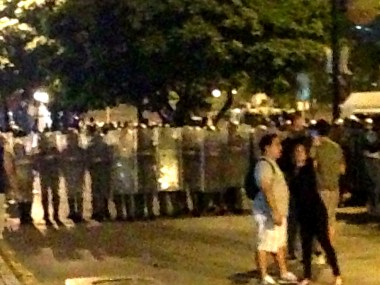
And here is the National Guard holding strong to stop students from going down to the Autopista:

GN1

And here is a picture of the fires the students built to stop the National Guard from going through:

fogota

And in the only gesture of peace and conciliation of the last 24 hours, Maduro ordered tonight that the National Guard withdraw from Altamira and the Autopista.

Things are tense. Very Tense. Falcon said some Generals have been detained because they disagreed with decision to announce the results. Others tell me they are searching for Capriles’ Minister of Defense “in pectore”. The European Union, OAS, US and other UNASUR countries have sent the message they will not recognize Maduro until votes are counted again.

Stay tuned…

But I just don’t believe any votes will be recounted and ballot boxes found in at elast eight places around the country, either being dispose of or being burned suggest I will be right. Fraud is the only word that comes to mind…


Chavismo Without Chávez Starts Badly

April 15, 2013

radical-change-e1312110201574

Even if you believe that Nicolas Maduro won today, today’s slim margin over the opposition places Maduro in the worst possible spot. Despite all of the advantages, all of the Government resources and institutional resources on his side, Maduro barely managed to beat Capriles. This a a 10 point drop in the “revolutions” popularity in six months, showing that Chavismo without Chavez, is just wishful thinking.

And Nicolas Maduro is certainly not the rightful heir to Hugo Chávez and his Cuban cohorts, even if Chávez thought so at one point in his life.

Maduro’s speech tonight was innocuous. He talked as if he had scored a huge win, instead justifying that a one vote win would have been enough.

But it isn’t and it wasn’t, for the simple fact that Chavismo’s party PSUV is divided, even more so now, as those that aspired to succeed Chávez likely think that Maduro was not the rightful successor to Hugo Chávez. And most of them think they are.

And this Pyrrhic victory for Maduro, implies that he will not be able to change course without generating an internal battle.  Thus, he will likely try to continue the policies of Chávez Government, which will in the end be his own demise.

And Capriles said it well tonight, when he said to Maduro: “You are the one that was defeated. We will not recognize the result until each and everyone of the votes is counted”

And Capriles was clear: “The result we see are different than the one you see”. Thus, Capriles said: “You were defeated and what you represent was defeated, as more than one million of Chavista voters, voted for Capriles. You have to revert your policies. The Cubans have to leave. The photo of the country is a different one than it was before. We are half and half. We are here to defend the Venezuelans.”

Capriles said that between intimidation and votes abroad, the number of votes can change, Thus, votes have to be counted one by one. Mr. Maduro, said Capriles: “if you were illegitimate before, you are more illegitimate now. I don’t pact with anyone. What the results say, is not what the people want. This is a Government “for the time being” and I will do anything I can so that the country can change”

Capriles also said: “Our witnesses had to see fascism in the eyes today. But this is  a system that is crumbling. We did not fight against a candidate. We fought against abuses. This fight is not over.”

I am told that in the count of actas, Capriles won. The tally, according to Capriles’ camp, says that with international votes Capriles won.
What is certain is that Maduro did not win by 1%.

And a full audit, adding the international votes, should and could give Capriles a victory. Very tough times ahead.

BTW, there are no longer pollsters that have gotten the numbers right for the last five elections.


Electoral Updates: Serious News As They Arrive Tonight

April 14, 2013

Chavez

This is about the worst that could happen for Maduro and for Venezuela. For Maduro, he starts out with a very weak victory. A victory that may be turned around in a recount. But more importantly, his party has seen a 10 point drop between Chavez and him and all other aspiring Chavistas think they could have done better. Tomorrow, they will start undermining him.

11:23 PM: Electoral Board member calls for recount of all votes. Head of Electoral Baord leaves when he speaks.

11:13 PM CNE on TV to announce results or something. Tibisay Lucena says with 99%.12% of votes with 78.2% Nicolas Maduro 7.5 Million votes 50.6% of the votes, Henrique Capriles 49.07% of the votes. Whether true or not this is a HUGE opposition victory.

11:10 PM At this time things are so close, that it may require adding all tallies to determine the winner. This is a huge oppsoition victory no matter what. For Maduro a tiny victory is a huge loss.

10:28 PM 65% of all actas counted Capriles ahead by 20,000 votes plus foreign votes

8: 43 Advantage Capriles but very close. Foreign votes may decide.

8:39 PM MUD says it is irresponsible to call for any gathering of people. That the MUD knows the numbers as well as the Government. Votes are still being counted.

7:53 PM This appears to be so close, that all tallies will have to be counted to determine the winner.

7:12 PM: Things are tight, with abstention right above 21-22% at the end

6:36 PM Abstention lower than at 1 PM, now above October. However, in the pro-Chavez centers, abstention averages 32%, in the pro-oppo centers, abstention running at 25%. This does not mean it is favorable yet, it just says we are going more.


There are lines in Boston

April 14, 2013

Boston

Thanks PH


Tour of Caracas On Voting Day: No Lines, Some Abuses

April 14, 2013

Update 3:30 PM: Participation has improved at this time, it is running 4% behind October only. Lara, Anzoategui and the Capital District have much higher participation, but in this range things look difficult.

Update 1:47PM: I am told by reliable people that at 1 PM the percentage of voters that had cast their vote was running 10% behind the same number in October.

I just took my usual spin through Caracas on election day, driving from Petare to Caricuao to see what was happening. What I saw was absolutely no lines anywhere, not even groups of people in front of voting centers, of which I must have seen two or three dozen. In fact, since I remembered that the biggest lines last October were in Plaza La Candelaria in downtown Caracas, I went there just to check, but the result was the same, no lines at all where in October there were multiple lines:

Image

Traffic was a mess in certain parts of the city. It took me longer to go around because there is an increasing trend to block an ever larger area around the voting center. In fact, in Avenida Romulo Gallegos in Montecristo, they blocked off two blocks of that avenue, which is an important street, particularly on Sundays when Cota Mil is closed until 1 PM. Took me a while to get out of that mess.

In fact, the whole thing is so ridiculous, that while I would have had a hard time taking picture of the lines, if they had been there, directly in front of most voting centers, I had no problem stopping in front of the Miraflores Presidential Palace and take a picture. The Guard did not like it, but he barely moved anyway:

Miraflores

There were many reports of abuses. The main one was that of the “accompanied” vote, whereby someone in the voting stand accompanies voters to make sure they are voting the “right” way. This type of vote is allowed for older people and those with disabilities, but the person that accompanies the voter can only do it once and has to sign a form. This was not being done in many polling stations, particularly in Zulia State and TV was showing videos of this being done.

But the immutable Tibisay Lucena, Head of the Electoral Board,  came on TV and said everything was peachy and rosy. That the only incident she had to report was our people eating their ballots after casting the vote and some irregularities, only a few, in assisted voting.

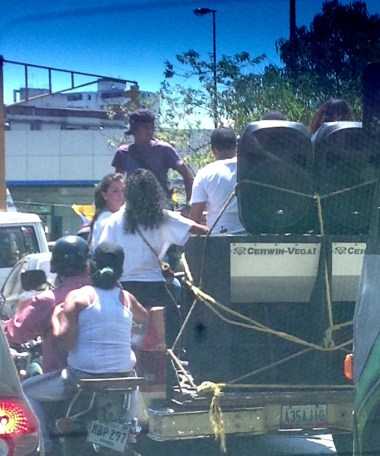
I did see lots of motorcyclists in groups wearing red shirts and making noise, passing in some cases near voting centers , which is forbidden. There were also many trucks with improvised speakers on top, encouraging people to go and vote, no matter who they were going to vote for. I took a picture of one of them thru the car window, at the edge of La Urbina and Petare,which I was not planning to post:

chamos

except that right after I took the picture the police pulled them out, harassing them about campaigning. I stopped to help out, which one of the cops did not like, telling me to “Circulate, citizen” (Circule, ciudadano). Right at that point a Chavista truck with songs promoting Maduro went by and people started yelling at them that they did not dare stop the Chavistas and the cops decided to leave (Not going after the Chavistas). In fact, as I write this, the son of the Rector of Universidad Metropolitana, a good friend, is detained for driving in one of these “promote the vote” trucks.

Meanwhile in El Silencio, you can see the PSUV post behind the fountains, where four or five people were distributing propaganda, which is not allowed on election day:

SILENCIO

Everyone is explaining away the lack of lines as saying that people have voted three times using the same system since October. Others say that this is because the opposition is staggering the voting according to age. But I went to Chavista areas and just did not see lines anywhere, which leads me to believe that abstention will be high. Remember that prior to 2006, abstention levels tended to be closer to 40% than 20%. Does Chavez’ absence from the ballot indicate we will go back to those levels now?

I just don’t know, but we will know in a few hours.


Poll Numbers Have Changed Fast In Venezuela, But It May Not Be Enough

April 12, 2013

20130412_TALC1_17_1_F1

So, I have been in Caracas for less than 48 hours to cast what is likely to be one of the most expensive votes (my airfare was outrageous!)  on Sunday’s elections and even pollsters that I don’t trust too much, because of their pro-Chávez stance, are trying to change my mind with their ever decreasing gap between Maduro (Who is still ahead in these polls) and Capriles.

I don’t want to throw too many new numbers at you, but two pro-Chavez pollsters and one considered to be more neutral have seen the gap narrow from almost 20 points, during Chávez’ mourning period, to single digits a week ago (all three), based on polls before Easter, to 7.2% in Datanalisis poll today, with more recent data.

And while I have never been a big Datanalisis fan, it is precisely because of that, that the numbers  are interesting. You see, Datanalisis never seems to get the abstention right and in elections where that has yielded an unexpected result, they have been wrong. Thus, when they say that abstention will be in the 20% range and the fast changing difference is now only 7.2%, I have to wonder: What if?

Because I just can not possibly believe that abstention will be that low. Chávez was loved, adored and admired, this is Maduro we are talking about now. Maduro ain’t Chávez. Even Chávez saw abstention levels of 25% in the 2006 Presidential election, where he whipped Manuel Rosales. I find it hard to believe that Maduro, will be able to match that, even with Chávez’ endorsement.

And if abstention gets into the 30% range, that 7% gap gets down to where it may be almost impossible to predict what may happen, even if I still think Maduro is likely to have the edge. But not a huge edge, maybe 3 to 5% at most.

So, what seemed improbable a month ago still seems difficult, but not impossible. Last December regional elections saw 50%abstention, but largely because the opposition did not go out and vote and somehow Capriles has managed to get people excited again.

But given that Maduro’s campaign, while improving, has been less than inspired, one simply has to wonder whether people will go out and vote for the man Chávez anointed, just because he did it.

I am a numbers guy and the numbers suggest Maduro will win by a smaller margin that polls say, but looking at just the overall numbers (which also say Capriles is more popular than Maduro, for example) without knowing exactly what people feel about the Son Of Chávez, it is very hard to predict that the outcome will be different than polls predict.

In fact, abstention has been key in promoting and demoting pollsters in Venezuela as the “best”, to the point that not one can claim to have predicted each and every election and referendum result since 2006. Every single time, one of them has miscalculated and the number that did them in, was precisely misjudging the abstention level.

Give me 20% abstention, Maduro wins easily. Give me 30%, things get interesting and unpredictable, but cheating and tricks still make it hard, give me 35% and we are into Black Swan territory.

I think it will be closer to 30%, making it close, but with Maduro holding the edge. If less, game over.