The Santero Economics Trinity

January 18, 2016

Trinity_knot

Some people took offense at my last post on Santero Economics when the new VP for the economy was named. They thought the term lacked seriousness in an economic debate.

I disagree.

When I first introduced the term, I was making two analogies, one to the famous Voodoo economics term that Geroge Bush Sr. coined referring to Reagan’s economic ideas, but more importantly, I defined why the term was justified by defining what Santeria was and comparing it to the current framework for economic policy in Venezuela and I quote my post from July 5th. 2015:

“Santería, which is composed of a set of beliefs taken from various religions, which are some times incoherent and even contradictory and which are based on hope, spiritual beliefs and ideas with little fundamentals. Thus, we can characterize the current policies as, Santero Economics, as the policies are equally incoherent, based on hope and many times go against each other, with no relation to known economic principles and fundamentals.

And today, I complete the cycle, first it was Tony Boza’s ideas, then Salas’ and now with a description of the foreign part of the Santero Trinity, Spanish economist Alfredo Serrano, who has recently espoused his seven steps to solving Venezuela’s Economic problems.

I will not go over all seven of them in detail, but this reminds me of an article which is somewhere in this blog in which someone suggested Chavez was proposing a society which had nothing to do with who Venezuelans where and ignores their habits, culture and idiosyncrasies. Serrano’s proposals seem to ignore the reality of Venezuela and Venezuelans today. In fact, it seems to ignore the reality of what Chavismo has brought on Venezuela in the last 16 years too.

Let’s look at the proposals:

Proposal #1: The State of “Misiones Sociales” requires an economic mirror; for every social mission, an economic mission is needed to unleash new productive forces internally. To do this, public procurement must serve as the economic muscle in favor of the new democratizing social metabolism. We must pursue  the economic multiplier effect derived from the Social Revolution.

Jeez, I really don’t know where to start, let’s do it at the beginning: Which Social Mission are we going to work with? Has Serrano made a diagnosis of the current status of those “misiones”?  The way I understand it, the educational misiones, Ribas, Robinson and Sucre are sort of half-assed right now, as people are not getting neither the instruction, nor the money, nor the promised programs. And if they were, how would you propose to promote Mision Ribas, for example, as an economic force, when you pay people to study. Do you want them to study or to produce something? My understanding is that it promotes people not working as the “beca” to study is more than enough to live on, or at least as good as also working.

And I don’t see how the health “misiones” can be leveraged economically, least of all, when Barrio Adentro is 60-70% abandoned.

I mean really, tell me how this can be turned and “leveraged” into production, when half of it is simply not functioning:
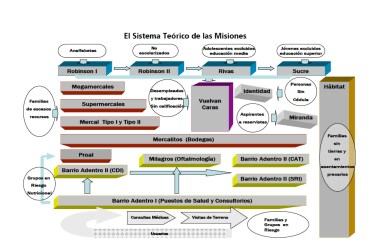
misiones.jpg

I mean, pick your favorite Mision and tell me whether is active or not and, if it is, whether it can be leveraged into a new-fangled metabolism for economic production. His words, not mine. Mercales show lines and shortages, Barrio Adentro is barely alive, people are not getting their “beca” for Rivas o Sucre.

I mean, really? What country is Serrano talking about? And how is he going to do it?

Let’s move on

Proposal 2: It is necessary to sort out what can be produced and what is not. A productive Revolution requires getting down to work with the new economic engines, considering: a) the real added value that can be generated internally, and b) the outer limit imposed by global value chains. Nothing would produce new goods if it is just for importing much of the value added.

Sounds wonderful! But isn’t that what the Government claims to have been doing for the last ten years? And isn’t the fact that the Government did that, “prioritizing,” that we have shortages, lines and empty shelves?

Are we going to import Martians to do it this time around? Or Chinese? (They are here already). Or Cubans, to see if this time they get it right? Because it seems that all the Government has done in 15 years is do exactly that and the results are sort of lacking…(More than sort of, but let’s be magnanimous)

Proposal 3: Not everything is a matter of engines; it is also  a matter of actors. The democratization of the production system is a necessary and sufficient condition in the new economic era because it is the only way to break the current oligopolistic dependence. The communal power must be essential pivot in the new economic order, both productive and distributive issue and marketer. The commune has to stop being economically marginal; the output is certainly not a neoliberal communal output.

Uff! As someone once said, “Como se come eso?” (How do you eat that stuff?)

First of all, we are talking about a crisis that needs to be resolved TODAY, not in five years. People need to eat, for example. People in the communes are concerned about making ends meet, getting stuff that they can’t get, standing in line and surviving under current hardships. What are you going to do? Bring a whiteboard telling they have to produce milk, meat, tomatoes, mangoes chickens and rice?

Has this guy ever considered how it is different to breed cows in the tropics? Or to grow any sort of plant? Does he know about how the Government nationalized and destroyed Agroisleña, the only provider of technical advise, seeds and even funding to the small producers? In order for the communes to get into any of this  “productive” stuff, you would need to return Agroisleña (now Agropatria) to its original shape, before you can even think about educating, teaching and training the communes to produce really basic stuff. And the Government that destroyed it is supposed to do it?

Really?

To say nothing of obtaining the required medicines and vitamins to grow a healthy chicken, which have been lacking for months even to producers that have the money. To say nothing of being able to buy the cows that can produce milk in the tropics, feed for them and the medicines for when they are ill.

All very long term and you need a lot of money if you ask me.

4. We must avoid falling into the  neoliberal trap to address the issue of foreign exchange from the exclusive focus of the nominal value. Is it important to discuss the exchange rate? Yes, as long as previously defined what the new currency allocation matrix. At a time of scarce foreign exchange, it is crucial to choose how they will plant to flower currencies other real economy in the shortest possible time. It requires a kind of acupuncture so he is they will be given an anti-inflationary,  productive use and pro growth to the available foreign currency.

The “neoliberal trap” of focusing on the nominal value is because keeping the nominal value artificially and incredibly low is what has given rise to the biggest corruption racket and trap in the history of Venezuela and dozens of billions of dollars lost to Government officials as well as to exports to Colombia, which the Government has for years been unable to stop.

Again, will we have Martians running this? Does Mr. Serrano even understand what is happening in Venezuela every day and how inefficient, corrupt and incompetent Chavismo has been in the face of all these distortions?

I will skip 5, but here is 6:

6. Faced with restrictions outside, it is essential to make progress on tax sovereignty. There is enough room to do a tax revolution based on principles of social justice. It must implement a plan to combat fraud and tax evasion. It needs to raise in whatever it takes to ensure social and productive investment, and preventing external shock has negative impact internally.

Really? Who will pay this tax? Social justice when professionals make less than $30 a month? Again, who will pay? Companies? Which ones? What is the magnitude of this revolution or uncollected tax? Does Mr. Serrano understand even who pays taxes in Venezuela? Does he know the cutoff for yearly income to pay or not taxes? Does he know that banks make money by buying tax free bonds from the Government, which will be impossible to sell if they were not tax free? Really, with an economy with a 10% GDP contraction the solution is a tax revolution? Please…

And the best is the last point. I dont know where Mr. Serrano has been, but here is point 7:

7. Another answer is to return to the regional path effectively. It would surely trigger special margin Sucre plans to import priority goods bypassing the dollar. It is essential also import new paths without dollar, Mercosur, with some compensatory methods, while a new map of investment is achieved from the region.

Well, I will not even comment on this,  the “regional path”, enough said, wonder what Macri thinks?…but I have to wonder, has this guy ever been in Venezuela for any length of time?


Some Steps Forward And Some Back In Venezuela

January 17, 2016

6a00d8341c4e6153ef010535a11220970c-800wi

It has been six weeks since the opposition won the Parliamentary election and many things have happened. But I do not really want to give you a blow by blow analysis of what happens or is happening in the country, but rather try to see and understand the overall picture. Thus, I did not report on the details of Maduro’s speech to the Assembly or many other topics which some may think require some commentary.

But I think is more important to report on the overall picture of the country six weeks after the elections. And what I can say is that there has certainly been some progress, some steps forward, but the whole picture is still lacking, as the country seems to be drifting into a crisis, with probably more steps forwards than backwards, but too much uncertainty still present in the country.

To begin with, I don’t think either side has understood well the message the voters sent in Dec. 6th. On the one hand, the Maduro administration has not understood that the vote against it represents a vote against the consequence of its badly mismanaged economic policies. Despite this, it continues on a path to radicalize the country, blame the economic war, all of which will bring little economic benefit, precisely the only thing the voters wanted him to pay attention to.

The opposition, on the other hand, seems to be understanding its victory as a mandate to get rid of Maduro, which is probably why most opposition voters cast their vote for. But as I have discussed previously, The in between, both the Ni-Ni’s (who don’t belong to either side) and the pro-Chavista voters, were casting a vote to punish Chavismo, but not necessarily because the opposition electrifies them and wants them to run the country. So far, the opposition has said little in how it intends to deal with Economic problems. True, it is little that the Assembly can do on economic matters, but this does not mean that it can not make proposals or counter-proposals, of which it has done little on these matters. Perhaps the only exception is the Bill to give ownership to the Mision Vivienda homes, which was repudiated by Chavismo.

Perhaps the most positive thing to has happened is that there has been acceptance of the victory by the opposition. Even if this has been a reluctant acceptance or not, it is there, whether thanks to the military or not. The opposition found the need for security the first day the Deputies were sworn in at the Assembly, but the routine of at least bi-weekly sessions is such, that the last time the Assembly met in a regular session, there were no significant security forces outside the Assembly building. (The same inside, where reporters and public can now go in without much hassle)

This represents some semblance of the return of normal democratic life to the country, a huge advancement.

And this return to normalcy is also present in an increased access to the media by the opposition. Even if VTV did not want to show Ramus Allup (A negative nomination on which I have opined sufficiently), it had no other recourse but to show his speech right after Maduro’s speech. By now, some of the old/new media, such as Globovision, has begun to hedge it bets, increasing its coverage of the opposition.

More democracy can only be good.

I think it was a negative for the opposition to go back on the swearing in of the three questioned Amazonas Deputies. It should not have done so, if it was not willing to go Constitutional-conflict on the terrible decision by the Electoral Hall of the Court. Given the 45 thousand-plus decisions in a row  by the Court in the last 15 years, it should not have expected anything else.

While it was a puzzle why Amazonas was picked, given how close elections were there, the truth may have been revealed this week, when it was noted that some Chavista Deputies have requested the Supreme Court interpret whether the indigenous representatives to the Assembly should be elected by the population of those States at large or only the indigenous population. Curiously, the opposition had raised this issue in the past , only to be denied, even when Chavismo dominated that vote. Chavismo probably thinks that it can win one of the three Assembly members with this trick and deny the 2/# majority to the opposition, but I doubt it.

Unfortunately Maduro did not understand the message about the economy and seems to still be clueless at this time. Since Dec. 6th. oil has dropped by about US$ 8 per barrel (somewhat less for Venezuela’s oil basket) but the Venezuelan President did not mention any concrete measures in his State of the Union address and his “Economic Emergency” Bill” only include the possibility of more expropriations, despite the dismal failure by Chavismo with them over the last 16 years. He did say gasoline prices should be increased, a decision which is solely in his hands. He should talk less and do something.

And with oil under $30 per barrel (less than US$ 23 for the Venezuelan basket) this means that foreign currency revenues for the country will be under 50% of what they were during 2015. And as Venezuelans line up for food, medicines and even to have their deodorant refilled, one has to ponder how awful things will get in the upcoming months…


First Constitutional Crisis As Supreme Court’s Electoral Hall Attempts To Freeze Venezuelan National Assembly

January 11, 2016

notsoblind

Well, sooner than you could say Henry Ramos, the first big Constitutional crisis exploded today, in Venezuela as the Electoral Hall made a ruling that sets up a huge confrontation between powers.

The Hall ruled:

1- The Venezuelan National Assembly is in contempt of the court for not obeying its decision to not swear in the Deputies from Amazonas State.

2- Because of this, says the Electoral Hall, any decision made by the Assembly so far and in the future is completely illegal

3- The Court orders the National Assembly to immediately “disincorporate” the three Deputies.

The decision is quite bizarre in too many ways, but what do you expect from “Justices” some of whom do not qualify to hold the position and violate the law in many cases, as they were card carrying members of Chavismo’s party PSUV?

First of all, the legal concept of taking away the proclamation of a Deputy does not exist. Moreover, there are precedents for this, which are not even mentioned in the decision by the same Hall and the Constitutional Hall of the Venezuelan Supreme Court.

Second, once proclaimed, according to the Venezuelan Constitution, only the National Assembly itself can “qualify” a Deputy. Nobody else can, least of all, the Electoral Hall of the Supreme Court which only rules on Electoral matters. Once the Electoral Board proclaimed the candidate, this is no longer an electoral matter. The same applies to nullifying acts by the National Assembly. It is not the role of the Electoral Hall to nullify such acts, least of all “future” acts, an absurd legal concept.

Maybe these “Justices” do not understand that the Electoral Hall rules on Electoral matters, no on matters which should be the realm, if at all, of the Constitutional Hall of the National Assembly.

Finally, it is sort of stupid to rule invalid decisions by the National Assembly that are taken without the three “questioned” Deputies participating in the vote. If they had nothing to do with the decision, there was nothing illegal about it.

But the real conflict arises and will explode now for the simple reason, that the National Assembly can simply not accept the decision for political reasons. Since the decisions are illegal, backing down would imply that the Court would simply stop the elected National Assembly from doing anything in the future.

And the key word here is “elected”. A Court that was not elected by popular vote and under questionable circumstances from a legal point of view, can not pretend to be above the popularly elected National Assembly.

Moreover, I think the National Assembly has no other recourse but begin proceedings against the same  Justices, something that they can do. Thus, we go into an infinite loop of non-recognition of one by the other.

Who will be the referee in such a battle?

Meanwhile, the economy gets worse, the price of oil goes down and the Maduro Government devotes itself to talking about the removal of Chávez’ pictures form the National Assembly building.

Clearly, there is no interest in attacking the economic problems and distortions. Even more clearly, there is no intention in recognizing the qualified majority obtained by the opposition.

Who was it that said Chavismo was democratic? Yeah, sure!


Santero Economists Take Over Economic Policy In Venezuela

January 7, 2016

gabinete

Organizational Chart for the new Venezuelan Cabinet named by President Maduro

 In July, I suggested that even with the upcoming elections, Santero Economics, the peculiar form of economic management that has taken over Venezuela since Maduro got to power would not go away with the Legislative elections. Yesterday President Maduro named his new Cabinet (Chart above, there are so many Ministers that it is essentially unreadable) and it is clear from it, that the Santeros have taken over.

What Maduro did, was to make Luis Salas Vice-President for the Economy. Salas is the center piece of the Santero Economic team as he represents one third of the group (together with Tony Boza and Alfredo Serrano, who is not Venezuelan, that has kidnapped Maduro’s Economic mind (yes, it’s meant to be cynical!) over the last three years.

There are some positives, like naming Economist Rodolfo Medina to the Ministry of Finance. Medina is a Professor of Econometrics at Central University, he is no Milton Friedman, but at least he knows and understands traditional economic theory. He is accompanied by Jesus Farias, a communist Economist, who at least has been proposing that there should be a single exchange rate, who will be the new Minister of Foreign Trade and International Investment, a newly created post, which only proves the level of ignorance involved in forming the Cabinet. Uber leftists Ricardo Menendez remains in the post of Minister of Planning.

One of the first problems of this team is precisely the level of incoherence involved. How will Medina, a practicing economist talk to Salas, a 100% Santero Economist? How will Farías argue with Salas, when Salas is against many of the ideas proposed by Farias?

 For the last three years, Salas, Boza and Serrano have imposed economic thinking in Venezuela, despite the fcat that they did not occupy any Ministry. They are the “creators” of the concept of “Economic War” as the explanation fro the large levels of inflation and the scarcity that is present in Venezuela. Their solution to the economic problems is more controls, more supervision, more taxes and fighting the oligarchs who are responsible for everything.

 While the foreigner in the Santero Economic think tank, Serrano, is an Economist, Salas is a Sociologist and Boza claims to be a Popular” Economsit”, whatever that may mean.

What these people do, is to disregard the body of work of economic knowledge, based on theory and experience and construct arguments (not theories) to suggest that body of knowledge is simply incorrect. There are no publications involved, just some self-published pamphlets which contain no equations, only graphs of empirical data, and hyperbolic and false statements to supposedly support their views. I linked Boza’s pamphlet last July, here are Salas’ Economic “postulates” for lack of a better word.

Among the many things that Salas posits, is that the law of supply and demand is vulgar, that monetizing the deficit is not inflationary, that inflation onl occurs because of speculation, that in real life inflation does not exist and that it all is an economic war, much like that waged against Allende in Chile. Thus, the solution is simply to be tougher, increase controls over prices and make the private sector pay more taxes.

 Which means that santero Economics will prevail, inflation and scarcity will accelerate and little will be done by Maduro and his Cabinet to attack the distortions in the Venezuelan Economy. Not only does Santero Economics not work, but those in the Economic team do not have the coherence or managerial capability to accomplish much.

Except for the pain that this implies, what this means is simply the acceleration of the demise of the Maduro Government, who will bring down Chavismo with him. There will be no change in direction now and given the past, those recently named will not exit the Cabinet fast if they obtain no immediate results.

This bodes badly for Venezuela and its people short and medium term, but at the same times sets the stage for promoting an outcome in which Chavismo no longer leads in the country.

(Two questions for the new VP:

  1. If the law of supply and demand is “balurda”, can he comment on why oil prices have come down in the last year and a half?
  2. If creating money does not cause inflation, why not print infinite money so that everyone is very rich?)

A Bright And Hopeful Day For Venezuela

January 6, 2016

byebyechavezWorkers remove Chavez’ giant poster from National Assembly building

While I am far away, I could not help but be glued to the events in Caracas today. While it was certainly not a smooth day, it was a great day for Venezuela. A day of hope and possibilities, a bright day for the future of democracy in the country. A very important day for Venezuela’s history and the image above clearly shows that change is in the air. The statues have yet to fall, but it’s coming. The beginning is here, let’s see how long it takes to get to a good point.

I will start with the most important signs of the day:

-The National Assembly controlled by the opposition was allowed to be sworn in, almost with no violence. This was not clear would be the case a couple of weeks ago.

-The Press (from all sides) was allowed into the Assembly freely for the first time in years to report what was happening. Reporters need not be afraid anymore.

-The opposition had presence in the media, beginning to restore its practical ban from TV, radio and print. The “people” will be able to see and hear the other side like it has not happened in years.

-The opposition managed not to be provoked by Chavismo, maintaining a serious and peaceful tone. A new tone of democracy and conciliation.

-Chavismo showed its true autocratic colors. It refused to have a dialogue, resorting to the usual insults. Except some the insults were elegantly returned by the opposition. Perhaps nothing exemplified this more than the very direct reproach of the use of Diplomatic Passports for drug dealing, which must have stung the First Lady, who is now a Deputy for Cojedes State.

-The first steps towards more institutionality were taken. No more rubber stamps, no more legislation from the Executive branch, no more hiding behind the revolution. The message was clear, the Assembly will call on all powers to explain what they did, do or plan to do. There will be accountability for all Government officials

-Chavismo looked bad. From an apparently inebriated opening speech by the oldest Deputy in the Hall, to their use of expensive watches and jewelry, to Chavismo abandoning the Assembly, they sent the wrong signals to voters that clearly indicated that they want change. Blaming the opposition for the country’s problems is simply not working, the change is coming, but from the other side.

The negative part was that the opposition did not manage to swear in all the Deputies, but it still has a two thirds majority. Clearly, there is a force behind the whole day taking place the way it did. Someone told Maduro and his cronies to avoid violence, to allow the voice of the voters to be heard. Chavismo wanted to question 22 Deputies, but it did not happen and the case in Amazonas is extremely iffy. It would have been nice to have all of them sworn in and impose the authority of the Assembly.

For me, another negative is the Presidency of the Assembly. A new Venezuela deserves better than Ramos Allup there, no matter how realpolitik it may have been to name him. He represents the old guard, tied to lies, corruption and protection of relatives. If he is the best the opposition has, the opposition has a long way to fill the shoes it wants to fill*.

A good beginning. A bright beginning. Many Chavistas must be trembling after today. They can no longer hide. Checks and balances look like they are back in Venezuela. So is the press, which will have access at least to ask uncomfortable questions. It may be time to carefully decide whose side you are on or how strongly you support Maduro. Red shirts are out. Suits are in. If Chavismo keeps screaming and acting like cry babies, the demise of the revolution will simply accelerate.

There is a long road ahead, but it seems as if each day it looks a little shorter…

*For those who are not convinced of this, I invite you to reflect on what Ramos did to Alek Boyd and why he did it. Is that the Venezuela we want?


Happy New Year From The Devil

December 31, 2015

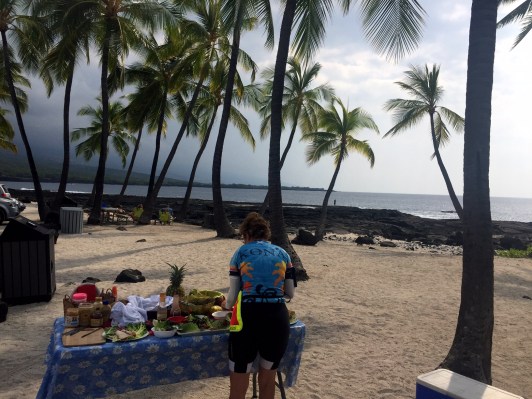
IMG_1567                                Picnic-pit stop for lunch at the beach on the last day of the year

The Devil is biking around the Big Island of Hawaii for the next few days. From there, he wishes every one of his readers a wonderful 2016 and may prosperity and peace come to our beleaguered country, Venezuela, in 2016.


Stage Set For First Constitutional Clash in Venezuela in 2016

December 31, 2015

indexAs predicted in my next to last post Constitutional clash is set for the swearing in ceremony of the new National Assembly, as the newly and illegally named Supreme Court Justices of the Electoral Hall admitted a seventh request to have the effects of the December 6th. election suspended.

Up to today, we had known that there were six such requests. They had been introduced on December 28th. against certain Deputies elected on Dec. 6th. But on the 29th. an additional request was introduced to suspend the effects of the whole election in Amazonas State, which implies that the Court is saying that the Electoral processes in which three opposition Deputies and one Chavismo Deputy were elected are temporarily suspended.

The whole process was clearly set up by Chavismo to attempt to negate the 2/3 majority by the opposition on the new Parliament. But the whole process in itself stinks:

-One of the “Justices” considering the cases voted for herself as a Deputy.

-The lawyer that introduced the case is a public employee, which is illegal.

-The members of the Electoral Hall were on vacation and suddenly decided to end it.

-The opposition had recused all of the members of the Electoral Hall, which implied they had to resolve that, before the cases could be considered.

What is most interesting is that the opposition’s interpretation is that the decision by the Electoral Hall is not applicable, because the election is over, the candidates had been proclaimed and the request can no longer be executed. According to this interpretation, the Deputies had been proclaimed and thus the Electoral Hall can no longer suspend the process and at this point only the National Assembly itself (Art. 187 of the Constitution) can “qualify its members and know about their resignation…”

Thus, the MUD argues the Court has no Jurisdiction on this.

In fact, the article linked above, the best article on the subject, also notes that in the absence of these four Deputies, the opposition would still retain the 2/3 majority, because it would be counted on the basis of existing Deputies, not possible Deputies.

But perhaps the weirdest thing about the case, is that none of the races involved in Amazonas are close. The closest is that of Deputy Nirma Guarulla elected by 2,260 votes out of 63 thousand and some votes, a difference that seems very difficult to overturn.

diputadas

The rest are almost impossible, as the Deputies elected by list split the votes in half and both got elected, one for the opposition and one for Chavismo. (They got 63 thousand of roughly 64,000 votes between the two of them)

The final election affected is that of the indigenous representative for the south, which was a runaway victory for the opposition candidate:

indigena

which won by about the number of votes that the second place candidate obtained.

Thus, it is unclear at this time what Chavismo aims to do with these results. A place like Aragua had much smaller differences than these, but these cases were rejected by the Court.

In any case, a clash of Constitutional powers is set to take place on Jan. 5th. as the new Assembly will admit all of those elected.

What will the Court and Chavismo do?

And once the Assembly starts working, its next step may be to increase he number of Justices and/or question the validity of those recently elected.

Meanwhile Maduro announced his new “economic” measures, which were so stupid that it is not even worth mentioning…


Some Venezuelan Christmas Mysteries

December 24, 2015

Arbolito

Ah! It’s Christmas. At last we can relax for a couple of days and think about nice things, enjoy family and toast to life!

So, while you are relaxing, I leave you with these Venezuelan Christmas mysteries, in no particular order:

-Why do hallacas have capers in them, if we don’t have them in Venezuela?

-Why did Chávez choose Maduro?

-Corolary: Why did Cabello not fight Maduro once Chávez died and later he staked his future on Maduro’s fate?

-Why do some Venezuelans follow Niño Jesus, others San Nicolas and then some Santa Claus?

-Does anyone who is not Venezuelan understand what Gaitas have to do with Christmas?

-And why are nacimientos (nativities) shrinking?

-And why do Venezuelans celebrate the night before Christmas and sleep and watch movies on the 25th.?

-And what’s the true story with the attempt to revoke 22 elected Deputies at the Supreme Court this week? Did it happen or not?

-Does anyone remember that people would paint their houses right before Christmas or was that a family tradition?

-Have you ever seen a “Furruco” factory?

-And why is midnight mass called Misa de Gallo (Rooster’s Mass)?

And on that note, Merry Christmas to all the readers. Thank you for reading, commenting and hanging on for so long. That Santa Claus, San Nicolas, El Niño Jesús (Yes!) brings you everything you wanted and don’t drink too much Ponche Crema (Or do!).

Best from the Devil!


A Priceless Detention Order Related To PDVSA Graft

December 21, 2015
View this document on Scribd

The above detention order is simply priceless. I can only imagine how, Cesar Batiz, Setty and Alek Boyd feel when they read it. They pioneered the subject and went after these people relentlessly. They are now reaping the fruits of their labor.

My understanding is that the indictment of Rincón itself is sealed, but the detention order and the Judge’s reasons for not giving bail are simply priceless.

To wit:

-Defendant Rincon-Fernandez (Rincon) is a Venezuelan national charged with violating the Foriegn Corrupt Practices Act and conspiring to launder money.

-The indictment charges that Rincon and his co-defendants set up several schemes to obtain contracts with PDVSA. In al schemes bribes were paid to PDVSA officials to get Rincon affiliated companies on the short list of companies which were entitled to bid for PDVSA contracts.

-Rincon also bribed individuals to put non-competitors on the short list.

-The investigation covered 730 bank accounts (how many do you have?), of those, 10% were realted to Rincon, his family and his companies. The indictment seeks forfeiture of three Swiss bank accounts. While the government has traced $100 million from the scheme into those Swiss accounts, it can not trace outgoing funds due to Swiss banking law secrecy.

-From 2009 through 2014, over one billion dollars was traced to this conspiracy. Of that amount, $750,000,000 was traced to Rincon between 2010 and 2013.

One billion dollars!!!

And I note that during at least part of this period:

Chávez was alive and President of Venezuela!

Rafael Ramirez was President of PDVSA!

Jorge Giordani was both Minister of Finance and Planning and a member of the Board of PDVSA!

Luisa Ortega was prosecutor!

And during all this time, there were many denunciations of this corruption and NOBODY in Venezuela did anything, including Chávez, Ramirez, Giordani and Ortega.

What will the last three say now?

Chavismo is simply too much…This is stuff of movies and fiction, live from Bolivarian Venezuela…

And here is the arrest warrant, released the next day

View this document on Scribd

The Venezuelan Garden Of Possible Bifurcation Paths Into The Future

December 20, 2015

Fractal-tree

I start with a quote:

The evil that one endures patiently because it seems inevitable becomes unbearable the moment its elimination becomes conceivable

Alexis de Tocqueville

and the title of a book by Jorge Luis Borges: “The garden of bifurcation paths” from which I simply borrow the analogy of what the title conveys.


Predicting what will happen in 2016 in Venezuela is a guessing game that requires understanding  all of the possible varieties of bifurcations that are possible in the decision making process of both what the Government will do and what the opposition will do. And guessing at all of the possible variations and possibilities is simply an impossible guessing game.

However, if we go back to the quote above  from Tocqueville, one can simplify the guessing game to its conclusion: At this point in time, the inevitability of Chavismo in the future of Venezuelan politics and Government is no longer a given. A crack was opened in the Government’s dam and the people now realize that it is very easy to open new cracks that will simply bring the dam down. And the stubbornness  or blindness exhibited so far by the Maduro administration only helps in accelerating its demise. As Tocqueville says, the ill has diminished with the victory on December 6th. by the opposition, but the sensitivity to it has increased. And I would add that it will increase dramatically, if the Government fails to act on the economy.

And yes, the most likely outcome is Maduro’s departure, the question is whether he will bring down Chavismo with him, or whether Chavismo will sacrifice him for the benefit of the Bolivarian revolution. The longer Maduro and his closest advisers insist in radicalization and confrontation, the higher the probability that in the end his administration will crumble and he will bring down Chavismo with him.

But the path is not trivial.

But let’s start at the beginning: Chávez died, the Government did hold elections and recognized the victory of the opposition with a qualified majority.

That is an already explosive combination when you add to it that the Venezuelan oil basket is below US$ 30 per barrel for the first time since 2004.

But the first three thoughts are more important: Chavismo is where it is because Chavez died, decided to anoint Maduro, not the brightest light bulb in the Chavismo universe (with small caps), and for reasons that have not been made explicit, accepted to hold the Parliamentary elections and its defeat. Whatever these reasons were, and given that the poll numbers were clear, the three facts above have a very important significance: Within Chavismo, the moderates imposed their views over the radicals on the results and unless the radicals decide to get rid of the moderates (which may be hard to do now, as well as the worst thing they could do) there is no turning back and the new National Assembly will take over on Jan. 5th., even if there are attempts to bar the entrance of the new Deputies to the Assembly building.

Between now and then we will continue to hear about null or blank votes, but given that the Chavista controlled Electoral Board established the rules, that Chavismo won where these votes were largest and that that is not a cause for contesting an election, there is little that can be done. Ironically, the whole Electoral Board has been on vacation since Dec. 12th. and will not go back to work until Jan. 3d. Contesting the results because of too many null votes could backfire for Chavismo, given that the opposition could also benefit in the process in different circuits.

Thus, Chavismo will focus for now on illegally naming the twelve Supreme Court Justices that are currently vacant. Illegally, because the Supreme Court Law establishes the periods and conditions for the pre-selection of the Justices and under no condition can naming them be a topic of “urgency” which is all you should consider during extraordinary sessions. Furthermore, a team of lawyers is legally challenging each of the nominations, which will create another violation of the law if it is not considered and blocks their nomination. If Chavismo bypasses all these, the legal case for removing these Justices becomes even more solid.

Meanwhile, it is clear that there is strong dissent within Chavismo. Maduro had promised to change the Cabinet, said the military will go back to their military posts, but neither has yet to happen. If the “moderates” win, watch the military stay in the Cabinet. So far, lengthy days of discussions have yielded no truce, but the radicals are not winning.

The opposition has not shown a lot of unity either. It would have been very positive for the opposition to say who would be the President of the incoming Assembly by now. Given that there are supposedly two candidates (none my favorites for different reasons) it would have been nice to have made the announcement by now. If every step going forward is going to take this long to be decided, one has reasons to worry.

So, between now and Jan. 5th. there will be few major happenings, as Venezuela is already going on vacation. I certainly hope opposition leaders will stay working this year, rather than give all of the space to Chavismo to instill fear on those that voted against it.

And thus we get to Jan. 5th.

The first question is what will happen during the installation of the National Assembly. While many expect the worst, the signal that Chavismo will send if it does not allow the new Deputies to take their seats is too negative. Given that the moderates seem to be gaining the upper hand (elections, recognition of win) it seems today as if there may be isolated incidents of violence, but the Assembly will begin functioning on that day.

This alone will give the opposition a bigger voice, larger visibility and presence in the media. It is not only a matter of having ANTV to broadcast the message, but by allowing all media (including Chavista media) into the Assembly meetings, they will have a much larger placement in media.

The opposition should be forceful but conciliatory, giving the message at every step that  it will legislate for all. But it should clarify at every opportunity that economic policy is still in the hands of the Government. But unity and peace should be at the center of its message, including asking the Government to talk.

At this point, the bifurcations are determined by what the opposition will do. In particular, these four important paths have to be determined in order of priority:

-The Amnesty Bill

-Removing the new Justices if the Government is set in its path of naming them before Jan. 4th.

-Choosing between a recall referendum or a Constitutional Amendment to change the Presidential term.

-How can the Assembly influence economic decision making going forward?

-How to go about controlling and obtaining information from the Government.

The first two issues lead to immediate confrontation if Chavismo decides to confront them head on. My feeling is that the Amnesty Bill will be the first item on the new Assembly agenda. Maduro has threatened not to obey it, but it is a Constitutional prerogative (Art. 174, numeral 5) that the Assembly can issue such a Bill. In fact, the Constitution even bars such a Bill (Art. 74) from being considered as a referendum. Were the Judicial system to refuse to free those granted amnesty, they would have been kidnapped by Maduro, and everyone involved in the process could be suspended and censored.

And here is where the Constitutional clashes begin. In order to suspend anyone the “Moral Cuncil” has to approve it, but some of the same people involved in the decision to free the prisoners are in that Council. Moreover, the Government could send the Bill to the Supreme Court, the same Supreme Court whose members, particularly those in the Constitutional Hall, will be questioned in their legality by the Assembly. And who can resolve this case, since the new Justices would not be able to decide on their own case and have to recuse themselves?

There seems to be no way out of this logjam, if Maduro decides to confront.

Another decision is whether to attempt to recall Maduro or not. As I noted in previous posts, if the Dic. 6th. election had been a recall vote, the opposition would have barely won by 139,000 votes. (It needs to obtain at least the number of votes Maduro obtained in 2013). But it may not be the same for someone to vote for opposition Deputies as a protest, than to vote against Maduro being removed from office. Many may be reluctant to do so, they wanted to send a message to Maduro, but not necessarily remove him. And it was close.

A less confrontational path may be to propose a Constitutional Amendment, which also requires a referendum, changing the Presidential term to four years with only one reelection. (currently six years and indefinite reelection) In this manner, you are not saying Maduro has to go, but rather, Maduro’s completion of Chávez’ term ends in Oct. 2016 and he will have to run fto get reelected. This may be a much more attractive way for disgruntled Chavistas: Maduro has a few months to improve things and if he doesn’t, he will not be reelected.

While it is not the job of the National Assembly, the economic is foremost in people’s minds, as scarcity is the norm of the day in Venezuela. In fact, people say that lines are disappearing, simply because there is nothing to buy. But economic policy is the domain of the Executive branch, so what can the National Assembly do?

The Assembly could revoke some Bills, like the Illicit Foreign Exchange Bill or the Price Control Bill. But solving economic problems requires looking at the overall scheme of things. Tinkering with a few Bills may simply have unexpected consequences in the order of things. In terms of Bills, the Assembly may use the threat of revoking or changing them as a way of getting the Government to negotiate.

The budget is one area where the Assembly does indeed have a say. The 2016 budget has already been approved, but it has been a tradition in Venezuela (since way before Chávez) that the budget Bill is irrelevant and numerous “additional credits” are approved during the year. If it is true that the Government plans to devalue soon, something I am skeptical about, to disburse the extra Bolívars generated by this devaluation will require approval by the National Assembly. Thus, the Government gains nothing by devaluing if it does not collaborate with the Assembly.

And without its approval, it will be hard for Government officials to spend money, because they are individually responsible in the face of the law, at a time of a changing political landscape, which implies that they could face corruption charges for spending money that had not been approved. And this would apply all along the line of expenditures from the National Treasurer, to the Ministers and below.

The Assembly can also ask more transparency from Ministers, requesting information and data. If a Minister does not comply with the request, he can be censored by three-fifths of the Assembly, which implies his removal from office. The same applies to the Vice-President (Art. 187, numeral 10 of the Constitution)

All of the above will evolve differently depending on the order in which it happens. The reason to be optimistic, is that as Toqueville said, the people endured Chavismo until it lost, now they will find it unbearable at every step. The reason to be pessimistic is that as a physicist, with published papers on chaos, I also know that too many bifurcations lead to chaos.

Hopefully, we will only have  a few…