Venezuela to Issue a 2026 Global Bond: Ignorance, Idiocy or Else?

October 11, 2011

I should learn. There is no such thing as privileged information in Venezuela. For the last two days, I have been hearing that the Government would sell a bond to the public. Assuming it was PDVSA, which may need money, I thought maybe, just maybe, they will sell a bond to the Venezuelan Central Bank to supply that banks’ foreign exchange system called SITME. But given the volatility and the lack of depth of bond markets in the last few weeks, which ignorant fool would even think of coming out with a bond now?

I guess I forgot those in charge of finances in Venezuela have no clue. Thus, THEY are coming out with a new bond at a time where we may have Heisenberg’s Uncertainty Principle apply to them: Without the issue the price may be X, but the sheer presence of the new bond may push the price down…just about for all bonds, PDVSA or Venezuela. Way to go idiots!

But such are the idiots that run this country. They are clueless. Let me explain a little bit.

During the month of September, markets have been hit by three fears: Europe, a recession in the US and the Chinese economy cooling down. Because memories are fresh, the reaction by investors has been to run for safety. Despite the recent downgrade of the US, the dollar and US Treasury bonds became the “in” thing to have. People sold off everything, stocks, bonds, emerging markets bonds, Brasil, Asia, Russia. The works. Buyers went on strike with many of these. When there are no buyers and a few players, prices simply collapse. And the price of bonds did just that.

Russian bonds dropped 10% in price, Argentinean ones even more, Venezuelan ones like 10%, some more, some less. But people thought Venezuela did relatively well. the country’s “risk” went down, but not as much as most of the world.

But still, Venezuelan bond markets dropped, became fairly illiquid, by this I mean, volumes went down, down to 20% or 30% to what they were in June. Maybe worse, but these numbers are just not public. But that is what traders tell me.

So, after a month of no country or company issuing anything (Pemex even pulled out one bond) Giordani and his clueless combo decide to issue US$ 3 billion of a Global 2026 bond with a coupon of 11.75%. This will be sold to local investors, privileged ones at that (read oligarchs, the rich, the enemies of the revolution), who will purchase cheap (very cheap) foreign currency with their ever depreciating “Bolivares Fuertes” (Strong Bolivars, not a joke)

To put it in proper perspective. The Government will sell US$ 3 billion of this bond in Bolivars at 95% of the price. That is, people who buy $1000 of the bond will buy it at 95% of Bs. 4.3 times 1000 dollars or Bs. 4,085. Of course the bond will be worth somewhere between 70% to 75%, so you will get between $700 to $750 for Bs. 4.085 or you will pay between Bs. 5.83 or Bs. 5.44. Even if the bond drops to 65% you are still buying dollars at Bs. 6.28per dollar. A true bargain.

A great deal if I ever saw one, when you think a free floating Bolivar would be worth around Bs. 8-10 per US$.

But what is good for you today, is terrible for Venezuela tomorrow. This bond will generate for the Government the equivalent of US$ 2.85 billion at the official rate of exchange. But over the years it will cost the country with the 11.75% coupon a total of US$ 8,287. Too expensive to support a silly exchange rate policy. Pan para hoy, hambre para manñana.

But even worse, you have to ask yourself why? The average price for the Venezuelan oil basket in 2011 is the highest EVER. Period. At US$ 84+ per barrel, the country has never had such a high revenue level.

So, why compromise the future in this way? Why pay so much to get barely US$ 3 billion?

That is the 64,000 lochas (Coin for 1/8 th of a Boluvar) question. Either these guys are siphoning off billions of dollars to the parallel funds or they are being so inefficient that they need more and more. To pay the companies that skim off a few hundred million to subcontract electric plants, like in the previous post or simply to guarantee that Hugo Chavez gets elected in 2011.

And that is the scary scenario. After 2011, maybe they just don’t give a damn. All their eggs are in the 2011 basket, reelect a crippled Hugo and guarantee the survival of the revolution. Who cares about the people? Who cares about Venezuela? Who cares about efficient spending? Sovereignty? How do you eat that?

Issuing this bond is so crazy, that for the first time I believe these guys will default if Chavez is reelected. Not the next day. They will stretch it for as long as they want. Buy they simply don’t care. Hugon and the robolution is all that matters. Sovereignty, the people, efficiency are simply words, Hugo is the big deal. The only deal in town.

So, if you came here to find out whether to buy the bond or not. Go ahead, buy it, you will likely be getting Bolivars at below Bs. 6 per US$. It’s the deal of a lifetime. Just remember that this is compromising the future of the country in a serious way.

And the answer is: Else! These guys are idiots, these guys are ignorant and all they care about is the else: the survival of the revolution, the ability of Hugo to get reelected.

Except that cancer got in the way…


You Can’t Make Up the Stuff That Happens In The Bolivarian Revolution

October 11, 2011

The Chavez Disney style doll that goes around Venezuela (still has hair), was on TV this morning and lo and behold the dolls pants fell down. You can watch the movie here, but this would make this blog XXX if I posted the whole grotesque incident. Reality is stranger than fiction in the revolution.

Only in the revolution!!!


Another Day, Another Almost Tragic “Normal” Accident in Revolutionary Venezuela

October 7, 2011

It has been a month of accidents in Venezuela. Airplanes, trains, buses, accidents are now considered normal, nobody is responsible. In a country with four trains, three of them were involved in a recent accident leaving one person dead and 35 injured and the response of the Government was as if it was nobody’s fault, because “some cables had been stolen”

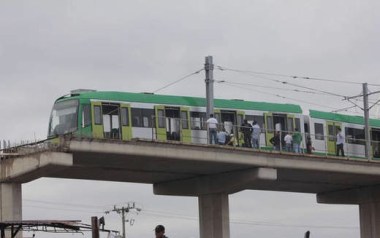
Then yesterday, we had another”normal” accident, this time in the Maracaibo subway system, a fairly new system, which has yet to be completed.  Basically, the brakes failed and the train continued beyond the barrier that is supposed to stop it and ended up a bare three meters away from falling down the end of the cement structure that supports the tracks, as you can see in the picture above.

The explanation?

It was all the rain’s fault! You see it rained, the train slipped because it had inertia. This seems to be “normal”. This is simply absurd, no rail system skips and slips because of the rain. If you put a barrier up to block a runaway train, it should stop a runaway train.  That is what engineers are supposed to design and prevent. But things not working in Venezuela are simply “normal” under the stupid revolution.

Of course, former Governor of Zulia Francisco Arias Cardenas, without having a clue, suggested sabotage by the opposition, another favorite explanation by this irresponsible revolution. They could not blame the IVth. Republic the subway system did not exist then…


And Now Hugo Wants to have ChOPEC

October 6, 2011

Today, Hugo Chavez held one of his impromptu nationwide TV address at noon, which had no purpose other than stop TV stations from showing the memorial and burial of former Venezuelan President Carlos Andres Perez.

The excuse for the address was some visit by Russian emissaries to the Orinoco Oil Fields. Chavez was obviously not there, but managed to talk and talk. During his verbal incontinence, he made a little publicized remark, saying that he had this “witty idea” , to create a new organization of only the four or five largest producers of oil in the world.

He gave no reason for this “witty idea”, he just “had” this whim and that is why this poor country has been suffering so much, because we keep implementing all the destructive ideas of Hugo Chavez, which never seem to be very positive or constructive.

I guess the whole point is to have the Chavez Organization of Petroleum Exporting Countries (ChOPEC) whose role would be to showcase…Hugo Chavez, would be my guess.

Chavez seemed to realize how silly the idea was at some point, saying that this “would not affect OPEC”, but never explaining why this new organization was needed at all.

But he never explained how Venezuela fits into the group of the four or five largest oil exporters in the world. Because it doesn’t! According to OPEC (page 46), Venezuela is the 6th. largest producer of oil within OPEC alone!

Another day, another Chow, sorry, show…


All hope abandon ye who live here in Venezuela

October 4, 2011

(And there is still ways to go…)

I felt like that line in Dante’s Divina Comedia, All hope abandon ye who live here in Venezuela. While Dante was talking Hell, it just seems like the same here and that Venezuelans seem to like it.

This is how I feel after reading the latest data from Datanalisis, a pollster which is quite controversial, but which has been fairly accurate in the past. According to them, Chavez’ popularity has jumped 10% points since July and is currently at 58%, while vote intentions went from 31% to 40%.

With the electric problems, inflation at 30%, airline and train accidents, shortages, even Chavez admitting the health system is the pits, people still love Chavez.

Makes sense? Obviously not, but that is our reality.

Go figure!


The eternal vicious cycle of inflation and shortages under Chavez’ revolution.

October 2, 2011

Today’s El Universal has an article talking about how hard it is for local producers to sell regulated products at a profit, which leads to shortages. The Government, of course, denies there are shortages, saying the whole thing is a “mediatic campaign” by sectors that control these products and want to have “exorbitant” profits.

Shortages are measured by Cavidea, pollsters and the Venezuelan Central Bank. Cavidea says shortages are running at 20%, in perfect agreement with Datanalisis, which gives the same number, up from 9% a year ago. The Venezuelan Central Bank gave for August (Cavidea and Datanalisis are for September) a lower value of 13.5%.

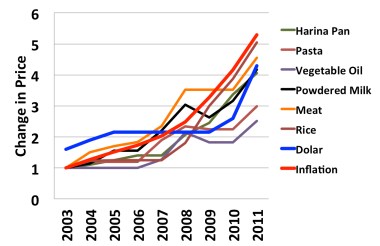
In order to look at this problem long term, I made a rather busy chart, shown below, in which I took the price for some basic products, all regulated, normalizing it to the price in 2003, when controls began and included inflation (in bright red), also normalized to 1 in 2003 and the price of the official dollar, which I did not normalize (in dark blue)


As you can see, if one compares to inflation, all prices are behind the inflation curve. This curve is also not complete, as inflation for this year is not included, in the plot, 2003 inflation is added in 2004, 2004 in 2005 an so forth.

Of course, the Government gives foreign currency to some importers to bring these products from abroad, so that a comparison to the official dollar for imports may be fairer in some cases, with the caveats, that even if you import all your product, you still have local costs that keep increasing every year at a good clip.

However, most of the regulated products I included in his chart are made in Venezuela, with the exception of milk. Interestingly, this item, which is currently one of the most difficult to find in markets, has kept up rather well with the inflation curve, rather than the US dollar curve, despite being mostly imported. In contrast, vegetable oil producers are being squeezed, no matter which comparison you make, to either inflation or the official dollar, lagging by 250% the inflation index. So have pasta producers.

Other products, like rice, after holding them back for the first few years of controls, have kept up rather well in the last few years.

However, from the chart it is clear that it must not be easy for any of these producers to make money if one compares to inflation, after all, we are talking about the fact that inflation has increased by a factor of more than 500% since 2003, while only rice and meat, have managed comparable gains in prices of more than 450%.

This graph also show why the Government shoots itself in the foot in its goal to reduce inflation: The more that it holds back price increases, the more inflation will be held back until next year, making it practically impossible to reduce the yearly CPI. In fact, in 2001 the CPI was only 13.1%, in the absence of price controls and exchange controls, but just about then, the Government began to spend beyond its means, needing a devaluation in 2002, which pushed inflation higher and introducing price controls and exchange controls in 2003. Inflation went down in 2005 and 2006, precisely because many price increases were held back, that is what is fueling inflation these days, just trying to manage the balance between shortages and inflation.

Like so much under Chavez it is an impossible policy in the long term. Something has to give. It is a vicious cycle, if you hold back prices you create shortages, if you don’t allow prices to go up to fair value, you push inflation into the future. If you don’t allow for reasonable profits, you get less investment and fewer products.

But the revolution thinks it’s winning


Too Many Rumors in Caracas, what to look for…

September 28, 2011

Rumors flying right and left in Caracas, only the international press and Twitter (@fredliberty2010, @DolarToday) saying much. What should one believe?

I don’t know…

But from day one of Chavez’ illness, I have told people to watch for one sign:

The day Venezuela’s VP Elias Jaua is replaced, the day that I believe something is up.

So, don’t wait for signs from the sky, or from Twitter , or from your local Babalao, watch the VP, If he stays, nothing is afoot, if he is replaced…

Oh Baby!


Clueless Chavismo Does Not Even Know How To Deal with A Landslide

September 27, 2011

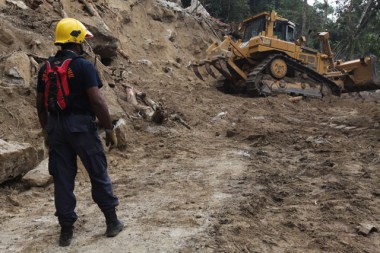
Late in August, I am not sure what day, landslides in the road to Choroni blocked the road. I have two friends in their eighties that had to be helicoptered out that week. At the time, the wise Governor of Aragua State said that it would take four days to clear the road.

It may seem like a chicken and egg problem, the Governor says these are the worst landslides in history, but the rainy season has not been particularly bad. It could be a maintenance problem, or may be not.

But what is amazing is that today, the same guy, Governor Isea, gives a press conference to say that tonight, sometime after 7 PM, traffic was partially restored on the road to Choroni.

We are talking SEVEN times later, 28 days to be exact, rather than four and there is still a rock on the way such that only one car can pass thru at a time. Yes, in the middle there was partial access, but these guys are ONLY a month late!

Is he proud of this? Does he really think he is a hot shot Governor? How clueless can he be? We are talking about beautiful Choroni, a town that lives off tourism being isolated for a full month!

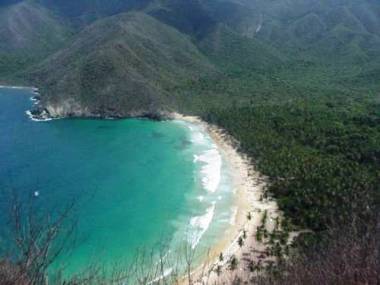
Even if the beach is nice:

an believe it me, it is. Why would you even bother to try to go there?

And you will not even bother going until the rains end, maybe in February?

This does wonders for the local economy of Choroni.

And in talking to my friends, who have had a house there for decades, they don’t ever remember the road being closed for more than two or three days and it has now been a month!

And you can bet Isea will hold a press conference when full traffic is restored! That’s how clueless these guys are, they don’t even know how to deal with a landslide or a series of landslides, which are not even a record.

But they think they are doing great!


The non-existing automobile policy of the Venezuelan Government goes brainless

September 25, 2011

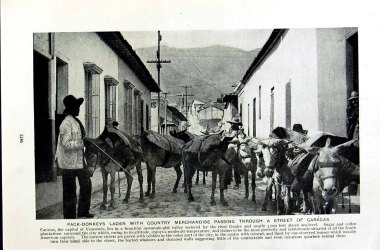
Donkeys in downtown Caracas, circa 1920

Starting this week, the Venezuelan Government will cap the prices at which cars can be sold in the country. This is yet another silly and failed policy by a Government who has done little in terms of defining any policy for the sector.

The Government did not have a policy in place before exchange controls were imposed in 2003, nor has it had a policy since.

Before exchange controls, it increased taxes on cars, such that all cars pay a basic 30% custom taxes, which becomes higher by 10% for luxury cars, which are defined as those that sell for more than US$ 30,000. After controls, the Government has gone from a free for all of imports at the preferential official exchange rate, to limited foreign currency for car parts or car imports.

In the middle, the Government did all sorts of things that simply did not help. Like allow any automobile brand to come in and give the importers cheap controlled dollars. For local manufacturers this created problems, it is hard to compete with imports, when your local costs are seeing 25% inflation year after year. Everything from fancy American cars, to German cars, to cheap Chinese imports, got cheap dollars until the numbers of cars imported (and the dollars!) simply soared to levels that were simply absurd. And the Government took notice. (They apparently weren’t watching)

Oh yeah! In the middle we were promised cheap Iranian and Chinese cars, made in Venezuela, that would break the back of all other car companies. We are still waiting.

Of course, the Government does not ask itself the basic question: Why do people want so many cars?

The answer is simple: cheap gas and cheap relative car prices relative to inflation. Cheap gas means that the cost of fueling the car is irrelevant when you buy or drive a car in Venezuela, courtesy of a crazy 8.5 US cents per gallon policy by the Venezuelan Government, since Chavez has yet to increase the price of gas even once during his twelve years in office. (Yes, with 1,300% inflation in those years!)

The second reason is that on a relative basis, cars are cheap. Twelve years ago, when Chavez took power, one dollar cost Bs. 0.575, given that inflation has been around 1,300%, that same dollar should cost around Bs. 7.45, instead the Chavez administration gives car companies dollars at Bs. 4.3 for the import of cars and parts to make cars. On top of that, in 1999 car companies could buy all the dollars they wanted to make cars, today those dollars are limited, i.e. the number of cars being sold is quite limited.

But even worse, the number of cars being sold is limited in an environment where the Government is printing money. How much money? Let me put it in perspective. In 1999, all of the Bolivars in the country would have bought 700,000 $20,000 cars. Today, all of the Bolivars out there would buy over 4,000,000 cars at the same price. That’s a factor of seven times!

Ever heard of supply and demand?

Not the Chavistas. For them it is all speculation. Thus, the “new” automobile policy is aimed at that. The solution is to regulate how much car companies can earn and they have magically decided to fix that at 10%. With 25-30% inflation that sounds like a sure no brainer so that that there will be fewer and fewer cars for sale in the upcoming years. Less investments, fewer companies, fewer cars.

It is indeed a revolution, just like Cuba, Venezuelans will be driving beaten down cars, or more romantically for a brainless revolutionary, they will be riding the donkeys or mules that their grandparents rode like the picture above.


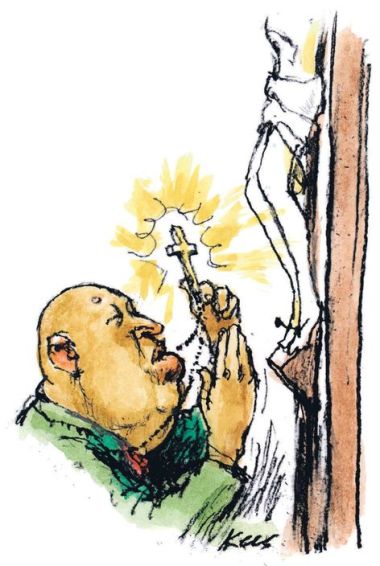
Praying for Hugo in Manhattan

September 22, 2011

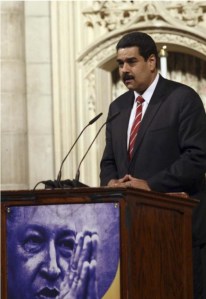
I am still a little confused by these images from the prayer service for Hugo Chavez held in Manhattan. Are we to believe now that Maduro has become a believer? And how about Sean Penn? And you have to wonder about a church whose claim to fame was that Fidel Castro the agnostic visited once.

But it is the images that I wonder about.  The word “cursi” comes to mind (Corny in English?). But in the end who were they aimed at?

Look at the invitation:


Chavez’ pose is reminiscent of the “good” Chavez days. It looks airy, almost super natural. Very religious. The question is who are they trying to canonize? Hugo?

Or is the picture below, is that of the soon to be anointed Son and the Spirit under him?:

Is a message being sent? To whom? The Vatican or the Venezuelan people?

Or was this just another corny Chavista show?

(Note the Sixtine Chapel like shades on the purple image of Hugo!)