Venezuelan Minister for Electricty reveals the Idiocy of the Government

January 10, 2011

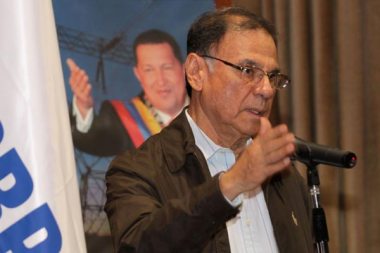
If anyone wanted proof of the absolute idiocy of the Venezuelan Government, today’s press conference by once-considered-serious Ali Rodriguez Araque, showed why the country is falling apart under the mismanagement of the Chavez administration.

As the country’s electrical infrastructure falls apart and Chavez bars the national electric company Corpoelec from raising electric rates, after seven years of a tariff freeze, Rodriguez Araque proudly announced that any Government institution that does not pay its electric service will have its electricity shut off. You see, Government entities, from Ministries to institutes owe Corpolec some four billion Bolivars, roughly US$ 930 million at the “new” and “unified” official rate, who knows what at the unspeakable green lettuce rate.

And therein lies the tragedy of this non-Government: Nobody is in charge, despite Chavez controlling all powers, each Minister, Head of Institute, Director or whatever, is his all-powerful Dictator of his own fiefdom, accountable to nobody. So, why pay electric bills? A penny saved is a penny earned…and to hell with the future of the country or it proper functioning.

Rodriguez himself notes than when he sends his employees to cut off power, his own people are jailed by the mini-Chavez’ in charge of the various institutions that fail to pay their electric bills month after month!

He is nobody in a Government of lots of little somebodies…

The mess is so huge that Rodriguez said that the revenues of Corpoelec, the revenues, from all the electricity that it sold in 2010, was only sufficient to cover half of the payroll of Corpoelec. Everything else, like so many other subsidies and distortions, has to be supplied by the central Government.

No wonder the electric network is such a mess, we should blame El Niño, but El Niño Hugo Chavez, the same one that unilaterally overrides studies that electric rates need to be increased or sends the victims of the floods to tents that can barely hold their own in a gust of wind.

But the bigger fool is Rodriguez, considered the most capable Minister in the first few years of the Chavez administration. He began the destruction of PDVSA under Chavez’ orders firing 20,000 workers in 2003, including all of the key technical personnel, allowed himself to be displaced from Finance by the incompetent Giordani and now attempts to do the impossible in trying to prop up the electrical power network, with no money.

Thus, the one time guerrilla fighter has now become a sorry pawn of Chavez’ delirium, quietly following orders and barking his own that nobody will follow.

He will not even have to turn off the lights, they will go off on their own.

Improvisation comes back to haunt the revolution day after day

January 9, 2011

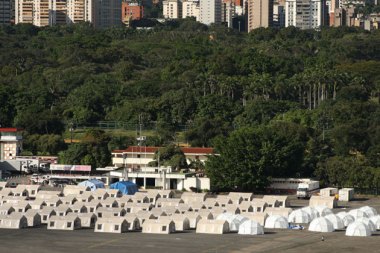
As part of the Government’s emergency planning, the Army went and bought some tents to provide housing to those left homeless by the recent flooding. The tents were set up at the La Carlota airport in the East side of Caracas. They looked like this:

and like this:

but then today, they flew off, as you can see in this picture:

You may wonder, a tornado? strong winds? a storm?

Nope, this was simply due to a helicopter taking off from the La Carlota airport.

Stupid is, stupid does…

It is just the result of the never ending improvisation of the Government.

Will some General be rewarded for this? Who made money buying the tents? Who came up with this harebrained idea?

We will never know…there is no accountability.


Dumb economic subsidies and arbitrages in Venezuela

January 8, 2011

(I am going to unify them)

Economic theory always talks about the efficient allocation of scarce resources, the acceptance that Governments have to optimize wealth, distribute it as uniformly as possible in order to maximize the well being and happiness of citizens. Clearly, none of Chavez’ “economic” advisers either understands this, nor has explained it to Hugo. The revolution continues to run on a path of destruction, where the State believes that it can do it all, in the process, it is destroying value, reducing those same resources that are scarce and simply trying to redistribute them around. In the end, if your could distribute it all evenly, Venezuela would turn out to be a Nation of poor people. Yes, the extremes have to be eliminated, but the way about doing it have all been wrong in the last twelve years.The subsidies and distortions in the end turn out to be more costly than actually reaches the poor. In fact, the money that it costs to sustain the gasoline subsidy alone could be used to give half the Venezuelan population over the “average” of the GDP/Capita of the country. Not that I am arguing that should be done.

But Chavez’ Government could care less about optimizing or improving resources. When a cement plant is nationalized just to be able to say that the Government owns it, the price of the plant, say US$ 1 billion is spent on buying an existing plant with x jobs, rather than creating a new plant that generates jobs. Even worse, the plant is run more inefficiently, there is less economic value and we are all poorer.

But there are worse subsidies and distortions than the dumb nationalizations. Minister of Planning and Finance Giordani has actually been arguing in the last few days that people were taking advantage of the dual exchange rate of Bs. 2.6 and Bs. 4.3 to the dollar offered by the Givernment.

Duhh!

It took him seven years to learn that?

I could have told him that would happen on day one. It is the story of dual exchange rates in the world and Venezuela.

But what really gets to me is that Giordani  has suggested that even Government imports were being sold as if they were purchased at the higher rate of Bs. 4.3 per US$. So, someone within the Government was making a lot of money out of that arbitrage, because someone had to pocket that difference. The worst part is, nobody is being accused, charged or being fingered. But n the end the truly, really worst part is that those that implemented these idiotic, corrupt, distorted and dumb system, are still running the show.

There is simply no accountability.

And there were many other arbitrages that were absurd and they still exist. It had become fashionable for middle and upper middle class people to send their kids to study abroad. They were given a basic stipend and tuition at Bs. 2.6 per US$ to go study abroad. Hey, with the parallel rate at three times that, how could you go wrong? I am not against education, but I would prefer a program to give scholarships to the best and the brightest at Bs. 0 to go abroad that to fund the well to do at Bs. 2.6.Because most of them could afford it anyway.

And why should I be able to buy US$ 400 of Internet goods at Bs. 4.3 per US$? I was planning to forego the pain of submitting the forms this year to get that amount, but the Government changed policy and I got an email two days ago telling me I had to do nothing, that my card was renewed automatically and I could go ahead and spent my money. This makes no sense at Bs. 4.3, its absurd, its unfair to the poor.

It is the furthest thing from optimizing the allocation of scarce resources. It is the opposite, it is giving money to the rich to buy widgets and gadgets from Amazon, even if they don’t accept my Venezuelan credit card for kindle books.

And I don’t even ask for the travel money, or my US$ 5,000 a year from SITME at US$ 5.3, something some people spend all the time planning and preparing for.

But these things are likely to be tiny in the scale of food imports from the Government and the private sector. Who knows what is authorized at Bs. 2.6, now Bs. 4.3. For that matter who knows what is being imported at Bs. 4.3 and sold at an equivalent exchange rate of Bs. 10 per US$.

But Giordani hails his own decisions, refuses to recognize he imposed this crazy and goofy system and in fact, he is continuing it. At Bs. 4.3 per US$ you still get a subsidy for your kid to study abroad, for your Internet dollars, for food purchased at Bs. 4.3 and sold as if it was purchased at Bs. x higher and likely for breast prosthesis used to enhance the attractiveness of Venezuelan upper and middle class women.

Giordani must be proud of that.


New Venezuelan National Assembly Sworn in today

January 5, 2011

I know, I know, I should have blogged about today’s swearing in of the new National Assembly. Sure it was good to have opposition Deputies back, my biggest surprise was that there was no violence, I guess Hugo must have ordered good behavior to his troops because the world was watching, I was sure there was going to be violence, the same way I was sure Hugo was not going to back track on the University Bill, which shows how much I really know, even if I try to “think” like Chavismo, which sounds oxymoronic.

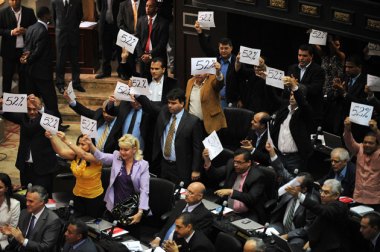
So, let’s review: No violence, that was good. Signs saying 52.2% for the opposition, you have to love this picture:

that was also good, seeing opposition Deputies there and talking, that is also good. Even juts bringing up boring points of order, like the fact that the Supreme Court request could not be in today’s agenda, that is good. Having Chavez say that they are going to crush opposition Deputies, that is also very good. Just wondering what he means for now.

The cool thing is the opposition is back, “No volveran” is dumb at this point in time, so it is good for Chavez and his minions to keep repeating it, they are back, whether they wanted it or not.

The bad part was watching the new President of the Assembly, Fernando Soto Rojas, swear himself in. He made Cilia Flores look good, imagine that! But knowing the guys background is the worst part. Talk about being Vende Patria! This guy killed Venezuelan soldiers and is proud of it! This guy is a Cubanoid, he helped Cubans attempt an invasion of Venezuela! This guy was actually rejected by the voters and Chavez illegally inserted him into the slate in a State this guy does not live or vote in!

Just watch him, Was he really drunk? I don’t know, but his intimate chat with Simon Bolivar gave me the creeps, he is certainly not what I want for our leadership. Where did he get that suit? If you don’t speak Spanish, it does not really matter, the body language says it all :

But maybe what bothered me the most was the public, not only applauding him, but taping him! Were they his grandchildren?

So, this is my much reluctant National Assembly post, sorry if you expected more, there wasn’t much beyond what we already knew…


How Cheap is Gasoline in Venezuela? Another Reality Check

January 5, 2011

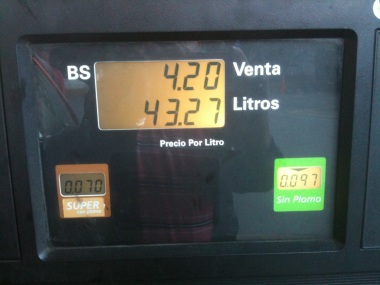
After a few discussions with readers, I decided to do another reality check on the price of gasoline in Venezuela. For all intents and purposes, it is free, no cost, zippo, as the picture above demonstrates.

I filled my tank yesterday. I used 93 octane, unleaded, which in Venezuela costs Bs. 0.097 per liter as you can see above in the green square.

Now, let me explain that Bs. 0.097. With the latest devaluation, the lowest exchange rate available is Bs. 4.3 per US$, which menas that a liter of gasoline in Venezuela is:

(Bs. 0.097/Bs. 4.3)= 0.0225 US$ cents

A number so small, that it is hard to relate to. Try 8.5 cents a gallon, yes US$ 0.085 per gallon or 35 times cheaper than the $3 gallon which prevails today in the US. Think about it, 35 times cheaper!

That is why I prefer for you to look at the other number: I got 43.27 liters for Bs. 4.2, or I filled my tank for less than a US dollar, exactly 97.6 cents.

Of course, there are exchange rates which are worse than Bs. 4.3 per dollar, like the Central Bank’s SITME system, which is Bs. 5.3 or the “forbidden rate”, which are even higher. If you use those, it is even cheaper.

Let’s put it in perspective: A bottle of water of 300 ml. or so, costs Bs. 7, more that my tank of gasoline. A can of Coca Cola about Bs. 6 or 7, also more than my tank of gas. I had a salad today, Bs. 50, ten times a tank of gas, well actually 11.9 times if you want to be precise.

I have a brother who fills his motorcycle with Bs. 0.45, gives the attendant Bs. 1 and tells him to keep the rest. The other day, my bother only had a Bs. 10 bill, gave it to the attendant and he said, no, it’s ok. The gas is indeed free!

So, if you double it, it is still free. Zero impact.

Think about it a different way: A barrel of gasoline is about 203 liters. It sells in Venezuela for US$ 4. It costs to produce at least US$ 20 at the new “low” exchange rate. Venezuelans use about 800,000 barrels of gasoline a day, times 365 times $16 of production subsidy is about US$ 4.6 billion. And I am probably low in the estimate. Of course, we could export it too and even make money. What a capitalist concept!

But think. Who owns cars? Rich people. Poor people go in buses. The impact of a one dollar tank of gas on the ticket price is zilch, zero, ok, it’s 1x 10⁻³, basically irrelevant. For the rich, it is a nice subsidy. Traffic is hell, so in the end we pay for it anyway.

Get the picture?

Evo Morales increased the price of gas from about 50 cents a gallon to 90 cents a gallon. He had to back track. But he went back to prices which are six times higher than in Venezuela, he wanted to make it almost twelve times more expensive.

This goes back to my old question: Can we insert a little rationality into our system, please!!!

Note added: Reader Lazarus, who knows the stuff, does the calculation in the comments for the size of the subsidy, here is his conclusion:

The loss opportunity cost to the country? Estimating, conservatively, 500,000 bbl per day internal consumption, if sold at the international market price of ~$120 per barrel of refined product, less the $3.50 actual sales prices, is about $58 million per day (BsF 267 million). Annually comes to $21 BILLION.

As he says, you could build a lot of stuff with that amount.

(By a remarkable coincidence, both Caracas Chronicles and Setty discuss the same topic today from different angles, maybe we should send all three posts to Ramirez and someone in the Government who speaks English)


Chavez “Vetoes” His Own University Bill That He had The Assembly Approve

January 4, 2011

In a very interesting about face, President Hugo Chavez “vetoed” the same University Bill he sent to the National Assembly he controlled. Despite the staunch defense of the Bill by his Ministers and supporters, President Chavez showed up on TV tonight and vetoed the Bill in the name of “discussion” and being “open”

Of course, he can’t even veto it…but the new Assembly is not about to ratify it either.

It appears as if the protests almost up to Christmas Day by the students unnerved the Government, which knows it’s losing support. Vetoing the Bill tonight is a slap in the face of the outgoing National assembly, which leaves today, and implies that it will be impossible to approve a new one in the new National Assembly, where Chavez does not have the two thirds super majority necessary. He could approve it within the Enabling Bill, but the reaction may be tough from the students.

Chavez also backtracked on the increase of the Value Added Tax, saying that the “funding” for the emergency caused by the flooding had been found. This must be the only poor country in the world, where a Government “finds” a couple of billion dollars lying around just like that.

But for now, Hugo “reculo“, a sign that the Dictator does not feel as strong as many think.

And that, my friends, is good news. But don’t believe we have won much…just temporary…


Chavismo really thinks Venezuelans are stupid

January 4, 2011

Here is the top chart of statements that prove Chavismo thinks Venezuelans are stupid:

At #1, Minister for the Productive Economy Ricardo Menéndez: “Unifying the exchange rate could even lower prices in Venezuela”

Sure Ricardo, we are stupid, really stupid.

At #2, Armando Leon, Central Bank Director: ” In practical terms, there is no devaluation, because the implicit exchange rate that is used to fix prices of the things that are being sold in the economy is not Bs. 2.6 and that is what we have observed during the last four months of the year and we had warned about it”

Get it? I don’t. If someone has to pay 65% more for the same thing, that means that someone is going to want 65% more to sell the stuff. But yes Armando, we are stupid. Remember the Bolivar “fuerte”?

At #3, Jorge Giordani, Minsiter of Finance: “Unifying the exchange rate will have a minor impact on inflation”

It must be that he thinks “minor” is like the age of a human being, that is, minor means under 18….percent!

At #4, Hugo Chavez, Dictator: “They say we are generating the conditions to apply a neoliberal adjustment. It is, of course, a strategy to lie outrageously in order to create confusion…monopolistic power, with Fedecamaras in the lead, inflates prices, disregarding economic rationality and laughing at the people”

I got stuck on the “disregarding economic rationality part”, just that he uses “economic rationality” blew my mind.  He is clearly absolutely sure we are stupid.


More on the Venezuelan devaluation

January 3, 2011

When the Government decided to unify the exchange rate last week, it did something that was necessary, but at the same time it is an isolated measure that in the end does little if nothing else is done to the economy. As I have said too many times, the problem is that the Government has established so many controls of the economy, that everything is distorted and when you touch one of these distortions it reverberates negatively throughout the economy. This devaluation from Bs. 2.6 to Bs. 4.3 is one more example of that.

The Venezuelan economy contracted 1.9% in 2010, after shrinking by 3.3% in 2009. Think about this, it is eight consecutive semesters of contraction, this is a long recession by any standards and there seems to be no end to it.

The problem is in part that there are no real economists running the show. Thus, the plans and decisions which are made are simply stop gap measures to what the Government perceives are the problems. And for the Government this means spending, that is all that it seems to be focused on all the time.

But think about it, oil prices are near $80 for the Venezuelan oil basket and the Chavez Government does not have enough money to live on. And with stagflation destroying productivity, the Government decides to increase the VAT, reestablish a financial transaction tax and devaluing the rate from Bs. 2.6 to Bs. 4.3, which applied basically to food and medicines.

Jeez, if that is loving the poor, they are getting too much loving from Hugo and Giordani, because all of those measures happen to hurt the poor the most.

-The VAT is a great tax to collect for the Government, but since the poor spend all their money, it is a tax that gets them the most.

-The Financial transaction tax is only applied to those that have bank accounts, which does not include the poor, but it is a cost that will be translated into inflation.

-The 65% increase in food and medicines impacts the poor the most, as they spend more of their income on food than anything else.

-The gasoline subsidy benefits the rich the most. By now gasoline is essentially free, for $1 you can fill your tank in Venezuela (and that includes a tip too)

The devaluation is estimated will give the Government about Bs. 13 billion in additional income, about US$ 3 billion, but it could have achieved more by adjusting gasoline prices at the same time. Doubling the price of gasoline from Bs. 0.1 to Bs. 0.2, i.e. from nothing to nothing, would have given PDVSA US$ 1 billion in additional income, but would have had much less inflationary impact on the poor.

Because in the end it is a strange devaluation. It moves the Bs. 2.6 to Bs. 4.3, but PDVSA changes more of its currency at the higher rate. Thus, it generates fewer new Bolivars for PDVSA, while making it more expensive for the Government to subsidize the imports. Why not do a little of everything? Why not slide the others? Or eliminate the Bs. 4.3 and have all go trough SITME at Bs. 5.3? I guess it’s too moo much to ask of the current financial authorities to show some coherence.

But in the end, the problem is that all of the announcements are fiscal measures that benefit the Government, but there are no announcements that help improve salaries, productivity, restore confidence, reduce gas consumption and/or attack the basic distortions in the economy. So, you have the worst of shock therapy to the economy, without doing anything constructive.

The only sector that benefits from these measures are local producers, who will be able to compete with imports that were being subsidized. This will be a good year for them. Their problem is that the Government is unlikely to increase prices instantly. It will likely drag its feet for two or three months trying to delay the spike in inflation or at least spread it around.

Exporters, despite claims to the contrary are indifferent to the devaluation. They have received the higher Bs. 4.3 rate since January 2010, despite which non traditional exports did not go up in 2010.

In part the problem is that the government does not even seem to remember why it imposed exchange controls. In its control mindset, it does not even consider eliminating it, which would in the end boost the economy after the initial impact. The current system of controls is costly, time consuming and creates arbitrage opportunities (which are reduced by the recent devaluation). Simply the changes in rules, delay investment and decisions. It is preferable to have a single exchange rate and find ways of subsidizing those that really need it.

The Government loses credibility when it says that this devaluation will have little impact on inflation. over 70% of imports were made in 2010 at the lower rate of Bs. 2.6 per US$. If the Government does not allow price increases, there will be shortages, but it should not delay the approvals, they will go against is goal to get the economy moving.

I still think that 2011 may yield another negative GDP year. The wild card as usual is oil, which may move to $100 per barrel and stay there. Even then growth will be anemic, inflation will top 30% and in the middle of another oil boom, the Venezuelan economy will continue to be one of the worst ones in the world.

And guess who is to blame for that?


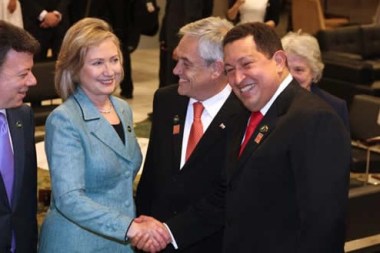
Hugo smiling at the Empire

January 1, 2011

No post today, but could not resist putting these pictures up and ask, what’s your best caption?

Santos: Don’t worry, he is not a suicide bomber

Hillary Clinton: Is he kidding me, he wants to shake my hand?

Piňera: Boy! He has gotten fat!

Hugo: Friends again?

Santos: See, there was no bomb in his hand!

Hillary Clinton: I hate diplomacy, ick!

Piňera: He has no clue, don’t worry!

Hugo: Women can’t resiste me. I am so handsome!


Happy New Year to everyone!

December 31, 2010

Well, I am certainly glad 2010 is going away. It was truly a bad year for me personally, a story that remains to be told one day. So, I am happy 2011 is coming and hope there is some change both in Venezuela and around me. Writing is in part an escape, an opportunity to verbalize feelings, organize thoughts. I do benefit from your input as it allows me to keep the important things in focus. So, many, many thanks from me to you.

And drinking a nice wine, celebrating with family is the way to wait for the new year. For the third or fourth year in a row, I will be going to Plaza Altamira to wait for the New Year. There is something very warm and cozy about saying Happy New Year with thousands of people around you. This year, I will go with more family including my 85 year old mother, which should make it even warmer.

To everyone of you, that your most important wishes become true in 2011 and that the new year brings you health, love and peace of mind, the three most important things there are and the ones that truly matter.

As we say here: !Un abrazo!