Archive for the 'Uncategorized' Category

Will Falcon Ask To Be The Candidate?

December 17, 2012

henri-falcon1-630x300

And now the most important question left is: Will Falcón ask to be the candidate fr the opposition in a future Presidential race?

If I were him, I would think long term and pass, I don’t believe he can build a successful national campaign in the short time that is likely to be available. But ambition and the fact he has that mysterious piece of DNA that drives politicians to desire power, may short circuit such a rational decision. But I hear that he is already talking about it.

The difficulty is that he can not come out today and say he wants to be the candidate. He has to wait until the sequence of events develops on its own, before he can do anything about it publicly. Otherwise, it would not only be in terrible taste, but it may alienate the same electorate that he wants to attract from the Chavismo-light end of things.

The second question is what will Capriles do if Falcón wants it. I think he should hand over the baton and not even fight it. He blew it and he can’t blow it again. If he loses against Maduro, he is done as a Presidential possible (He may be done already anyway) The time to think long term and high risk was back in October and he failed to see it.

So now, the opposition faces the reality of really having two “Chavista” candidates running for President. Oh wait! That happened once already. In fact, the guy who was the opposition candidate then, happened to win last night for PSUV in Zulia State.

Oh well!

Some Thoughts On The Results Of Venezuela’s Regional Elections

December 16, 2012

We still don’t know the official abstention number (40%+) and the total number of votes for each side. The latter remains a very important number going forward.

Capriles’ number is ok, but not great, should make him the candidate against Maduro. If abstention is as high as has been said (clearly 40%-plus), Chavismo would like the Capriles-Maduro face off to be sooner, rather than later, as I have been predicting. Time works against Chavismo. Seems like Maduro would win an election that takes place soon.

Merida and Tachira are hard to understand. Chavez lost in both and now the PSUV candidates manage to score a win. Does this mean Vielma Mora is the most viable Chavista candidate for the ¨Chavismo sin Chavez¨ era? Jaua has never won an election, Arias lost one, Maduro has never run for anything but Head of the subway union and Diosdado lost to Capriles once. Vielam Mora, on the other hand, ran almsot on his own and won. Man to watch out!

Pablo Perez was terrible. He did not deliver on October 7th. , he did not deliver today. Maybe maracuchos should stop saying that the country does not accept maracuchos. Zulia seems to have problems with them! The Salas in Carabobo should learn that you can’t expect to stay so long in power. People do get tired.

To me, abstention is a puzzle. It is fine to argue that Chavez is the only one that get the vote out. But to have 30% of the electorate decide not to vote less than three months after Chavez’ victory in October is a complex mystery to me. Whatever happened to the sympathy vote? What turned the voters off in 75 days? We are talking about the fact that in this election, only about the same number of people that voted for Chavez in October went out to vote. Is this reasonable? I don’t think so, because Chavismo did not do much better than in October, so you can’t say the oppo vote was weak. A lot of Chavistas stayed home. Why?

Maybe Capriles should say Falcon will be his Vice-President. But again, let Chavistas deal with the economic adjustment. They created the distortions, let them deal with it. A maduro win, may not be so bad for the future after all.

Any ¨people¨ that elect Rodriguez Chacin as their Governor, deserve worse.And with Rangel Silva winning, we now have two people blacklisted by the US Government for their involvement in drug trafficking.

It was bad for the opposition to only win three Governorships. But Chavismo can’t feel good about the abstention level. From the numbers available, abstention was more than 40%. Much more than in 2008. The fact this happens so soon after the most successful election in terms of abstention for Chavismo and in the midst of Chavez’ recurrence, raises a lot of questions.

Bolivar is still up for grabs. Did not expect that, given the abstention levels in such a Chavista State. Andres Velasquez will put up a fight. He deserves  a chance. The Bolivar union workers never had a better friend and activist than Velasquez, but they have never given him the power. Had Velasquez won in 1994, Venezuela’s history would have been much different and for the better.

Finally, the Head of the Electoral Board did a terrible job reading the results. She read the numbers wrong, did not give candidate totals and when she gave Bolivar’s results she said twice the were not irreversible, but then gave the wrong numbers. She tries to grab the attention and then screws up!

Now the guessing game begins. Another election in two months? three months? Four months?

My guess is think soon, rather than later. How does February 3nd. sound to you? The 10th. is Carnival…Just wondering…

Official Results at 9:00 PM In Venezuela Regional Elections

December 16, 2012

cne-logo1

First Official Results:

Zulia, opposition loses

Miranda a win for Capriles (+6%)

Lara a win for Falcon

Amazonas for the opposition

Barinas for PSUV

Monagas PSUV wins

Anzoategui Aristobulo 53% to 41%, opposition loses

Apure PSUV wins

Aragua PSUV 52% to 42.7%

Barnas PSUV 54 to 41% Adan Chavez

Carabobo Ameliach 53.49% to 42.7%

Cojedes PSUV 59% to 35% opposition

Delta Amacuro PSUV 71% PJ 20.99%

Falcon PSUV 48.28%, PJ 35.28%

Guarico PSUV 70.1% AD 25.5%

Lara Falcon 54% PSUV 41.98%

Merida PSUV 47.56% PJ 37.96%

Miranda Capriles 50.5% , PSUV 46.5%

Monagas PSUV wins

Portuguesa PSUV 50.2%

Sucre PSUV 55.77%, 35% opposition

Tachira PSUV wins

Trujillo 79.4% PSUV

Vargas PSUV 69%

Yaracuy PSUV 57.8%

Zulia Arias Cardenas 50.99%

Nueva Esparta PSUV wins.

Amazonas, Opposition wins 56%

Bolivar PSUV 45.41%, opposition 44.64%

Seems opoosition wins three states and incredibly loses Merida and Tachira where Chavez lost in October.

Venezuelan Regional Election Update at 8:30 PM

December 16, 2012

The best electoral system in the world, according to Jimmy (Who?) Carter, can’t call any of the 23 Gubernatorial elections at 8:30 PM tonight.

But the Devil hears:

Miranda (+6%), Lara and Amazonas in the bag for the opposition.

Zulia looks hard to win

Monagas, Merida look good

Bolivar tied at this time

Carabobo, Tachira and Nueva Esparta we are slightly ahead

Barinas looks like it can go our way (Hard to believe!) (I am told WE WON!)

So far, this is very positive for the opposition!!!

Let The Abuse Of Power Take Over In Venezuela’s Electoral Process

December 16, 2012

IMG_9070

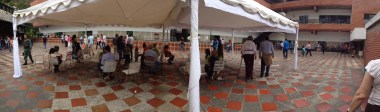
(Thanks DA for the panoramic of your almost empty voting center)

As projections indicate that abstention will be between 45 and 50%, if voters flows continue at current rates, the abuse of power on the part of the Chavista Government has begun in earnest. First, Vice President and fingered successor Nicolas Maduro held a press conference, promoting the votes of Chavista voters and, of course, suggesting that all Chavez wants is for his supporters to go out and vote. The Electoral Board said nothing of this, except for Electoral Board member Vicente Diaz who during the press conference called for its suspension as it was in clear violation of the Electoral Laws. The broadcast of the press conference was interrupted as Vicente Diaz spoke on TV. Reportedly, Chavez’ son in law (And Minister of Science an Technology. Nepotism? Nahh!!! Revolution!!!) was ready to repeat a broadcast like the one yesterday, which was also in violation of the law, but was suspended.

At this time, the question is whether there will be an acceleration of Chavista voters as the polls close, like what happened in October, or if the general apathy will prevail. If apathy prevails, look for the opposition and Chavismo to win in their natural strongholds. There would likely be no surprises and Chavismo will be concerned about how Maduro would perform head to head against Capriles, if he were to win easily in Miranda. If Chavismo manages to drive out the vote in the last hour, the opposition could be reduce below six Governorships.

At this time nobody is placing any bets and the mood is cautious in both camps.

Abstention Seems To Be The Story So Far In Venezuela’s Gubernatorial Elections

December 16, 2012

photo

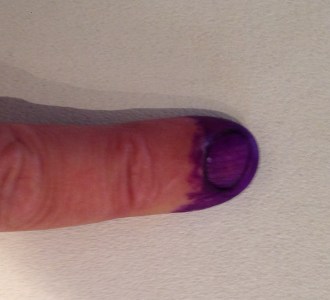
So I went this morning to take pictures of voting centers and the best I could come up with was a lousy picture of my ink-stained finger. Essentially, there are few lines for voting, I could not find a single center with a line outside to take a picture of. This election is different, a large fraction of Caracas simply does not vote, so I could not take my usual tour of the more pro-Chavez Western part of Caracas, they choose no Governor, and instead had to go East, to Petare, where the lines seemed to be for shopping, rather than for voting.

And the few data points I have from around the country suggests that it is the same all over. In two very pro-Chavista parishes in a Southeastern state of Venezuela, where Chavez won in October by 38% and abstention was 20.3% and 17.2% respectively, abstention at 10 AM was simply huge. In one center, which has about 270 voters, not one person had voted after the polls had been opened almost an hour.

Once again, in elections without Chavez, even Chavistas don’t seem to care much. He is definitely the electoral phenomenon.

What this means is that we are in uncharted territory. Low abstention, like in October, was good for Chavismo. Abstention between 25% and 35%, favors the opposition, but above that level, where we seem to be at this point of the day, is no mans land. More likely even a poor Chavista machinery will be enough to win in many states, but this is likely not be uniform across the country.  This may be good for the States where the opposition has Governors in danger of losing, like Carabobo and Nueva Esparta, but reduces the likelihood of a surprise by the opposition in States like Aragua and Anzoategui. Maybe we get an almost repeat of 2008.

I will update throughout the day, if there is something to upgrade about, I hope there is.

Trying (Not) To Look At Venezuela’s Sunday’s Gubernatorial Elections

December 14, 2012

20121214_TALC1_21_1_F1And so we come to Sunday’s gubernatorial elections, which now may turn out to be more important than most people believed a month ago. One may argue about how many Governorships the opposition will win for hours (And I will) but in the end other things become more important, such as:

-The overall total vote by each side

-How Capriles performs on Sunday.

The first one, because it will determine how Chavismo plans its strategy going forward. Chavez won by 10.76% in the Presidential race in October, but Chavez is Chavez, and by now it is clear that when he is involved, the results are much different than when he is not. But Chavismo did manage to mobilize people like never before in October and thus will be watching what happens on Sunday with great care.

If Chavismo does not manage to get a huge advantage over the opposition (defined as more than 6% difference in the total vote) then Maduro could be in trouble in a one to one race and Chavismo has to regroup and redesign strategy. But if Chavismo gets more than 6% points over the opposition in the overall vote nationwide, then Chavismo will feel confident that Maduro can beat Capriles (or anyone) and the sooner the election takes place the better. And this is likely to be the result, as sympathy for Chavez’ illness and the mobilization of Chavismo will likely give Chavismo a bigger victory than it would have scored a few weeks ago. So look for Chavismo to seek a Presidential election sooner than you expect (How does February 11th. sound to you?)

The second will influence the first one. Capriles decided to run and now he must be worried. If he loses, he is toast. Forever!. If he wins by little, he is in trouble. If he wins big, he has survived one of the worst mistakes of his life.

But, how does it look?

Unfortunately, not clear. As in the Presidential election, abstention will be key. When Capriles beat Diosdado Cabello in 2008, he did it by 7% points, but abstention in this range favors the opposition and it was around 36% then, a huge number. And yes, some things favor Capriles over 2008: He is better known, he has been Governor since 2008 and has done a reasonable job and most of all, his opponent is as bad as they get.

But on the other hand, Chavismo is going to go all out to bury Capriles. Jaua may not be very likeable, but his image seems to be covering every single square centimeter of paper in the State of Miranda, save for toilet paper. And the number of refrigerators and stoves given away in the name of the revolution in Miranda since Jaua began running is staggering. Pollsters do not want to be too clear, they are cagy, saying their error is large in these regional elections. I have seen three polls and two give a large lead to Capriles and one says Jaua by a little, so I will have to go with a Capriles win.

Beyond that, it is hard to be specific. Analysts feel that Amazonas, Lara and Zulia are in the bag, but I am nervous about the last one. Beyond that, it gets dicey. It seems Carabobo and Nueva Esparta, sure things two months ago, are now questionable but doable. Merida is likely going for the oppo, Tachira will be a tough fight with Vielma Mora there and Anzoategui should be in the bag. Maybe Aragua will fall our way. Sucre is a long shot.

And that´s it

So, The opposition will be happy with four or five, elated with six or seven and, dream on, more than eight Governorships would be a true rush.

But I doubt we will come on the high end of things. The emotional turn out is likely to tip it the other way.

But in the end, it is abstention that will give you the number. In the 2008 elections for Governor, the States in which the opposition won, had abstention ranging from 31% to 40%. Any similar numbers and we get six to eight States. Bring it down to 25% abstention and we will be happy with four or five. Any higher and it gets scary. As in susto!

So, that´s my take. Hope I am wrong!

But as you can imagine, I will be there, would not miss this vote for anything. I am a democratic addict!

What The Venezuelan Constitution Says About Replacing An Absent President

December 12, 2012

A93OBspCQAEGMBY.jpg_large

There have been many discussions in the comments about what Article 233 of the Venezuela Constitution says about how to replace the President of the country.

Let’s look at the article in Spanish:

Artículo 233. Serán faltas absolutas del Presidente o Presidenta de la República: la muerte, su renuncia, la destitución decretada por sentencia del Tribunal Supremo de Justicia, la incapacidad física o mental permanente certificada por una junta médica designada por el Tribunal Supremo de Justicia y con aprobación de la Asamblea Nacional, el abandono del cargo, declarado éste por la Asamblea Nacional, así como la revocatoria popular de su mandato.

Cuando se produzca la falta absoluta del Presidente electo o Presidenta electa antes de tomar posesión, se procederá a una nueva elección universal, directa y secreto dentro de los treinta días consecutivos siguientes. Mientras se elige y toma posesión el nuevo Presidente o Presidenta, se encargará de la Presidencia de la República el Presidente o Presidenta de la Asamblea Nacional.

Cuando se produzca la falta absoluta del Presidente o Presidenta de la República durante los primeros cuatro años del período constitucional, se procederá a una nueva elección universal y directa dentro de los treinta días consecutivos siguientes. Mientras se elige y toma posesión el nuevo Presidente o Presidenta, se encargará de la Presidencia de la República el Vicepresidente Ejecutivo o Vicepresidenta Ejecutiva.

En los casos anteriores, el nuevo Presidente o Presidenta completará el período constitucional correspondiente.

Si la falta absoluta se produce durante los últimos dos años del período constitucional, el Vicepresidente Ejecutivo o Vicepresidenta Ejecutiva asumirá la Presidencia de la República hasta completar el mismo.

The first part defines what an absence is. And then it says “When the absolute absence of the President elect occurs before he takes power, there will be a new universal election within thirty days immediately following. While the President is elected and the new President takes office, the President of the National Assembly will take office.

The next paragraph is what happens in the first four years of the Presidency.

And then it says: “In the cases before, the new President will complete the corresponding Constitutional period”. That is, if the President elect is incapacitated and there is time for an election and if the same happens to the elected President in the first four years of the term.

Finally it says: “If the absence occurs during the last two years of the Constitutional period, the Vice-President will assume the Presidency until it completes the term”

Some lawyers believe the last part trumps all, if the President dies the Vice-President takes over.

What is confusing is what it says about the new President completing the the Constitutional term. But this refers to the elected President only. That is, if the President elect dies with sufficient time to hold a new election and have a new President, before the term ends, the newly elected President would complete the term

But this is no longer the case. There is no time to elect a new President before the Constitutional period ends. There are less than thirty days until the inauguration. Thus, it is impossible for the “new President” to complete the term and the President-elect is not holding office, thus, he can not be replaced in office.

The only possibility left, is what the last part says that the Vice-President completes the term and the President of the National Assembly takes over on Jan. 10th. once the “Constitutional term” is completed.

Which makes you wonder about the timing of the operation. It was performed precisely on the day in which there were no longer thirty days left and there was no room for any other interpretation.

A simple example in which the President and the President-elect are different may clarify this:

Suppose Capriles had been elected and something happened to him. If this event happened with more than thirty days left for his inauguration, the President of the National Assembly would take over, elections would be scheduled and held and the newly elected President would complete the Constitutional term.

But if this happened within thirty days to the inauguration, only the Vice-President is empowered by the Constitution to complete the term. Nowhere does it say that the President of the National Assembly completes the term.

That is what lawyer say…

(The Minister of Information just said that Chavez may not be back for his new term)

Possible Scenarios For Venezuela Going Forward

December 11, 2012

20121211_TALC1_24_1_F1

The further out in time, the more difficult it becomes to predict what will happen in Venezuelan politics. But for now, Chavismo has the upper hand on the opposition with Chavez’ decision to anoint Nicolas Maduro as his successor. As long as Chavez is alive, this decision will likely be respected by all important factions of Chavismo and this is probably the main reason why the choice was made: To placate the many forces that are likely jockeying for position and allow Chavez to be present during a Presidential campaign. While today’s operation is quite dangerous, recall the first procedure in the same area sent the Venezuelan President into intensive care, naming Maduro was likely done in the knowledge that Chavez’ prognosis is bad in the medium term.

The opposition on the other hand has nowfallen behind. Had Capriles stayed out of the Miranda race, he would be the obvious leader of the opposition. Now this designation is in danger depending on the outcome of Sunday’s election. Capriles should win easily, but needs to win by a landslide. Chavismo’s candidate Elias Jaua is not as well known and has little charisma, even if the State of Miranda has been covered with his face. When I was in Venezuela a couple of weeks ago, it seemed as if his face was on all walls of the city, as Chavismo tried to kill Capriles as a future possibility. With Chavez absent to back Jaua, it seems difficult for this to happen, as most pollsters suggest Capriles will win, but a small margin of victory will weaken Capriles and bring other candidates into the fray, with no time for primaries.

By Sunday we will know how well Capriles is placed for a possible second Presidential run, which will likely be his last, if he fails to win the Presidency.

Between now and Jan. 10th., if something were happen to Chavez, Chavismo’s plan to have Maduro be the heir apparent will be briefly interrupted, as it will be the President of the National Assembly who would become President on Jan. 10th. There could be a quirky moment on Jan. 5th. if Diosdado Cabello were to be removed in a “just in case” move, but I doubt it will happen for only five days insurance, as it would affect the unity of Chavismo. If they do decide to replace him, a losing Elias Jaua would likely be the man.

All efforts are likely to be centered on having Hugo Chavez show up on Jan. 10th. to be sworn in. If he does, he can appoint Maduro to be his Vice-President and Chavez can resign after that.

While many analysts suggest that Chavismo will take its time (months, most believe) in calling for an election to replace Chavez, I strongly disagree. The move to designate Maduro as the successor was likely made in the belief that Maduro can win (Yes, he can!) easier with Chavez alive and promoting him, rather than in his absence, which would additionally release the power demons  in the various factions of Chavismo. Additionally, since Chavismo will win a large fraction of the Governorships on Sunday, this should also discourage the opposition on a Presidential election to replace Chavez. Thus, Chavismo will benefit from an election as soon as possible.

But even more importantly, if Chavez takes over on Jan. 10th. and designates Maduro immediately as his replacement, who calls for elections in thirty days, the opposition will be way behind, caught flat footed, having no candidate and/or organization. In contrast, Chavismo will still have PSUV ready to help and coordinate the vote drive and its funding is simply unlimited.

Essentially, time is against Maduro and Chavismo, if the Presidential health is deteriorating fast, as it seems to be given the recent developments.

In the scenario of a Maduro victory in a Presidential election, things get fuzzy. A new President Maduro is likely to make few changes as long as Chavez is around. Whether Maduro changes or not Ministers is harder to predict. Given that he is expected to be more pragmatic, he may switch personalities around in order not to ruffle the boat, such as moving Merentes to Finance and separating the two Ministries (Wishful thinking?). Given Maduro’s statement that the exchange controls can be improved, it is clear that he has some strong thoughts on the matter. But Chavez will likely be watching over him.

Once Chavez is too ill to interfere, all bets will be off. Maduro will start trying to consolidate power, moving his pieces in and pushing his enemies out. The only  puzzle at this time is who are Maduro’s friends within the military. The military has too many different factions and Maduro has never been identified with any of them.

And the military is likely the biggest wild card of all. Absent Chavez, it is difficult to predict how they will react to a Maduro Presidency.

Eventually, Maduro is more likely to go his own way and impose his own style and agenda. And while he is believed to be more pro Cuban than many civilians, he is likely to go the opposite way. His weakness is that he lacks popularity, he knows that he will have to fix the economy to stay in power and only focusing all of  the resources in Venezuela, will he truly be able to do that. Beyond that, it will be his economic advisers, once he decides to fly solo, that will determine the course of his economic policies. Talk about the picture being fuzzy!

Of course, Capriles may yet win. He needs the landslide on Sunday and then to forget about taking a vacation for Christmas. Unfortunately, most of the opposition leaders are likely to go away and it is unlikely that the MUD will have a plan in place by the beginning of January to counteract Chavez’ strategy in time.

It may be all for the better. Let Chavismo be in charge of the economic adjustment to correct the distortions they created. It will unfortunately leave voters with the image that Chavez was invincible and he is sorely missed, but it will also open the way, in the end, for  a different kind of Government and different type of plans for the country.

Chavez’ Health Will Delay (Again!) Much Needed Economic Decisions

December 10, 2012

During 2012 the Chavez administration spent like there was no tomorrow and avoided making any corrections to the numerous distortions present in the Venezuelan economy. Spending went down in October after the Presidential election, but most economic decisions were still on hold.

In fact, even the expected issuance of a new Pdvsa bonds to supply SITME was delayed until after a possibke devaluation in January, as it made little sense to issue now with a devaluation so close in time.

Most expected announcements after the Gubernatorial elections and a devaluation seemed assured even before the end of the year.

No more.

Chavez’ renewed absence and the very likely possibility of a Presidential election in the first quarter of 2013, places all economic decisions on hold, including devaluation, gas price increase, foreign exchange system, Sitme, bond issuance and the like.

It is likely that no economic decisions will be seen until April and that spending will once again be irresponsibly placed on steriods in order to promote the need for a Maduro Presidency. The feeling of prosperity has to stay in place once again, as Venezuela will go into electoral mode for the emoteen time in fourteen years.

This will only make economic adjustments tougher and the new President, whether Chavista or not, will be blamed for them. Meanwhile the holy image of Hugo Chavez will be preserved in history asthePresident that brought prosperity and could do no wrong
even if all of the adjustments will be due to his idiotic and irresponsible management of the economy.

And Giordani’s role in creating this mess will likely be forgotten.