Archive for the 'Uncategorized' Category

First Constitutional Crisis As Supreme Court’s Electoral Hall Attempts To Freeze Venezuelan National Assembly

January 11, 2016

notsoblind

Well, sooner than you could say Henry Ramos, the first big Constitutional crisis exploded today, in Venezuela as the Electoral Hall made a ruling that sets up a huge confrontation between powers.

The Hall ruled:

1- The Venezuelan National Assembly is in contempt of the court for not obeying its decision to not swear in the Deputies from Amazonas State.

2- Because of this, says the Electoral Hall, any decision made by the Assembly so far and in the future is completely illegal

3- The Court orders the National Assembly to immediately “disincorporate” the three Deputies.

The decision is quite bizarre in too many ways, but what do you expect from “Justices” some of whom do not qualify to hold the position and violate the law in many cases, as they were card carrying members of Chavismo’s party PSUV?

First of all, the legal concept of taking away the proclamation of a Deputy does not exist. Moreover, there are precedents for this, which are not even mentioned in the decision by the same Hall and the Constitutional Hall of the Venezuelan Supreme Court.

Second, once proclaimed, according to the Venezuelan Constitution, only the National Assembly itself can “qualify” a Deputy. Nobody else can, least of all, the Electoral Hall of the Supreme Court which only rules on Electoral matters. Once the Electoral Board proclaimed the candidate, this is no longer an electoral matter. The same applies to nullifying acts by the National Assembly. It is not the role of the Electoral Hall to nullify such acts, least of all “future” acts, an absurd legal concept.

Maybe these “Justices” do not understand that the Electoral Hall rules on Electoral matters, no on matters which should be the realm, if at all, of the Constitutional Hall of the National Assembly.

Finally, it is sort of stupid to rule invalid decisions by the National Assembly that are taken without the three “questioned” Deputies participating in the vote. If they had nothing to do with the decision, there was nothing illegal about it.

But the real conflict arises and will explode now for the simple reason, that the National Assembly can simply not accept the decision for political reasons. Since the decisions are illegal, backing down would imply that the Court would simply stop the elected National Assembly from doing anything in the future.

And the key word here is “elected”. A Court that was not elected by popular vote and under questionable circumstances from a legal point of view, can not pretend to be above the popularly elected National Assembly.

Moreover, I think the National Assembly has no other recourse but begin proceedings against the same  Justices, something that they can do. Thus, we go into an infinite loop of non-recognition of one by the other.

Who will be the referee in such a battle?

Meanwhile, the economy gets worse, the price of oil goes down and the Maduro Government devotes itself to talking about the removal of Chávez’ pictures form the National Assembly building.

Clearly, there is no interest in attacking the economic problems and distortions. Even more clearly, there is no intention in recognizing the qualified majority obtained by the opposition.

Who was it that said Chavismo was democratic? Yeah, sure!

Santero Economists Take Over Economic Policy In Venezuela

January 7, 2016

gabinete

Organizational Chart for the new Venezuelan Cabinet named by President Maduro

 In July, I suggested that even with the upcoming elections, Santero Economics, the peculiar form of economic management that has taken over Venezuela since Maduro got to power would not go away with the Legislative elections. Yesterday President Maduro named his new Cabinet (Chart above, there are so many Ministers that it is essentially unreadable) and it is clear from it, that the Santeros have taken over.

What Maduro did, was to make Luis Salas Vice-President for the Economy. Salas is the center piece of the Santero Economic team as he represents one third of the group (together with Tony Boza and Alfredo Serrano, who is not Venezuelan, that has kidnapped Maduro’s Economic mind (yes, it’s meant to be cynical!) over the last three years.

There are some positives, like naming Economist Rodolfo Medina to the Ministry of Finance. Medina is a Professor of Econometrics at Central University, he is no Milton Friedman, but at least he knows and understands traditional economic theory. He is accompanied by Jesus Farias, a communist Economist, who at least has been proposing that there should be a single exchange rate, who will be the new Minister of Foreign Trade and International Investment, a newly created post, which only proves the level of ignorance involved in forming the Cabinet. Uber leftists Ricardo Menendez remains in the post of Minister of Planning.

One of the first problems of this team is precisely the level of incoherence involved. How will Medina, a practicing economist talk to Salas, a 100% Santero Economist? How will Farías argue with Salas, when Salas is against many of the ideas proposed by Farias?

 For the last three years, Salas, Boza and Serrano have imposed economic thinking in Venezuela, despite the fcat that they did not occupy any Ministry. They are the “creators” of the concept of “Economic War” as the explanation fro the large levels of inflation and the scarcity that is present in Venezuela. Their solution to the economic problems is more controls, more supervision, more taxes and fighting the oligarchs who are responsible for everything.

 While the foreigner in the Santero Economic think tank, Serrano, is an Economist, Salas is a Sociologist and Boza claims to be a Popular” Economsit”, whatever that may mean.

What these people do, is to disregard the body of work of economic knowledge, based on theory and experience and construct arguments (not theories) to suggest that body of knowledge is simply incorrect. There are no publications involved, just some self-published pamphlets which contain no equations, only graphs of empirical data, and hyperbolic and false statements to supposedly support their views. I linked Boza’s pamphlet last July, here are Salas’ Economic “postulates” for lack of a better word.

Among the many things that Salas posits, is that the law of supply and demand is vulgar, that monetizing the deficit is not inflationary, that inflation onl occurs because of speculation, that in real life inflation does not exist and that it all is an economic war, much like that waged against Allende in Chile. Thus, the solution is simply to be tougher, increase controls over prices and make the private sector pay more taxes.

 Which means that santero Economics will prevail, inflation and scarcity will accelerate and little will be done by Maduro and his Cabinet to attack the distortions in the Venezuelan Economy. Not only does Santero Economics not work, but those in the Economic team do not have the coherence or managerial capability to accomplish much.

Except for the pain that this implies, what this means is simply the acceleration of the demise of the Maduro Government, who will bring down Chavismo with him. There will be no change in direction now and given the past, those recently named will not exit the Cabinet fast if they obtain no immediate results.

This bodes badly for Venezuela and its people short and medium term, but at the same times sets the stage for promoting an outcome in which Chavismo no longer leads in the country.

(Two questions for the new VP:

  1. If the law of supply and demand is “balurda”, can he comment on why oil prices have come down in the last year and a half?
  2. If creating money does not cause inflation, why not print infinite money so that everyone is very rich?)

A Bright And Hopeful Day For Venezuela

January 6, 2016

byebyechavezWorkers remove Chavez’ giant poster from National Assembly building

While I am far away, I could not help but be glued to the events in Caracas today. While it was certainly not a smooth day, it was a great day for Venezuela. A day of hope and possibilities, a bright day for the future of democracy in the country. A very important day for Venezuela’s history and the image above clearly shows that change is in the air. The statues have yet to fall, but it’s coming. The beginning is here, let’s see how long it takes to get to a good point.

I will start with the most important signs of the day:

-The National Assembly controlled by the opposition was allowed to be sworn in, almost with no violence. This was not clear would be the case a couple of weeks ago.

-The Press (from all sides) was allowed into the Assembly freely for the first time in years to report what was happening. Reporters need not be afraid anymore.

-The opposition had presence in the media, beginning to restore its practical ban from TV, radio and print. The “people” will be able to see and hear the other side like it has not happened in years.

-The opposition managed not to be provoked by Chavismo, maintaining a serious and peaceful tone. A new tone of democracy and conciliation.

-Chavismo showed its true autocratic colors. It refused to have a dialogue, resorting to the usual insults. Except some the insults were elegantly returned by the opposition. Perhaps nothing exemplified this more than the very direct reproach of the use of Diplomatic Passports for drug dealing, which must have stung the First Lady, who is now a Deputy for Cojedes State.

-The first steps towards more institutionality were taken. No more rubber stamps, no more legislation from the Executive branch, no more hiding behind the revolution. The message was clear, the Assembly will call on all powers to explain what they did, do or plan to do. There will be accountability for all Government officials

-Chavismo looked bad. From an apparently inebriated opening speech by the oldest Deputy in the Hall, to their use of expensive watches and jewelry, to Chavismo abandoning the Assembly, they sent the wrong signals to voters that clearly indicated that they want change. Blaming the opposition for the country’s problems is simply not working, the change is coming, but from the other side.

The negative part was that the opposition did not manage to swear in all the Deputies, but it still has a two thirds majority. Clearly, there is a force behind the whole day taking place the way it did. Someone told Maduro and his cronies to avoid violence, to allow the voice of the voters to be heard. Chavismo wanted to question 22 Deputies, but it did not happen and the case in Amazonas is extremely iffy. It would have been nice to have all of them sworn in and impose the authority of the Assembly.

For me, another negative is the Presidency of the Assembly. A new Venezuela deserves better than Ramos Allup there, no matter how realpolitik it may have been to name him. He represents the old guard, tied to lies, corruption and protection of relatives. If he is the best the opposition has, the opposition has a long way to fill the shoes it wants to fill*.

A good beginning. A bright beginning. Many Chavistas must be trembling after today. They can no longer hide. Checks and balances look like they are back in Venezuela. So is the press, which will have access at least to ask uncomfortable questions. It may be time to carefully decide whose side you are on or how strongly you support Maduro. Red shirts are out. Suits are in. If Chavismo keeps screaming and acting like cry babies, the demise of the revolution will simply accelerate.

There is a long road ahead, but it seems as if each day it looks a little shorter…

*For those who are not convinced of this, I invite you to reflect on what Ramos did to Alek Boyd and why he did it. Is that the Venezuela we want?


Happy New Year From The Devil

December 31, 2015

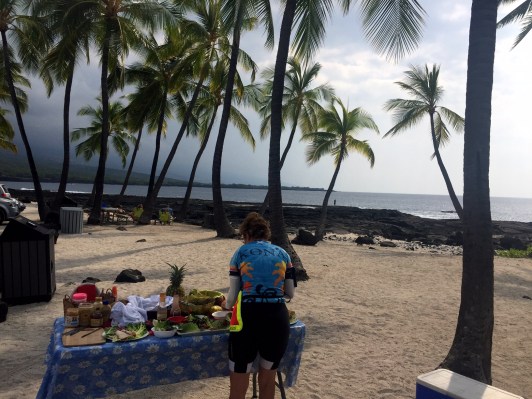
IMG_1567                                Picnic-pit stop for lunch at the beach on the last day of the year

The Devil is biking around the Big Island of Hawaii for the next few days. From there, he wishes every one of his readers a wonderful 2016 and may prosperity and peace come to our beleaguered country, Venezuela, in 2016.

Stage Set For First Constitutional Clash in Venezuela in 2016

December 31, 2015

indexAs predicted in my next to last post Constitutional clash is set for the swearing in ceremony of the new National Assembly, as the newly and illegally named Supreme Court Justices of the Electoral Hall admitted a seventh request to have the effects of the December 6th. election suspended.

Up to today, we had known that there were six such requests. They had been introduced on December 28th. against certain Deputies elected on Dec. 6th. But on the 29th. an additional request was introduced to suspend the effects of the whole election in Amazonas State, which implies that the Court is saying that the Electoral processes in which three opposition Deputies and one Chavismo Deputy were elected are temporarily suspended.

The whole process was clearly set up by Chavismo to attempt to negate the 2/3 majority by the opposition on the new Parliament. But the whole process in itself stinks:

-One of the “Justices” considering the cases voted for herself as a Deputy.

-The lawyer that introduced the case is a public employee, which is illegal.

-The members of the Electoral Hall were on vacation and suddenly decided to end it.

-The opposition had recused all of the members of the Electoral Hall, which implied they had to resolve that, before the cases could be considered.

What is most interesting is that the opposition’s interpretation is that the decision by the Electoral Hall is not applicable, because the election is over, the candidates had been proclaimed and the request can no longer be executed. According to this interpretation, the Deputies had been proclaimed and thus the Electoral Hall can no longer suspend the process and at this point only the National Assembly itself (Art. 187 of the Constitution) can “qualify its members and know about their resignation…”

Thus, the MUD argues the Court has no Jurisdiction on this.

In fact, the article linked above, the best article on the subject, also notes that in the absence of these four Deputies, the opposition would still retain the 2/3 majority, because it would be counted on the basis of existing Deputies, not possible Deputies.

But perhaps the weirdest thing about the case, is that none of the races involved in Amazonas are close. The closest is that of Deputy Nirma Guarulla elected by 2,260 votes out of 63 thousand and some votes, a difference that seems very difficult to overturn.

diputadas

The rest are almost impossible, as the Deputies elected by list split the votes in half and both got elected, one for the opposition and one for Chavismo. (They got 63 thousand of roughly 64,000 votes between the two of them)

The final election affected is that of the indigenous representative for the south, which was a runaway victory for the opposition candidate:

indigena

which won by about the number of votes that the second place candidate obtained.

Thus, it is unclear at this time what Chavismo aims to do with these results. A place like Aragua had much smaller differences than these, but these cases were rejected by the Court.

In any case, a clash of Constitutional powers is set to take place on Jan. 5th. as the new Assembly will admit all of those elected.

What will the Court and Chavismo do?

And once the Assembly starts working, its next step may be to increase he number of Justices and/or question the validity of those recently elected.

Meanwhile Maduro announced his new “economic” measures, which were so stupid that it is not even worth mentioning…


Some Venezuelan Christmas Mysteries

December 24, 2015

Arbolito

Ah! It’s Christmas. At last we can relax for a couple of days and think about nice things, enjoy family and toast to life!

So, while you are relaxing, I leave you with these Venezuelan Christmas mysteries, in no particular order:

-Why do hallacas have capers in them, if we don’t have them in Venezuela?

-Why did Chávez choose Maduro?

-Corolary: Why did Cabello not fight Maduro once Chávez died and later he staked his future on Maduro’s fate?

-Why do some Venezuelans follow Niño Jesus, others San Nicolas and then some Santa Claus?

-Does anyone who is not Venezuelan understand what Gaitas have to do with Christmas?

-And why are nacimientos (nativities) shrinking?

-And why do Venezuelans celebrate the night before Christmas and sleep and watch movies on the 25th.?

-And what’s the true story with the attempt to revoke 22 elected Deputies at the Supreme Court this week? Did it happen or not?

-Does anyone remember that people would paint their houses right before Christmas or was that a family tradition?

-Have you ever seen a “Furruco” factory?

-And why is midnight mass called Misa de Gallo (Rooster’s Mass)?

And on that note, Merry Christmas to all the readers. Thank you for reading, commenting and hanging on for so long. That Santa Claus, San Nicolas, El Niño Jesús (Yes!) brings you everything you wanted and don’t drink too much Ponche Crema (Or do!).

Best from the Devil!

The Venezuelan Garden Of Possible Bifurcation Paths Into The Future

December 20, 2015

Fractal-tree

I start with a quote:

The evil that one endures patiently because it seems inevitable becomes unbearable the moment its elimination becomes conceivable

Alexis de Tocqueville

and the title of a book by Jorge Luis Borges: “The garden of bifurcation paths” from which I simply borrow the analogy of what the title conveys.


Predicting what will happen in 2016 in Venezuela is a guessing game that requires understanding  all of the possible varieties of bifurcations that are possible in the decision making process of both what the Government will do and what the opposition will do. And guessing at all of the possible variations and possibilities is simply an impossible guessing game.

However, if we go back to the quote above  from Tocqueville, one can simplify the guessing game to its conclusion: At this point in time, the inevitability of Chavismo in the future of Venezuelan politics and Government is no longer a given. A crack was opened in the Government’s dam and the people now realize that it is very easy to open new cracks that will simply bring the dam down. And the stubbornness  or blindness exhibited so far by the Maduro administration only helps in accelerating its demise. As Tocqueville says, the ill has diminished with the victory on December 6th. by the opposition, but the sensitivity to it has increased. And I would add that it will increase dramatically, if the Government fails to act on the economy.

And yes, the most likely outcome is Maduro’s departure, the question is whether he will bring down Chavismo with him, or whether Chavismo will sacrifice him for the benefit of the Bolivarian revolution. The longer Maduro and his closest advisers insist in radicalization and confrontation, the higher the probability that in the end his administration will crumble and he will bring down Chavismo with him.

But the path is not trivial.

But let’s start at the beginning: Chávez died, the Government did hold elections and recognized the victory of the opposition with a qualified majority.

That is an already explosive combination when you add to it that the Venezuelan oil basket is below US$ 30 per barrel for the first time since 2004.

But the first three thoughts are more important: Chavismo is where it is because Chavez died, decided to anoint Maduro, not the brightest light bulb in the Chavismo universe (with small caps), and for reasons that have not been made explicit, accepted to hold the Parliamentary elections and its defeat. Whatever these reasons were, and given that the poll numbers were clear, the three facts above have a very important significance: Within Chavismo, the moderates imposed their views over the radicals on the results and unless the radicals decide to get rid of the moderates (which may be hard to do now, as well as the worst thing they could do) there is no turning back and the new National Assembly will take over on Jan. 5th., even if there are attempts to bar the entrance of the new Deputies to the Assembly building.

Between now and then we will continue to hear about null or blank votes, but given that the Chavista controlled Electoral Board established the rules, that Chavismo won where these votes were largest and that that is not a cause for contesting an election, there is little that can be done. Ironically, the whole Electoral Board has been on vacation since Dec. 12th. and will not go back to work until Jan. 3d. Contesting the results because of too many null votes could backfire for Chavismo, given that the opposition could also benefit in the process in different circuits.

Thus, Chavismo will focus for now on illegally naming the twelve Supreme Court Justices that are currently vacant. Illegally, because the Supreme Court Law establishes the periods and conditions for the pre-selection of the Justices and under no condition can naming them be a topic of “urgency” which is all you should consider during extraordinary sessions. Furthermore, a team of lawyers is legally challenging each of the nominations, which will create another violation of the law if it is not considered and blocks their nomination. If Chavismo bypasses all these, the legal case for removing these Justices becomes even more solid.

Meanwhile, it is clear that there is strong dissent within Chavismo. Maduro had promised to change the Cabinet, said the military will go back to their military posts, but neither has yet to happen. If the “moderates” win, watch the military stay in the Cabinet. So far, lengthy days of discussions have yielded no truce, but the radicals are not winning.

The opposition has not shown a lot of unity either. It would have been very positive for the opposition to say who would be the President of the incoming Assembly by now. Given that there are supposedly two candidates (none my favorites for different reasons) it would have been nice to have made the announcement by now. If every step going forward is going to take this long to be decided, one has reasons to worry.

So, between now and Jan. 5th. there will be few major happenings, as Venezuela is already going on vacation. I certainly hope opposition leaders will stay working this year, rather than give all of the space to Chavismo to instill fear on those that voted against it.

And thus we get to Jan. 5th.

The first question is what will happen during the installation of the National Assembly. While many expect the worst, the signal that Chavismo will send if it does not allow the new Deputies to take their seats is too negative. Given that the moderates seem to be gaining the upper hand (elections, recognition of win) it seems today as if there may be isolated incidents of violence, but the Assembly will begin functioning on that day.

This alone will give the opposition a bigger voice, larger visibility and presence in the media. It is not only a matter of having ANTV to broadcast the message, but by allowing all media (including Chavista media) into the Assembly meetings, they will have a much larger placement in media.

The opposition should be forceful but conciliatory, giving the message at every step that  it will legislate for all. But it should clarify at every opportunity that economic policy is still in the hands of the Government. But unity and peace should be at the center of its message, including asking the Government to talk.

At this point, the bifurcations are determined by what the opposition will do. In particular, these four important paths have to be determined in order of priority:

-The Amnesty Bill

-Removing the new Justices if the Government is set in its path of naming them before Jan. 4th.

-Choosing between a recall referendum or a Constitutional Amendment to change the Presidential term.

-How can the Assembly influence economic decision making going forward?

-How to go about controlling and obtaining information from the Government.

The first two issues lead to immediate confrontation if Chavismo decides to confront them head on. My feeling is that the Amnesty Bill will be the first item on the new Assembly agenda. Maduro has threatened not to obey it, but it is a Constitutional prerogative (Art. 174, numeral 5) that the Assembly can issue such a Bill. In fact, the Constitution even bars such a Bill (Art. 74) from being considered as a referendum. Were the Judicial system to refuse to free those granted amnesty, they would have been kidnapped by Maduro, and everyone involved in the process could be suspended and censored.

And here is where the Constitutional clashes begin. In order to suspend anyone the “Moral Cuncil” has to approve it, but some of the same people involved in the decision to free the prisoners are in that Council. Moreover, the Government could send the Bill to the Supreme Court, the same Supreme Court whose members, particularly those in the Constitutional Hall, will be questioned in their legality by the Assembly. And who can resolve this case, since the new Justices would not be able to decide on their own case and have to recuse themselves?

There seems to be no way out of this logjam, if Maduro decides to confront.

Another decision is whether to attempt to recall Maduro or not. As I noted in previous posts, if the Dic. 6th. election had been a recall vote, the opposition would have barely won by 139,000 votes. (It needs to obtain at least the number of votes Maduro obtained in 2013). But it may not be the same for someone to vote for opposition Deputies as a protest, than to vote against Maduro being removed from office. Many may be reluctant to do so, they wanted to send a message to Maduro, but not necessarily remove him. And it was close.

A less confrontational path may be to propose a Constitutional Amendment, which also requires a referendum, changing the Presidential term to four years with only one reelection. (currently six years and indefinite reelection) In this manner, you are not saying Maduro has to go, but rather, Maduro’s completion of Chávez’ term ends in Oct. 2016 and he will have to run fto get reelected. This may be a much more attractive way for disgruntled Chavistas: Maduro has a few months to improve things and if he doesn’t, he will not be reelected.

While it is not the job of the National Assembly, the economic is foremost in people’s minds, as scarcity is the norm of the day in Venezuela. In fact, people say that lines are disappearing, simply because there is nothing to buy. But economic policy is the domain of the Executive branch, so what can the National Assembly do?

The Assembly could revoke some Bills, like the Illicit Foreign Exchange Bill or the Price Control Bill. But solving economic problems requires looking at the overall scheme of things. Tinkering with a few Bills may simply have unexpected consequences in the order of things. In terms of Bills, the Assembly may use the threat of revoking or changing them as a way of getting the Government to negotiate.

The budget is one area where the Assembly does indeed have a say. The 2016 budget has already been approved, but it has been a tradition in Venezuela (since way before Chávez) that the budget Bill is irrelevant and numerous “additional credits” are approved during the year. If it is true that the Government plans to devalue soon, something I am skeptical about, to disburse the extra Bolívars generated by this devaluation will require approval by the National Assembly. Thus, the Government gains nothing by devaluing if it does not collaborate with the Assembly.

And without its approval, it will be hard for Government officials to spend money, because they are individually responsible in the face of the law, at a time of a changing political landscape, which implies that they could face corruption charges for spending money that had not been approved. And this would apply all along the line of expenditures from the National Treasurer, to the Ministers and below.

The Assembly can also ask more transparency from Ministers, requesting information and data. If a Minister does not comply with the request, he can be censored by three-fifths of the Assembly, which implies his removal from office. The same applies to the Vice-President (Art. 187, numeral 10 of the Constitution)

All of the above will evolve differently depending on the order in which it happens. The reason to be optimistic, is that as Toqueville said, the people endured Chavismo until it lost, now they will find it unbearable at every step. The reason to be pessimistic is that as a physicist, with published papers on chaos, I also know that too many bifurcations lead to chaos.

Hopefully, we will only have  a few…
Long And Winding Road For Change In Venezuela After Sweeping Opposition Victory

December 7, 2015

road

I have been waiting for the CNE to give a new bulletin of yesterday’s results, but so far no luck in obtaining a complete set of numbers for what happened last night. Remarkably, the number of Deputies for the opposition keeps increasing, with the latest estimate between 117 and 118 Deputies. The opposition did publish earlier a list of the 112 Deputies that will surely be announced as winners up to now.

This is truly in the upper range of any expectations, as voters clearly expressed their disenchantment with the Bolivarian revolution  and the current state of the Venezuelan economy. Maduro was not that gracious or wise in accepting the defeat, devoting most of his time to blaming the “economic war” for the defeat and not the economic stupidity of his Government’s policies. Never had the phrase “It’s the Economy Stupid” resonate more than today in Venezuela.

And while the opposition has to rejoice in its victory, it will be a long and winding road to obtain the change the people want, particularly on economic matters. It will also be a conflictive route to change, as Chavismo will certainly resist the possible dismounting of the Bolivaraian State.

And the opposition has to understand its victory for what it is. People turned against the Government, but the sweeping victory is a strong rejection of Chavismo, more than a strong support for the opposition. And the strong mandate calls for action, but it is precisely on Economic matters that it is more difficult for the Venezuelan National Assembly to have an impact.

But at the same time, the 2/3 majority gives the opposition many powerful tools to at least negotiate with Chavismo, including removing and naming members of the Electoral Board, Supreme Courts and all other major public powers, approval of Constitutional reforms, issue organic laws, name Permanent commissions of the National Assembly and approve and propose referenda, including revoking the Presidency after its third year of mandate.

But all and any of the above implies conflict, decisions and optimizing time and resources in order not to waste time in pyrrhic fights with little immediate positive consequences.

How the weakened Maduro Government reacts will be key in the process. So far, Maduro seems to have been too defensive in the reaction to the loss. His mandate has been severely weakened in the eyes of his own supporters, party and national opinion and there is little he can do for maintaining the status quo. But at the same time, he will have a hard time implementing an economic change that he has clearly not agreed with in the past. Internal fighting and bickering within Chavismo must be intense and it is clear that Maduro will have to assume all of the blame for the blow received by Chavismo on Dec. 6th.

Venezuela and PDVSA bonds jumped on the news, but they simply recovered back to the prices of a week ago, a clear signal by the market that it is concerned about the future. However, the mandate received by the opposition should in general be more supportive for prices, even in the face of US$ 38 oil today.

It will also be important for the opposition to maintain its cohesiveness. Difficult decisions are coming such as who should be named President of the National assembly come Jan. 5th. when the Assembly is sworn in and the priority in the legislative actions that the opposition will undertake with its super majority.

A difficult and somewhat daunting task ahead, but a much brighter prospect for a country ruled autocratically and by whim for too many years.


First Report By Venezuelan Electoral Board Gives Opposition 99 Deputies

December 6, 2015

10:00 AM At this time, the opposition could be getting as many as 117 or 118 Deputies when all votes are counted.

The Venezuelan Electoral Board just announced the first official results announcing the Opposition obtained With 96.03% of the vote 99 (72 lists plus 27 on their own behalf) Deputies and Chavismo’s PSUV obtained only 46 (22 list plus 24 on their own behalf) Deputies. This means close to a super majority, a scenario that I considered highly unlikely even today. 17 Deputies by name can not be defined, the three indigeneous people and one by list. 74% of the people voted.

More as they are announced

Good night everyone! Happy day at last!


Voting Much Stronger In The East Of Caracas Than In The West

December 6, 2015

I went to do my usual spin around Caracas to see how things were going along. I went from one and to another hitting too deep into Catia (More on that later!) as well as Petare. My overall general conclusion is that the lines were shorter and lighter in the West areas (Catia, La Pastora, Quinta Crespo), than in the East from Chacao to Petare, where I saw bigger lines.

In the west the presence of Chavismo was felt more, including the omnipresent image of Chávez everywhere, as well as kiosks too close to polling stations. Here is how present Chávez was:

chavez

How prescient of him to know exactly what the ballot would look like in 2016…

In the West, polling centers were less detectable than in the East of Caracas, streets were seldom blocked, which seems to be the rule in the East of the city and lines in the west of Caracas were fairly short, if present. This would suggest to me at first sight to imply that desilusioned Chavistas are not going out to vote. They may not want to vote for the Government, but are not willing (or capable) of casting their ballot for the opposition.

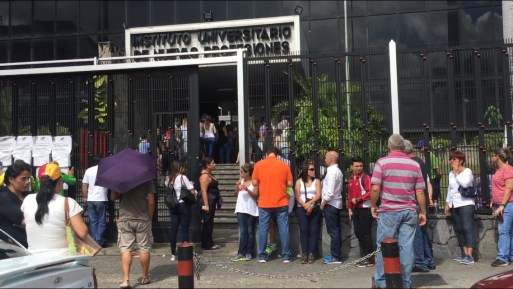
In Catia, a Chavista stronghold, the Davil saw very few lines. In fact, it was only when I got closer to downtown (further East), like in this picture in Lice Andres Bello, when lines appeared:

IMG_8238.JPG

That was the biggest line I saw in the West by far. The second one was this one, near the Panteon Nacional:

IMG_8230

We really saw no more than those two lines in a fairly wide and long spin around the West.

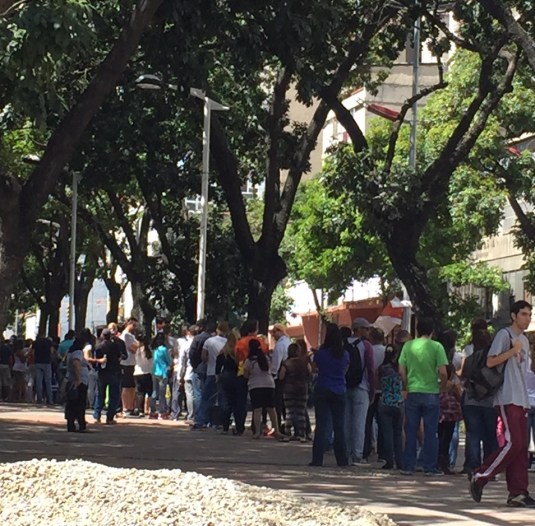
In the East, lines were common, as were traffic jams caused by stupid closings of streets, sometimes in very inefficient ways.

This was in Avenida Romulo Gallegos, it was a long line, but hard to get a good capture of the whole thing:

IMG_8245

This was quite typical of the visible and less visible centers in the East of Caracas.

The day was not without incident. I went a bit too deep into Catia for my comfort and at some point decided to make a U-turn and turn back. Unfortunately, there were some cops right at the end of the U-turn, which proceeded to stop me. They made me get out of the car, open the trunk, show all the papers etc. They then proceeded to bounce me from cop to cop telling me what I did was illegal, bla, bla, bla. All the time I kept saying, yes I know it was illegal, sorry, I was lost and did not feel safe. They talked about tickets, amounts, I could not drive etc, etc., while I said I knew. After three cops, they brought the lady cop who informed me that the penalty was all of Bs. 1,500, three months of suspended driving etc. I said, what can I say, I wanted to be safe.

It seemed that they were expecting me to offer a “solution” to the problem. Since I did not, she gave all the papers back to the first guy (the nicest one too) who told me since I had accepted my responsibility from the go he was going to let me go without writing up a fine.

Perhaps the salient feature of the whole thing is how they attempted to use a lot of big words when talking to me, but always relaxing back to slang in the end. While they had me there another car was stopped, but they withdrew guns, but I was getting into the car by then and set into the sun, like good devils do.