Archive for the 'Uncategorized' Category

Another Guri update: Corpoelec presentation

April 4, 2010

The last few days, the OPSIS website has not been updating the data, all we know is that there was a sharp drop in the inflow into the Guri dam, as on March 30th. inflow dropped to as low as 430 m^3/sec, the lowest level all year.

As usual, our friend Moses sends us some very interesting information in the form of a link to a Corpoelec presentation, which is now on the web right here.

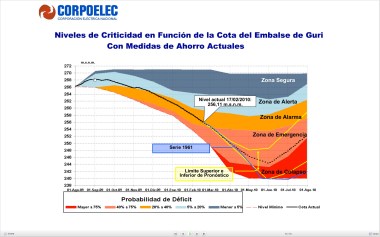
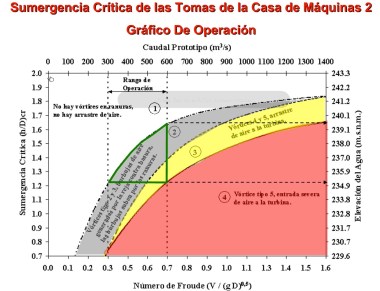
The first conclusion from seeing this is that there is no doubt that Corpoelec is considering the operation of the Guri dam below the magic 240 meters above sea level, based on this graph:

I do not understand the details of this plot, but there is clearly a “range of operations” which goes as low as 234.9 meters, well below the “critical” level of 240 meters above sea level. This region has a higher risk of vortex formation as the water level drops, but the graph suggests that there is some leeway in allowing it to drop below 240 meters, which would be good news as we will see below.

The next plot shows what Corpoelec estimates will happen in time, showing that it does not expect the 240 meter level to hit until May 23d. very similar to the model I presented and those in the comments using higher order fits:

Finally, there is this plot that estimates the current trajectory, comparing it to historical values.

From all this data and if Guru can be operated down to 238 meters, it would only be June until we have a problem.

Thus, I continue to be optimistic that in 2010 Guri will not reach the critical level and has to be shut down. Of course, the problem is that first, we need rain, but more importantly, the starting level for 2011 will be low and we will need a lot of rain to start the dry season for next year at a high level.

The recurring theme of Venezuela issuing a bond “backed” by gold

March 31, 2010

Periodically, the geniuses that manage Venezuela’s finances return to the idea that they can somehow issue a bond “backed” by gold production and that this will make it different, special and the country would have to pay less because of such guarantee. The idea was being kicked around last year, so that the Corporacion Venezolana de Guayana (CVG) could issue gold bonds, without having to pay an outrageous coupon on the bond. Since Venezuela yields like 12-13% and PDVSA 13-15%, imagine if CVG which loses money issues a bond. Thus, Minister Sanz has floated the idea of a gold bond many times, he did it again today.

Except it would make no difference whether it is backed or not by gold.

After all, aren’t all PDVSA or even Venezuela bonds backed by oil? Certainly not by the hard work of Venezuelans, no?

The problem is that if Venezuela ever had a crunch time in terms of money, such as the one being predicted by Morgan Stanley yesterday as soon as maybe the end of this year, the fact that the bonds are “backed” by oil, or gold would be simply useless.

Because the oil or the gold is here in Venezuela.

Thus, if CVG or the Central Bank (It is not clear who would be the issuer) “backed” a bond with gold production, the gold is in Venezuela. You would still have to go through Venezuelan Courts to get it. The risk is as good (or as bad) as the recently issued PDVSA “local law” bonds which foreign investors like less than the PDVSA bonds issued internationally. (I disagree with this interpretation, but that is a different story)

What Sanz or Merentes don’t understand is that for the gold “guarantee” to give the Government an advantage, it would have to be deposited abroad in an escrow account, something which I doubt Chavez is ready to do now, or ever.

I actually wrote about this already in August of last year when it was first floated. later Sanz himself said Chavez had approved the idea.

But, forget it. As long as the gold is here, or it will come from future local production, what matters most is who will issue it. CVG will have to pay more than the Republic or the Central Bank. A lot more.

That’s what happens when a country is run by amateurs.

The daunting task of providing for half a million new Venezuelans per year

March 28, 2010

Forget for a moment what is happening in Venezuela today. Concentrate on a single fact, a single number looking towards the future, Venezuela’s population grew last year by 480,000 people (The net of 580,000 births and 120,000 deaths). it is a daunting task to think about how to provide for these newly arrived Venezuelans in the years ahead, without even worrying of solving the problems that already exist.

I try to think about it in three different dimensions: When you read what the average Venezuelan wants out of life or expects out of its Government, there are three general priorities that motivate them politically: Hope, purchasing power and quality of life. Hugo Chavez has been able to provide lots of hope, a slight improvement in purchasing power which is now going to go below what it was when he became President, but he has failed miserably on improving quality of life.

It looks as if, with or without Chavez, it is only hope that can once again improve for the average Venezuelan in the next ten years. Improving the rest, even if you just focus in the newly born, represents a daunting task.

Take housing as an example. Providing housing to those 500,000 kids per year in the next four years will require half a million new homes if we assume two kids per family and two parents. Half a million homes is half the homes built in Venezuela by the Government ever since such programs exist. There are only 3.7 million formally built homes in Venezuela.

Well, building 125,000 homes per year, which I reiterate, would only provide homes for the newly born and their parents, is far above the maximum number Chavez has been able to build in any of his eleven years (27,000 housing units) and even above the maximum  (98,000 units) built in any of the ten years preceding him.

Thus, providing housing to these new Venezuelans is way above the organizational capabilities this country has had in the recent decades and the ability to even build them may been seriously compromised by the nationalization of the cement companies (to say nothing of the lack of electricity to generate the steel beams used in Venezuelan construction.

But note that there is already a shortage of 2.5 million housing units in the country,thus, even beginning to attack the problem is quite a task.

But is it? Coincidentally, there is an interview with one of the architects from a group that proposed to Chavez how to remedy the housing problem with a ten year US$ 30 billion program which seemed impossible to finance in 2000. They lasted two years in the constant shuffle that Chavez applies to his Cabinet and managers, as well as the fact that their program was completely decentralized. Add to that economic interests from the Capitalist, the socialists and the Bolibourgeois and the program went away faster than Chavista Justice acts on cases involving their enemies.

So, housing looks really tough.

Let’s consider purchasing power. Despite the biggest oil boom in the country’s history with oil prices increasing eight fold in the last eleven years, purchasing power improvements in the first ten years were only marginal and economists are predicting that the average Venezuelan will actually lose all those gains before the end of the year. Back to 1998 in a puff! Not pretty!

So, simple rules about growth in income break down in Venezuela because of The Devil’s Excrement. It is not a problem that the Venezuelan economy or oil prices would have to grow by 2% to accommodate the 480,000 new Venezuelans, the problem is that in the absence of a National Plan, with sound priorities like getting rid of military spending to benefit the people and the need for oil production to increase, Venezuelans will be poorer and poorer in the next few years. Politicians will be able to offer hope, but not much more which is real.

Unless, you could agree on four or five National priorities, a pact among political contenders that Housing, Oil, Education and infrastructure have to be taken out of the political diatribe.

Which simply sounds far fetched, if not impossible.

I could go on and on. You could take the electric problem, which takes knowledge, planning and money, or the crime problem, which takes knowledge, planning and money, or the education problem which takes ditto. Those half a million Venezuelans represent a daunting task and a challenge, which politicians in either side of the spectrum seem to be far from even attempting to address.

But ever since I realized that there will be half a million new Venezuelans every year going forward, that number has been giving me nightmares.
Venezuela: Where everything is truly backwards

March 24, 2010

(Comrade, sorry to interrupt you activities, can you tell me where Oswaldo Alvarez Paz´house is?)

In another demonstration of long term planning, responsibility and caring for productivity and the values of hard work, President Hugo Chávez has just announced that Monday, Tuesday and Wednesday of Easter week (next week) will also be holidays next week in order to save electricity. We have an eight day holiday for the whole country starting Saturday.

Everything is backwards these days in Venezuela.

Note added: After Hugo had his whim, the Government realized the announced “Feriado Nacional” could not be “Nacional”, it is end of the month, tax payments are due on Wednesday and a country can’t function like that for eight days, so we get the exceptions:

Electric companies, telephone, hospitals (??), banks, drugstores, Foods, Hotels (obvious), Restaurants (holidays don’t apply to them anyway), public transporation.

Question of the day?

March 21, 2010

(What are you searching for?)

The question of the day is:

And if we catch Chavez lying in his blog, what happens?

Hugo Chavez, ETA and the FARC

March 15, 2010

Today, Judge Eloy Velasco, from the Spanish Audiencia Nacional, the same one that ordered the detention of Pinochet, ordered the detention of 12 presumed members of Basque terrorist organization ETA and Colombian terrorist organization FARC. Among them is Arturo Cubillas Fontan, who is in charge of the Security Department of the Venezuelan Land Ministry, a Ministry presided until very recently by Venezuela’ current Vice-President Elias Jaua. Curiously, Spanish newspaper ABC also presented today an accusation that another member of ETA, Jose Antonio Egido works for the Venezuelan Foreign Ministry, showing that Chavez’ support and collaboration with ETA is more than just coincidental.

Because the accusation against Cubillas is quite clear: He is being accused of training FARC guerillas with explosives. Such training took place in the border between Colombia and Venezuela and Cubillas showed up accompanied by at least one Venezuelan military officer AND in a Venezuelan military vehicle.

Of course, the reaction by Chavez’ Government, the same one that investigates the slightest whisper by someone from the opposition on TV which could be construed as conspiring against the Government, wraps itself around the Venezuelan flag, cries sovereignty issues, but fails to look into the accusation, calling it garbage and the like. Recall the same thing happened with another “friendly” Government in the case of the Maletagate affair, where not one of those involved was ever investigated in Venezuela, despite clear proof that it went all the way to the top.

And as events develop, we get visits from the usual PDF’s, scandalized that we could possibly believe these accusations from the Spanish Court, as if it did not have a track record that proves the accusations.

Because while it may be now that a Court of the world does not need to suck up to Chavez, his cronies and his wealth, anyone reading the many Venezuelan blogs does not need the Audiencia Nacional’s help to know that Chavez was and is in cahoots with the ETA and the FARC.

The FARC in particular has an ample and proven track record with Hugo Chavez. And while I will become repetitive, because this same evidence has been used before, I would like to show all of this evidence in its splendor

For example, wasn’t it Hugo Chavez that said that the FARC were not terrorists, but armies that needed to be recognized?

And not once, but twice:

And wasn’t it Chavez that asked for a minute of silence on National TV in memory of Raul Reyes, the same terrorist who visited the Miraflores Presidential Palace (Chavez later claimed he did this at the request of Colombia’s President Pastrana, who denied it) for reasons never revealed, meeting with Venezuela’s Vice-President?

And how about Chavez’ buddy Piedad Cordoba with Reyes in a video that some claim was partly taped in Venezuela, here defended by Chavez:

Or how about this professionally taped video on the death of FARC terrorist Marulanda, which was apparently made by Chavez’ international propaganda TV station Telesur:

Or how about the Venezuelan Minister telling the FARC  whom he called “comrades” and who was told by the guerrilla member “We are moving forward”, Chacin agreeing with her.

Need I show more? How many pictures of FARC leader Ivan Marquez at the Presidential Palace can you find in the Internet? Should we believe Chavez, his cronies or the same Audiencia Nacional that has gone after terrorists, Pinochet and acted against them?

Of course, it may have to go after Chavez in the end. Is that what he is afraid of?

An update on what is happening at Guri dam

March 11, 2010

Well, I have good news and bad news. The good news, is that the model that I presented the other day is doing ok so far, it was predicting for yesterday a height of the water level at Guri dam of 253.25 meters and the reported level in the Opsis website is 253.16 meters. This is not bad, given that I used data up to February 15th., thus, after 14 days, the error is only 9 centimeters, which tracks the model quite well. Cross your fingers.

Except the bad news is that this is more complicated that it may have seemed at first sight.

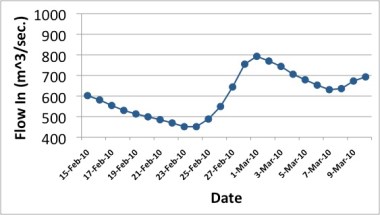
First of all, it has been raining! That is definitely good news. Here is a plot of the water flow into the Guri dam:

as you can see, the flow almost doubled after February 25th. as the rain brought in more water for a few days, going from around 400 cubic meters per sec. to 800. Then the flow dropped again to around 600 m^3/sec. and on March 8th. it rained again and water inflows levels are around 700 m^3/sec.

The bad news is, that despite the fact that water inflows are higher than in all of February, the water level is still dropping, as seen below in the the plot of the Height above sea level of the water:

As can be seen, the water level keeps dropping. We have had more rain and more water, but the rate at which the level has been dropping seems to be continuing.

How come?

Easy, as the water into the dam has increased, the flow out through the turbines that produces the electricity has also been increased as can be seen in the next chart:

As you can see, as the rain has provided more water, the dam has been used more and the flow out has increased. In fact, it seems to be increasing daily as if the people running it are controlling it accordingly.

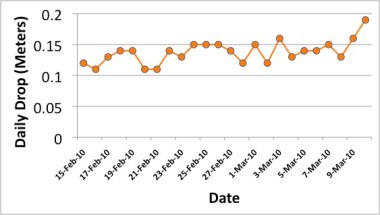
This implies, that despite the rain the daily drop in height has not slowed down, in fact, it has increased:

almost reaching 20 centimeters daily.

Thus, I am not sure why it is dropping faster, it would seem as if more water is being allowed to flow to produce more electricity, but the rate of increase in the flow out does not seem to be as large as to justify the faster drop in the height. It may be that because it is much hotter and there is a less surface area to the lake, there is much more evaporation or the shape is playing a role.

Comments are welcome, particularly by the experts, who may enlighten us on dam management!

An Act of Corrupt, Capitalistic and Robolutionary In(Justice)

March 10, 2010

(In Spanish here)

Today the Venezuelan Supreme Court pensioned off 90% of the Court, applying the benefit to all the Justices that were eligible. At the same time, all of these Justices will continue in their functions until Chavez’ Constitutional period ends in 2012. Only one Justice, likely the only honest and ethical one, Justice Marmol Leon opposed it. Here is the decision.

Why you may ask why was this done?

Easy. The National Assembly is about to approve a Law limiting salaries in the Venezuelan Government to no more than around Bs. 9,000 (about US$ 1,200 at the parallel rate), which would limit pensions to this number if they were pensioned off in 2012. Instead, they get their pensions today at the current salaries which is like 4 to 5 TIMES higher and on top of that will stay applying their peculiar version of robolutionary Injustice.

The cynical and unethical behavior of these people never ceases to amaze me!

I guess you could call it an act of corrupt, capitalistic and robolutionary Injustice!

A Simple explanation for Venezuela’s Electric Crisis

March 2, 2010

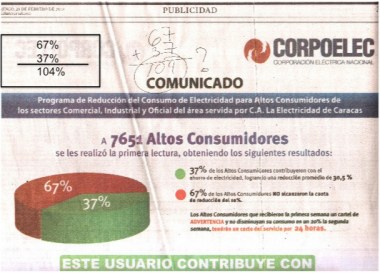
The ad above in Sunday’s El Nacional, by Venezuela’s Electric company Corpoelec shows in a very simple manner why we have such a severe electric crisis. According to the ad, 37% of high volume consumers managed to save the required amount, while 67% did not manage it, adding to a whopping 104% of all users!!!!

With such revolutionary math, no wonder we have such an electric mess!!!

(Hat tip: @jesuspi)

Strong confrontation between Uribe and Chavez

February 22, 2010

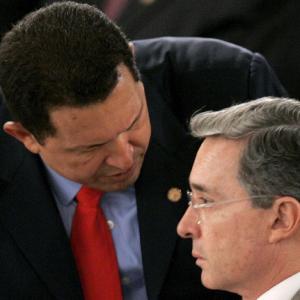
Reportedly at the meeting in Cancun to create a new organization of Latin American unity, Hugo Chavez and Alvaro Uribe got into a strong confrontation. As the two Presidents argued about Venezuela’s commercial boycott of Colombia, Chavez sen Uribe to Hell (Vete pa’l carajo) and when Chavez threatened to leave Uribe told him to be a man and stay to argue face to face (sea varon y quedese a discutir de frente). (In English here)

There is never unity when Hugo is involved, if you are not with him, you are against him.