Clueless in Caracas: A Tale of Two Ministers

August 8, 2011

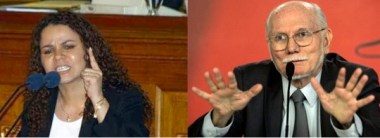
It’s easy to be concerned about Iris Varela being Minister for Prisons, what she says is easy to understand and as Quico says very dangerous. But in part, it is because the extreme nature of her statements is so non-sensical and in language easy to understand that makes her her now infamous statements shocking:

1) 40% of the prison populations should legally be out in the streets.

2) If a Judge does not release a prisoner, I call the President of the Supreme Court.

3) Ordered that no new prisoners be admitted in any jail in Venezuela.

All three of these violate the rule of law, common sense and are easy to understand by anyone who has some inkling as to how societies function.

But is Ms. Varela any more dangerous than Jorge Giordani who has been the “economic” brain of the revolution since 1998? (Minister of Planning 1998-2002, Central Bank Board member 2001-today, Minister of Planning 2004-today, Minister of Finance 2010-today, member of the Board of PDVSA 2011-)

Take for example what Giordani said after issuing the recent Global 2031 bond:

-We are removing Bs. 18 billion from the liquidity or 40% of it. (This is supposed to be one of the “good” things of issuing the bond)

First, it is 40% of excess liquidity, not liquidity, the latter stands at Bs. 354 billion. In fact, liquidity (M2, the amount of money in circulation) has gone up by 17% so far in 2011 (or has been allowed to increase by that much), which is the main cause for inflation. But even worse, Bs. 18 billion takes total liquidity back to what was present in the system on June 15th., only six weeks ago.  That is, the amount of liquidity that this US$ 4.2 billion (!) bond removes from the economy just takes us back six weeks to the money created by this Government. Wouldn’t have been easier not to print that money?

But Giordani does not seem to understand the role of liquidity in the system. When Chavez got to power, there were some Bs. F. 10 billion in circulation. Today there are Bs. F. 350 billion in circulation. This is Giordani’s Baby, one way or the other he has been around at each step of this monstrous creation of money.

Now, just so you get an idea, the Venezuelan economy in those same twelve years that Chavez has been in power has grown a total of 31.4% in real terms, but the amount of Bolivars out in the streets has gone up by 3,900% in absolute terms. Do you see the problem? It’s the new money creating the inflation, too many new Bolivars chasing just 31% more goods. It is not a chicken and egg problem, you control the number of Bolivars, you control inflation. Ask Paul Volcker, who stopped inflation cold in the US in the early 80’s.

In fact, let’s compare it to the US during the same period. GDP in the US has increased by 35%, slightly more than Venezuela, but monetary liquidity has increased by only a factor of 2, or 100%. And you probably have heard about the “problem” in the US with all that new money that was thrown around in QE1 and QE2 to stimulate the economy. Well, Giordani has done a factor of 35 more in money printing, thus the lower inflation in the US. But note, Venezuela had its main product for export, oil, increase by a factor of 10 in price during that period, and the US economy managed to grow more in that period, despite the fact that there was a huge financial and housing crisis.

So much for capitalism being dead, Hugo!

And to complete Giordani’s trifecta of danger, there is the infamous “excess” international reserves concept, in which every year “excess” US$ in the Central Bank (as defined by the Government) are transferred to Chavez’ petty cash fund the Fonden. So far, US$ 67 billion have been transferred out of the reserves.

In 1998 when Chavez got to power, there were US$ 14.2 billion in international reserves. Oil was around US$ 12 per barrel.

Today? Today there are US$ 29.2 billion in reserves, but oil is topping U$90-100 per barrel.

Put another way, in 1998 there were Bs. 0.53 for each dollar in the Central Bank in international reserves and the exchange rate was Bs. 0.574 per US$. If all Bs. were converted into dollars, there would still be dollars in the Central Bank.

Today there are Bs. 12.12 per US$, but the exchange rate is Bs. 4.3 per US$. If all Bs. were converted into $, the reserves would be wiped out and there would still be almost Bs. 240 billion around.

But imagine if the US$ 67 billion transferred to Fonden were part of the Central Bank’s reserves. Venezuela would have US$ 97 billion in reserves or there would be Bs. 3.4 per US$ in reserves, if all Bs. were converted to $, there would be plenty of dollars left.

Thus, Giordani has been in charge of a no-growth, inflationary economy for twelve years and at every step it has been his policy making that has screwed up things.

Amazingly, he is still in charge! And very dangerous!

What would you prefer twelve years of Iris with the crime rate doubling or tripling again or another 1,200% of inflation?

You Pick!

Hugo Chavez Defines His Tired, Failed Presidency And Revolution

August 7, 2011

In the interview of Hugo Chavez by Jose Vicente Rangel, shown today, but taped on Thursday, the Venezuelan President attempts to describe the successes and failures of his Presidency. In so doing, Chavez shows how tired and failed his revolution and his Presidency are. The “successes” are mostly old or in the end, failures, while the failures are mostly old too, remembrances of his most heroic days:

Successes:

-Constituent Assembly which opened the doors to the new Constitution and Socialism

Well, this happened long ago (11 years to be precise) and he is changing history, the new Constitution, which he just ignores and violates lately, did not open the door to socialism, had nothing to do with socialism.

-Taking over PDVSA

Again this happened 8 years ago and so far all eh has managed to do is reduce the company’s ability to function, destroy its human and technological capabilities and reduce production.

-Socialism

Again, he said we were going into socialism long ago (2005?), but has yet to define it or even implemented. Socialism is not taking over companies and destroying them, nor taking over farms and abandon them. Socialism is not having a President wear fancy watches and buying armored Bentley’s to take him around. Socialism is not the creation of a wealthy “bolibourgeois class” that lives of the Government importing everything or the financial transactions it invents.

Thus, in his successes, nothing is recent, nothing is real, just smoke and mirrors of old political “victories”

On the failures:

-Having an “orthodox” economic policy in the first few years of his Government

Well, that is also old, but if he thinks the non-orthodox policies have been good, he should look at July’s CPI, a 2.7% increase, giving a 25% increase for the last 12 months and 4.8% increase in food prices in July alone.

-Lack of efficiency of his Government

The only constant in his failures, twelve years of consistent inefficiency.

-Having respected military hierarchy up to 2003.

Once again, something that happened long ago. Nothing would have changed if he had done it earlier, just the destruction of institutions would have been accelerated.

Without desiring it, Chavez has define, in both what he thinks were successes and failures, how tired his empty revolution is, he draws on a distant past. Nothing from the last six years, except the continued ineffectiveness of his Government.


Hugo Chavez Proves He Is No Democrat

August 4, 2011

While I have never had any doubt about Chavez’ democratic beliefs, today he proves he is no democrat and does not believe in democracy, saying that in 1998 he had doubts about whether the path for his revolution was a peaceful and democratic one or not. And to make the point complete, he then goes on to say these doubts resurfaced in 2002.

As if we did not know. Two coups in 1992, decided to run in 1998, has always threatened with his weapons, has used his weapons against the “people’ and often, including April 2011…

Another one for the record, another one for the trials, he will have doubts again, he is no democrat, he will not relinquish power via democratic means.


Nine Devilish Years, which makes me feel…exhausted!!!

August 4, 2011

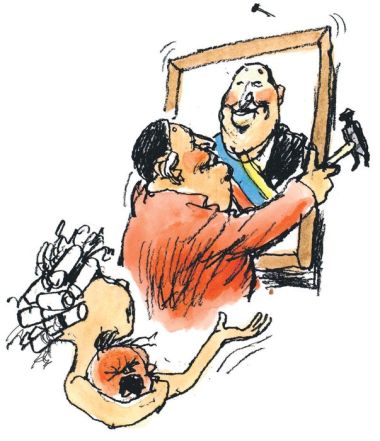
A friend and reader sent me an email today and reminded me that my blog has been around one of these days for all of nine years. I checked and indeed it was born on Aug. 4th. 2002, exactly nine years ago today. Which makes me feel, when I think about it, like the picture above…

Exhausted!!!

I thought this would be short and sweet, a two to three year project, which turned into a nine year night job…and counting…

But hey! See that tree at the end of the road, there is still hope! And I happen to be very stubborn and tenacious (Yes, I was born in late April). So, I will be around for a while.

Here is that first post:

Banana Republics 101 Part I

Most people who live in or are from underdeveloped countries take offense when anyone refers to their own or, for that matter, any other country, as a Banana Republic. The term originated in the Central American countries were the United Fruit Co. operated, but has come to signify countries which may not even qualify to be called countries because of the way they are run. I do feel like I live in one, when I try to explain to my friends from abroad any of the following:

-For the first time in ten years Venezuela has economists in both the Minisitry of Finance and the  Ministry of Planning. In the past, we have had a Mathematician, a Sociologist, an Urban Planner and an engineer, to cite a few. (Not true anymore in 2011, thyey got rid of the Economists, brought back the Mathematician and Urban Planner)

-Venezuela is part of OPEC, where it gets together with its most important competitors to decide how much each country should produce per day. Interestengly enough, Venezuela is the OPEC country, other than Iraq for different reasons,  that has reduced its production the most in the last thirty years. Despite this, few Venezuelans are convinced we should split from OPEC. Thats ok with me, but don’t you think we should even discuss it? (Still the case in 2011)

-There were mudslides in the coastal zones near Caracas in Dec. 1999. Estimates are that close to 40,000 people died. The US Army Core of Engineers offered to rebuild the coastal highway (for free!!) an send ships to Venezuela. The Government refused to accept the aid and the ships  turned back. To this day, three years later, the highway has yet to be completed. (Parts of it were rebuilt, some are a mess today in 2011)

-We say we live in a democracy. Despite this, only one candidate in the last ten years was elected in a primary of his party. He lost. (Still the case in 2011)

-There were riots this week in Caracas. Government supporters rioted for two days, shot people, blocked streets and created chaos in the city. The Government announced today that it had asked the Attorney General to investigate the abuses of the police when they used tear gas from a helicopter. The President has banned the flying of police helicopters over the city. There has been no call to investigate the rioters, where they got their weapons or who leads them. (Nothing ever gets investigated in 2011, except to screw the opposition)

Hate to see what a Banana Republic would be like…..


Did Diosdado Cabello really say that?

August 3, 2011

There is no doubt that the fact that the opposition decided to go with a single voting card has instilled fear and confusion in Chavismo. Chavismo never expected it would happen, but it did. Chavez attacks it, Jaua attacks it. Then Diosdado Cabello attacks it in the video above and then says:

“They are more tangled up than we are…”

Did Diosdado really say that?

Yeap! Not once, but actually three times, with his characteristic stutter. (Minute 0:34)

Maybe Diosdado could expand further on their “enredo”, they must really be tangled up for him to get stuck on that single idea.


Chavez Presidential Honor Guard, Not so Honorable

August 3, 2011

How about this “Generalito” in charge of Chavez’ Honor Guard who tells Chavez in no uncertain terms:

“You will always be our Commander, for now, forever. And there is no doubt we will never accept another Commander”

Some Democrat and ignorant fool this not so honorable General, who clearly does not understand democracy or the Venezuelan Constitution. Hopefully, there will not be a “Commander” to pay full respect and devotion to in Miraflores Palace after December 2012.

This is simply an attempt to suck up to Chavez and at the same time intimidate the opposition. But here it is, for the record and for the trial…

And yes, I am trying to intimidate too.


Chavez’ New Look: More Than Just a Bald Head

August 2, 2011

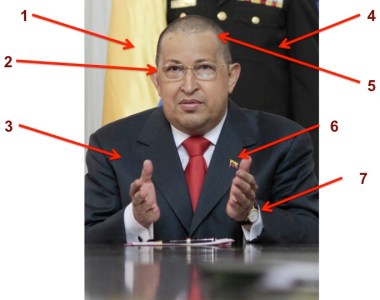
So, everyone looked at Chavez’ bald head when he talked about his “New Look”, but everything about Chavez’ image is carefully calculated and designed. From left to right:

1) Flag behind him, not always present.

2) Glasses, more likely due to the chemotherapy, which means he used to wear contact lenses for vanity reasons, but now can’t.

3) Nice, businessman-like new suit. Gone is the red shirt, only the red tie remains true to form.

4) Well appointed guard behind him, making him look Presidential.

5) Bald head, some spots begin to show up, particularly on the right side of the head. Cut before it becomes noticeable.

6) Little Venezuelan flag substitutes jackets and other implements.

7) Nice gold non-socialist Patek Phillipe watch, model 5119J, retails for close to $20,000 but you can get it for about 15K if you are a careful shopper. I wonder who coughed up the money for this present. And where did the Panerai go?

So, we are back to the soft, serious image. The lovable Hugo, I just wonder how long it will last. We have seen “new” looks before.


Is Hugo Chavez’ Behavior What One Would Expect Up To Now?

August 1, 2011

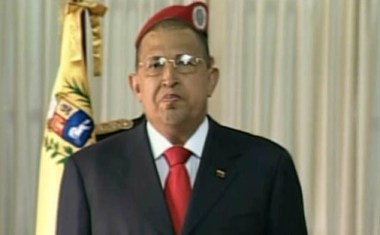
(Nice overlap between Chavez’ “New” bold look and the red beret on the guard behind him)

Having just finished reading the book “Leaders and their Followers in a dangerous world-The Psychology of Political Behavior” by Jerrold M. Post, I can’t help but attempt to analyze and extrapolate what I read to the recent behavior of Hugo Chavez after his recent illness.

First, the way in which the illness has been handled conforms to expectations:

“There is a premium on concealing illness, or, if this is not possible, on minimizing the perception of the severity of the impairment…this need to preserve the image of health may cause leaders to avoid comprehensive diagnostic evaluation and treatment altogether or to undergo inadequate treatment secretly”

Well, Chavez was and clearly is a textbook example of this. From the time of his “knee” ailment, to taking him to Cuba later, he avoided a comprehensive evaluation and tried to have treatment in secret, however, things got complicated. There was and there continue to be attempts to conceal the illness and its severely. Curiously, it is Chavez that seems to reveal the most about what he has, nobody else says or reveals much and when they do, like Izarra, Rangel or that famous PSUV press conference, they are usually lying. It is Chavez verbal incontinence that has told us some, but not all of the details of the illness. In fact, today, amazingly, we still don’t have a formal announcement of what the President has, other than he has cancer and we don’t even know where.

Second, how narcissistic leaders (and the book clearly defines him as one) react to a terminal illness may vary, but based on the book, it would seem from that he should be intensifying his acts, seeking the immortality through what he does, personality traits become more intense now that his life may end sooner than he thought:

“The specter of the end of his life may ignite a terminal explosion in a frantic last ditch attempt to ensure immortality”

I really don’t think we have seen this (yet?) in Chavez. He has actually been perhaps even more subdued, even removing some of the symbols of his Presidency, like changing “Patria, Socialsimo o Muerte”, saying it is not normal to wear red shirts all the time and that he does not want to have the word socialist attached to everything. Perhaps we have to wait for this to surface. But he may be misjudging what he is doing. Many of these symbols are entrenched in the population and changing signals on them is simply confusing for people accustomed to a unified discourse and signalling from Chavez and his Government. Acting hasrhly is one signature of the behavior an this may or not be a consequence of this.

What is clear from the book is that these type of leaders and narcissistic personalities tend to go into denial, refusing to accept that they will relinquish power, which may explain the surprise trips that Chavez has made every time that he has been under treatment in Cuba. Historically, when an autocrat has a  severe illness, those that surround him want greater participation, but the autocrat refuses to yield. He wants control and power, he does not want to lose that. They tend to make decisions, particularly tough ones, too late or in a rush. They lose the control and premeditation that they usually exhibit in their plotting and acts.They act rashly and make mistakes, they tend to engage in a new relationship with subordinates, where they listen even less to advise.

Thus, from what I learned in the book, it is hard to reach a conclusion, but we don’t know all that is happening.

Going forward, I was struck by this sentence in the book:

“Dreams of glory are responsible for some of civilizations greatest achivements, but the intemperate reactions of aging and ailing leaders to the ebbing of their power and the frustrated dreams of their youth have been responsible for some of history’s most tragic excesses”

Let’s hope this does not apply in our case.

Next: in the reading list:”When illness Strike the Leader: The Dilemma of the Captive King” by Robins and Post.


Venezuelan Electoral Factoid # 3,141,156: Cuba Versus Miami

August 1, 2011

There are 215,000 Venezuelans who legally live in the US. Of these, 25,903 are registered to vote in Miami, which acts as a voting center for Florida, Georgia and North Carolina. Chavez got only 2.23% of the votes in that Consulate against Manuel Rosales in 2006.

Contrast that with Cuba, where barely 665 Venezuelan are currently registered to vote. Chavez got 100% of the votes against Manuel Rosales in 2006 in Cuba.

But,…there are FOUR (4) voting centers in Cuba so that the 665 voters can comfortably vote for Hugo at their leisure.


Does it really matter who is named Minister under Chavez?

July 31, 2011

I have been somewhat surprised by the number of emails and comments talking about the fact that Deputy Iris Varela was named Minister for Prisons or whatever name that new Ministry was given.

But really, does it really matter?

The fact that Ms. Varela has no managing experience is simply a continuation of a long chain of Ministers with similar non-qualifications. About the only requirement to be Minister under Chavez is that you are loyal. I mean, a guy who seeks treatment for a life-threatening disease with the least competent possibility, can not truly believe in expertise.

Take über Minister Jorge Giordani, he has a Bachelors in Electrical Engineering, a Ph.D. in Urban Planning and now he is Minister of Planning and Minister of Finance, is on the Board of the Central Bank and PDVSA. For only a brief time during Chavez’ tenure, Giordani has not been in charge of Economic Planning in the country. During this period, inflation is close to 1000% and except that one is not allowed to quote the parallel rate, devaluation has also been in that same range. Giordani has tried everything an has been unable to reduce inflation, reduce debt, control liquidity. He ha no idea on what needs to be done, but he keeps chugging along.

It seems to be the same everywhere, Setty has told us recently about the wonderful plans to increase oil production under Rafael Ramirez, while Cronicas de Caracas told us about the Minister of Sports that wants to pass a Bill that will likely destroy professional sports in Venezuela and we are not even sure the guy ever graduated from the University. But we are sure Vice-President Jaua did, even if it took him 15 (or was it 20?) years to do it. Oh yeah! Minister Garces has a Ph.D., which he obtained in 2007, he never even proved he could research, let alone manage a group, or a Minsitry and his expertise has little to do with being Minister of Transport and Communications.

So, should I really care about Iris Varela being named Minister for Prisons? Not really. Would she recognize a human right if she saw one? Ask Cesar Perez Vivas. Today she says very nonchalantly that 20,000 of the 45,000 prisoners in the country “have all the legal conditions to be out of jail”. She talks as if she was an extra-terrestrial who just landed in Venezuela to solve the prison problem, not an integral part of the Government which has allowed this “small” illegality to exist. I mean, the same people who have ignored for twelve years the crime problem, all of a sudden realize there are 20,000 people in jail who should legally be free. She proves it today when she says: If a Judge does not obey me, I just ask the Chief Justice to remove him.  This is Varela’s concept of “Justice” tp say nothing of the  absence of room for criticism in the revolution.

And her goal? To shut down jails. Really, and where does she plan to put the 30,000 remaining prisoners who are currently in jails designed for about 15,000 prisoners at most?

In the end, it really does not matter. Know how, knowledge, ability, management are simply non existing concepts in the revolution. Just to prove it, look up PDVSA’s financials in the company’s webpage. Don’t look at revenues, don’t look at earnings, don’t look at production. Simply go to point g) on page 14. There under the heading “Research and Development” you will see the progression of expenses for this very important (to me!) item:

2008 $555 million

2009 $276 million

2010 $188 million

To me that says it all about the role of knowledge and know-how in the Chavez revolution. As a General told me ominously a few years ago: “If Chavez can Be President, why not me?”