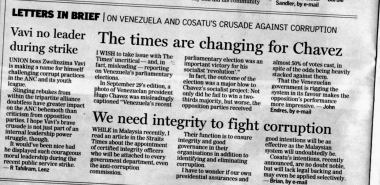
Long time reader and friend John Endres took Johannesburg’s Times to task for reporting Sunday’s election as a victory for Chávez and they published his letter.
Way to go John!
Observations focused on the problems of an underdeveloped country, Venezuela, with some serendipity about the world (orchids, techs, science, investments, politics) at large. A famous Venezuelan, Juan Pablo Perez Alfonzo, referred to oil as the devil's excrement. For countries, easy wealth appears indeed to be the sure path to failure. Venezuela might be a clear example of that.
Long time reader and friend John Endres took Johannesburg’s Times to task for reporting Sunday’s election as a victory for Chávez and they published his letter.
Way to go John!

fi – 1 is the absolute frequency immediately below the modal class.
fi-1 is the absolute frequency immediately after the modal class.
ai is the amplitude of the class. Where there is evidence of a deep class struggle.
That said, any idiot understands that there is a variance of data grouped according to the following procedure of the Hulk method:
 It is then, as can be seen, a choice that has nothing to do with the national, but with the circuital and as demonstrated, it is entirely reasonable and logical that an overstated majority of minority representation that is most in relative terms ratio based on a weighted representation of the elements of territorial differentiation on the basis of who has it larger. Still, size does not matter but the quality of representation.
Put another way: the sum proportion of the population disparities lead all to a decreasing level of representation of circuit factors accumulated more if circuits are negative polarity, which caused some machines will not work.
Everything is in the Law and as legal principle says: “Dura lex, sed lex”, ie the law is the law while it lasts. And we will be hard put to let them get in the coming months, following the principle of Aristobulus, the Greek, “possidetis iuris”, which means, “because I I feel like it, kid .. . so what? “.
Hope this is enough so that it is clear to all and you stop bugging me.
Let it be Communicated and published, God and Federation.
(But most of all Federation) (but centralist) (ie focused on the list) LS (D)
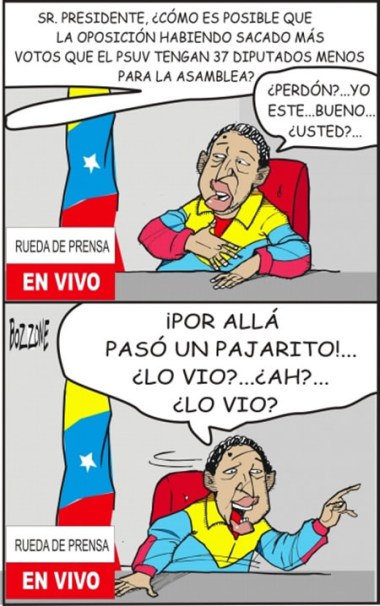 Mr. President, how can it be that the opposition with more votes than your party got only 37% of the Deputies? Sorry, well… I… then… you…well, did you see the bird? Did you see it? Ah? Did you see it?
—Art. 186 of Venezuela’s Constitution (Chavez’ Constitution) says”The National Assembly will be composed by Deputies elected in each federal entity by universal, direct, personal and secret vote with proportional representation, according to a population base of 1.1 % of the population.
—Despite this, the opposition, despite obtaining approximately the same number of votes as Chavez’ PSUV party, only got 39.39% of the Deputies in the National Assembly. Not Proportional at all, as stated in the Constitution.
—This happened because of a rule change, a new “methodology”, which was selectively applied only to eight States: Zulia, Distrito Capital, Miranda, Carabobo, Amazonas, Barinas, Lara and Táchira. These are the States where the opposition has strength, except fr Chavez’ home state of Barinas.
—The top five vote candidates by vote, were all opposition candidates, the bottom 15 candidadtes by vote were Chavista candidates.
—Pro-Chavez candidates that won received on average 55,092 votes, Opposition candidates on the other hand received on average 81,728 votes.
—Without the revolutionary new “methodology” the opposition estimates it would have obtained 14 more Deputies (79), at the expense of Chavez’ PSUV which would have obtained 81 seats in the Assembly.
—In the Capital District, the opposition got more votes than Chavez’ PSUV, but only won two out of eight nominal Deputies. So much for proportionality…
—In Carabobo State, the opposition got 53.7% of the votes and PSUV got 43% of the votes, despite which the opposition only got four Deputies and Chavismo seven. Proportionality is truly dead in Carabobo.
—And it works both ways, because of the rule tampering and the methodology, in Zulia State, the opposition got 54.8% of the vote versus Chavismo’s 44.4%, but the opposition got twelve out of thirteen Deputies. That’s not fair either, but it results from the new “methodology”. The opposition getting so many votes was not in the “plan”, the “methodology” was implemented when Chavismo was more optimistic.
—Finally, no matter how you want to spin it, the truth is that Chavismo did not do well. As proof, here are the voting trends in three Chavista strongholds of the past, including Vargas State, once considered as strong Chavista territory as could exist. The chart shows the percentage of the vote for Chavez for President in 2006, for the Chavista Governor and for the list vote in this election. The trend is clearly not Chavismo’s friend in any of these states. Just extrapolate two more years.

(Sorry for the post in Spanish)
Querida Socorro,
Con curiosidad leímos tus declaraciones del día de hoy, en las que dices, con la precisión de un reloj suizo, que las circunscripciones electorales fueron diseñadas por un “método” basado en la “ley.”
¿Cuál es ese “método” Socorro?
Los únicos estados donde hubo modificaciones fueron Zulia, Distrito Capital, Miranda, Carabobo, Amazonas, Barinas, Lara y Táchira. Qué casualidad que siete de estos ocho estados favorecen a la oposición, y el otro (Barinas) es el estado natal del Presidente.
Cosas de la matemática, dirás. Pero dinos, ¿será posible que compartas con nosotros la mágica fórmula matemática – “el método”, como lo llamas tú – que dio ese maravilloso resultado?
No seas pichirre, vale. Si tienes un “método” exacto que obliga a unir Baruta con Chacao y Leoncio Martínez, ¿acaso no es un crímen tenerlo guardado bajo llave?
Debe ser fascinante ese “método” que los llevó a dividir el Municipio Sucre del Estado Miranda en tres partes – dos partes en las que tradicionalmente gana la oposición, y otra en la que gana el gobierno y que fue anexada a Guarenas.
Debe ser muy sabio ese “método” que unió las parroquias de El Paraíso y La Vega del Distrito Capital – en las que la oposición salió relativamente bien – con las parroquias de Antímano y Macarao, donde el chavismo nos da palo.
Ese método debe ser tan sofisticado que por eso nadie lo entiende. ¿Será por eso que tu colega Vicente Díaz dijo que no existían criterios técnicos para los cambios? ¿No crees que ese “método” – que ni siquiera el otro rector del CNE conoce – quiere ver la luz del día? ¿Acaso no merece tu “método” salir del closet?
Mira, Socorro, nosotros no somos sino unos simples ciudadanos blogueros. No tenemos a la mano la fuerza del aparato del Estado, ni comandamos el Plan República. No tenemos las armas tecnológicas, financieras, ni matemáticas que ustedes, los poderosos, sí tienen.
Lo único que sí tenemos – por ahora, ¿verdad? – es nuestra voz y el artículo 186 de la Constitución, que dice que la representación en la Asamblea deberá ser proporcional.
Y por eso te invitamos a discutir tu “método” con nosotros, donde quieras y cuando quieras. Trae tu fórmula, y nosotros traemos nuestros estudios que, modestia aparte, creemos son bastante serios. Trae tu “modelo” y nosotros traeremos las predicciones y pronósticos que hicimos y que lograron predecir el resultado de la elección.
Porque si es verdad que el “método” no favorece a nadie en particular, no deberías tener problema en debatirlo con nosotros. Si tu “método” es como lo pintas, te lo reconoceríamos sin dudar.
Es más, si nos convences, te hacemos tronco de publicidad. Como nuestro trabajo ha sido citado por The Guardian, The Economist, la BBC, Reuters, y otros medios internacionales, capaz y hasta te ayudamos a revertir esa “matriz de opinión” contraria al CNE que también hoy denunciaste.
Sería sólo un simple debate entre compatriotas. Democracia pura, pues.
Entonces Socorro, ¿te anotas?
Los autores de

Venezuelan pollsters were unusually cagey in this election and they were right to be. Given the uncertainties in the undecided voters, the phantom Ni-Ni’s, as well as the hard to predict abstention and the lack of detailed polls in each district, it was somewhat daring to try to predict the outcome.
But as they were cagey in public, in private it was a different matter spewing out theories and predictions, most of which were simply wrong. They should have kept quiet.
So, without further ado, here is why I paid attention to Daniel and Quico more closely than most pollsters. In fact, in a report I write about Venezuela I used their analysis to predict 65 Deputies for the oppo and 50% of the vote. Better than if I had used most of the “experts” below :
Constant Fail!: Seijas. Chavez’ pollster was telling us Chavismo would get 62% of the vote with a 3% error. Sorry Seijas, you are getting tiring, please try to narrow that error. For that matter, why not do a real poll, not one Chavez wants to read.You seem to be always wrong. Was it 65% or 62% in the 2007 referendum? Fail!
New and repeat Fail: GS XXI: Merentes used to run it and have 20% errors. Now it is Jesse Chacon’s time. The former Minister of Science predicted 110 Deputies and a majority for Chavez. Not bad, less than 15% error, in a military and militaristic world that must be acceptable, in the case of polling and statistics: Fail!
What’s wrong with you: Big Fail!: Datanalisis. If you know that it is hard to predict, why try? But you did. With a huge number of undecided you somehow decided love for Chavismo would prevail and turned a 28% for Chavez to 26% for the opposition poll with 40% undecided into a Chavez victory. Sorry, it just did not work, even if you tried to fix it via Twitter once you knew the oppo had won: Fail!
Not bad, given your imprecision: I always find Schemel of Hinterlaces somewhat vaporous, but he got it mostly right this time around when he predicted an opposition victory with a 34 to 32% advantage. Not bad, you have been wrong before, but you get a gold star this time.
Best in category: Consultores XXI. Time and time again, they get it right (Except the 2004 recall vote where they were calling for a small victory by Chavismo, funny no?). They said 62% for Chavismo in 1998 and 2000, but even Chavistas don’t listen to them. But they did it again, This analysis of the effect of abstention nailed it on the head and that was a key factor:

But it is clear Daniel and Quico/Juan, without the resources and just good old fashioned thinking, do a much better job.
I have known Andreina since the early days of blogs when she was a journalism student in Barquisimeto and had this personal blog. The blogging community was so small, we had parties and almost everyone showed up. That was a while back and I was very proud yesterday when I saw the video of her question to Chávez, as a Radio France reporter, and how she stood up for herself, refusing to accept being called ignorant and trying to get an answer that she never got from the autocrat. He also lied about Radio France and today Radio France responds to him
It’s very simple to explain, as El Pais said it this morning, the most populous states with 67% of the population only elect 53% of the Deputies.
In fact, under the old regulations, the opposition would have obtained roughly the same nummber of Deputies as Chavismo according to El Nacional.
Way to go Andreina!
The Venezuelan opposition scored a big victory, despite its defeat in not having a majority of the National Assembly. The opposition obtained 52.9% of the vote, obtaining 635,000 more votes nationwide than Chavez’ PSUV party. Thus, the opposition not only managed to block Chávez from obtaining a two-thirds majority, its minimum political goal, but also showed how rigged the system is when it obtained a majority of the votes, but only around 40% of the Assembly pending the undecided seats.
The results emphasized how rigged the system is, as the Venezuelan Constitution guarantees in Article 63 the right to proportional representation, but Chavismo, through its control of all powers changed rules and districts in order to insure it could retain control of the national Assembly. These changes were brought to the attention of the Venezuelan Supreme Court who either rejected the cases or has never ruled on them, showing once again, that the rule of law is seriously compromised in Venezuela. The results highlights that Chavez’ “legitimacy” is seriously questioned now, given this victory despite the loss in the popular vote.
The biggest loser in the election was not Chávez, but Henri Falcón, the Governor of Lara State who split from Chávez selling himself as an alternative to Chávez, but who failed to obtain a single seat in the Assembly.
There were some surprises at the regional level, such as the 12 to 1 victory in Zulia State, a victory for that state’s Governor Pablo Perez, as well as surprising victories in Anzoátegui, Sucre and Aragua state in what had been considered Chavismo strongholds. In Caracas’ Capital District, the opposition obtained more votes than Chavismo, but received only 3 out of ten Deputies. Acción Democrática, became the opposition’s largest party, obatining 1.8 million votes nationwide out of the 5.7 million obtained by the MUD parties.
Not having a two thirds majority implies that the Government will now have to sit and negotiate naming Supreme Court Justices, the General Prosecutor, the Comptroller, and the People’s Ombudsman or approve major structural changes in the country’s structures.
But the results do not guarantee that Chávez will stop the pace of his revolution. He has some of the Bills he needs in place to continue forward and he can increase parallel funds to promote his pet projects away from the supervision of the National Assembly. However, the opposition will have a strong and constant presence in the Assembly that will give it visibility going forward.
For Chávez, the results are a warning sign in the face of the 2012 Presidential election. If oil does not increase significantly in the next two years, problems will compound as oil production drops and the lack of investment continues to have important effects on infrastructure. Add crime, inflation and lower imports and the panorama is not easy for the Venezuelan President.
Thus, no spin can change the impact of the opposition victory. No participatory democracy like the Venezuelan one can have the results obtained last night. For once, Chavez’ tricks and treachery show dramatically what he is about and that alone is a huge victory for the opposition.
It is 1:56 AM and the Electoral Board, the CNE has just announced the first results, here is what they said (as much as I can remember) and my instant analysis. I am having problems with Cantv, hope the post goes thru, Mud is the opposition, Psuv is Chavez’ party:
66.45 % of the people voted
Amazonas 67.92% vote list one for PPT one for PSUV one for PPT
Aragua 66.8% Psuv 5 Mud 3
Anzoategui 67.92% Mud 5 Psuv 1
Barinas 66.4% Psuv 5 Mud 1
Bolivar 61.81% Psuv 6 Mud 2
Carabobo 66.28% Psuv 6 Mud 3
Cojedes 64.22% Psuv 3 Mud 1
Delta amacuro 68.13% Psuv 4
Distrito Capital 67.12 Psuv 7 Mud 3
Falcon 64% Psuv 4 Mud 2
Guarico 63.67% Psuv 3
Lara 68.69% Psuv 6 Mud 3
Merida Psuv 4 Mud 2
Miranda 67.45% Psuv 6 Mud 6
Monagas 63.89% Psuv 5 Mud 1
Nueva Esparta 64.92% Mud 3 Psuv 1
Portuguesa 64.5% Psuv 5 Mud 1
Sucre 58.37% Mud 3 Psuv 3
Tachira 70.44% Mud 5 Psuv 1
Trujillo 62.32% Psuv 4 Mud 1
Yaracuy 66.33% Psuv 4 Mud 1
Zulia 69.89% Mud 12 Psuv 3
Vargas 63.87% Psuv 3 Mud 1
I am dead more comments tomorrow
The total gives me 89 for Chavez’ Psuv to 61 for the opposition with four undecided. The opposition stops Chavismo from having 2/3 majority, no info on total votes, looks close based on number of Deputies.
Opposition is saying it got more votes than Chavez’ Psuv party, obtaining 52% of the vote and no more than a possible maximum of 40% of the Deputies. Chavez’ democratic legitimacy in Venezuelan is now in question.
 Caracas Chronicles wrote the brief post above, predicting the opposition got more votes than the Government, but Quico forgot to check his bandwidth and there was overload. It was not hacked. His site is not accessible right now, but I had it opened , so here is an image of his site and Juan’s until it gets restored, for those curious about it.
It is almost 12:39 PM , most polls have been closed for over six and a
half hours and the servile electoral board has yet to announce the
results.
This is a disgrace and an insult to all Venezuelans. With 90% plus of
all tabulated, Venezuela’s $300 million dollar voting system, once
called “the best voting system in the world” has yet to give us a
single result.
Are we to believe that all 165 races are too close to call?
This is absurd, this represents almost $200 per voter, without taking
into account expenses for each election. The Government could buy
everyone an Xbox and we could all vote at once and know the results in
minutes. Or cell phones for that matter.
This is what underdevelopment is all about. We are told nothing, the
system is hailed and we all put up with it.
It’ shameful, it’s a disgrace, it is an insult.
But we put up with it.

 Unknown Feed
 The Devil's Excrement