
We despise you and dislike you, but please gringos send some dollars, the arepa project ain’t working well
April 16, 2010
It was a remarkable strategy, as Hugo spewed his usual vile against the imperialists and the Empire, Minister of Energy and Oil and President of PDVSA was in Washington, looking for US investment in Venezuela’s oil industry. Ramirez said the US “can’t miss this opportunity”, as if everything was normal in the relations between the two countries.
But wait, the US has no Government oil companies and most oil companies whether US based or not, simply were not that interested in what PDVSA and Ramirez had to offer. In fact, the Carabobo oil field only managed to sell two of the three projects, for reasons that go from high royalties, to high taxes, to PDVSA cpntrol, to no international arbitration to quationable financing.
So while the deranged leader spewed out his best stuff here, Ramirez was in DC, asking and lobbying for a meeting with the US Secretary of Energy in a clear sign that the Government of Venezuela or someone in it knows that that there is a serious financing problem going forward. So serious that we let Chevron get a piece of Carabobo and if Obama asked nicely, we may give an oil company of his choice the field that nobody wanted.
A truly amazing spectacle and turn around. What’s next? Alvarez Paz as Chavez’ VP?
But the truth is that to undo what Chavez has so carefully worked on in the last eleven years will not be easy. Both US and European oil companies distrust PDVSA and Venezuela and have better places to invest their money than in the overall uncertainty of a Venezuela with law. order, money and electricity.
At this time, it looks very difficult for these projects to ever be completed unless oil soars to $150-$200. PDVSA simply has no money. In fact, it is my personal opinion that the economic puzzle of how come if oil is up, the swap rate is also up, CADIVI outflows are down and international reserves are also dropping (even if Fonden money is ignored) has a simple answer: PDVSA has not been handing over enough foreign currency to the Central Bank because of its own cash flow problems.
So, Ramitez comes to Washington with his hat in hand, reversing Giordani’s ten year old promise that he would need to use his hat to get rid of all of the investors trying to get in Venezuela.
But I doubt he will accomplish much. The changes made are simply to vast to make Venezuela interesting at this time.
Somehow, even the simplest projects are not working. To begin with, any PDVSA controlled project implies a limit of Bs. 12,000 per month to the highest ranked engineers, while independent contractors offer four to six times more. Ad to that that the company is supposed to be everything to everyone and the whole thing is simplynon-sensical.
Meanwhile at the other end of the spectrum, the “Arepera Socialista” that started operations barely three and half months ago, is already in trouble: The “solidarity” price of Bs. 5 per arepa, had to be increased by 50% to Bs. 7.5, as the reality of such silly things like markets, inventories and costs hit the project. I guess Saman is no longer a volunteer, and cheese went up, and they paid a penalty for too much electric consumption or did not open often enough. Of course, if the idealists increase prices by 50% it is not speculation, it is good management and nobody goes after them. It is the oligarchs that can’t increase prices.
So, please my good gringo friends, we have always admired you in our revolutionary Government, we just had to express hate and dislike because we only care about getting elected and being anti-US is very popular. So, please send us some dollars, we really don’s care if oil projects are not working well, but when our incompetence affects serious stuff like eating arepas on the cheap, it is time to invite you back.
Images of the “armed people” of Venezuela
April 14, 2010The last three rallies that Hugo Chávez has held show a qualitative change over the heyday of the now fat Dictator’s popularity. In one, in the El Valle area of Caracas, attendance was so bad that Huguito had to cut short his speech. The buses were there, but the people weren’t
Then we had the rally in El Calvario with the “Peasant Militias”. The militias attended in brand new uniforms and Cogollo hats, evidence that they recently got to their attire. They surely got paid to go, I guess they got to keep the hat and the uniform, but had to return the rifle. There were no bullets.
Then we had yesterday’s militia rally, once again a way of guaranteeing attendance. We don’t know how much they got paid for attending, but note the uniforms are different below from those in El Calvario.
And yes, it was supposed to be a militia rally, but it was also supposed to be a celebration of the phantom rise of the “people” in favor of Chavez in April 13th. 2002. This time, like then, the “people” decided to stay home as evidenced by the pictures below, taken from the front:
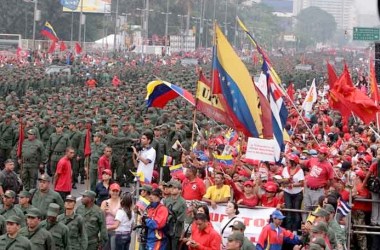
or from the back:
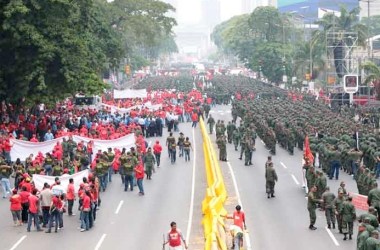
There are more “militia” than people. It is not that the people have become militia, it is that dressing them in fatigues and giving them guns, it is harder for them to escape to the Malls or parks of Caracas.
Not all of them had guns, I guess you did not get your unloaded gun if you were in bad shape:

or if you were too weak or to old to carry one all day around the heat of Caracas:

Some people say that the rally was made to scare the Venezuelan military. I am not sure they were scared by this not-ready-for-prime-time-force, I would hope that the real Venezuelan military is in better shape than this one. I would be afraid of leading these people with loaded weapons to go visit Parque del Este, even if only for an ice cream, let alone to fight someone who has fired a weapon once in his or her life.
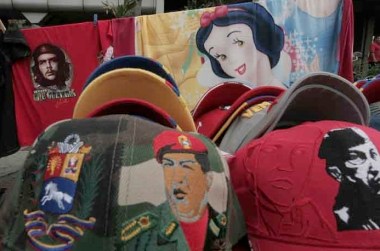
But in the end it is all a matter of images. To someone in Santa Cruz de Mora, these images may impress or intimidate, but only as long as they did not see that the militias are in the end protected by the images of Hugo, Che and, of course, Snow White:
Some numbers about Venezuela just don’t lie
April 12, 2010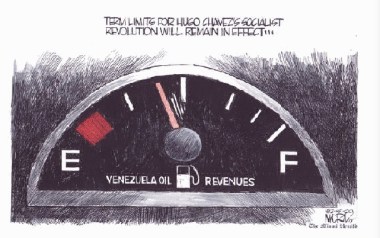
Numbers, numbers, numbers, they can be painful, but they tell the truth. Some interesting ones from around the country and the world.
1) Today Chinese company Synopec bought Conoco’s 9.03% stake in Syncrude for US$ 4.65 billion.
What does that have to do with Venezuela?
Easy. The Chavez Government nationalized Cerro Negro, a heavy oil crude project, in which Exxon Mobil owns 41.6% of the company. It also nationalized Petrozuata, a similar project in which ConocoPhillips had 50%. Both companies have gone to arbitration as Venezuela offered a tenth of what these companies want in compensation.
The World Bank arbitration Court always looks at comparable transactions in the world when awarding compensation. Thus, this becomes a good comparable, a very recent one at that. Moreover, ConocoPhillips sold a minority stake, while PDVSA took control of these projects, the price is different but we will ignore that in this discussion.
Syncrude produces 280,000 barrels a day according to their website, but they can take it to 500,000 barrels a day. But both Cerro Negro and Petrozuata can be expanded and that requires money in any case. So, I will consider all three projects to be static, valued at their current levels of production.
At the transaction price, the value of 100% of Syncrude is US$ 51.5 billion for a project that produces 280,000 barrels of oil a day, that says each 1,000 barrels is valued at 184 million dollars. That means that Cerro Negro with 120,000 barrels of production is valued at US$ 22 billion and Petrozuata at US$ 36 billion.
This also means that Exxon Mobil’s stake is worth around US$ 9.1 billion and CoconoPhillips’ stake is worth around US$ 18 billion. ExxonMobil is asking the arbitration Court for US$ 12 billion, I have not seen a number for what ConocoPhillips is demanding.
So, just there Venezuela has a debt of some US$ 27 billion. Not a pretty number. It will take four or five years, but the number is final, no appeal.
2) We continously hear about Carabobo and Junin, those wonderful projects that are the future of PDVSA. Except that they cost money and PDVSA has to come up with 60% of the money, to wit:
Carabobo 1 and 3 Total Cost 40 billion, Financing 2 billion, PDVSA’s share US$ 22 billion
Carabobo 2 Total cost 20 billion, PDVSA says it will go at it alone US$ 20 billion
Junin signed projects (3) in partnership with Russia, China and ENI. Total cost US$ 60 billion, PDVSA’s share US$ 36 billion. Assume Russia and China finance US$ 4 billion, PDVSA’s share US$ 32 billion.
Junin 10 field which PDVSA says it will do alone Total cost US$ 20 billion
PDVSA is responsible for US$ 3 billion in infrastructure, such as pipelines, power plants and the like.
That gives you like US$ 97 billion in five years if all of the promises of Hugo and Ramirez become reality, which, of course they will not. Half of that would be too much. I wonder if these companies or countries will sue Venezuela or ask for more if PDVSA can’t come up with the funds. BTW, the “oil opening” model of each project issuing its debt is looking better and better, except that PDVSA did not control them, the partner did. Hard to repeat now. Losing sovereignty one stupid mistake at a time.
We are talking 20 billion a year in debt, loans, whatever. Simply impossible. The stupidity of the last few years is coming back to haunt the Government. Add to this the other deficits and it gets very tough. And the arbitration in part 1) adds US$ 27 billion.
3) Venezuela’s reserves went under US$ 28 billion for the first time in one year.
Around US$ 12.7 billion is in gold.
Around US$ 10 billion is invested, mostly euros.
Around US$ 4 is not there, it is rights, or money available to be borrowed
Getting tight there, no wonder CADIVI is so stingy. Reserves (without Fonden) are down US$ 2 billion so far this year.
You do the math, unless oil prices go up. Oh baby!
4) Good one (For once!). It must have rained quite a bit in the Caroni river basin. Flow jumped from something like 775 m^3/sec. on Friday to 2,886 m^3/sec on Sunday. Rarely has flow jumped down below 1,000 m^3/sec after being so high this late in the spring.
And since we are on the topic of Guri, here is a truly historical char, since 1950 of the flow into the area

So, as I have said for a while it looks ok, like we are going to make it, 2011 may be trouble, but it does not look like we will get to the critical point this year.
Harder to write about Venezuela as its leader and the country become more bizarre by the day
April 11, 2010
If I had to characterize Chavez’ speech today, the only word that comes to mind is simply:
Deranged!
He told a story of April 11th. 2002 that even included his heroism that day! He talked as if in his brief departure those days, he was in control all the time, as far as choosing to go to the island of la Orchila because there would be communications and Jose Vicente Rangel would be in touch with him. He is now the hero of that evening, after the murderers of Puente El Llaguno who saved his butt, saying he decided to resign in order to save lives, as if the bodies were not already cold by the time he resigned that night.
And then he says the “people” want to be armed and that on the 13th. he will distribute rifles to the “people”. (Do I get one?) By now, he says that if the opposition threatens again, he will become even more radical. Read this as: if the opposition has any sort of victory in September I will become more radical, find parallel ways to deal with legislating and become even more non-democratic.
Which goes to the point of this post: It becomes harder and harder to write about all this. The country is being destroyed? We all know that. The Government has divided the country into two classes? We all know that. There is no justice? We all know that.
So, it becomes harder to write, to get enthusiastic about writing. Venezuela is simply facing economic collapse. Just this week, Veneconomy estimated that PDVSA needs $117 billion to develop the projects of the heavy oil crudes of the Orinoco. That is how nutty the whole PDVSA strategy is. But these guys gloat when they talk about it. Is it that they do not know how to add? Where do they expect that money to come from? Half those projects have to be canceled and the rest given to the partners, increasing their stakes. For free by the time it is done.
The same with the elections. The opposition so far has disappointed me, but even if it had not, what will happen if it succeeds in September? More repression? A parallel system in which the communes receive the money instead of the States? Looks bleak if it loses, bleak if it wins.
And then there is the ever deeper penetration of the country by the Cubans. Venezuela is supporting Cuba, but Cuba has invaded Venezuela silently. And I can’t help but fear that if the Cubans need it, they will get rid of Hugo and simply take over. And you know what they will have to do if they do this…
It has been a while since logic has served much in Venezuela. The swap rate soars, the Government does nothing, inflation pushes up. Tomatoes went up 120% in March, I guess I will eat a Capresa only with cheese which only went up 30% (Its controlled). Went to the supermarket today with a list of eight items, after visiting three of them, found half my items only. It wasn’t even pay day or weekend. Have had water rationing for two weeks now. Despite many personal measures to save electricity at home, my electric bill says I spent more than a year ago and got hit with a 75% penalty on my Bill. Should I just stop the measures and see what happens?
I feel like going and stealing you know whose bust in front of the Capitol building as a symbol of protest. I am sure I could get away with it easily, but I worry that I would get mugged getting there or back, so, I will leave it at that.
In some sense, it is easier these days to write about the Guri dam level, or deficits, than to write about an incomprehensible Government and its demential strategies. But, I end as I began, Chavez seems deranged, changing history, blaming all his failures on someone else, but not realizing he has no successes to boast about. It is all failures, except for the fact that he still there talking about a revolution that is not. A process which is a failure. A sovereignty that he is giving away long term with his actions. A country that he is destroying economically, socially and morally, one step at a time.
And he gloats and talks about it, as if he lived somewhere else in another dimension…
One day, Hugo Chavez will have to pay for the deaths on April 11th.
April 10, 2010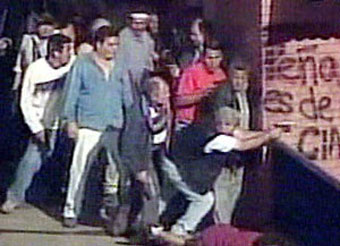
 (Puente El LLaguno from above (top) and from below (bottom) on April 11th. 2002)
I was going to write a post about April 11th. , but just read Caracas Chronicles, where Brian Nelson author of The Silence and the Scorpion tells his point of view and “aha” moments on his research about that terrible day.
Hopefully there will be justice and one day Hugo Chavez will have to pay for being responsible for so many deaths and injuries that day and for his total disregard for the human rights of Venezuelans, no matter what their political views may have been, then or now.
Two mysteries about foreign currency in Venezuela
April 8, 2010
Mystery Number One:
-Oil is up
-Cadivi gives less than it did last year
-Government seems to be intervening less in swap market
But international reserves fall US$ 7 billion in three months, US$ 5 billion transferred to Fonden, but US$ 2 billion is very real. International Reserves are at a 52 week low today.
Mystery Number Two:
-The Government said in January when the swap rate was near Bs. 6 per $ that it wanted to lower the swap rate to Bs. 4.3 per US$
-The Central Bank began selling US$ zero coupon bonds to “aid in lowering this swap rate. First sale was at a fixed price equivalent to Bs. 5.2 per dollar. Second to fifth sales at Bs. 4.8 per dollar. Sizes are small, few people get the bonds, swap prices soars hitting an all time high last week above Bs. 7 per US$.
-Today the Central Bank calls for an auction in which people can bid between 110 (Bs. 4.7) and 112 (Bs. 4.8)
What’s the idea? Essentially the Central Bank is giving away dollars, very cheap ones, for an unknown purpose, since these sales do not lower the swap rate.
Your guess is as good as mine…
What do investors think of Venezuelan dollar debt? How does it compare to other countries?
April 5, 2010
In the next to last post I showed some graphs from Morgan Stanley that seemed to unnerve some people, both pro and against Chavez. As I have tried to explain the job of these guys is to guide their customers in the minefield of Venezuela’s debt, thus their report is an economic opinion of what they are seeing, with no intrinsic political bias. At the end of the day these guys will do well if their recommendations work out.
It has been the standard view in Wall Street that “Venezuela (and PDVSA) have the ability to pay” its dollar denominated debt. However, it seems to me as if the devaluation in January made people realize that Venezuela’s GDP measured at Bs. 2.15 then, was not quite right, and thus the fact that Venezuela’s debt was “reasonable” compared to the country’s GDP is being brought into question now that the Government has decided there are two exchange rates, Bs. 2.6 for the Government and essentials and Bs. 4.3 for the rest. At Bs. 4.3 the Venezuelan economy is simply half of what people thought it was in December and given that the parallel swap rate is now at Bs. 7, then people worry that in US$, the Venezuelan economy is even smaller than they previously thought.
So, let us ask the question from a different angle. Ok, Wall Street is negative, but what are Venezuela’s and PDVSA’s bond prices telling us? What do investors think? A reader attempted to talk about that using sophisticated language in the comments in the next to last post, but I know that such technical language is above the knowledge of the average reader of this blog, so I will try to address it differently.
First of all, let me tell you that since late last year the world of bonds has changed quite a bit. Investors who could not find yields (returns) in safer investments drove prices up (yields down) of almost all bonds in Emerging Markets…
Except Venezuela.
Yeap, even the Ukraine that was yielding (returning) the same as Venezuela in November, rose so much that Venezuela is the lone high yield in the Emerging Market world.
In fact, lets take Argentina. A populist Government, a country that defaulted in 2000, the same country that for a while had to sell debt directly to Chavez every time it needed money. What is Argentina yielding now?
Well, the floating rate Boden maturing in 2012 yields 7.012% today and the fixed (7%) rate 2015 yielded today 10.8%
Summarizing
Argentina 2012 7.02%
Argentina 2015 10.8%
How does this compare to Venezuela?
It depends. If it is Venezuela issued under international law, it is very similar:
Venezuela 2013 11.19%
Venezuela 2014 11.95%
a bit more really, than Argentina, thus investors perceive higher risk.
But if you look at PDVSA the difference is much larger
PDVSA 2011 (zero coupon) 10.35%
PDVSA 2015 14.65%
Now, there is a huge difference (14.5% versus 10.8%!) suggesting investors are not very comfortable with PDVSA’s ability to pay compared to Argentina. I disagree with that perception, but that is besides the point. My opinion is just one opinion, the people who buy the bonds vote with their pockets.
But Argentina should not be like Venezuela, it has no oil, should be a worse risk. But it isn’t.
What about Colombia?
Well, there is no comparison:
Colombia 2012 1.58%
Colombia 2015 4.28%
This is a HUGE difference!
You get 10% more on PDVSA than on Colombia, a country that a few years ago, people were worried about its dollar commitments. But it’s “oil opening” has generated nice oil revenues (Helped in part but Venezuelan oil ex-pats, fired from PDVSA). And Colombia’s economy is booming, even if Hugo does not want to import anything from there.
But Colombia is the rule not the exception. Look at all these issues:
Ukraine 2012 6.3%
Bulgaria 2015 3.9%
South Africa 2012 2.33%
Panama 2012 2.07%
Peru 2012 1.33%
Brazil 2012 1.2%
Now, let me clarify that this is very sloppy. I should show you the coupons (amount to be paid yearly per face value) to make a proper comparison. But why bother? The differences are so large that it does not matter.
The truth is that PDVSA is yielding roughly ten times more (10x) than Brazil until 2015. Investors are saying they have no fear in buying Brazilian bonds at 1.2% until 2012, but they are worried (really worried!) with PDVSA bonds which yield 10.35% if you keep them for the next 16 months. Whatever their reasons, these investors are agreeing with Morgan Stanley, there may be a cash crunch in foreign currency and Chavez may decide to tell investors to bag it.
Will he do that?
I doubt it. There are too many measures he can take, from increasing the price of gasoline, to another devaluation to shrink demand. The problem is that these measures should be taken today, not next year or in 2012. Except we have elections…
But the point is that international investors are voting with their money against Venezuela. They are asking Venezuela to pay through the nose to have them use their money to buy Venezuela and/or PDVSA bonds.
But it should not be that way. Venezuela’s oil and current world’s oil prices should make Venezuelan debt very attractive to foreign investors. Venezuela has comfortable maturities (US$ 1.5 billion in 2010, US$ 4.5 billion in 2012, US$ 1.5 billion in 2013…), Venezuela has CITGO, the German refineries. But
But it also has Chavez-risk, non-transparent numbers and, much like Morgan Stanley, other people have made their calculations and the probability of a bad ending can not be dismissed. If oil prices stay here or drop, watch out! So, why bother.? I will take Ukraine’s 6.3% until 2012, that country may be a basket case, but at least they are trying to fix things and they are talking to the IMF. Thus the difference.
So, you may not like Morgan Stanley’s conclusions, but if you have some savings then put your money where your emotions or intuition is and buy PDVSA’s 2014’s and get a 15% yield to maturity.
Just pray that Morgan Stanley’s guys are wrong, otherwise you may not get paid for quite a while…
(Note and disclosure: This is what the markets are saying. I don’t fully agree with it and currently hold PDVSA 2014 bonds)
Another Guri update: Corpoelec presentation
April 4, 2010The last few days, the OPSIS website has not been updating the data, all we know is that there was a sharp drop in the inflow into the Guri dam, as on March 30th. inflow dropped to as low as 430 m^3/sec, the lowest level all year.
As usual, our friend Moses sends us some very interesting information in the form of a link to a Corpoelec presentation, which is now on the web right here.
The first conclusion from seeing this is that there is no doubt that Corpoelec is considering the operation of the Guri dam below the magic 240 meters above sea level, based on this graph: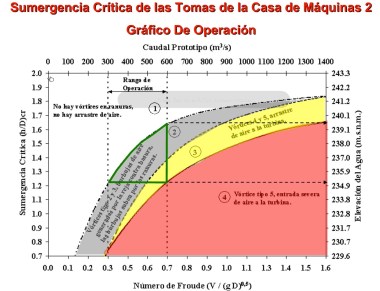
I do not understand the details of this plot, but there is clearly a “range of operations” which goes as low as 234.9 meters, well below the “critical” level of 240 meters above sea level. This region has a higher risk of vortex formation as the water level drops, but the graph suggests that there is some leeway in allowing it to drop below 240 meters, which would be good news as we will see below.
The next plot shows what Corpoelec estimates will happen in time, showing that it does not expect the 240 meter level to hit until May 23d. very similar to the model I presented and those in the comments using higher order fits:

Finally, there is this plot that estimates the current trajectory, comparing it to historical values.
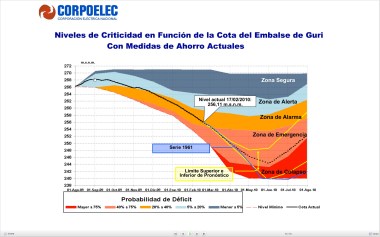
From all this data and if Guru can be operated down to 238 meters, it would only be June until we have a problem.
Thus, I continue to be optimistic that in 2010 Guri will not reach the critical level and has to be shut down. Of course, the problem is that first, we need rain, but more importantly, the starting level for 2011 will be low and we will need a lot of rain to start the dry season for next year at a high level.
Hugo plays at being rich, while beggars and strangers bearing gifts visit Venezuela
April 2, 2010
Today Chavez had a couple of visitors, one a beggar, Evo Morales from the Bolivian altiplano, the other one a stranger bearing expensive gifts, Vladimir Putin, from the cold steppes of Russia. Evo was probably taking advantage of Putin’s visit, wondering if in the multi-billion dollar discussions between Hugo and Vladimir, he could squeeze a few million out of his buddy. Vladimir, trying to seal deals and get commitments out of Hugo for weapons and useless trinkets, before Hugo’s money runs out.
Although the more cynical observers suggest that Vladimir came to seal deals precisely because the money is running out. They figure that Vladimir wants oil fields in exchange for trinkets like weapons and power plants, while the oil fields will become Russian property when and if the money runs out. At the same time Vladimir can play world politics, playing buddies with Hugo, making Obama and Hillary cringe.
So, while Chavez and the incompetents surrounding him can’t provide the most basic services to the population, the Russians claimed Venezuela would buy 50 war planes from them, while Hugo signed an agreement for cooperation on space exploration, a $20 billion investment in the Orinoco Oil belt and, of course, how could I have left it for last, Chavez’ dream of having nuclear energy now that he seems to have screwed up all of the country’s power system.
But unless oil prices shoot up to the stratosphere that Chavez wants to help explore, money seems to be getting very short around here, so when Chavez talks about a US$ 20 billion investment in the Junin field, he seems to forget that since by law (his new laws!) PDVSA has a minimum of 60% of all these projects, PDVSA has to come up somehow for its US$ 12 billion in this project and you have to add the Carabobo projects, all of the electric power plant investment needed now (smaller oil exports!). a possible setback in arbitration for expropriating oil and cement projects and, of course, funding all his entitlement projects. (Imagine Chavez telling Evo: Please don’t interrupt, we are talking billions here, so, yes you can have your $125 million, but please shut up Evo)
Because besides the “needs” above, there are signs that money, particularly dollars are not as easily found around the Venezuelan Government as it used to be. The first sign was the January devaluation, while expected, that Chavez would allow a 100% devaluation for most important items took many (all?) by surprise. Other signs have followed: The slide in the swap rate, the 15% decrease in international reserves, the slower outflows from CADIVI despite the higher exchange rate and even Chavez’ lower number of trips abroad.
And I have to wonder if Chavez was shown the somewhat gloomy projections by Morgan Stanley (Thanks to the reader who got me a copy!) in their latest report on Venezuela (Maybe Evo came because he saw them). These are the darkest predictions I have seen so far for the balance of foreign currency in Venezuela in the upcoming years:


The graphs are the result of modeling the country’s dollar balance using the trends in import growth, capital flight, oil output decline, rising local oil consumption using the future oil prices as predicted by the oil futures market. Then, there are two scenarios: In the “severe” scenario” (Top graph), the projection is made using the trends of the last three years, In the benign scenario (Bottom graph), they use the trends of the last twelve years.
In each scenario there are two projections, which reflect simply whether the Carabobo projecst will or not contribute to the dollar balance before 2015. (Note that the first step after the two fields were assigned was not complied with, contracts were supposed to have been signed last week, they weren’t. Apparently the Government is not complying with any of the changes it offered to make in the contracts before the auction took place)
As you can see the dollar balance deteriorates fast in both scenarios, reaching -US$ 180 million by 2015 in the “severe” scenario and -US$ 100 billion in 2013 in the “benign” one. In fact, there is little difference in the overall trend in either case, what changes is how fast they develop. In the severe case, there is a net deficit of US$ 5-10 billion by the end of this year, while in the benign case it only happens in 2011. Thus, the problem is the prediction, the time scale is irrelevant given the numbers. The point is that in both, Venezuela would have to find some US$ 60 billion in financing sometime between 2011 and 2013. At Bs. 4.3 per dollar this implies increasing the country’s debt to an amount roughly like the GDP of Venezuela, a Greece-like number that seems far-fetched to fulfill.
Thus, Chavez should land soon on his true reality that he can’t even meet his local expenses, let alone fancy-schmanzy space and nuclear power projects which would cost billions under his command.
But Vladimir, Evo and yes, Fidel and Ramiro, will take whatever they can get until someone tells Hugo that he is in deep…trouble.


 The Devil's Excrement