Archive for March, 2013

The Post Chávez Era Begins

March 7, 2013

CabelloyMaduro

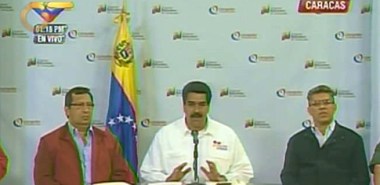
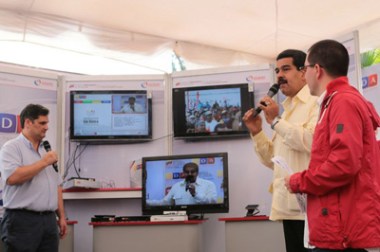
An thus the post-Chávez era begins. It is ironic than the man on your left, is a middle (upper?) class caraqueño, who joined the Liga Socialista and from there jumped to union leader of Caracas’s subway. On the right, is a lower middle class military technocrat, who was with Chavez in his conspiracies, but only ranked a minor technocratic job when Chavez´first term began. Maduro was ideologically trained, Diosdado was his own man. In time, both rose fast in the Chavista meritocracy, Diosdado became Minister and then VP, later Governor, Maduro went from President of the Assembly, to Foreign Minister and from that position, given his loyalty and less independent thinking, he ended up on top, Chavez’ designated heir apparent.

It could have been Rafael Ramirez ( also middle class), Vielma Mora, Arias Cardenas, but somehow, this middle class failed student topped all of them by being loyal and ideologically correct, even if he never wore a military uniform.

Others were simply left behind, like Chávez compadre Raul Baduel. He saved Chavez’ butt in 2002, but later he was too outspoken, removed as Minister of Defense and later jailed on corruption charges for his anti-referendum stance in 2007.

Which leaves us with Maduro.

And it is clear that over the last few months, Diosdado has been loyal. He has never said he should be acting President, even if the Constitution says he should. After fourteen years of not visiting Cuba, he went there three or four times in the last three months. And he has been quiet in the last few days. In fact, he was the one to announce that Maduro’s swearing in ceremony will be tomorrow at the Military Academy in an apparent sign of unity.

Maduro on the other hand, had said little since announcing Chávez’ death, up to today, when he announced that Chávez body will be held for seven days so everyone could see it and pay its respects. He went even further announcing that Chavez’ body would be embalmed and held at the Revolutionary Museum, ironically the site of Chávez biggest defeat in February 1992,

It is all part of the campaign. Maduro even suggested ” I am Chávez”, a clear sign of the level of insecurity of the inheritors of the revolution.

Unfortunately, Maduro does not have Chavez’ presence, while he faces tough decisions going forward in particular on the economy. He probably knows he does not have the good will, but think he can inherit it. Unfortunately, other Chavistas think they have more going for them than Maduro and that bodes badly for the stability of the country long term.

But for now, the show must go on (Chávez dixit) and Maduro will be Chavismo’s leader for a while. Unfortunately for Nicolas, the effort to win the election in October, together with the distortions in the economy, make the medium term economic future very difficult. Maduro likely understands this, He will likely be confrontational politically, but likely more pragmatic on the economy. It is no coincidence the US is sending former Representative William Delahunt who under the “Group of Boston” monicker, led meetings in Cape Cod between US and Venezuelan lawmakers when Maduro was President of the Assembly.

Unfortunately,  what Maduro needs is even more profound in terms of the economy and we don’t think Maduro will take that step of trying to minimize controls and adjust the economy all at once. Which will likely come back to bite him in time.

At that time, it is unclear who may conspire or come out on top, but any scenario is just as likely as possible. I do not dare predict.

Indeed, the post Chavez era has begun.
Venezuelans Pay Tribute To Hugo Chávez

March 6, 2013
Entierro
.

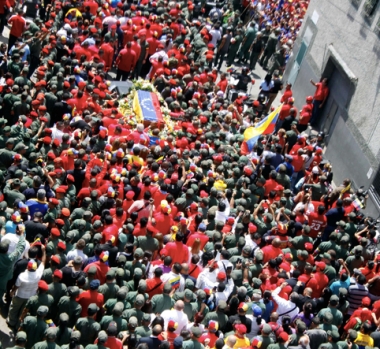
Chavez’ supporters turned out en masse today in their outpouring of love and sympathy for their dead leader, as his coffin was carried from the Military Hospital to the Miltary Academy in Caracas. Most of the main leaders of Chavismo were there, even if the cameras seemed to be avoiding Diosdado Cabello. Foreign leaders have begun arriving, as the funeral will be carried out on Friday.Chavez reportedly will be buried in Barinas, following his family´s wishes.

After yesterday’s “tough” and “confrontational” speech by then Vice-President Nicolas Maduro, there was a much more conciliatory one last night, in which Maduro thanked the opposition for the message read by Miranda Governor and likely candidate for the opposition Henrique Capriles. Unfortunately, Maduro’s interview was in the wee hours of the morning and not as widely shown as the more disturbing one before Chavez’ death was announced.

Caracas and the country were peaceful and tranquil, with few reports of violence, as expected. The whole country was absorbing the news as the opposition was respectful of the sad moment for Chávez’ supporters and admirers. Even those that opposed Chávez were cognizant of the fact that the moment was historical and that things going forward could be complex for the country. It was more a moment for reflection than for expression. There were some celebrations reported abroad, but they seemed to be more in tune with the naive belief that there will be some abrupt change in Venezuela now.

While there was no formal announcement or swearing in ceremony, Maduro signed the decree declaring seven days of mourning as acting President, confirming Foreign Minister’s Jaua statement that he would fill in for Chávez while a new election is held. This clearly sidesteps the Constitution, but it does not appear as Cabello will make an issue of it and the opposition should also ignore the point, even if it is in clear violation of the Venezuelan Constitution. After all, it appears as if this is what Chavismo was trying to avoid, that Maduro’s interim Presidency could be questioned. Only a single voice from Chavismo, that of former President of the National Assembly Soto Rojas, ever the rebel, has been heard suggesting Cabello should take office. Chávez would have been proud of him.

The opposition will likely be more interested in when the new Presidential election will be held. The Constitution specifies that the election should take place within thirty days of Chavez’ absolute absence, which is quite problematic given that the last week of those thirty days falls within Easter week which is a long holiday in Venezuela. This suggests that April 7th. or 14th. are more likely dates, which should be fine with the opposition, as long as it is technically feasible. There are no signs up to now that Chavismo wants to extend this date further into the future. Any delay would favor what little chance the opposition has, but I don’t believe the opposition should be complacent about holding the election too far into the future. A little leeway should be accepted, but the law and the Constitution should be followed

The discordant note was provided today, once again, by the Minister of Defense, who openly invited all Venezuelans to vote for Maduro in order to “give a blow to those fascists where it hurts”. Absolutely unnecessary, although the burial itself was clearly being staged as part of the campaign.

Going forward, as I said before, I do not believe that Capriles has much of a chance against Maduro in the face of the sympathy and the grief about Chavez’ death. Maduro is likely to be as radical as Chávez politically, but much more pragmatic on the economy. He should realize that he does not have nor will he ever have, Chávez goodwill. His survival depends on his management of the economy. And his enemies are more likely to be within PSUV, than in the opposition, as the weight of allowing for indefinite reelection of the President and internal differences, will likely create huge strains within PSUV and Chavismo in the future.

Meanwhile, the international Chávez propaganda machine is working full time on creating the Chávez hyper-legend. I participated in a TV show today where false statistics and facts about Venezuelan history were thrown around shamelessly. Chávez may have been good about selling symbols and ideas, but he was terrible about implementing any of them. I wonder what this foreign academics would think or do, if they had to survive on a Venezuelan Professor’s salary, decimated during the last fourteen years. Would their revolutionary ideals survive on less than US$ 300 a month (parallel rate)?
.

I very much doubt it!

Announcements On The First Day Will Define A Lot For Venezuela After Chavez

March 5, 2013

military

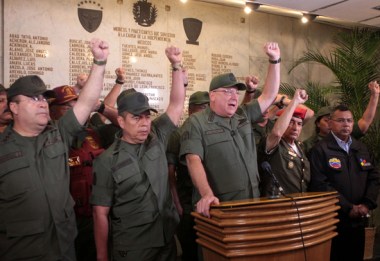
It is my interpretation that the first Maduro speech was the result of not having reached a decision as to how to proceed forward once Chavez’ death ocurred. You don’t have a gathering of the Cabinet, twenty Governors, the military high command and the high ranking members of Chavez’ PSUV party, to discuss spelling some US Air Force attache to Venezuela or talk about discipline in this tough moment. We may never know the truth, but I suspect that the meeting at 11 AM was to discuss how to proceed and there was not a unanimous agreement.

While one can be concerned about Diosdado Cabello’s absence, it is also true that his mother died on Sunday and was buried yesterday. However, under the Constitution it should be him that assumes the Presidency until the election is held within the next thirty days, which I think will likely be stretched until April 7th. or 14th.  because clearly, there could be logistic problems and within thirty days involves holding elections on Easter Sunday, when most of Venezuela is likely returning from vacation.

But the two key decisions are precisely that, that Diosdado Cabello assumes the Presidency until the elections and the announcement that, at least, there will be quick elections. In this manner the Constitutional order will be preserved, which still matters.

Any other path, will signify a bad start for the post-Chavez era, which will likely irreversibly mark the future of Venezuela.

While it was offensive for the military high command to use the word comrade and socialism and political slogans, I found two positives in their words: First, they said the Constitution will be enforced by them and then they sent a message of support for Nicolas Maduro and Diosdado Cabello. Given Maduro’s leading role in all this, the second part had to contain a message to all. I do hope that I am not reading too much into this, but  that is my interpretation.

Because in the end, I think all of the secrecy and moves of the last two months have been motivated by the desire to have Chavez be sworn in so that Maduro could be President and candidate at the same time. Things did not work out Maduro’s way, let us then hope the Constitution is followed and the post-Chavez era begins on the right foot for Venezuela.

Venezuelan President Hugo Chávez Is Dead

March 5, 2013

ostovar20121209064900023

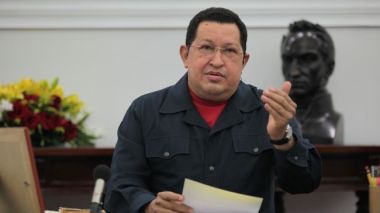
It has just been announced that Venezuelan President Hugo Chávez, seen above in his last public speech, has died today at 4:25 PM from complications arising from his surgery in Cuba on Dec. 12th. The announcement was made by Vice-President Nicolas Maduro on nationwide TV.

Maduro2

Maduro Announces Chavez’ Cancer Was Likely Induced

March 5, 2013

maudro

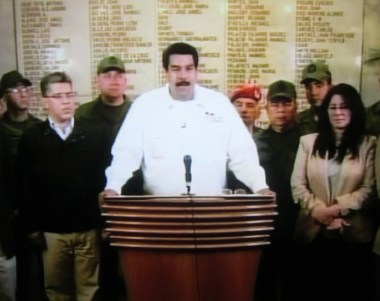
Vice-President-in-impostor Nicolas Maduro has just announced that Chavez’ cancer was likely induced by the enemies of Venezuela in rambling speech.

US attache kicked out for conspiring.

Bad attempt to imitate Chavez.

Calls Chavez the new Libertador

Rambles on ethics, Fatherland, oligarchy, the people…

Repeats that Chavez is receiving “complementary chemio treatment”

Did Maduro announce repression is coming when he said “Nobody has immunity?

Chavez’ Digital TV: Much Ado About Nothing?

March 4, 2013

feb 21 TV-digital-en-Vzla

Recently, there was a lot of noise made about the new Venezuelan (Chavista?) digital TV standard, presented by President-in-impostor Maduro, together with Chávez’ son in law and Minister of Technology and Science Jorge Arreaza, who has lately been capturing a lot of the headlines, as spokesman for the soon to be Chávez Royal family.

According to Arreaza, the digital TV project is Chávez pet project, and it does not surprise me: The project does nothing to develop our own technology, it overpays for technology so that it can be purchased from his buddies and it has a fascist streak inside it.

Sounds like Hugo all right.

The focus so far on the digital TV  project has been either on the fact that Globovision was excluded, as covered by CC, or Daniel´s recent post on the related SIBCI system created by the Chavernment. But while in Caracas a couple of weeks ago (side note: I was actually on my way to meet the great Juan Nagel, of CC fame), I was listening to the radio and this guy (I don’t know who it was) was blasting the whole project from the technological to the corruption angle. You see, censorship under Chavismo has some very peculiar features: You can say what you want, as long as you don’t become a target. If you become a target, watch out! Anything can happen, from concession suspension, to jail, to having your boss be pressured to remove you.

But if you are an analyst at 8 PM on an elitist radio station, you are as much of a target as, say, an English language blogger. Bloggers seem to annoy or irk the friends of the Chavernment, not the Chavernment itself.

In any case, after listening to the story on the radio, I decided to look into it. And the whole thing is as bizarre as most of the last fourteen years. And by the way, I still find it very hard to understand how people who claim to be so nationalistic and to defend sovereignty, can not only ignore our own technical capabilities, but sell their ideals in exchange for money or simple admiration (or infatuation) for others.

The story actually starts when Venezuela decided to develop digital television before any other Latin American country had announced to do so. The origin is obscure, but it seems to originate in Socorro Hernandez, then President of CANTV, today a CNE Director, who chose a Chinese standard DTMB (and technology) for the project. Rumor has it that actually the Chinese chose her, as the Chinese standard, barely existed there at the time and even today, only exists there. And you have to give credit to none other than Jesse Chacón, credit where it is due, that realizing Socorro’s folly, stopped it and went for the Japanese/Brazilian standard.

The Japanese jumped at the chance, even suggesting they could finance a pilot project of turning VTV’s (the Government’s TV station) signal into digital. But after a couple of hundred million dollars (Chavistas know how to add and use foreign currency!) not much happened, the Japanese and Brazilians gave up in disgust and that is when the sneaky Argentineans stepped into the project.

And we are not talking about just any Argentinean, we are talking about the De Vido brothers, in charge of Planning and Science. Julio, the one in Planning is the big shot, he is none other than the one that was in the famous flight where Antonini got caught with the US$ 800,000 briefcase, known as Maletagate.

Meanwhile at Cendit,the National Center for Research and Development in Telecommunications, whose logo is “Building Sovereignty in Telecommunications”, some well meaning guys actually developed all of the technology for building the decoders in Venezuela. Despite this, the “labia” of the Argentineans had more power and Venezuela contracted for thirteen transmission systems and 300,000 decoders with them, reportedly the decoders were overpriced by a factor of three. (Which could be justified to have them developed in Venezuela, but not in Argentina)

But you see, the big selling point of the Argentineans was the fascist angle. In contrast with digital TV projects elsewhere, where access to the spectrum and the signals is just a standard provided by the State, in Argentina the idea is for the Government to offer “free” digital TV controlled by the State to compete with subscription based satellite and cable systems, which dominate in that country.

The problem is that in Venezuela, the digital TV signal will not eliminate the analog one until seven years from now. By then, the face of television, whether by Internet, or cable, satellite or whatever, will have changed forever, making the whole project and the noise, much ado about nothing. Except that the Japanese, the Brazilians, the Argentineans and the Chinese have sold us new trinkets on our way to digital “sovereignty”.

Not much has changed since Columbus. We are still dazzled shiny trinkets

Which would be funny, if the intent was not so fascist in the end.