Hyperinflated Arepa Index (HAI) XI: With Elections Comes Sharp Rise

December 15, 2015

arepa

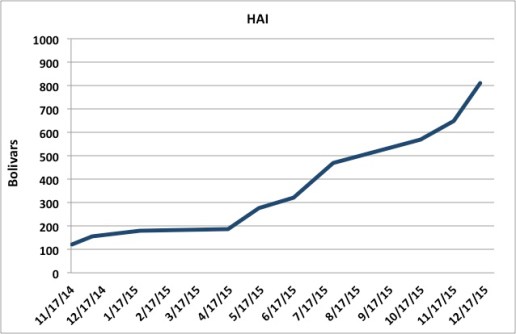
On the last day of my very intense visit to Caracas during the Parliamentary election, I had a chance to go sample another one of the very fine arepas de queso de mano that I enjoy so much. And there was a big jump of 24.6% in the three weeks since my last sample, one of the biggest changes I saw all year with the arepa which a year earlier was Bs. 156, reaching the incredible price of Bs. 810 each. This represents a one year increase of 419%.

I had sort of expected a big rise, as i know the exchange control office had visited merchants ahead of the election. While forcing merchants to bring prices back, the agents also suggested that they could increase prices after the elections.

Shelves are now emptier than they were before Dec. 6th. As someone told me today on the phone: “No, don’t worry, there are fewer lines, there is very little to buy…”


Some Lessons From The Recent Parliamentary Elections In Venezuela

December 12, 2015

2015

There are many fascinating elements that can be derived from last Sunday’s Parliamentary elections. And there are lessons for both sides, which should be absorbed and digested accordingly. Since many of them are unrelated, I will make a list of some interesting ones:

-The magnitude of fraud that can be accomplished via the voting machines is by now limited

In 2004, the Government manipulated the vote in various ways. The two most important factors were the votes “added” in the absence of opposition voters and the use of multiple ID’s to vote. My estimate based on the many technical papers that were published is that that fraud could not amount to more than 5%, which implied that the opposition lost the recall vote at the time, albeit by a much smaller margin.

In time, the opposition has learned to plug up many of these holes.There have been two strategies: One, to have witnesses at as many polling stations as possible. In the recent election, the opposition obtain credentials for witnesses which exceeded those of Chavismo by 2,000 people. Moreover, there were numerous reports that Chavista witnesses did not show up and were replaced by opposition volunteers.

Secondly and more importantly, special attention was paid to the audit process in polling stations where the opposition has little presence and where important candidacies would be decided. Around 100,000 volunteers showed up at closing time, not only to be present for the audit, but also to demand its closure if there were no voters in line. One of the engineers involved in this project estimates that 46 of the 51 Deputies they targeted for election were successful in part due to this effort.

Both of these efforts increased the percentage of paper “Actas” or tallies the opposition had, which allowed it to win the 112th. Deputy by having copies of all tallies in Circuit 3 of Aragua which was won by a scant 83 votes. Chavismo “claimed” up to the last minute there were additional actas, which simply did not exist.

-The vote is indeed secret

While there was a time that Government workers feared that the CNE could tell how you voted, with more and more elections people have learned that they can vote for the opposition and nothing happens to them. Chavismo helped made this clear when bosses in various Government offices began asking their workers to bring a photograph of their ballot, which confirmed their suspicion they could not tell how you voted. Numerous people in offices, using social media and the like made offers to “photoshop” voting ballots to give the boss the correct picture. Additionally, the opposition made a campaign to emphasize that taking pictures of your ballot is illegal. The threats by Government officials were thus significantly reduced and the fact that there is no persecution now, is proving to people that they simply can’t know

-Chavismo is still a force, but lost a lot of ground

Many people have been shocked by the fact that despite inflation, lines, corruption and scarcity, slightly more than 40% of the Venezuelan voters cast it in favor of Chavismo. This is indeed a large number, but it is magnified by abstention. There were essentially two numbers that pollsters had a difficult time being precise about: How many people would abstain and how many of the pro-Chavez voters would cast their vote for mostly unknown opposition candidates. The two questions are inter-twinned, logic says in a highly Chavista state, smaller abstention means that more Chavistas will cast their vote. It also says that in a highly opposition state, the smaller the abstention, the more the votes for the opposition.

However, in reality what happened was that the opposition did well in Chavista states because people wanted to express their disenchantment with Chavismo and in many pro-opposition states, abstention was high, suggesting that Chavistas simply decided not to go out and vote for the opposition.

It is not easy to generalize, but let’s look first at the overall numbers. Pollsters were expecting abstention to be much like that of the 2010 Parliamentary election, which was 33.6%, but it turned out to be much lower coming in at 25.8%. Thus, 74.2% of the voters cast their vote nationwide.

But let’s take Miranda Circuit 2, where I vote, a strongly opposition area. Only 66.4% of the voters cast their vote there and Freddy Guevara won handily, despite the low turnout. But, in general, in Chavista states where the opposition did well, abstention was on average lower than 25% (except in Bolivar), while in most Chavista States where it did not do well abstention was higher than 30% (Except Portuguesa and Yaracuy). Thus, the opposition tended to do better than expected in Chavista states with large urban populations (Bolivar, Anzoategui, Vargas and less well in the very rural states (see previous post)

And to me it suggests that those that abstained tended to be more pro-Chavez voters, who disapprove of Maduro but could not set their hearts in voting for an opposition candidate. Thus, in the end, Chavismo got 40-plus percent of the vote, but of those that did not vote, a larger fraction were in the camp that is pro-Chavez, but disapproves of the job Maduro is doing.

-Violence was, once again, not a factor.

Every election since I was young (Yes, that long!) I have heard the fears of widespread violence breaking out. It has never materialized. People waited peacefully for the results. People received the results peacefully. Yes, there were some attempts at violence as the polls closed, but they were quickly dissipated.

-A recall vote would not be a slam dunk

Many people think a recall referendum should be a priority for the incoming National Assembly. Such a referendum is possible starting either immediately or in April 2016, depending on the TSJ. Up to April 2017 a recall vote would be followed by a Presidential election. After that the Vice-President would take over for the President and complete his or her term.

There are two conditions for a recall to be successful: One, that you get 50% of the vote. Two, that you get more than 50% than the person obtained when he was first elected. Well, we got 7.726 million votes on Dec. 6th., but Maduro got 7.587 million votes in 2013. This means only 139 thousand votes, a bit too close for (my) comfort.

There may be other routes that achieve the same purpose.

-So far, the military has been institutional

Yes, I qualified it with a so far, because I just don’t know how close (or how far) we were from an attempt not to recognize the results. The same way that I don’t know whether something is or not cooking at this time. But in most polling stations where the military vote, the opposition turned out to be victorious. Por ahora (For now), the military has decided to be institutional.

That is definitely good news!

I will close here, probably too long to keep your interest. I will post in the next few days about what I expect, hope and can predict about the next couple of months in Venezuela.

Opposition Victory In Venezuela Was More Solid Than Sweeping

December 8, 2015

tablaTable with popular vote organized on the left alphabetically and on the right by percentage of the popular vote obtained by the opposition. I have placed a box over traditionally more pro-Chávez states where the opposition got more than the median of votes than in the Nation. (Based on last night’s percentages by CNE)

While it is easy to attempt to use the term sweeping in describing Sunday’s victory by the opposition last Sunday, a closer look at the data suggests that it was more of a solid than a sweeping victory. Solid, because what the opposition did was increase sharply its total number of votes  in the more rural States where it customarily lost badly to Chavismo, while solidifying its victory in its more traditional urban areas. Thus, it was more broad based victory in terms of total votes and a solid ground to be future strength upon.

This is not the narrative that most pollsters and politicians were telling us. We were told that it was the hyper rejection of the Government that would lead to a sweep in traditional opposition areas, which would lead to the opposition dragging rural States along and, if the victory was large enough, the possibility of a qualified majority in the National Assembly was within reach.

Instead, the opposition sharply increased its vote in Chavista States, which helped it obtain fairly uniform favorable results that gave it the 66% majority without reaching 60% of the vote.

As an example, the opposition swept all districts in 8 of the States of the country: Amazonas, Anzoategui, Aragua, Barinas, Bolivar, Merida, Nueva Esparta and Vargas. This is a remarkable result, as only one, Mérida, can be considered to be a “traditional” opposition enclave.

In fact, the pattern repeats if one looks at the top ten states in which the opposition increased its votes  the most by percentage, a rank that goes roughly like (I have ignored decimals in the ranking): Guarico, Trujillo, Vargas, Aragua, Nueva Esparta, Capital District, Bolivar, Cojedes, Falcon and Zulia. All of these States increased from +10% to +8% on Sunday in terms of total votes for the opposition with respect to the 2013 Presidential election. But the top nine are all traditional Chavista strongholds and is only when we get to Zulia we get to a State considered to be more pro-opposition in the past.

Yes, the opposition swept Tachira, but only increased its vote by 3%. Meanwhile, string opposition States like Carabobo, only went up by 4%, with Miranda and Lara, gaining 7%, solid, but not the sharp increase of Chavista strongholds.

Thus, it was a solid victory by the opposition, which only lost ground by votes in sparsely populated Delta Amacuro, which gives it the chance to sow a future if it steers well its control of the National Assembly.

It is probably premature to interpret what this all means, but I would be inclined to say that this shows that the vote was more a rejection of Chavismo and Maduro’s Governmen than one of approval for the opposition.

This also seems to imply (to me) that the Assembly should concentrate in rebuilding institutionality and not in trying to replace the current Government. The winners may not be as popular as they think they are.


Long And Winding Road For Change In Venezuela After Sweeping Opposition Victory

December 7, 2015

road

I have been waiting for the CNE to give a new bulletin of yesterday’s results, but so far no luck in obtaining a complete set of numbers for what happened last night. Remarkably, the number of Deputies for the opposition keeps increasing, with the latest estimate between 117 and 118 Deputies. The opposition did publish earlier a list of the 112 Deputies that will surely be announced as winners up to now.

This is truly in the upper range of any expectations, as voters clearly expressed their disenchantment with the Bolivarian revolution  and the current state of the Venezuelan economy. Maduro was not that gracious or wise in accepting the defeat, devoting most of his time to blaming the “economic war” for the defeat and not the economic stupidity of his Government’s policies. Never had the phrase “It’s the Economy Stupid” resonate more than today in Venezuela.

And while the opposition has to rejoice in its victory, it will be a long and winding road to obtain the change the people want, particularly on economic matters. It will also be a conflictive route to change, as Chavismo will certainly resist the possible dismounting of the Bolivaraian State.

And the opposition has to understand its victory for what it is. People turned against the Government, but the sweeping victory is a strong rejection of Chavismo, more than a strong support for the opposition. And the strong mandate calls for action, but it is precisely on Economic matters that it is more difficult for the Venezuelan National Assembly to have an impact.

But at the same time, the 2/3 majority gives the opposition many powerful tools to at least negotiate with Chavismo, including removing and naming members of the Electoral Board, Supreme Courts and all other major public powers, approval of Constitutional reforms, issue organic laws, name Permanent commissions of the National Assembly and approve and propose referenda, including revoking the Presidency after its third year of mandate.

But all and any of the above implies conflict, decisions and optimizing time and resources in order not to waste time in pyrrhic fights with little immediate positive consequences.

How the weakened Maduro Government reacts will be key in the process. So far, Maduro seems to have been too defensive in the reaction to the loss. His mandate has been severely weakened in the eyes of his own supporters, party and national opinion and there is little he can do for maintaining the status quo. But at the same time, he will have a hard time implementing an economic change that he has clearly not agreed with in the past. Internal fighting and bickering within Chavismo must be intense and it is clear that Maduro will have to assume all of the blame for the blow received by Chavismo on Dec. 6th.

Venezuela and PDVSA bonds jumped on the news, but they simply recovered back to the prices of a week ago, a clear signal by the market that it is concerned about the future. However, the mandate received by the opposition should in general be more supportive for prices, even in the face of US$ 38 oil today.

It will also be important for the opposition to maintain its cohesiveness. Difficult decisions are coming such as who should be named President of the National assembly come Jan. 5th. when the Assembly is sworn in and the priority in the legislative actions that the opposition will undertake with its super majority.

A difficult and somewhat daunting task ahead, but a much brighter prospect for a country ruled autocratically and by whim for too many years.


First Report By Venezuelan Electoral Board Gives Opposition 99 Deputies

December 6, 2015

10:00 AM At this time, the opposition could be getting as many as 117 or 118 Deputies when all votes are counted.

The Venezuelan Electoral Board just announced the first official results announcing the Opposition obtained With 96.03% of the vote 99 (72 lists plus 27 on their own behalf) Deputies and Chavismo’s PSUV obtained only 46 (22 list plus 24 on their own behalf) Deputies. This means close to a super majority, a scenario that I considered highly unlikely even today. 17 Deputies by name can not be defined, the three indigeneous people and one by list. 74% of the people voted.

More as they are announced

Good night everyone! Happy day at last!


All We Need Now Is For The Government To Accept Opposition Won In Venezuela

December 6, 2015

11:29 PM Rumor is that the CNE will announce smaller number of Deputies for the opposition (108?) to mitigate impact of results. They will say other races are too close too call, even if they know they rea not.

10:42 PM: 112 and still fighting for more…

10:36 PM Right now, 112 is a certainty.

10:30 PM At this time, people are suggesting the opposition has obtained 2/3 of the Deputies. I am told this is possible but can not be called at this time.

9:46 Some races in Carabobo, Lara and Monagas too close to call at this time.

9:27 PM At this point, the Devil says opposition will get minimum of 93 Deputies with a possibility of more.


And The Long Electoral Night Begins In Venezuela

December 6, 2015

8:55 PM Estimates are up to 93 Deputies for the opposition at this time

9:10 PM I hear from great source 90 Deputies for sure, more possible.

9:04 PM over 90% of the votes tallied and trasmitted, MUD has the tallies for all these machines, don’t buy rumors at this time.

8:27 PM Don’t listen to rumors, at this time 71% of the votes have been tallied and transmitted.

8:19 PM Don’t believe all the rumors, at this time 53% of all machines have transmitted their tally, which implies a much larger number has closed at this time

7:30 PM People complaining about not all centers being closed, but the reality is there is nobody showing up to vote at this time anyway.

Associated Press reports Maduro said at 4:50 PM his party can’t win all elections.

6:45 PM Soon after the picture below, motorcycle gangs showed up asking for the voting center to be reopened. The National Guard showed up to stop them.

6:15 PM: This is the Liceo Andres Bello at this time, shown in previous post as the one with longest lines in Western Caracas.

Andresbello

6 PM : The National Electoral Board has ordered all polls to be opened until 7 PM. This is a violation of the law, which states that if nobody is in line it should be closed.

Mid to upper nineties in Deputies seems to be the whisper number at this time


Voting Much Stronger In The East Of Caracas Than In The West

December 6, 2015

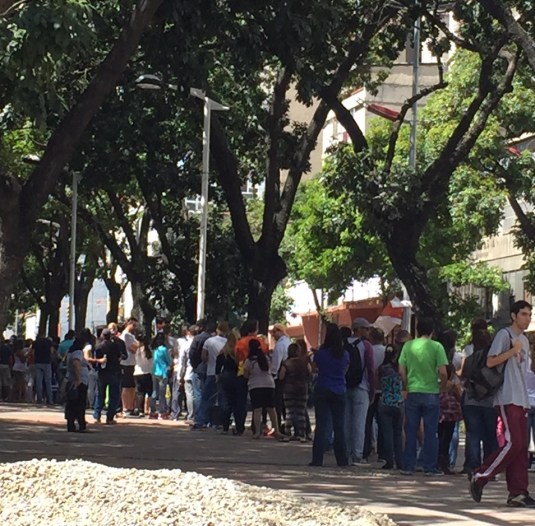
I went to do my usual spin around Caracas to see how things were going along. I went from one and to another hitting too deep into Catia (More on that later!) as well as Petare. My overall general conclusion is that the lines were shorter and lighter in the West areas (Catia, La Pastora, Quinta Crespo), than in the East from Chacao to Petare, where I saw bigger lines.

In the west the presence of Chavismo was felt more, including the omnipresent image of Chávez everywhere, as well as kiosks too close to polling stations. Here is how present Chávez was:

chavez

How prescient of him to know exactly what the ballot would look like in 2016…

In the West, polling centers were less detectable than in the East of Caracas, streets were seldom blocked, which seems to be the rule in the East of the city and lines in the west of Caracas were fairly short, if present. This would suggest to me at first sight to imply that desilusioned Chavistas are not going out to vote. They may not want to vote for the Government, but are not willing (or capable) of casting their ballot for the opposition.

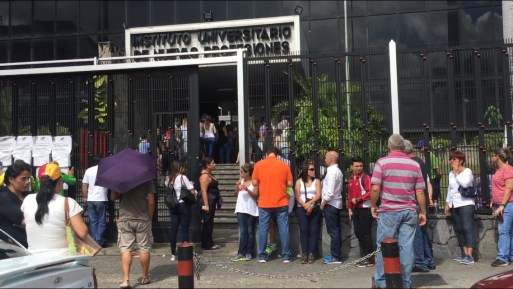
In Catia, a Chavista stronghold, the Davil saw very few lines. In fact, it was only when I got closer to downtown (further East), like in this picture in Lice Andres Bello, when lines appeared:

IMG_8238.JPG

That was the biggest line I saw in the West by far. The second one was this one, near the Panteon Nacional:

IMG_8230

We really saw no more than those two lines in a fairly wide and long spin around the West.

In the East, lines were common, as were traffic jams caused by stupid closings of streets, sometimes in very inefficient ways.

This was in Avenida Romulo Gallegos, it was a long line, but hard to get a good capture of the whole thing:

IMG_8245

This was quite typical of the visible and less visible centers in the East of Caracas.

The day was not without incident. I went a bit too deep into Catia for my comfort and at some point decided to make a U-turn and turn back. Unfortunately, there were some cops right at the end of the U-turn, which proceeded to stop me. They made me get out of the car, open the trunk, show all the papers etc. They then proceeded to bounce me from cop to cop telling me what I did was illegal, bla, bla, bla. All the time I kept saying, yes I know it was illegal, sorry, I was lost and did not feel safe. They talked about tickets, amounts, I could not drive etc, etc., while I said I knew. After three cops, they brought the lady cop who informed me that the penalty was all of Bs. 1,500, three months of suspended driving etc. I said, what can I say, I wanted to be safe.

It seemed that they were expecting me to offer a “solution” to the problem. Since I did not, she gave all the papers back to the first guy (the nicest one too) who told me since I had accepted my responsibility from the go he was going to let me go without writing up a fine.

Perhaps the salient feature of the whole thing is how they attempted to use a lot of big words when talking to me, but always relaxing back to slang in the end. While they had me there another car was stopped, but they withdrew guns, but I was getting into the car by then and set into the sun, like good devils do.


Venezuelan 2016 Parliamentary Elections Are Here!

December 6, 2015

I will be updating during the day! Read from bottom to top!

8:10 AM It is 8:10 AM and the CNE is reporting something like 90.3% of all polling tables open, below historical numbers at this time. Those that have yet to be installed is because 8 AM is the cut off time to wait for the principal members to show up before alternates take over.

Manipulation is at high levels, I just saw Chávez voting on the Government’s TV station. Just a video clip from the past, but still quite surprising!


Venezuela On Edge On The Eve Of The December 6th. Parliamentary Vote

December 5, 2015

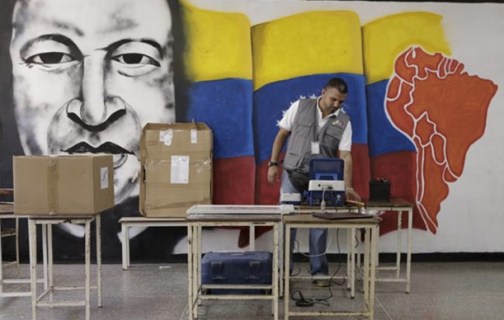
venny

A not so unbiased polling station with electronic votng machine and voting material in front of Chavez’ figure

Arrived only a few hours ago on Saturday and all I can say is that people are on the edge tonight wondering what will happen tomorrow. The cockiness of three weeks ago is not as blatant. Yes, the opposition will get a majority, but after 16 years of Chavismo people (and rumors) are rampant about possible tricks and maneuvers by the government.

This was not helped by the fact that there were Internet blackouts in many parts of the country today. The Head of Conatel, the telecom regulator denied this, but friends tell me that if you tried to call CANTV to report the problems, they were not even answering the phone.

The result is an atmosphere of mistrust and skepticism about what may or may not happen tomorrow. Or the day after, for that matter…

On the positive news front, the Electoral Board announced that witnesses for the opposition outnumbered those of Chavismo’s PSUV by 2,000, a clear indication of the inability of Chavismo to mobilize people like it used to. Many friends also reporting that numerous polling stations have seen no presence of pro-Government members, leading to the installation of the process without them.

Meanwhile, as the international media is harassed as they arrive in Venezuela and also as they try to cover the elections, Chavismo is selling it as a campaign against the country, even citing the number of negative (380), neutral (75) and positive (24) news items about the country. Which according to Chavismo, reflects this campaign and not reality.

Never mind that many reporters have had heir equipment confiscated at the airport and many have been told they can not take pictures of mundane events and their media has been erased.

Meanwhile visiting former Presidents managed to obtain a promise from the Government that political prisoners would be allowed to vote (They were not going to), while the opposition has created a parallel system of observation of the electoral process by foreign dignitaries, as well as social media tools to denounce problems tomorrow with the voting process.

Meanwhile, some pollsters claim to have seen a Maduro resurgence (!!!!), while others say that the result will depend on what Chavismo and now lukewarm Chavistas do. If the latter decide to stay home, the opposition will squeak by, but if they decide to go and express their unhappiness the opposition could enjoy a huge victory, even if short of the super majority.

I am sticking to my guns of a simple majority, roughly 55-58% of Deputies, hoping that former Chavistas are so disenchanted that they prove me wrong. I like the fact that Chavistas are outnumbered by the opposition witnesses and that they have been absent from the installations of the polling stations. But I just wonder if they will they be absent from voting too…

Abstention will be key and pollsters have little confidence that they have a handle on their number. Add proportionality, gerrymandering, fraud and tricks and numerical predictions are really hard to make.

I will do my usual scan throughout Caracas and report solid news, if such an animal exists before midnight tomorrow.

Best of luck to Venezuela from the Devil!