Archive for July, 2009

Arbitrary new rules on radio and TV stations show the objective is a single voice, a single leader in Venezuela

July 12, 2009

(Este post en español aquí)
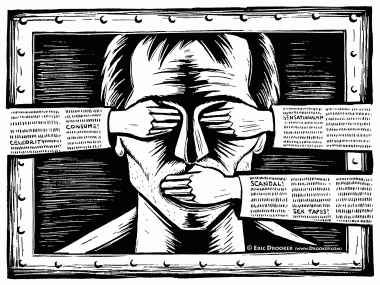
censorship-1Last week, Chavez’ hatchet man Diosdado Cabello, alias “Pretty Eyes”, came out and proposed a whole set of new regulations for radio stations and cable TV that represent another frontal attack on free speech and democracy in Venezuela.

To begin with, the whole new regulatory framework has absolutely no legal basis. Venezuelan legislation only says that nobody can control more than 10% of the radio spectrum. Thus, when Disodado Cabello argues that too much of the spectrum is owned by a few people, that is a political or personal opinion that he is now turning into law, just because his revolutionary hormones tell him to.

To begin with, the “census” of radio stations and their ownership opened by telecom regulator CONATEL in the last few months has no legal basis. To come out and say that only the original person that was assigned the concession of the radio spectrum, is simply a rule made up by Diosdado and his robolution on the spur of the moment. In the past, concessions were sold, inherited and even leased, as long as the regulator was informed. In fact, the new Telecom law that was approved in 2000, recognized the validity of those concessions and established a process by which all of the concessions in existence would be changed and turned into administrative permits within two years of the approval of the law. The process was never carried out, instead this census is opened and the Government “finds”, without explanation, that 240 of the 1004 radio stations in the country do not fulfill this “new and improved” unknown requirement, because the station was sold, the owner died or Diosdado felt like it.

And it becomes clear by now what is going to happen as Diosdado says that the radio spectrum will be “given to the people” a euphemism for “will be assigned directly by me” to whomever he wants and feels represents the “people”. We have seen this before and is another novel variation on corruption established by Chavez’ robolution.

And “Godgiven” also decides on a new criteria in arbitrary fashion: No “circuit” (network) of radio station can be comprised of more than three stations and if more, no broadcast can be longer than half an hour a day. This is simply an economic killer. Forget about nationwide news, no “circuit” can afford to have a reporter everywhere. Forget also about nationwide sports transmissions of a baseball game, no station in Apure will be able to have someone broadcast the Caracas-Magallanes game or the Serie del Caribe. The same way that on that election night in 2012, that station in Apure or Barinas, will have to be wondering when the “half hour” to broadcast the results should take place.

It also means that in the interior of the country even mild opposition voices will be silenced. As stations are no longer allowed to be part of “circuits” like Union Radio, La Mega, Onda, Exitos and the like, these regional stations will no longer be able to hear the opinions of important politicians and analysts who live in Caracas and are regularly interviewed in the largest markets of Caracas and Maracaibo and included in the nationwide programming.

But you can bet whatever you want that Chavez’ obligatory nationwide and system-wide “cadenas” forcing every radio station and TV station in the country to broadcast what he feels like saying, will not have the half hour restriction that is being imposed on everyone.

The math is clear: There are 1004 radio stations in Venezuela, 105 belong to the State, 243 are “community” radio stations and the remainder are private. Force 240 to switch to your side and the Government will have 588 radio stations on is side, an overwhelming majority. With unlimited resources to boot.

But add to that the restrictions on networks of radio stations and what you do is isolate opinions in the interior of the country to those of the Government, as the private sector will only have a string and permanent presence in the large centers of population.

All of these strategies in the end actually restrict the access to information making it less democratic, as the “new” stations, whether run by the Government or the community end up being unpopular as they want to broadcast what the political ideologues want and not what the “people” really want. Witness the case of RCTV which had all of its equipment confiscated and truned over to the Government’s TVES station which has never been able to go beyond 3-3.5% of rating, while RCTV had 35%. In fact, the great beneficiaries of the shutdown were Venevision, which captured a large fraction of the pent up demand and Direct TV and cable stations, which benefited by the increased number of subscribers looking for alternatives.

Of course, this will affect news flow, as news radio stations will be the most affected by the new rules, by in the end it restricts liberties, choice and freedom to listen to everything, whether it is Chavez’ boring (To me) Alo Presidente or Cadenas or the new and old voices of the opposition.

And there are other rules aimed at forcing “Venezuelan” foreign stations on satellite and cable TV to carry Chavez long-winded programs and speeches, simply because these represented a way out of having to listen or watch Chavez.

In the end, the Government could do the opposite, offer hundreds of frequencies to counteract the networks already in existence, that would promote diversity and democracy,  but the reality is that the Government knows that nobody will listen to them. People are fed up with the constant stream of Government BS and the only way to limit the tide is to limit free speech, to reduce what the people  can hear. To make it difficult to the guy in Barinas  to know there is a protest in Caracas and to make it equally difficult for th guy in Caracas to know about the strike in Guayana.

It is not about democracy and free speech, it is about promoting the voice, the one and only voice of Dictator Hugo Chavez. Which is what the revolution is all about, his eternal permanence as President of Venezuela.

Next: Print media and the Internet…like everything associated with the Chavez Government, it is a jump back, it is going back to a past where people were not only less informed, but had less access to information.

It is the way of the revolution, the promotion of ignorance and the cult to a single voice and a single leader.

The curious case of Antonio Ledezma

July 9, 2009

(Este post se encuentra en Español aqui)

20090707_TALC1_8_1_F1

Typically a politician begins his career within a party or a political organization or office and climbs up. But seldom does a politician rise, least of all in Venezuela, then drop and then manage to rise even higher than he had ever managed to get before. This is the curious case of Antonio Ledezma. As times has gone by, not only did he manage to strike a tremendous and disciplined victory and campaign versus Chavez’ machinery  and simpatico pro-Chavez candidate Aristobulo Isturiz, but his public image continues to rise, not only above where he has ever been, but even more surprisingly above any leader of the current Venezuelan opposition.

Ever since his election last November as Mayor of the Metropolitan area of Caracas, Ledezma has become the most consistent and persistent political leader of the heterogenous opposition. He has obviously been helped by the way Hugo Chavez stripped him of most of his duties, responsabilities and funding. This whole affair has been so outrageous and undemocratic, that everyone can see that the votes of the people of Caracas were stolen by Chávez after the fact.

But even more important, Ledezma has compensated his lack of charisma with his energetic approach. Last Christmas it seemed as if only Chavez and Ledezma did not go away for the holidays and Ledezma has fought since then the immoral war against him with dignity and remarkable poise.

What Ledezma has done is to go back to the style that helped him rise as a student leader of Accion Democratica, tiredlessly working day after day. An attitude he brought to his campaign that led him to be Mayor of the Libertador District, a position for which he was reelected to in 1998, but his term was shortened by the Constitutional reform of 2000. And maybe, just maybe, it is only a personal perception that Ledezma lacks charisma, he has beaten Aristobulo Isturiz twice and last November, he managed to beat an Isturiz backed by the overwhelming Chavista machinery and funding. That’s more than most opposition politicians past and present can claim to have achieved.

And taking a move out of Chavez’ playbook, it is now Ledezma that walks around carrying the little blue book containing the 2000 Bolivarian Constitution as in the picture above, a symbol and gesture that Chavez seems to have forgotten or realizes would be a little bit of a farse since he tramples his once ” best Constitution of the world” almost daily.

And in the middle of the Honduran crisis, which is actually boring to most Venezuelans, Ledezma decides to go on a hunger strike at the OAS Headquarters in Caracas, demanding the attention of the OAS and asking its Secretary General Insulza, that he ask all countries to respect the OAS Democratic Charter and not apply selectively as has been done in the last few years.

agencia2_2009-07-08_1247085897.orig

And as the Government of Venezuela was trying to get the OAS to agree to have  Ledezma removed, Insulza, who seems to have lost what little credibility he had left as Secretary General of the OAS, had no other recourse to accept those of Ledezma’s demands he could act on, while the Venezuelan Government quickly paid the money due to Ledezma’s office the day before the strike.

And while Chavez barked and threatened on Honduras, but got little done so far, Ledezma grabbed the spotlight (in all but the Government’s media) with his hunger strike, supported by the workers from the Caracas City Hall and the constant stream (and crowd!) of visitors to the OAS. (Even if most opposition politicians failed to even show their face)

And he quit the hunger strike and left today stronger than any opposition politician. He was the center of attention and now he will be received at the OAS (Joined by all opposition Governors, a Ledezma proposal) to formally present the numerous violations of the Venezuelan Constitution and the Democratic charter by the Government of Hugo Chavez.

It is indeed a curious case, how Antonio Ledezma has reinvented himself by going back to his youth, managing to come out of nowhere to suddenly become the most relevant opposition politician. Whether this speaks badly of the opposition is not the point. The point is that Ledezma seems to have more political intuition and desire than those that claim to lead opposition parties, without ever having received the same approval of the voters that Ledezma actually has.

Chavismo’s ideological consistency

July 8, 2009

(Este post se encuentra en Español aqui)

20090708_TALC1_20_3_G1

(I condemn the boycott of Cuba…Hello, Honduras does not want to obey us? Let’s boycott Honduras!)

I have been trying to understand the ideological consistency of Chavista actions and policies.

Case 1: Chavismo rejects and despises the economic boycott against Cuba.

Chavez announces that it will cut off Petrocaribe’s oil supply to Honduras until Zelaya returns to power. (Chavez is even asking that Honduras now pay back aid given before Zelaya was removed from power)

Case 2: Chavez rejects the “coup” against Zelaya because coups are something that military gorillas  do and are anti-democratic

The graduates from the 2008 Air Force Academy choose as the name of their graduating class “November 27th. 1992” in celebration of the coup attempt led by the Air Force (and fully supported by Hugo Chávez) on the date.

Case 3: Chávez and Venezuela reject the intervention of the US in any country in Latin America.

Chávez calls for Obama and the US to intervene in Honduras…

This all has the consistency of ideological tapioca…

Picture of the year: Ravell gets protection for Globovisión

July 7, 2009

(Este post se encuentra en Español aqui)

121228_1

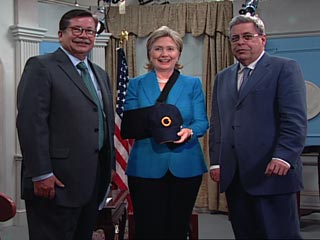
Hillary Clinton with the Ciudadano and Alberto FedericoRavell, just after Ravell twisted her right arm in order to have this picture taken and use it as protection with Hugo Chávez.

Petrobono 2011 operetta ends with a sleight of hand and a twist

July 6, 2009

(Este post se encuentra en Español aqui)

Let’s recap: The Petrobono 2011 was supposed to be for US$ 2 billion, but expanded to US$ 3 billion. It was supposed to trade only in Venezuela, but then PDVSA offered to register it abroad. It was supposed to be institutional, but then it was opened to individuals. The schedule was changed three times and it was issued under local law.

It’s purpose? To raise funds for PDVSA and help drive down the parallel swap market that was Bs. 6.45 at the time.

Finally, it closed last week and after this series of comical and amateurish steps, it was supposed to be assigned today.

No more surprises you think?

WRONG!!!

Because today PDVSA announced the results and the cut off price was 175% at Bs. 2.15 per US$ purchased and in a surprising sleight of hand, PDVSA placed less than the US$ 2 billion originally planned or less than half of the “increased” amount of US$ 3 billion.

Essentially, given all of the uncertainties still remaining on the issue, investors decided to play it very safe and place bids that would give them a low price in local currency for their foreign currency. But in the end, PDVSA raised less than it wanted and investors went through a lot of grief for nothing. PDVSA says there were bids for US$ 7.9 billion, which we find suspect, unless the Government’s own banks placed last minute bids.

But in the end this has just been an operetta, a comical display of sheer incompetence that achieved less than half of one of the two main goals of the placement. Because in the end, today the swap rate ended up above what it was when the bond was first announced (Even if rumors of its existence did play a role in keeping the rate down)

And to add insult to injury, there is the new twist tonight that PDVSA says that it is studying issuing “soon” the remainder of the failed issue at a price even higher of 181%.

Jeez, so the lucky ones that actually got the bond will live until the remainder is issued under the shadow of the possible arrival in the market of almost US$ 1.6 billion in additional bonds, which will do little to prop up the price of the bond once it is registered in the international markets.

What will they say tomorrow? That they will wait to register it in the international markets for the new issue? Truly nothing surprises us anymore in this mindless and incompetent revolution, so why not this too?

A bunch of high school students would have probably done a better job than these revolutionary “professionals” of not so high finance in placing, now and then, the new Petrobono 2011.

UN: Venezuela leader in cocaine transit, another victory for the robolution

July 6, 2009

(Este post se encuentra en Español aqui)

On Sunday, El Nacional (Ciudadanos page 13, by subscription) carried an article on the recent report by the United Nations on drug consumption and trafficking, which besides talking about the increase in consumption of opiates in Venezuela (page 89 of report),  it says Venezuela has become the largest transit country for cocaine in the world (page 72 of report), with an estimated 40% of all cocaine shipments going through the Bolivarian Republic of Venezuela.

The first thing you notice is the reaction of the Venezuelan Government, rather than being embarrased or surprised, or simply announce a new war on drugs, they somehow reach the conclusion that this was a victory for the country, finding it positive, as the UN found “Venezuela among the top countries in seizures of cocaine shipments”.

Well, it turns out that seizures in Venezuela are actually down, not up, while the percentage of cocaine trafficking that goes through the country is actually up significantly , but apparently the Colonel has little acquaintance with basic mathematical concepts.

But the most bothersome thing about this is the implications. Who watches the border for drug trafficking? Well, our illustrious military, which has been able to lobby for and purchase billions of dollars in defensive and offensive weapons, tanks, helicopters and jet fighters, but the country only has a single airplane dedicated to fighting drug trafficking and a meager seven frigates for over 1,000 Kms. of coast.

And the reason for this you may wonder? Well, I will not insult your intelligence on this, but it is quite obvious: corruption. The military looks the other way for the same reason that the Government looks the other way in the dozens of corrupt financial/business schemes that the robolution has invented in the last few years under the watch (??) of Hugo Chávez.

Thus, another victory for the Chávez revolution, joining those of terrifying crime statistics, kidnappings and corruption. Unfortunately, while these last three can be reverted in the future, the nefastous corrupting effects of drug trafficking and use, have proven to be almsot impossible to reverse once they are ingrained into the culture of a country.

The Devil goes bilingual, watch for exdiablo.com

July 5, 2009

(Este post se encuentra en Español aqui)

In the next few days, I will start a somewhat crazy experiment that all logic tells me I should not even try: I will make this blog bilingual by posting everything here in English and at www.exdiablo.com in Spanish.

There are multiple reasons for doing this and even more for not doing it.

When I began my blog, it was my goal to let people outside of Venezuela know what was happening, how Hugo Chavez was walking this very fine line of illegality and abuse of power to take our rights away from us. This is no longer the most pressing need. By now, Chavez’ autocratic and dictatorial style is there for everyone to see, only the most fanatic and fervent worshippers of Hugo still believe his revolution means well, is not militaristic and does not have as its main purpose the indefinite preservation of Hugo Chavez in power.

But this does not mean that the story should not be continued to be told in English.

At the same time, there is much that is not being told in Spanish, or not being told in detail by the traditional media (fear, pressure?), so that there should be a place to tell the same stories in Spanish. I should at least try to get people to be aware of them even if they don’t get as incensed as I get.

There are a number of problems with this project. First of all is simply time, each and every post has to be translated and we all know that you are not the best translator of your own writings, as the original language will influence how you do it. The second problem, is that it takes time and therefore I will blog less. So, if there is someone out there that is willing to help once in a while with translating my posts, I would appreciate it. My rule will be that I will not post three times without translation being available.

There is also the problem with exposure, obviously in Spanish the blog will be much more visible, but that is a risk I am willing to take at this time. As I always say, I only have one country, so what the hell!

Every intuition tells me that the idea is crazy, it’s too much work and will reduce my blogging, but somehow I feel I have to do it and have been toying with it ever since I changed to this new software at the beginning of the year. I have not even consulted it with my blogging conscience, my brother, which will give you an idea of how much I think that if I really analyze it hard, I will simply not do it.

So, there you have it, the devil goes bilingual fulltime, which I hope does not make me go bipolar, like that other animal hanging out on the Venezuelan blogosphere.

One Government, one voice!!!

July 4, 2009

While Insulza is trying to defend murky democracy in Honduras, in Venezuela the “One  Government, one voice” program continues successfully. Every day, democracy is diminished in Venezuela and Insulza seems to have a Mad Magazine, “What? Me worry attitude”. Let’s see:

—In Tachira State, the democratically elected Governor of the State will be unable to celebrate Independence Day, because the pro-Chavez General in charge of the region will not allow him to go into Plaza Bolivar, because “He is the military Governor” and has decided to militarize the State. Take that Insulza!

—And as part of the “One Govennment, one Voice” peculiar Chavista democracy, Cedice’s ads in favor of private property (They were not against anything, just pro-private property”, were suspended by the man the “people” ousted from the Governorship of Miranda State and resurfaced as all powerful Chavista Minister of Infrastructure and in charge of the media and telecom regulator Diosdado Cabellos. He will also shut down 200-plus radio stations, just because…he can!!! Are you listening Insulza?

—And n Carabobo State, the illustrious but barely illustrated Mayor of Valencia Edgardo Parra led a mob in he attack of the headquarters of newspaper El Carabobeño, in which the facilities were vandalized. Thus, the guy in charge of local security leads a mob, which damages private property and establishes a clear threat against freedom of expression. Insulza: Please defend democracy, but don’t meddle with Hugo!!!

It’s the new Latin American democracy: One Government, One Voice!!!

Petrobono or Petrobrainless?

July 1, 2009

For two months the Government was “thinking” about issuing a bond for PDVSA. Last week it finally announced it, but:

1) It was too large an issue

2) It was only aimed at corporations

3) It was not registered abroad

4) It was forbidden to be traded in US$

5) The scheduled seemed to ignore i) Monday was a banking holiday, Friday was a stock market holiday in Wall St.

then

i) First the Government decided to let individuals participate

ii) Then it changed the schedule

iii) Then it allowed it to be traded in US$

iv) Finally, yesterday it said it would register in the international markets.

but…

–It is issued under Venezuelan Law, not under international regulations (PDVSA bonds were issued in 2007 under Reg S), international investors will not be as interested.

–Friday is still a holiday in the US and Thursday is half a holiday for fixed income markets.

–It is still too large at US$3 billion.

Thus, the bond remains a strange animal and will yield more than already existing PDVSA bonds. I will create indigestion in international markets as Venezuelans sell it abroad.

My suggestion:

Ask your broker to give you a price such that:

1) The bond yields more than 22%

2) You are buying dollars at or below Bs. 6 per US$

Better yet, do nothing, but next Monday or Tuesday buy the bond in US$ in the international markets as it gives you a yield (Yield to Maturity) of over 22% per yea for the next two years.

Issuing these bonds should be simple, the people managing it are simply brainless, so we go from Petrobono to Petrobrainless.

That is what the robolutionary PDVSA is all about.

As two mores scientific papers show anomalies on the RR, the WSJ picks up the subject

July 1, 2009

This month, the journal Statistical Science accepted two more papers that provide scientific evidence that all was not well with the 2004 Recall Referendum that took place in Venezuela. This provides further evidence of widespread manipulation of the votes in the referendum and constitutes the third and fourth scientific papers accepted for publication. Curiously, none of the papers purporting to show that the vote was clean or that these papers constituted no proof has ever been accepted for publication in a peer reviewed journal.

I have already talked about the paper by Delfino and Salas, which was earlier accepted for publication and there is a second paper by Maria Febres Cordero and Bernardo Marquez, also published in the same journal.

The first paper accepted is one I have discussed already by Raquel Prado and Bruno Sanso, which deals with the mathematical discrepancies between exit polls and the results reported by the Electoral Board. What is perhaps most intriguing about this study is that there are two polls showing the same anomalies.

The second paper accepted for publication is by Pericchi and Torres and I have also reported on this, but the accepted paper goes further than the report I presented. They apply Benford’s Law for both the first and second digit to the 2004 USA Presidential elections, three (1996,200 and 2004) Puerto Rican elections the 2000 Venezuelan Presidential election and the 2004  recall vote. They fond that the second digit law is compellingly rejected ONLY in the case of the Venezuelan recall vote and ONLY for the votes from the electronic voting machines. In fact, their results show an excellent fit to, for example, the 2004 USA Presidential elections, as well as the manual votes in the Venezuelan recall vote.

All of these topics have become quite relevant today due to the controversial results of the Iranian elections. In fact, today the Wall Street Journal publishes an article on the subject quoting Prof. Mebane who used similar techniques to show that the second digit Benford Law suggests that there was ballot stuffing in Iran. The article even quotes early detractors of the use of these techniques changing sides given the evidence of all these studies. The Carter Center criticized the use of Benford’s Law as it “could” under certain conditions suggest fraud in fair elections.

These new results invalidate the conclusions of the Carter Center, but by now they have moved on to talk about democracy (don’t laugh) in Honduras and none of their “work” on the elections has ever been accepted for publication.This seems to be a new form of judgemental imperialism by foreign politicians that have no clue about what they are talking about, but keep interfering with the affairs of our countries.

Note added: And the WSJ seems to have picked up on Benford