Archive for March, 2010

An Act of Corrupt, Capitalistic and Robolutionary In(Justice)

March 10, 2010

(In Spanish here)

Today the Venezuelan Supreme Court pensioned off 90% of the Court, applying the benefit to all the Justices that were eligible. At the same time, all of these Justices will continue in their functions until Chavez’ Constitutional period ends in 2012. Only one Justice, likely the only honest and ethical one, Justice Marmol Leon opposed it. Here is the decision.

Why you may ask why was this done?

Easy. The National Assembly is about to approve a Law limiting salaries in the Venezuelan Government to no more than around Bs. 9,000 (about US$ 1,200 at the parallel rate), which would limit pensions to this number if they were pensioned off in 2012. Instead, they get their pensions today at the current salaries which is like 4 to 5 TIMES higher and on top of that will stay applying their peculiar version of robolutionary Injustice.

The cynical and unethical behavior of these people never ceases to amaze me!

I guess you could call it an act of corrupt, capitalistic and robolutionary Injustice!

While Venezuelans are coerced to use less electricity than in 2009 due to the lack of investment, Chávez lends Cuba US$ 170 million to build a power plant there

March 9, 2010

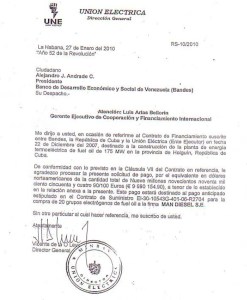
While Venezuelans are coerced, penalized and threatened if they use as much electricity as last year, which is only due to the Government’s incompetence and lack of investment, Chávez lends (???) Cuba US$ 170 million to build a plant in the province of Holguin which will have 175 MW of power and will be interconnected to Cuba’s power grid

Above, letter to Alejandro Andrade, President of Venezuela’s development bank Bandes asking for a 10 million euro payment as part of the “loan” for the power plant in Holguin

Letter with wire instructions for the payment of 10 million euros

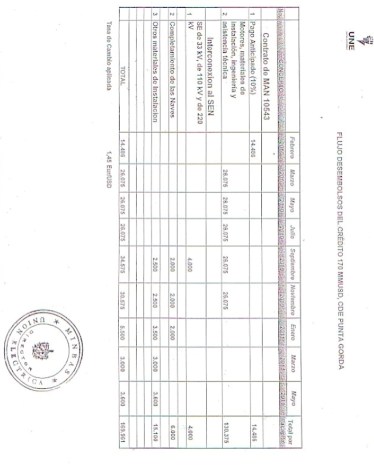
Schedule of payments for the year 2010 for building the power plant in Holguin

(Hat tip DR!)

Some clarifications on the post of when the Guri dam will reach the critical level

March 8, 2010

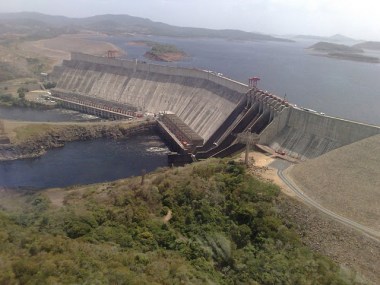
(Picture of a section of the Guri dam a few days ago)

(I still have no Internet at home, rather than answering the comments, here are some clarifications on yesterday’s post)

1- What is the critical level?

Strictky speaking is 240 meters, but it is likely to be higher. Flow may have to be restricted and you have to worry about other technical problems, so a better number may be 244-245 meters, which will occur around May 10th. if it does not rain.

2.-What is the correct question to ask?

I think it is the critical level, not when is that the water stops dropping. The reason is that if it starts raining and the daily drop rate falls from 15 centimeters to 7-8 centimeters, you push the day the level gets critical 50-100 days into the future. Historically, by the end of June, the water flow has always been above 4,000 m**3/s, thus if the rains slow down the rate thirty days, the probability is extremely high that a positive equilibrium (More flow in than out) will be reached.

3.- What about the conical shape of the dam?

The shape of the dam should be or is  in the linear fit to the historical data. How fast the water drops is a function of inflows, the shape of the dam, evaporation and height. I don’t pretend or intend to model of those, I simply note that so far the fit is extremely good. I will keep monitoring it.

4.-This is not a severe drought year due to El Niño

While this is not a great year, there have been worse. The current outflow and inflows into the dam are above the worst ones historically for the same date. El Niño is a complex phenomenon, this is not the strongest one either, nor the longest running as noted in this post in January. El Niño is simply a convenient political excuse.

5.- What about the turbines?

I have not had recent information about how many turbines are online or not. This is a separate issue. My understanding is that one can not be repaired. Another has been fixed. That leaves seven off line, last time I heard.

I was a little more optimsitic when I wrote the post that I am now. It looks like assuming “240 meters” was the wrong thing to do, it seems to be higher, thsu it is going to be quite close. However, it may not last long. My worry is that if Guri is shutdown, blackouts will affect the oil industry, supplies, communications. It could be really bad for a few days. On the positive side, there have been some rains down there, inflows have moved up to 700 m**3/sec.

This slide show of Guri about ten ago days tell you the whole story.

An attempt to answer the question of whether the critical level of the Guri dam will be reached

March 6, 2010

Recent Picture of the Guri dam

All week, I (we) have been worrying about whether the Guri dam will or not reach the “critical” level of 240 meters above sea level at which point it will have to be shut down. In El Nacional there was an article on Friday in which one person talked about simulations and another gave a very definite date of something like April 4th.

This post is an attempt to answer that question. I start by looking at a graph I already published once:

This is the historical behavior of the flow of Rio Caroni that feeds Guri. As you can see, the minimim historical flow, shown in the green line, had a low around May 10th. Thus, unless this year represents a minimum in historical flow, this should be the worst possible scenario we may expect.

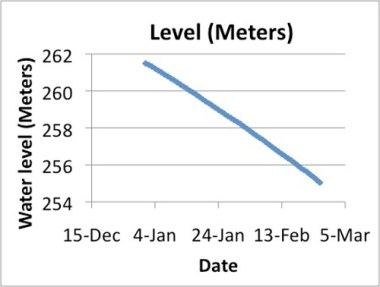
As usual, friend Moses came to the rescue yesterday linking to this post in Noticiero Digital which has a table of the level of Guri day by day since January 1st. This is how the water level has dropped so far this year and until Feb. 25th.

You can see that the daily drop is accelerating, which I noted yesterday because in January the daily drop was 8 or 9 centimeters and Chavez quoted 14 centimeters in February. Thus, because of a number of factors, conical shape, lower water inflow, lower levels, the change in not linear, the water drops faster as the days go by.

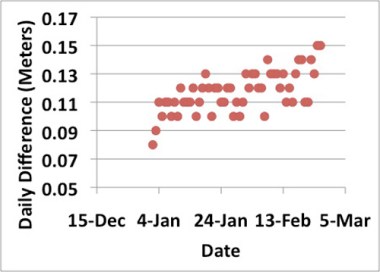
Instead of lloking at the level, it is better to look at the daily change as a function of time:

as you can see, there is a lot of scatter in the plot, due mostly to the fact that the data only has two significant digits. I did a fit to it and it looks quite good with a simple linear fit, the water level dropping accelerating its drop by about 0.594 mm. per day, that is it takes about 16 days to add  a centimeter to the daily drop.

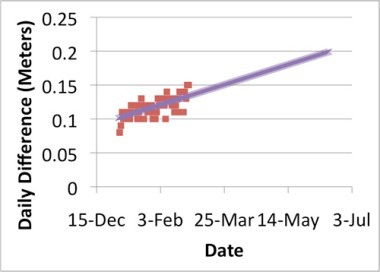
This is the the data for the first two months of the year extrapolated all the way to June 16th.:

As you can see, the fit is pretty good and looks linear. In any case we can monitor in the upcoming days whether the model predicts the correct level day after a day and adjust accordingly.

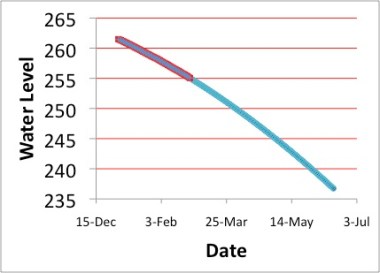
Of course, I can now extrapolate using the model what would be the level into the future and how the date compares to the May 10th. cut off of the first graph above. Using the model, I get:

The plot above shows the orignal data in red below the water level data in blue generated by the model. The crossing of the 240 mts. level (I am not sure the exact number) takes place on May 29th. two weeks after the historical minimum. To give you an idea, I only used data up to the 25th. of February and today, the OPSIS page says that the level is at 254.20 and my model says 254.22, not bad at all, it does not seem to be accelerating or changing.

Given that May 10th. is the historical minimum for the water flow and the model says May 29th. it seems quite unlikely that Guri will have to shut down.

Comments are welcome.

A rant about how little happened in Venezuela this week, but what a week!

March 5, 2010

(I order you to stop!)

Sometimes, living in Venezuela can be a very bizarre experience. As you probably noticed, I have not posted much most of this week. A lot happened, but how many times can you write about Chavez-Farc-ETA? Or how many times can you write about the electric crisis? Or the economy shrinking? Or the Government’s lies? Or Chavez going in Cadena?

It does get boring, but at the same time it has become our every day life. I spent part of the week considering various scenarios if Guri should collapse. We don’t know if it will, but the probability that it happens is finite and significant. While Chavez talks about 100 days for the critical level to be reached, because there are 14 cms. to go and 14 mts. to that level on January 12th. the Government said the level was dropping by 9 cms. daily. Thus, it is not a linear phenomenon, like Moses discussed in the comments at the time. In fact, today El Nacional is talking about days in which the level dropped by 16 cms. this week.

Yes, it may rain before May, but reality is that this planning is not virtual it is quite real and absurd at the same time. But while planning for work is complete, I have not planned for my home. I do have a couple of UPS’s around that may last a couple of hours each, but when you meet someone that knows about electrical networks and he tells you that he installed a power plant in his home two years ago, the term “inside information” truly acquires a new meaning in your life.

And while Quico still has the stomach not only to watch Chavez, but even Tweet about it, I don’t. Chavez is clearly campaigning for something while the country falls apart. But he is definitely as cynical as can be. First, he announces that a tiny power plant will now be used to power the town of Guanta. The plant was part of Cemex’ nationalized cement plant. From there, he goes to Barinas, where he has the guts to go and visit CAEEZ, a monument to the corruption and incompetence of the Chavze Government. But hey! The CAEEZ project included a small power plant which uses residues from sugar cane processing, so he can’t help but show it, even if CAEZZ is such a symbol of the economic and production failure of Chavez’ whatever-you-want-to-call-it project.

And if that was not enough, he announces the nationalization of Turboven. But wait! Wasn’t Turboven nationalized three years ago?

Well, yes, the whole of Venezuela’s power generation industry was nationalized three years ago, but after an initial letter to Turboven, nobody followed it up. EDC was nationalized, Electricidad de Puerto Cabello was Nationalized, the Government overpaid for Seneca, Margarita’s electric company. But in an incompetent and inefficient Government, everyone forgot about Turboven. Until yesterday…

So yesterday’s Cadena was about an irrelevant power plant, a symbol of the Chavze Government corruption and incompetence and and after thought…That is how little Chavez has to show for eleven years of bread and circus.

Very little.

And then, the Central Bank, after a three week hiatus comes back and sells US$ 50 million in zero coupon bonds to bring the swap rate down. It moved down all right, from Bs. x.9 to Bs. x.8 per dollar, while the Central Bank sold dollars at Bs. 4.8 per dollar, if you got any. Is this policy? You could have fooled me. Giving away dollars is perverse and inmoral, but what else is new. As Chavez said ” We can’t bring down the swap rate down in one week, it takes months to do it”

Yes Hugo, but since you announced that you were bringing it down to Bs. 4.3 per dollar, all it has done is move up and it flirted with Bs. 7 per $ this week. In fact, the joke is that CADIVI is not functioning, because at Bs. 4.3 plus commission to get your dollars, it is almost the same as going to the swap market, without the paperwork.

And in closing this rant, I have a message to those that say or think the Government has so much money to spend ahead of the September elections: While it is true, in theory, it is not quite right. The Government devalued from Bs. 2.15 to Bs. 2.6 and Bs. 4.3. PDVSA, the only supplier of foreign currency for all practical purposes, will have to exchange 70% of its dollars at Bs. 4.3 and the rest at Bs. 2.6.

But it so happens, that last year, the parallel swap market was heavily intervened by both the Government and PDVSA at levels above Bs. 5 per US$, so while PDVSA and the Government will have “more”, it will not be a huge amount given that PDVSA and the Government sold some US$ 13-15 billion above Bs. 5 per US$.

Moreover, there is a huge difference between selling into the swap market and selling to the Central Bank at Bs. 4.3 per US$. When PDVSA sells US$ to the swp market, it absorbs Bs. that are already in existence. When it sells them to the Central Bank, the Central Bank “creates” Bolivars, which go into the monetary base and are inflationary unless the monetary authority sterilizes them, which it has not done very efficiently in recent years.

Finally, I have bad news and good news. The good news is that the Constitutional Hall of the Venezuelan Supreme Court reinstated the Mayor of the Sucre municipality in Zulia State. Don’t interpret too much into this, it was so absurd and irrelevant that it was reversed. Naming the Mayor that lost the election was simply stupid. The bad news is that economists think that 2010 will be better than 2011, unless oil prices shoot up, which nobody thinks they will.

And thus, I end my rant, nothing happened this week in Hugolandia, but what a week!

Venezuela’s Final GDP numbers for 2009 not pretty

March 3, 2010

The Venezuelan Central Bank released final numbers for the Venezuelan GDP and they were worse than the original estimates by the monetary authority with the contraction reaching 3.3% for the year and the final number for the fourth quarter of 2009 reaching -5.8%, even worse than the original estimate of -4.9%.

The Central Bank explained away these numbers saying that they were the result of lower oil prices and the world crisis. Well, if this were true, then the fourth quarter showuld have been the best one of the year and not the worst one,  as world economies recovered and the price of oil in the fourt quarter of 2009 was higher tahn in the other three quarters.

Oil GDP in the fourth quarter dropped 10.2%, while the non oil sector contracted 4%. The private sector contracted by 7% as manufacturing was down dramatically Autmobile was down -18%, furniture -46%, metals -46%, Transportation -17%. The only positive sectors were all Government-related: Communications +10.5%, Electricity (????) and water +5.5 and public services (+2.8%)

If you add devaluation and the electricity crisis to these numbers going forward it does not look very pretty.

A Simple explanation for Venezuela’s Electric Crisis

March 2, 2010

The ad above in Sunday’s El Nacional, by Venezuela’s Electric company Corpoelec shows in a very simple manner why we have such a severe electric crisis. According to the ad, 37% of high volume consumers managed to save the required amount, while 67% did not manage it, adding to a whopping 104% of all users!!!!

With such revolutionary math, no wonder we have such an electric mess!!!

(Hat tip: @jesuspi)

21 years after the “Caracazo”, Chavez receives a “Cacerolazo”

March 2, 2010

A few years ago, Chavez would give the word and organizers would go out, buses would come in and a decent showing would be made to celebrate Ezequiel Zamora’s circumcision if that is what he wanted.

But no more.

On Saturday, Chavez decided to hold his rally in the El Valle area of Caracas, a popular lower middle class area that is the residence of many of his Cabinet Ministers. Unfortunately, not only was attendance poor to commemorate the people’s revolt at “The Caracazo” 21 years ago, as seen in the picture above, but while giving his speech, Chavez was given the biggest live “Cacerolazo” he has received since he held a parade in la Carlota in the summer of 2002. (This blog did not even exist then)

Chavez shortened his speech and promised that the next day in his Sunday program Alo Presidente he would announce further measures against those responsible for the “Caracazo“.

But the program was canceled, using as an excuse that Chavez was travelling, something he knew on Saturday when he spoke..

And while Chavez tried to steal the remembrance of the Caracazo, from ONG’s to FARC-related groups, we were reminded that the deaths from that day 21 years ago, reamin unpunished with not a single person convicted for a single one of the hundreds of deaths that day. Because Chavez only remembers the Caracazo when it serves his purposes. And after 10 years of the IVth. Republic and eleven of the Vth. Republic under his own personal supervision, impunity remains the order of the day, no matter what Chavistas may want to say.

And more Cacerolazos are on the way, as the 10% salary increase of today, will be accompanied by price increases in 19 basic foodstuffs (all needed)

Spain’s High Court accuses Venezuelan Government, Chavez plays dumb, dismisses charges

March 1, 2010

(Image stolen from Jesus Salamanca)

Chavismo may dismiss the charges made by Judge Eloy Velasco today, accusing the Venezuelan Government of collaborating with the ETA and FARC to kill top Colombian personalities, but they have to say something more than “unacceptable” or “delays from a colonial past” as Chavez dixit.

Because serious charges require serious answers and so far that is not what we have had from this side. Because by now Prime Minister Zapatero wants an answer and he is not going to like what he has heard so far. Nor is former President Colombian President Pastrana going to accept the typical cry baby explanations of Chavez and his crew. This is a time for real leaders and “varones” to face the music of their mistakes.

Because Judge Velasco and the Spanish High Court can not be swept under the rug of Chavismo lies and deceit. Judge Velasco has been looking at this case for nine years. He finally found no one, but dozens of smoking guns. And arguing that Reyes’ computers were fixed holds no water, there are many leads that lead Velasco to his charges and Zapatero to give him the green light. Remember, this is the same High Court that everyone cheered when it indicted Pinochet, different Judge, same reputation.

Because the indictment does not mince words, it says that there was cooperation between the Venezuelan Government, the FARC and ETA. Period. And it clearly says and states, that an employee of the Venezuelan Government Arturo Cubillas, who coincidentally happened to be the Head of ETA in Venezuela, trained “ETA members in the Colombian jungle, in exchange for ETA’s help in Spain, locating terrorist targets sought by FARC”, which included Uribe, Pastrana and Chavez’ future Presidential buddy Santos.

How do you like them apples?

I could go on. In one of the training “exercises” Cubillas showed up with a Venezuelan military truck full of my compatriots, serving the cause, I guess.

So, accusing Carlos Andres Perez is no help, nor saying that Reyes’ computers were trumped. Mr. Cubillas and his wife were Venezuelan Government officials. Period. Cubillas was caught red handed. Period. Either you deny a connection to Cubillas or you shut up, but you are not dealing with the fluffy Venezuelan opposition, Uribe, Zapatero, Pastrana and now Santos, want answers. No wishy washy statements about hearsay and the like, real answers, like a “varon”. Which Chavez and his Government don’t seem ready to do.

Except that Zapatero believes the Judge more than he believes Chavez or his bus driver Maduro. And Pastrana knows what Spain’s High Court has done in the past in the face of incredible political odds. So, it has been a bad week for Hugo and his thugs. From the CIDH report, to the High Court sentence to the Cacerolazo in El Valle, Hugo is not hitting his stride. You can fool some of the people all the time, but Chavez wants to fool even his shadow, who sees and hears every irresponsible thing he does or says.

(As for Cubillas, Alek Boyd told us about him long time ago. Were you listening?)

Hugo, say you didn’t do it!

March 1, 2010

From AP

A Spanish judge has accused Venezuela of collaborating with Basque separatists and Colombian rebels, and says these two groups plotted to assassinate Colombia’s president.

Judge Eloy Velasco made the allegation Monday in a 26-page indictment in which he charged six members of the Basque group ETA , most of them exiled in Latin America, and seven members of the Colombian leftist rebel group FARC with a variety of crimes including terrorism and conspiracy to commit murder.